

Revitalise Granite Island Penguin Centre – Save Our Last Colony
The issue
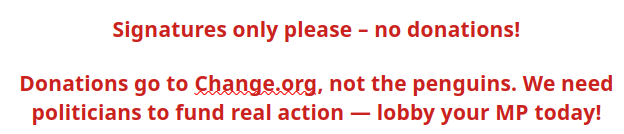
Revitalise the Granite Island Penguin Centre – Save Our Last Little Penguin Colony
Granite Island’s little penguin colony has collapsed. The November 2025 census recorded only 36 adults — a 98% drop from roughly 1,600–1,800 birds two decades ago. The October 2026 census recorded 46 adult birds. Associate Professor Diane Colombelli-Negrel has confirmed that these are all adult birds — juveniles are not counted in the census. Earlier research on this colony found a fledgling return rate of only about 2.3%. Most young birds produced this year will not return as breeding adults. Wright Island is already empty and West Island holds only a handful. From a base of a few dozen adults, with long-nosed fur seals present around the screw-pile jetty and rock wall, natural recovery is not occurring. Without intervention the colony is likely to disappear within a few years.
Victor Harbor currently attracts about 1.2 million visitors a year and generates around $163 million in tourism spending. Granite Island itself draws roughly 800,000 people for the walk, tram and views. Penguins are no longer a major draw, but a well-designed centre can change that.
We are asking the South Australian Government to fund the adaptive reuse of the existing café on Granite Island as a modern Penguin Centre. The proposal includes:
A penguin pool with strong underwater viewing windows
A small café for casual visitors (coffee, cold drinks, ice creams, sandwiches, pies and pasties) — no restaurant
A head-starting facility that works by incubating eggs
Artificial burrows and improved nesting habitat outside the building
A practical, lower-cost design that reuses the existing building
The centre will include a dedicated head-starting facility that works by incubating eggs rather than removing chicks from their parents. All head-starting will be from incubating eggs only. Eggs could be collected from the robust Emu Bay colony on Kangaroo Island (the largest little penguin colony in South Australia, with several hundred adults), avoiding any need to source eggs from interstate or Granite Island. Eggs are incubated in commercial cabinet-style incubators with automatic turning and precise temperature and humidity control.
This approach has clear practical advantages:
It does not take chicks away from their parents, avoiding the main concern raised by local volunteers.
Eggs are far easier and safer to transport than fledglings and present a much lower biosecurity risk.
Hatched chicks will first join the captive colony inside the Penguin Centre, building its numbers until the centre reaches its designed capacity.
Once the captive colony is at capacity, surplus fledglings and, later, full-grown birds will be moved from the centre into the new artificial burrows scattered around Granite Island.
These released birds can then join and strengthen the wild colony.
Head-starting by egg incubation is a well-established conservation technique used for other seabirds and has been successfully applied to little penguins elsewhere. Combined with the artificial burrows and the underwater viewing centre, it gives the remaining adults the best realistic chance of recovery without relying on natural recruitment alone. It also provides a clear, staged answer to the question of where the birds will come from.
Cost and returns (based on the linked documents)
Construction is estimated at $2.5–4.0 million for the adaptive-reuse approach.
With underwater viewing the centre is projected to attract 90,000–100,000 paid visits a year, reach operating profit around year 3, and generate an extra $8–14 million a year in local spending. That supports roughly 25–40 local jobs (café, tram, accommodation and related services). Even the more modest path (around 60,000 paid visits) is expected to deliver an operating profit by about year 5 and $4–8 million a year in extra local spending, supporting 15–25 jobs.
This is a practical way to keep the last colony in the Victor Harbor area alive, create a year-round attraction, and deliver measurable tourism and employment benefits.
Supporting documents
Research on the decline: https://thinlinx.com/extinction_event.pdf
One-page flyer with the latest figures: https://thinlinx.com/penguin_flyer.pdf
John Nicholls trail-cam proposal to provide an accurate count of Penguins in the recently identified 23 active burrows https://thinlinx.com/nicholls_trailcam_proposal.pdf
Please sign and share. The colony will not recover on its own.
Thank you for standing with the penguins — together we can bring them back before it’s too late! 🐧
See my latest petition about e-petitions being banned in South Australia at the link below
2,635
The issue
Revitalise the Granite Island Penguin Centre – Save Our Last Little Penguin Colony
Granite Island’s little penguin colony has collapsed. The November 2025 census recorded only 36 adults — a 98% drop from roughly 1,600–1,800 birds two decades ago. The October 2026 census recorded 46 adult birds. Associate Professor Diane Colombelli-Negrel has confirmed that these are all adult birds — juveniles are not counted in the census. Earlier research on this colony found a fledgling return rate of only about 2.3%. Most young birds produced this year will not return as breeding adults. Wright Island is already empty and West Island holds only a handful. From a base of a few dozen adults, with long-nosed fur seals present around the screw-pile jetty and rock wall, natural recovery is not occurring. Without intervention the colony is likely to disappear within a few years.
Victor Harbor currently attracts about 1.2 million visitors a year and generates around $163 million in tourism spending. Granite Island itself draws roughly 800,000 people for the walk, tram and views. Penguins are no longer a major draw, but a well-designed centre can change that.
We are asking the South Australian Government to fund the adaptive reuse of the existing café on Granite Island as a modern Penguin Centre. The proposal includes:
A penguin pool with strong underwater viewing windows
A small café for casual visitors (coffee, cold drinks, ice creams, sandwiches, pies and pasties) — no restaurant
A head-starting facility that works by incubating eggs
Artificial burrows and improved nesting habitat outside the building
A practical, lower-cost design that reuses the existing building
The centre will include a dedicated head-starting facility that works by incubating eggs rather than removing chicks from their parents. All head-starting will be from incubating eggs only. Eggs could be collected from the robust Emu Bay colony on Kangaroo Island (the largest little penguin colony in South Australia, with several hundred adults), avoiding any need to source eggs from interstate or Granite Island. Eggs are incubated in commercial cabinet-style incubators with automatic turning and precise temperature and humidity control.
This approach has clear practical advantages:
It does not take chicks away from their parents, avoiding the main concern raised by local volunteers.
Eggs are far easier and safer to transport than fledglings and present a much lower biosecurity risk.
Hatched chicks will first join the captive colony inside the Penguin Centre, building its numbers until the centre reaches its designed capacity.
Once the captive colony is at capacity, surplus fledglings and, later, full-grown birds will be moved from the centre into the new artificial burrows scattered around Granite Island.
These released birds can then join and strengthen the wild colony.
Head-starting by egg incubation is a well-established conservation technique used for other seabirds and has been successfully applied to little penguins elsewhere. Combined with the artificial burrows and the underwater viewing centre, it gives the remaining adults the best realistic chance of recovery without relying on natural recruitment alone. It also provides a clear, staged answer to the question of where the birds will come from.
Cost and returns (based on the linked documents)
Construction is estimated at $2.5–4.0 million for the adaptive-reuse approach.
With underwater viewing the centre is projected to attract 90,000–100,000 paid visits a year, reach operating profit around year 3, and generate an extra $8–14 million a year in local spending. That supports roughly 25–40 local jobs (café, tram, accommodation and related services). Even the more modest path (around 60,000 paid visits) is expected to deliver an operating profit by about year 5 and $4–8 million a year in extra local spending, supporting 15–25 jobs.
This is a practical way to keep the last colony in the Victor Harbor area alive, create a year-round attraction, and deliver measurable tourism and employment benefits.
Supporting documents
Research on the decline: https://thinlinx.com/extinction_event.pdf
One-page flyer with the latest figures: https://thinlinx.com/penguin_flyer.pdf
John Nicholls trail-cam proposal to provide an accurate count of Penguins in the recently identified 23 active burrows https://thinlinx.com/nicholls_trailcam_proposal.pdf
Please sign and share. The colony will not recover on its own.
Thank you for standing with the penguins — together we can bring them back before it’s too late! 🐧
See my latest petition about e-petitions being banned in South Australia at the link below
The Decision Makers
Supporter Voices
Petition Updates
Share this petition
Petition created on 11 February 2026