
Good morning.
Let’s address two things.
First, the recent change in language by the New York State Office of Parks, Recreation and Historic Preservation, which has begun referring to Martin Dunham Reservoir as an “artificial lake.” This shift may seem minor, but it represents a significant reframing of the reservoir’s identity and purpose. It signals that the state may be preparing the public for its eventual removal.
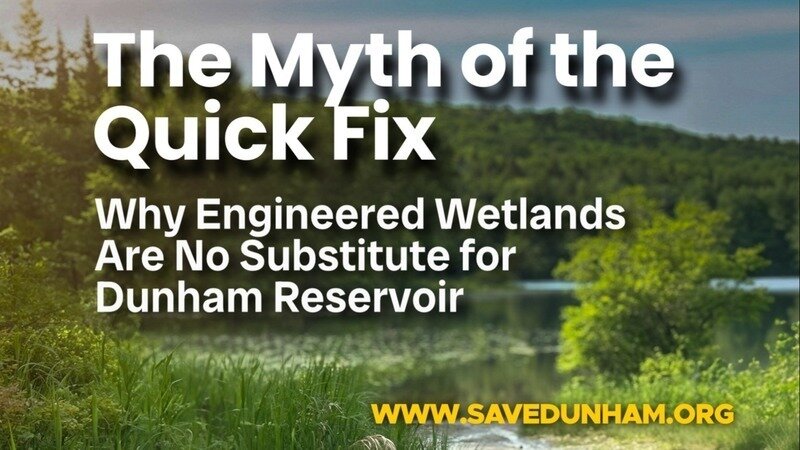
Second, the myth of the quick fix. This is a narrative being used to position engineered wetlands as modern, sustainable, and cost-effective replacements for aging reservoirs. On paper, it sounds practical. In practice, it masks the complexity, cost, and long-term risks of removing a functioning public asset.
This new terminology is not neutral. It is a strategic shift. Recasting a long-standing, living reservoir as “artificial” makes it easier to justify its elimination. The word implies something inauthentic, outdated, and easily replaced. That framing reflects a broader trend in state-level environmental planning, where dam removal and engineered wetlands are increasingly presented as preferred solutions.
Let’s be clear. The Martin Dunham Reservoir isn’t broken. It’s being abandoned.
The Stakes: Restoration or Decommission
After decades of deferred maintenance, the state is now weighing the future of one of Grafton Lakes State Park’s most iconic features. The decision carries generational consequences. It will determine whether the dam is restored and the reservoir preserved, or whether the structure is removed entirely and the lake is replaced with a constructed wetland.
This isn’t just an engineering choice. It’s a policy choice, shaped by language and perception.
While all three options technically remain under review, recent language and public statements indicate that the state is leaning toward the engineered wetland. It is being positioned as the more progressive, lower-cost alternative. The messaging has been careful. The terminology has been precise. And although the price tag is still high—nearly $10 million—it appears more defensible on paper than the full $20 million restoration plan.
On July 24, in response to WNYT’s coverage of the Save Dunham press conference at the Grafton boat launch, New York State Parks issued the following statement:
“The Martin Dunham Dam has been rated unsound… Depending on the quantity of upstream rainfall, this safety measure may lower the reservoir by up to 10 feet. The artificial lake will remain available for public recreation including boating and fishing. There has been no decision to decommission the dam at this time.”
That phrase—“artificial lake”—was not chosen at random. It strips the reservoir of identity and reclassifies it as a temporary, manufactured feature. In planning language, “artificial” often signals expendability. It softens the blow of removal by implying the landscape was never natural or permanent to begin with.
But that’s not the reality.
The reservoir is not disposable. It is a functioning water body shaped by decades of use and care. It is part of the surrounding ecosystem and part of the community’s lived experience.
The Illusion of Restoration: What Engineered Wetlands Actually Require
Engineered wetlands are often marketed as a green solution, as if removing a dam allows nature to simply return. That is not how these systems work.
In reality, they are complicated, multi-phase construction projects that begin with full-scale disruption.
The reservoir must first be drained. The exposed lakebed is then regraded, scraped, and reshaped using heavy equipment. Depressions are carved into the earth to mimic natural contours, though they are guided entirely by engineered hydrology models. These contours are not natural. They are imposed.
Inflow and outflow channels are designed and cut. Stone weirs, culverts, and drainage structures are installed to direct and control water levels. In some cases, plastic liners or compacted clay are used to retain moisture in soils that would otherwise fail to support wetland conditions.
Then comes soil amendment. Since natural wetland soils are rarely present in drained reservoirs, imported or engineered substrate must be added to support target vegetation. The site is then planted by hand or seeded with grasses, sedges, and wetland species. Fencing is often added to protect new growth from deer and geese.
This is not ecological restoration. It is ecological construction.
And that is just the beginning.
The system requires years of close monitoring and maintenance. Vegetation must meet performance benchmarks. Invasive species such as phragmites, purple loosestrife, and reed canary grass are likely to colonize and must be removed through labor-intensive and often chemical means. Water levels need regular adjustment. Nutrient levels require testing. Drought, algal blooms, erosion, and die-off are common problems in the early years.
These are not rewilded systems. They are human-controlled environments designed to simulate natural function, and they depend on active, ongoing management to succeed.
They are fragile. They are costly to maintain. And they are not the same.
They do not support deep-water fish or amphibians. They do not provide reliable conditions for swimming, boating, or skating. And they offer no continuity for the generations of park-goers who have formed relationships with this lake.
The Case for Full Restoration
The $20 million restoration plan does something rare. It restores what still works.
It reinforces the dam, stabilizes sediment, protects public access, and preserves habitat that has developed naturally over time. It maintains downstream flow and upholds the environmental balance that already exists.
Most importantly, it keeps the reservoir in place.
Martin Dunham Reservoir is a manmade system, constructed through public works, that has developed into a stable freshwater body over time. It supports a range of recreational uses and ecological functions. Fishing, paddling, skating, and wildlife observation have all been part of its consistent use. It is recognized not as a novelty or leftover infrastructure, but as an established and functional part of the park’s landscape.
We should not be erasing functioning historical infrastructure to save money or reduce liability, especially when the state has known about these maintenance issues for over four decades.
Removing the reservoir may lower the short-term cost on paper. But the loss is permanent.
And once it’s gone, it won’t come back.
A Public Safety Concern: What Happens Downstream?
Dam removal should also raise concern for the people who live below the reservoir. To date, no publicly available hydrological study or storm model has shown what the flow of the Quacken Kill would look like during a major rain event or hurricane if the reservoir were removed.
Right now, the reservoir provides stormwater detention. It holds back rainfall during high-volume events, protecting downstream areas from flash flooding, erosion, and infrastructure damage. This function is fundamental to the design of the system and to the safety of those who live and work in the valley below.
The state does maintain an inundation map for Martin Dunham Dam, showing which areas could flood in the event of structural failure. While intended for emergency planning, that map may also offer insight into where water would concentrate if the reservoir were decommissioned. However, that scenario has not been modeled publicly in the context of dam removal.
There is no evidence that a newly established engineered wetland would be able to provide equivalent flood mitigation. Wetlands can slow water flow, but they do not hold and retain stormwater the way an impoundment does. During the early years of wetland establishment, the soil structure is unstable and vegetation is immature. These systems are not designed for peak retention.
Until a full, site-specific stormwater analysis is completed and shared with the public, the risks of removing the reservoir remain unknown. Proceeding without that information puts lives and property downstream at unnecessary risk.
The Bigger Picture: Precedent and Public Trust
This is not just about one lake. It is about how we treat shared public infrastructure when it becomes politically or financially inconvenient. It is about whether we choose repair or removal, continuity or erasure.
When the state allows decades of deferred maintenance to accumulate, and then presents removal as the only logical option, it sets a precedent that threatens similar sites across New York.
As Wallace Stegner wrote, “something will have gone out of us as a people” if we allow public landscapes to vanish.
Martin Dunham Reservoir is worth preserving. It serves a purpose. It holds ecological and civic value. And it belongs to the public.
Losing it would mean losing more than a body of water. It would mean forfeiting something that still works, still matters, and still serves.
Call to Action
A sincere thank you to everyone who has made their voice heard.
The Save Dunham petition has now reached 2,000 verified signatures.
You can still sign or share at www.savedunham.org.
You do not need to be a resident of Grafton or Rensselaer County to get involved. This is a regional issue with statewide implications. Many communities across New York will soon face similar decisions about aging infrastructure and the future of their public lands.
Disclaimer
This article reflects the author’s analysis of publicly available information, state communications, and community input as of the date of publication. It is offered as commentary and advocacy. Readers are encouraged to consult New York State Parks and the Grafton Lakes State Park website for the most current official information. Public input is being accepted at dunham@parks.ny.gov.