

Save Chilika! Stop the Bridge That Threatens Our Wetland
The Issue
An urgent appeal for scientific scrutiny and reconsideration of the proposed national highway across Chilika Lagoon
Dear All,
We write to express our deep concern regarding the proposed national highway connecting Satapada, Khirisahi and Janhikuda across Chilika Lagoon in Odisha. We recognise the legitimate need for better connectivity, safer transportation and improved economic opportunities for communities living on and around Chilika's islands. However, infrastructure development in a wetland of such exceptional ecological significance must be guided by a rigorous understanding of its long-term consequences.
Our concern is with the possibility of making an irreversible decision before adequately understanding what stands to be lost.
Recent reports indicate that land acquisition has commenced for the approximately 7.655-km highway, including about 3.34 km of bridges. This is particularly concerning because the Expert Appraisal Committee (EAC) of the Ministry of Environment, Forest and Climate Change had earlier recommended a formal cost–benefit analysis comparing the proposed bridge with existing boat-based connectivity. It had also sought clarification on the necessity of the project.
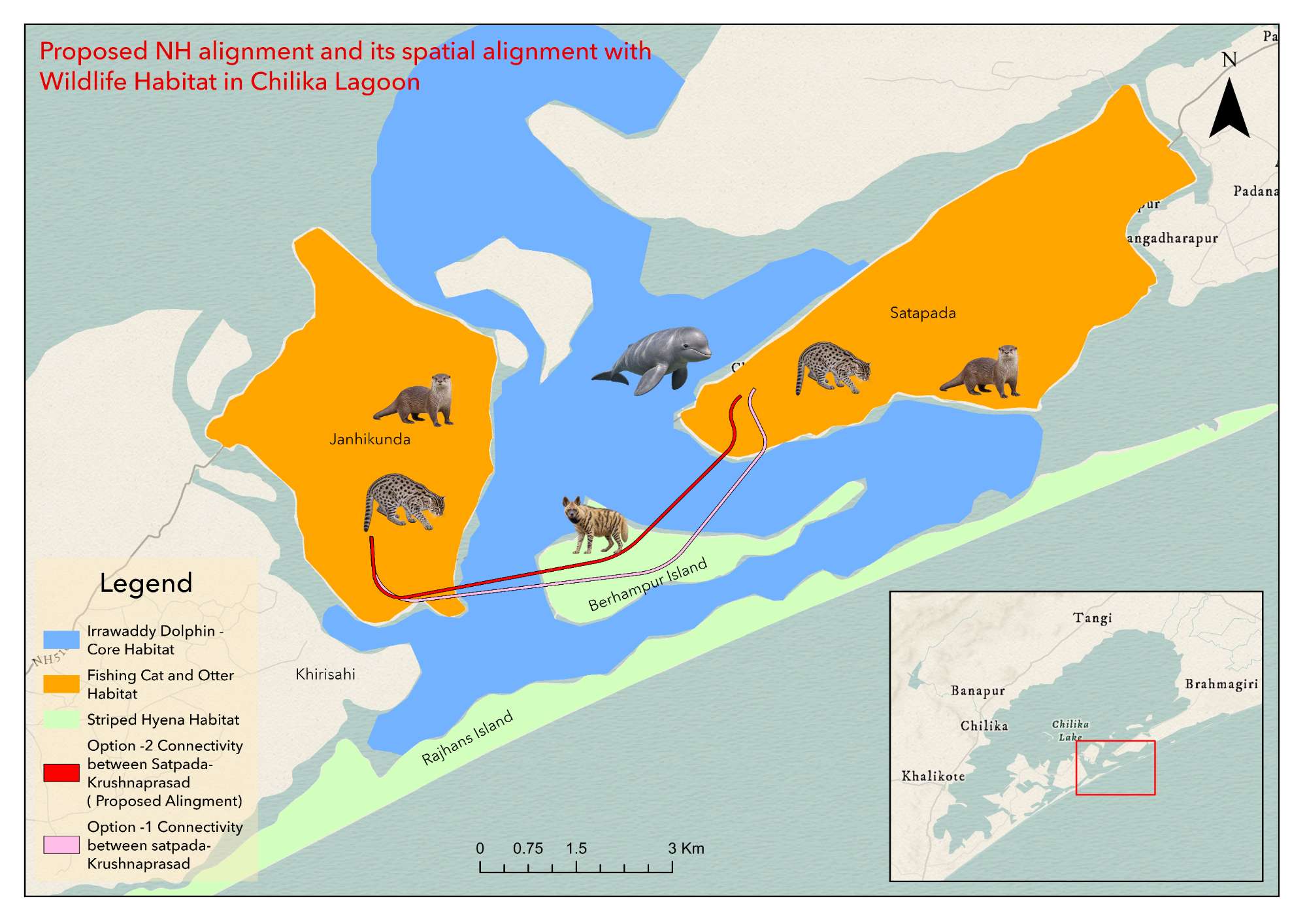
We respectfully request clarification on whether this analysis has been completed, independently examined and made publicly available, and whether its conclusions have been incorporated into subsequent planning decisions.
We draw attention to six important ecological and public-interest considerations.
1. Chilika's ecological survival depends upon the uninterrupted movement of water.
Chilika is is a dynamic coastal lagoon sustained by interactions between freshwater inflows, tidal exchange with the Bay of Bengal, sediment movement and seasonal variations in salinity.
Its history provides an important warning. During the 1990s, restricted seawater exchange and progressive siltation contributed to ecological deterioration, declining fisheries and serious consequences for local livelihoods. Following the opening of a new sea mouth in 2000, improvements in hydrological exchange contributed to a remarkable ecological and fisheries recovery.
The proposed highway involves bridges, approaches and construction on portions of the islands and lagoon landscape. Depending upon their design, associated embankments, foundations and construction activities could alter local currents, sediment deposition, water depths and habitat connectivity.
These are ecological processes that have already shaped Chilika's history and existence.
Before such construction is permitted, it is essential to demonstrate through independently validated hydrodynamic and sediment-transport modelling that the proposed alignment will not interfere with the processes responsible for sustaining the lagoon.
2. Obstruction of fish migration may undermine Chilika's fisheries and the livelihoods they support.
One of Chilika's most important ecological functions is its role as a nursery and feeding ground for fish, prawns and crabs. Many species depend upon movement between the sea and lagoon at different stages of their life cycles.
Scientific research following the 2000 restoration established that renewed recruitment of marine and estuarine species contributed substantially to the recovery of Chilika's fisheries.
Research on coastal infrastructure also demonstrates that bridges, causeways and associated alterations to water circulation can disrupt fish passage and connectivity, depending upon their location and engineering design.
It would therefore be insufficient to evaluate the highway only in terms of the land directly occupied by construction. Its potential effects on fish migration, spawning, juvenile recruitment and fisheries productivity throughout the connected lagoon must be examined.
Any ecological disruption could ultimately translate into economic losses for fishing communities, undermining the very development objectives the project seeks to advance.
3. The Irrawaddy dolphins of Satapada are exceptionally vulnerable to changes in habitat quality.
Chilika supports one of the world's very few resident lagoonal populations of the Endangered Irrawaddy Dolphin (Orcaella brevirostris). The dolphins inhabiting the Satapada and outer-channel region are particularly important because this area supports feeding, social activity, breeding and the rearing of calves.
Long-term research has demonstrated the dolphins' restricted distribution, strong habitat fidelity and dependence on the lagoon's ecological productivity.
Dolphins depend extensively on underwater sound for communication, navigation, foraging and detecting threats, making them especially vulnerable to anthropogenic noise. Scientific studies on small cetaceans have demonstrated that activities associated with bridge construction, including geophysical surveys, drilling, dredging and particularly pile-driving, can generate intense underwater noise capable of masking acoustic signals, disrupting feeding and social behaviour, displacing animals from preferred habitats and, at sufficiently high exposure levels, causing temporary or permanent hearing damage.
Any substantial changes in water depth, sedimentation, fish availability, underwater noise or the accessibility of their feeding grounds could reduce habitat quality.
Given the potential for cumulative and long-term impacts on an already vulnerable resident population, the Precautionary Principle must guide decisions concerning this infrastructure project.
The extinction of a resident dolphin population would represent an ecological loss that no financial compensation could reverse. We must ensure that infrastructure planning does not create conditions that could move this population closer to such an outcome.
4. The proposed infrastructure lies within a geomorphologically dynamic and cyclone-exposed coastal landscape.
The islands, sand bars and coastal margins surrounding Chilika are shaped by changing sediment supplies, erosion, deposition, waves, tides and tropical cyclones.
Published geomorphological studies show that Chilika's barrier-spit system and tidal inlets undergo substantial changes, with cyclonic events capable of rapidly modifying shorelines and sedimentary features.
These findings raise important questions about the long-term stability, maintenance requirements and safety of permanent highway infrastructure constructed on or near dynamic coastal landforms.
The possibility of foundation scour, shoreline retreat, storm-surge exposure and altered sediment movement must be considered over the entire intended lifespan of the highway, rather than solely under present-day conditions.
It is necessary to establish whether the proposed infrastructure is environmentally appropriate and economically defensible in a landscape where climate-related coastal hazards are expected to remain significant.
5. Chilika's islands and coastal habitats support threatened and poorly studied mammalian carnivores.
Scientific investigations have established that Chilika supports important populations of wetland-dependent and terrestrial carnivores.
A 2024 study in Endangered Species Research documented significant populations of the Vulnerable Fishing Cat (Prionailurus viverrinus) within Chilika, including its heterogeneous southern coastal landscape. The study emphasised the importance of maintaining both wetland habitats and healthy fish populations.
Other investigations have documented Honey Badgers (Mellivora capensis) along Chilika's coast and a remarkable coastal population of Striped Hyenas (Hyaena hyaena), including evidence of denning and use of vegetated sandy habitats.
At present, we seek clarity on the extent to which the proposed alignment intersects important carnivore habitats, movement routes and denning areas, and whether species-specific mitigation measures have been identified.
A detailed wildlife assessment, including camera trapping and habitat-connectivity analysis along the entire alignment and adjoining landscape, should precede any irreversible intervention.
6. Accountability towards a Ramsar site
Chilika's history raises a fundamental question of accountability in the use of public resources. The Government of India and the Chilika Development Authority invested substantial public funds in restoring the lagoon's ecological functioning, supported by scientific and technical collaboration with national and international institutions, including Ramsar Center Japan. Approximately ₹125 crore was provided through Special Problem Grants over the broader restoration programme. The landmark intervention of September 2000 involved dredging the outer channel and opening a new sea mouth to restore the exchange of seawater and freshwater, sediment flushing and biological connectivity. International support subsequently continued through initiatives such as the Ramsar Small Grants Fund for integrated management planning. The ecological recovery was sufficiently significant for Chilika to be removed from the Montreux Record in 2002 and recognised internationally as a model of wetland restoration. It is therefore a matter of serious public concern that another publicly funded infrastructure project is now proposed across the hydrologically connected outer-channel landscape near Satapada and Jahnikuda, without publicly demonstrated assurance that the processes restored through decades of investment will remain unaffected. Should public money be spent on infrastructure that could potentially compromise ecological functions that earlier public expenditure was specifically intended to recover? There must be institutional accountability for ensuring consistency between past conservation investments and present development decisions. We therefore call for the public disclosure of an independent, scientifically rigorous assessment of the highway's effects on tidal exchange, sediment movement, salinity gradients and fish migration, alongside a transparent cost–benefit analysis that accounts for the full ecological and economic value of Chilika's restoration.
The fundamental issue is whether the proposed highway's long-term public benefits have been adequately evaluated against the ecological, social and economic risks.
Chilika was once placed on the Montreux Record of threatened Ramsar wetlands because its ecological character had deteriorated. Its subsequent restoration and removal from that record in 2002 became an internationally recognised conservation success.
It would be deeply unfortunate if a new infrastructure project compromised the ecological functions that public investment and scientific efforts have spent decades restoring.
We therefore respectfully urge the relevant authorities to:
Pause further irreversible land acquisition and construction-related actions until the EAC's recommendations have been demonstrably addressed.
Make publicly available the formal cost–benefit analysis, detailed project report, environmental assessments, EAC proceedings and proposed mitigation plans.
Commission independent, seasonal studies on hydrology, sediment transport, fish migration, dolphin habitat use, terrestrial wildlife connectivity and cyclone-related engineering risks.
Evaluate alternative alignments and transport solutions, including safer, more reliable and environmentally responsible ferry connectivity, in consultation with island residents and fishing communities.
Ensure that the economic assessment incorporates fisheries, ecological services, livelihood security, future maintenance costs, disaster exposure and the potentially irreversible loss of biodiversity
We are conscious that communities living in and around Chilika deserve good infrastructure, improved services and reliable access to opportunities. Their needs must be central to any decision. But development that jeopardises the ecological foundations of their livelihoods cannot automatically be considered progress.
A highway may shorten a journey by several hours. But if it contributes to the long-term degradation of Chilika's waters, fisheries and wildlife, the costs may be borne by generations.
We appeal for facilitation of informed public discussion before the project proceeds further.
Chilika's future deserves a decision made with the fullest possible scientific evidence, public transparency and consideration for the people and species that depend upon it.
Once a lagoon's ecological functions are lost, rebuilding them may be extraordinarily difficult, costly or impossible.
Let us not risk losing through poorly informed construction what decades of conservation have worked to restore.
REFERENCES
Lagoon hydrology and fisheries
- Ghosh, A.K., Pattnaik, A.K. & Ballatore, T.J. (2006). Chilika Lagoon: Restoring ecological balance and livelihoods through re-salinization. Lakes & Reservoirs: Research & Management, 11, 239–255. https://doi.org/10.1111/j.1440-1770.2006.00306.x
- Mohanty, R.K., Mohanty, S.K., Mohapatra, A., Bhatta, K.S. & Pattnaik, A.K. Post-ecorestoration impact on fish and shellfish biodiversity in Chilika lake. Indian Journal of Fisheries, 53(4), 397–407 (2006 issue). https://epubs.icar.org.in/index.php/IJF/article/view/7494
- Bice, C.M. et al. (2023). Tidal barriers and fish – Impacts and remediation in the face of increasing demand for freshwater and climate change. Estuarine, Coastal and Shelf Science, 289, 108376. https://doi.org/10.1016/j.ecss.2023.108376
- Lennox, R.J. et al. (2025). Marine Fish Passage—Underappreciated Threats to Connectivity Within the Marine Environment. Marine Ecology, 46, e12859. https://doi.org/10.1111/maec.12859
Irrawaddy dolphins
- Sutaria, D. (2009). Species conservation in a complex socio-ecological system: Irrawaddy dolphins, Orcaella brevirostris in Chilika Lagoon, India. PhD thesis, James Cook University, Australia. https://doi.org/10.25903/5efj-ra92
- Sutaria, D., & Marsh, H. (2011). Abundance estimates of Irrawaddy dolphins in Chilika Lagoon, India, using photo-identification based mark-recapture methods. Marine Mammal Science, 27(4), E338–E348. https://doi.org/10.1111/j.1748-7692.2011.00471.x
- D'Lima, C. (2014). Striking a balance between fishing, tourism and dolphin conservation at Chilika Lagoon, India. PhD thesis, James Cook University, Australia. https://doi.org/10.25903/xe88-w251
- D'Lima, C., Marsh, H., Hamann, M., Sinha, A., & Arthur, R. (2014). Positive interactions between Irrawaddy dolphins and artisanal fishers in the Chilika Lagoon of Eastern India are driven by ecology, socioeconomics, and culture. Ambio, 43, 614–624. https://doi.org/10.1007/s13280-013-0440-4
Dolphin responses to underwater noise and infrastructure construction
- Bailey, H., Senior, B., Simmons, D., Rusin, J., Picken, G., & Thompson, P. M. (2010). Assessing underwater noise levels during pile-driving at an offshore windfarm and its potential effects on marine mammals. Marine Pollution Bulletin, 60(6), 888–897.https://doi.org/10.1016/j.marpolbul.2010.01.003
- Carstensen, J., Henriksen, O. D., & Teilmann, J. (2006). Impacts of offshore wind farm construction on harbour porpoises: Acoustic monitoring of echo-location activity using porpoise detectors (T-PODs). Marine Ecology Progress Series, 321, 295–308. https://doi.org/10.3354/meps321295
- Brandt, M. J., Diederichs, A., Betke, K., & Nehls, G. (2011). Responses of harbour porpoises to pile driving at the Horns Rev II offshore wind farm in the Danish North Sea. Marine Ecology Progress Series, 421, 205–216 https://doi.org/10.3354/meps08888
- Southall, B. L., et al. (2019). Marine mammal noise exposure criteria: Updated scientific recommendations for residual hearing effects. Aquatic Mammals, 45(2), 125–232 https://doi.org/10.1578/AM.45.2.2019.125
- Southall, B. L., Nowacek, D. P., Bowles, A. E., Senigaglia, V., Bejder, L., & Tyack, P. L. (2021). Marine mammal noise exposure criteria: Assessing the severity of marine mammal behavioral responses to human noise. Aquatic Mammals, 47(5), 421–464. https://doi.org/10.1578/AM.47.5.2021.421
- Jiang, Y., et al. (2019). Preliminary analysis of echolocation signals produced by fleeing Irrawaddy dolphins (Orcaella brevirostris). Acta Oceanologica Sinica, 38(1), 85–89. https://doi.org/10.1007/s13131-019-1373-y
- Dey, M., Krishnaswamy, J., Morisaka, T., & Kelkar, N. (2019). Interacting effects of vessel noise and shallow river depth elevate metabolic stress in Ganges river dolphins. Scientific Reports, 9, 15426. https://doi.org/10.1038/s41598-019-51664-1
- Marley, S. A., Salgado Kent, C. P., Erbe, C., & Parnum, I. M. (2017). Effects of vessel traffic and underwater noise on the movement, behaviour and vocalisations of bottlenose dolphins in an urbanised estuary. Scientific Reports, 7, 13437. https://doi.org/10.1038/s41598-017-13252-z
Coastal geomorphology and cyclone vulnerability
- Response of long- to short-term tidal inlet morphodynamics on the ecological ramification of Chilika lake, the tropical Ramsar wetland in India. (2022). Science of the Total Environment, 807, 150769. https://doi.org/10.1016/j.scitotenv.2021.150769
Mammalian carnivores
- Adhya, T. et al. (2024). Density estimation of the globally threatened fishing cat Prionailurus viverrinus through a participatory science approach in the Chilika lagoon, eastern India. Endangered Species Research, 54, 1–13. https://doi.org/10.3354/esr01322
- Adhya, T. & Dey, P. (2022). A coastal population of Honey Badger Mellivora capensis at Chilika Lagoon in the Indian east coast. Journal of Threatened Taxa, 14, 22026–22028. https://doi.org/10.11609/jott.8067.14.10.22026-22028
- Dey, P., Adhya, T., Varma, G.H. & Nandy, S. (2025). Preliminary notes on a coastal population of Striped Hyena Hyaena hyaena from Chilika lagoon, India. Journal of Threatened Taxa, 17, 27576–27583. https://doi.org/10.11609/jott.9559.17.10.27576-27583
Project and institutional documentation
- The New Indian Express (11 February 2025). EAC seeks cost–benefit analysis of the Chilika highway project. https://www.newindianexpress.com/states/odisha/2025/Feb/11/eac-raises-concern-over-7-km-bridge-on-chilika-lake-seeks-cost-benefit-analysis-from-nhai
- The New Indian Express (25 October 2026). Land acquisition begins for NH link over Chilika lagoon. https://www.newindianexpress.com/states/odisha/2026/Oct/25/land-acquisition-begins-for-nh-link-over-chilika-lagoon
- Chilika Development Authority. Eco-Restoration. https://www.chilika.com/eco-restoration.php

2
The Issue
An urgent appeal for scientific scrutiny and reconsideration of the proposed national highway across Chilika Lagoon
Dear All,
We write to express our deep concern regarding the proposed national highway connecting Satapada, Khirisahi and Janhikuda across Chilika Lagoon in Odisha. We recognise the legitimate need for better connectivity, safer transportation and improved economic opportunities for communities living on and around Chilika's islands. However, infrastructure development in a wetland of such exceptional ecological significance must be guided by a rigorous understanding of its long-term consequences.
Our concern is with the possibility of making an irreversible decision before adequately understanding what stands to be lost.
Recent reports indicate that land acquisition has commenced for the approximately 7.655-km highway, including about 3.34 km of bridges. This is particularly concerning because the Expert Appraisal Committee (EAC) of the Ministry of Environment, Forest and Climate Change had earlier recommended a formal cost–benefit analysis comparing the proposed bridge with existing boat-based connectivity. It had also sought clarification on the necessity of the project.
We respectfully request clarification on whether this analysis has been completed, independently examined and made publicly available, and whether its conclusions have been incorporated into subsequent planning decisions.
We draw attention to six important ecological and public-interest considerations.
1. Chilika's ecological survival depends upon the uninterrupted movement of water.
Chilika is is a dynamic coastal lagoon sustained by interactions between freshwater inflows, tidal exchange with the Bay of Bengal, sediment movement and seasonal variations in salinity.
Its history provides an important warning. During the 1990s, restricted seawater exchange and progressive siltation contributed to ecological deterioration, declining fisheries and serious consequences for local livelihoods. Following the opening of a new sea mouth in 2000, improvements in hydrological exchange contributed to a remarkable ecological and fisheries recovery.
The proposed highway involves bridges, approaches and construction on portions of the islands and lagoon landscape. Depending upon their design, associated embankments, foundations and construction activities could alter local currents, sediment deposition, water depths and habitat connectivity.
These are ecological processes that have already shaped Chilika's history and existence.
Before such construction is permitted, it is essential to demonstrate through independently validated hydrodynamic and sediment-transport modelling that the proposed alignment will not interfere with the processes responsible for sustaining the lagoon.
2. Obstruction of fish migration may undermine Chilika's fisheries and the livelihoods they support.
One of Chilika's most important ecological functions is its role as a nursery and feeding ground for fish, prawns and crabs. Many species depend upon movement between the sea and lagoon at different stages of their life cycles.
Scientific research following the 2000 restoration established that renewed recruitment of marine and estuarine species contributed substantially to the recovery of Chilika's fisheries.
Research on coastal infrastructure also demonstrates that bridges, causeways and associated alterations to water circulation can disrupt fish passage and connectivity, depending upon their location and engineering design.
It would therefore be insufficient to evaluate the highway only in terms of the land directly occupied by construction. Its potential effects on fish migration, spawning, juvenile recruitment and fisheries productivity throughout the connected lagoon must be examined.
Any ecological disruption could ultimately translate into economic losses for fishing communities, undermining the very development objectives the project seeks to advance.
3. The Irrawaddy dolphins of Satapada are exceptionally vulnerable to changes in habitat quality.
Chilika supports one of the world's very few resident lagoonal populations of the Endangered Irrawaddy Dolphin (Orcaella brevirostris). The dolphins inhabiting the Satapada and outer-channel region are particularly important because this area supports feeding, social activity, breeding and the rearing of calves.
Long-term research has demonstrated the dolphins' restricted distribution, strong habitat fidelity and dependence on the lagoon's ecological productivity.
Dolphins depend extensively on underwater sound for communication, navigation, foraging and detecting threats, making them especially vulnerable to anthropogenic noise. Scientific studies on small cetaceans have demonstrated that activities associated with bridge construction, including geophysical surveys, drilling, dredging and particularly pile-driving, can generate intense underwater noise capable of masking acoustic signals, disrupting feeding and social behaviour, displacing animals from preferred habitats and, at sufficiently high exposure levels, causing temporary or permanent hearing damage.
Any substantial changes in water depth, sedimentation, fish availability, underwater noise or the accessibility of their feeding grounds could reduce habitat quality.
Given the potential for cumulative and long-term impacts on an already vulnerable resident population, the Precautionary Principle must guide decisions concerning this infrastructure project.
The extinction of a resident dolphin population would represent an ecological loss that no financial compensation could reverse. We must ensure that infrastructure planning does not create conditions that could move this population closer to such an outcome.
4. The proposed infrastructure lies within a geomorphologically dynamic and cyclone-exposed coastal landscape.
The islands, sand bars and coastal margins surrounding Chilika are shaped by changing sediment supplies, erosion, deposition, waves, tides and tropical cyclones.
Published geomorphological studies show that Chilika's barrier-spit system and tidal inlets undergo substantial changes, with cyclonic events capable of rapidly modifying shorelines and sedimentary features.
These findings raise important questions about the long-term stability, maintenance requirements and safety of permanent highway infrastructure constructed on or near dynamic coastal landforms.
The possibility of foundation scour, shoreline retreat, storm-surge exposure and altered sediment movement must be considered over the entire intended lifespan of the highway, rather than solely under present-day conditions.
It is necessary to establish whether the proposed infrastructure is environmentally appropriate and economically defensible in a landscape where climate-related coastal hazards are expected to remain significant.
5. Chilika's islands and coastal habitats support threatened and poorly studied mammalian carnivores.
Scientific investigations have established that Chilika supports important populations of wetland-dependent and terrestrial carnivores.
A 2024 study in Endangered Species Research documented significant populations of the Vulnerable Fishing Cat (Prionailurus viverrinus) within Chilika, including its heterogeneous southern coastal landscape. The study emphasised the importance of maintaining both wetland habitats and healthy fish populations.
Other investigations have documented Honey Badgers (Mellivora capensis) along Chilika's coast and a remarkable coastal population of Striped Hyenas (Hyaena hyaena), including evidence of denning and use of vegetated sandy habitats.
At present, we seek clarity on the extent to which the proposed alignment intersects important carnivore habitats, movement routes and denning areas, and whether species-specific mitigation measures have been identified.
A detailed wildlife assessment, including camera trapping and habitat-connectivity analysis along the entire alignment and adjoining landscape, should precede any irreversible intervention.
6. Accountability towards a Ramsar site
Chilika's history raises a fundamental question of accountability in the use of public resources. The Government of India and the Chilika Development Authority invested substantial public funds in restoring the lagoon's ecological functioning, supported by scientific and technical collaboration with national and international institutions, including Ramsar Center Japan. Approximately ₹125 crore was provided through Special Problem Grants over the broader restoration programme. The landmark intervention of September 2000 involved dredging the outer channel and opening a new sea mouth to restore the exchange of seawater and freshwater, sediment flushing and biological connectivity. International support subsequently continued through initiatives such as the Ramsar Small Grants Fund for integrated management planning. The ecological recovery was sufficiently significant for Chilika to be removed from the Montreux Record in 2002 and recognised internationally as a model of wetland restoration. It is therefore a matter of serious public concern that another publicly funded infrastructure project is now proposed across the hydrologically connected outer-channel landscape near Satapada and Jahnikuda, without publicly demonstrated assurance that the processes restored through decades of investment will remain unaffected. Should public money be spent on infrastructure that could potentially compromise ecological functions that earlier public expenditure was specifically intended to recover? There must be institutional accountability for ensuring consistency between past conservation investments and present development decisions. We therefore call for the public disclosure of an independent, scientifically rigorous assessment of the highway's effects on tidal exchange, sediment movement, salinity gradients and fish migration, alongside a transparent cost–benefit analysis that accounts for the full ecological and economic value of Chilika's restoration.
The fundamental issue is whether the proposed highway's long-term public benefits have been adequately evaluated against the ecological, social and economic risks.
Chilika was once placed on the Montreux Record of threatened Ramsar wetlands because its ecological character had deteriorated. Its subsequent restoration and removal from that record in 2002 became an internationally recognised conservation success.
It would be deeply unfortunate if a new infrastructure project compromised the ecological functions that public investment and scientific efforts have spent decades restoring.
We therefore respectfully urge the relevant authorities to:
Pause further irreversible land acquisition and construction-related actions until the EAC's recommendations have been demonstrably addressed.
Make publicly available the formal cost–benefit analysis, detailed project report, environmental assessments, EAC proceedings and proposed mitigation plans.
Commission independent, seasonal studies on hydrology, sediment transport, fish migration, dolphin habitat use, terrestrial wildlife connectivity and cyclone-related engineering risks.
Evaluate alternative alignments and transport solutions, including safer, more reliable and environmentally responsible ferry connectivity, in consultation with island residents and fishing communities.
Ensure that the economic assessment incorporates fisheries, ecological services, livelihood security, future maintenance costs, disaster exposure and the potentially irreversible loss of biodiversity
We are conscious that communities living in and around Chilika deserve good infrastructure, improved services and reliable access to opportunities. Their needs must be central to any decision. But development that jeopardises the ecological foundations of their livelihoods cannot automatically be considered progress.
A highway may shorten a journey by several hours. But if it contributes to the long-term degradation of Chilika's waters, fisheries and wildlife, the costs may be borne by generations.
We appeal for facilitation of informed public discussion before the project proceeds further.
Chilika's future deserves a decision made with the fullest possible scientific evidence, public transparency and consideration for the people and species that depend upon it.
Once a lagoon's ecological functions are lost, rebuilding them may be extraordinarily difficult, costly or impossible.
Let us not risk losing through poorly informed construction what decades of conservation have worked to restore.
REFERENCES
Lagoon hydrology and fisheries
- Ghosh, A.K., Pattnaik, A.K. & Ballatore, T.J. (2006). Chilika Lagoon: Restoring ecological balance and livelihoods through re-salinization. Lakes & Reservoirs: Research & Management, 11, 239–255. https://doi.org/10.1111/j.1440-1770.2006.00306.x
- Mohanty, R.K., Mohanty, S.K., Mohapatra, A., Bhatta, K.S. & Pattnaik, A.K. Post-ecorestoration impact on fish and shellfish biodiversity in Chilika lake. Indian Journal of Fisheries, 53(4), 397–407 (2006 issue). https://epubs.icar.org.in/index.php/IJF/article/view/7494
- Bice, C.M. et al. (2023). Tidal barriers and fish – Impacts and remediation in the face of increasing demand for freshwater and climate change. Estuarine, Coastal and Shelf Science, 289, 108376. https://doi.org/10.1016/j.ecss.2023.108376
- Lennox, R.J. et al. (2025). Marine Fish Passage—Underappreciated Threats to Connectivity Within the Marine Environment. Marine Ecology, 46, e12859. https://doi.org/10.1111/maec.12859
Irrawaddy dolphins
- Sutaria, D. (2009). Species conservation in a complex socio-ecological system: Irrawaddy dolphins, Orcaella brevirostris in Chilika Lagoon, India. PhD thesis, James Cook University, Australia. https://doi.org/10.25903/5efj-ra92
- Sutaria, D., & Marsh, H. (2011). Abundance estimates of Irrawaddy dolphins in Chilika Lagoon, India, using photo-identification based mark-recapture methods. Marine Mammal Science, 27(4), E338–E348. https://doi.org/10.1111/j.1748-7692.2011.00471.x
- D'Lima, C. (2014). Striking a balance between fishing, tourism and dolphin conservation at Chilika Lagoon, India. PhD thesis, James Cook University, Australia. https://doi.org/10.25903/xe88-w251
- D'Lima, C., Marsh, H., Hamann, M., Sinha, A., & Arthur, R. (2014). Positive interactions between Irrawaddy dolphins and artisanal fishers in the Chilika Lagoon of Eastern India are driven by ecology, socioeconomics, and culture. Ambio, 43, 614–624. https://doi.org/10.1007/s13280-013-0440-4
Dolphin responses to underwater noise and infrastructure construction
- Bailey, H., Senior, B., Simmons, D., Rusin, J., Picken, G., & Thompson, P. M. (2010). Assessing underwater noise levels during pile-driving at an offshore windfarm and its potential effects on marine mammals. Marine Pollution Bulletin, 60(6), 888–897.https://doi.org/10.1016/j.marpolbul.2010.01.003
- Carstensen, J., Henriksen, O. D., & Teilmann, J. (2006). Impacts of offshore wind farm construction on harbour porpoises: Acoustic monitoring of echo-location activity using porpoise detectors (T-PODs). Marine Ecology Progress Series, 321, 295–308. https://doi.org/10.3354/meps321295
- Brandt, M. J., Diederichs, A., Betke, K., & Nehls, G. (2011). Responses of harbour porpoises to pile driving at the Horns Rev II offshore wind farm in the Danish North Sea. Marine Ecology Progress Series, 421, 205–216 https://doi.org/10.3354/meps08888
- Southall, B. L., et al. (2019). Marine mammal noise exposure criteria: Updated scientific recommendations for residual hearing effects. Aquatic Mammals, 45(2), 125–232 https://doi.org/10.1578/AM.45.2.2019.125
- Southall, B. L., Nowacek, D. P., Bowles, A. E., Senigaglia, V., Bejder, L., & Tyack, P. L. (2021). Marine mammal noise exposure criteria: Assessing the severity of marine mammal behavioral responses to human noise. Aquatic Mammals, 47(5), 421–464. https://doi.org/10.1578/AM.47.5.2021.421
- Jiang, Y., et al. (2019). Preliminary analysis of echolocation signals produced by fleeing Irrawaddy dolphins (Orcaella brevirostris). Acta Oceanologica Sinica, 38(1), 85–89. https://doi.org/10.1007/s13131-019-1373-y
- Dey, M., Krishnaswamy, J., Morisaka, T., & Kelkar, N. (2019). Interacting effects of vessel noise and shallow river depth elevate metabolic stress in Ganges river dolphins. Scientific Reports, 9, 15426. https://doi.org/10.1038/s41598-019-51664-1
- Marley, S. A., Salgado Kent, C. P., Erbe, C., & Parnum, I. M. (2017). Effects of vessel traffic and underwater noise on the movement, behaviour and vocalisations of bottlenose dolphins in an urbanised estuary. Scientific Reports, 7, 13437. https://doi.org/10.1038/s41598-017-13252-z
Coastal geomorphology and cyclone vulnerability
- Response of long- to short-term tidal inlet morphodynamics on the ecological ramification of Chilika lake, the tropical Ramsar wetland in India. (2022). Science of the Total Environment, 807, 150769. https://doi.org/10.1016/j.scitotenv.2021.150769
Mammalian carnivores
- Adhya, T. et al. (2024). Density estimation of the globally threatened fishing cat Prionailurus viverrinus through a participatory science approach in the Chilika lagoon, eastern India. Endangered Species Research, 54, 1–13. https://doi.org/10.3354/esr01322
- Adhya, T. & Dey, P. (2022). A coastal population of Honey Badger Mellivora capensis at Chilika Lagoon in the Indian east coast. Journal of Threatened Taxa, 14, 22026–22028. https://doi.org/10.11609/jott.8067.14.10.22026-22028
- Dey, P., Adhya, T., Varma, G.H. & Nandy, S. (2025). Preliminary notes on a coastal population of Striped Hyena Hyaena hyaena from Chilika lagoon, India. Journal of Threatened Taxa, 17, 27576–27583. https://doi.org/10.11609/jott.9559.17.10.27576-27583
Project and institutional documentation
- The New Indian Express (11 February 2025). EAC seeks cost–benefit analysis of the Chilika highway project. https://www.newindianexpress.com/states/odisha/2025/Feb/11/eac-raises-concern-over-7-km-bridge-on-chilika-lake-seeks-cost-benefit-analysis-from-nhai
- The New Indian Express (25 October 2026). Land acquisition begins for NH link over Chilika lagoon. https://www.newindianexpress.com/states/odisha/2026/Oct/25/land-acquisition-begins-for-nh-link-over-chilika-lagoon
- Chilika Development Authority. Eco-Restoration. https://www.chilika.com/eco-restoration.php
The Decision Makers
Petition Updates
Share this petition
Petition created on 2 November 2026