
California has a reputation for being ahead of the curve in healthcare standards — but when it comes to Certified Nursing Assistant (CNA) staffing ratios in hospitals, the reality can be just as unsafe and profit-driven as anywhere else in the country.
Recently, a PRN CNA working in California shared her experience of being placed on a mother-baby unit as the only CNA responsible for 25 mothers. No additional support, no nurse stepping in to help with basic care, and no plan for what would happen in an emergency. This wasn’t a fluke — management called it “normal.”
If that weren’t bad enough, her next (and final) shift at the same facility was on a cardiac unit where she was told — casually — that she would be the only CNA for 31 patients, with the unit holding up to 35. That meant one person was expected to provide total care, answer call bells, handle confused and combative patients, assist pre- and post-surgical cases, and respond to cardiac events — all at once.
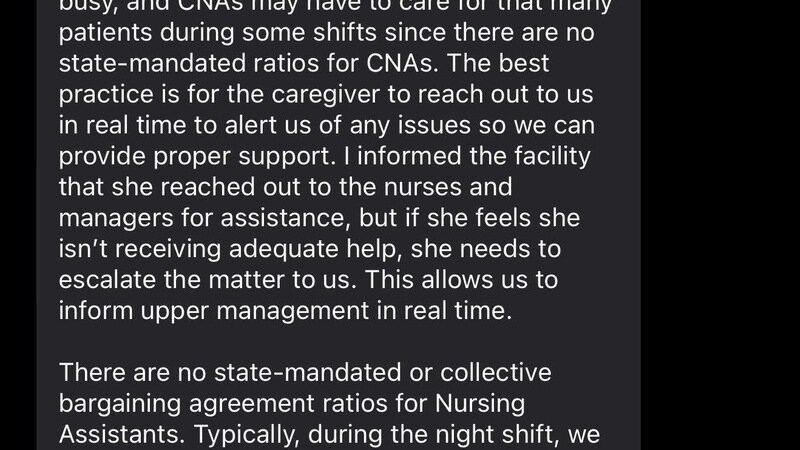
The CNA immediately called her agency (Aya Healthcare) and the charge nurse to report the unsafe conditions. While Aya supported her and escalated the complaint, the hospital’s response was telling:
“There are no state-mandated ratios for CNAs. This is standard practice.”
Translation: We could hire more staff. We choose not to.
And why? Because cutting CNA coverage saves money — even when it directly endangers patients and drives workers to the breaking point.
This Isn’t Just California’s Problem
The lack of CNA staffing requirements is a national crisis. In most states, there are no laws setting minimum CNA-to-patient ratios in hospitals, rehab centers, or long-term care facilities. That means administrators have almost unlimited leeway to stretch staff thin in the name of “efficiency,” knowing there’s little to no legal consequence.
It’s the same story in Virginia — where my fight for Dale’s Law began. Dale’s Law would make it illegal to assign unsafe CNA loads like these in long-term care facilities, set enforceable minimum staffing ratios, and tie Medicare/Medicaid funding to actual staffing compliance.
If Dale’s Law existed in California hospitals, 31 cardiac patients for one CNA would not just be outrageous — it would be illegal.
The Foxes Are Guarding the Henhouse
Let’s be honest: the government that allows this to continue is the same government that just passed massive nationwide Medicaid cuts. These are the same lawmakers who claim to care about patient safety but refuse to hold healthcare corporations accountable for chronic understaffing — even when they’re billing taxpayers for care that isn’t being delivered.
And here’s the thing — too many facility owners treat their healthcare operations like personal piggy banks. I’ve seen it over and over: hours cut, positions left unfilled, basic supplies stretched to the limit… all while “extra” money somehow finds its way into pet projects, shiny new business ventures, or making sure certain big-ticket personal events are suitably extravagant.
We shouldn’t be surprised by the outcome when the foxes are guarding the henhouse. Corporate owners make their profits, agency executives keep their contracts, and politicians keep their campaign donations. Meanwhile, the patients — and the CNAs caring for them — pay the real price.
Why This Matters Now
Unsafe staffing is not just a workplace problem. It’s a public health crisis.
When a CNA is given 31 patients, every single one of those patients is in danger — whether from delayed response times, missed changes in condition, or errors made in the chaos of impossible workloads.
We can’t afford to let “standard practice” be the excuse for systemic neglect. Whether you’re in California, Virginia, or anywhere else, the fight for safe staffing laws like Dale’s Law is about more than workplace fairness. It’s about keeping people alive.