

Reform the CARE Act to End Coercive Psychiatric Practices
The Issue
https://wclp.org/why-we-sued-to-end-care-court/
https://www.hrw.org/news/2022/08/04/advocates-oppose-california-care-court-legislation
https://www.cchrint.org/2023/09/18/who-guideline-condemns-coercive-psychiatric-practices/
Background on California Care Act (September 2023) from California Department of Health Care Services:
Senate Bill (SB) 1338 (Umberg, Chapter 319, Statutes of 2022) established the Community Assistance, Recovery, and Empowerment (CARE) Act, which provides community-based behavioral health services and supports to Californians living with untreated schizophrenia spectrum or other psychotic disorders through a new civil court process. The CARE Act is intended to serve as an upstream intervention for individuals experiencing severe impairment to prevent avoidable psychiatric hospitalizations, incarcerations, and Lanterman-Petris-Short Mental Health Conservatorships. The CARE Process will provide earlier action, support, and accountability for both CARE clients, and the local governments responsible for providing behavioral health services to these individuals. The CARE Act authorizes specified adult persons to petition a civil court to create a voluntary CARE agreement or a court-ordered CARE plan that may include treatment, housing resources, and other services.
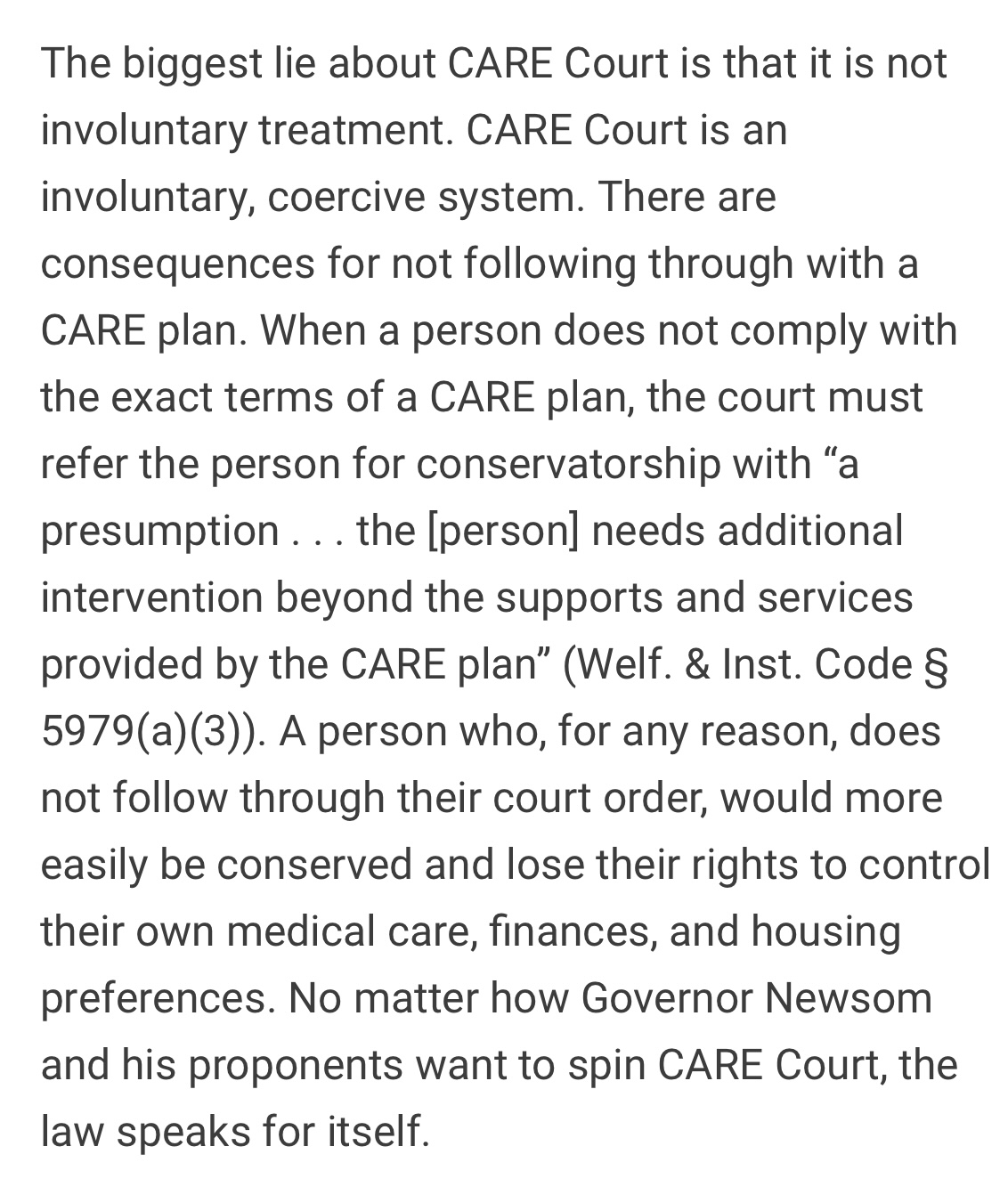
However, the California Care Act was specifically designed for those with severe mental disorders to receive forced court ordered treatment.
California Care Act does not protect the human rights and dignity of individuals diagnosed with a severe mental disorder. Despite its acknowledgement to provide care to those with mental disorders, it forces treatment on individuals who cannot refuse treatment, even if they believe antipsychotic drugs harms them. This violates all human rights of individuals and makes them vulnerable to psychiatric abuse and exploitation as there is no option to decline treatment or exercise any type of self-determination over their own physiology. The United Nations and the World Health Organization both condemn coercive psych treatment. Many of these individuals are not violent and do not display present suicidal behavior. Psychiatric treatment includes electroconvulsive therapy (electroshock), intramuscular injections, antipsychotic medications, and restraints. These treatments are given to individuals without cognitive and behavioral therapy having been offered. This alone is proof that psychiatric healthcare has not exercised every option available before relying on excessive use of medications that have more severe effects on individuals.
California Care Act targets the most vulnerable and marginalized groups of our community. It forces those with severe mental disorders to receive treatment, many of those whom are homeless, mentally disabled, former prisoners, and low income. Many of these individuals lack the resources and funding to receive quality health insurance and are more likely to be MISdiagnosed with a mental disorder, are less inclined to sue hospitals and doctors over medical malpractice, and lack the funding to receive therapy. They thus find themselves in the hands of a psychiatrist opposed to a psychologist, as psychologists are not found in government funded Medicaid psychiatric hospitals.
All diagnoses by a psychiatrist are made through observations and are not scientifically based. If a patient refuses treatment, the psychiatrist determines that their refusal for medication, is a symptom of their mental disorder, and that the patient is "lacking insight" and not stable to be in the community. All while denying that any side effects of the medications (apathy, restlessness, dyskinesia, decreased sexual ability, ability to speak and swallow) are exacerbating a patient's mental health condition.
Medi-Cal funded government psychiatric hospitals receive low profit revenue from short-term turn overs but profit when a short-term patient becomes a long-term patient. Short-term patients are evaluated and treated with prescribed medications and electroconvulsive therapy after having been evaluated for only 5 minutes.
Psychiatric medications such as antipsychotics and antidepressants have known severe effects that may include agitation, aggression, hostility, increase suicidal feelings, extreme restlessness, weight gain, involuntary muscle movements, and diabetic complications, to name a few. Electroconvulsive therapy may cause permanent memory loss and permanent brain damage, as acknowledged by one shock machine manufacturer.
These treatments turn short-term patients into long-term patients, with the potential to turn their diagnoses into more severe diagnoses and the potential to exaggerate symptoms making them a psychiatric health care consumer long-term, where they are exploited and abused by a healthcare system that does not question its own practices. Many of these individuals are not released back into the community and are being held in hospitals. Evidence shows that adequately-resourced intensive voluntary outpatient treatment is more effective than court-ordered treatment. Coercive treatment does not acknowledge each individual's trauma, rather it further traumatizes them. Please sign to give a voice back and bring back quality of life to those who have been robbed and trusted too blindly relying on a broken health care system.
*******Please sign even if you’re not a CA resident in order to end California's Care Act that exploits the human rights of our most vulnerable and oppressed individuals of society. People that are being targeted into long term health care consumers through exploitation*******
If you have a testimony regarding forced treatment/being subjected to the care act in CA, please contact endcacareact@gmail.com.

87
The Issue
https://wclp.org/why-we-sued-to-end-care-court/
https://www.hrw.org/news/2022/08/04/advocates-oppose-california-care-court-legislation
https://www.cchrint.org/2023/09/18/who-guideline-condemns-coercive-psychiatric-practices/
Background on California Care Act (September 2023) from California Department of Health Care Services:
Senate Bill (SB) 1338 (Umberg, Chapter 319, Statutes of 2022) established the Community Assistance, Recovery, and Empowerment (CARE) Act, which provides community-based behavioral health services and supports to Californians living with untreated schizophrenia spectrum or other psychotic disorders through a new civil court process. The CARE Act is intended to serve as an upstream intervention for individuals experiencing severe impairment to prevent avoidable psychiatric hospitalizations, incarcerations, and Lanterman-Petris-Short Mental Health Conservatorships. The CARE Process will provide earlier action, support, and accountability for both CARE clients, and the local governments responsible for providing behavioral health services to these individuals. The CARE Act authorizes specified adult persons to petition a civil court to create a voluntary CARE agreement or a court-ordered CARE plan that may include treatment, housing resources, and other services.
However, the California Care Act was specifically designed for those with severe mental disorders to receive forced court ordered treatment.
California Care Act does not protect the human rights and dignity of individuals diagnosed with a severe mental disorder. Despite its acknowledgement to provide care to those with mental disorders, it forces treatment on individuals who cannot refuse treatment, even if they believe antipsychotic drugs harms them. This violates all human rights of individuals and makes them vulnerable to psychiatric abuse and exploitation as there is no option to decline treatment or exercise any type of self-determination over their own physiology. The United Nations and the World Health Organization both condemn coercive psych treatment. Many of these individuals are not violent and do not display present suicidal behavior. Psychiatric treatment includes electroconvulsive therapy (electroshock), intramuscular injections, antipsychotic medications, and restraints. These treatments are given to individuals without cognitive and behavioral therapy having been offered. This alone is proof that psychiatric healthcare has not exercised every option available before relying on excessive use of medications that have more severe effects on individuals.
California Care Act targets the most vulnerable and marginalized groups of our community. It forces those with severe mental disorders to receive treatment, many of those whom are homeless, mentally disabled, former prisoners, and low income. Many of these individuals lack the resources and funding to receive quality health insurance and are more likely to be MISdiagnosed with a mental disorder, are less inclined to sue hospitals and doctors over medical malpractice, and lack the funding to receive therapy. They thus find themselves in the hands of a psychiatrist opposed to a psychologist, as psychologists are not found in government funded Medicaid psychiatric hospitals.
All diagnoses by a psychiatrist are made through observations and are not scientifically based. If a patient refuses treatment, the psychiatrist determines that their refusal for medication, is a symptom of their mental disorder, and that the patient is "lacking insight" and not stable to be in the community. All while denying that any side effects of the medications (apathy, restlessness, dyskinesia, decreased sexual ability, ability to speak and swallow) are exacerbating a patient's mental health condition.
Medi-Cal funded government psychiatric hospitals receive low profit revenue from short-term turn overs but profit when a short-term patient becomes a long-term patient. Short-term patients are evaluated and treated with prescribed medications and electroconvulsive therapy after having been evaluated for only 5 minutes.
Psychiatric medications such as antipsychotics and antidepressants have known severe effects that may include agitation, aggression, hostility, increase suicidal feelings, extreme restlessness, weight gain, involuntary muscle movements, and diabetic complications, to name a few. Electroconvulsive therapy may cause permanent memory loss and permanent brain damage, as acknowledged by one shock machine manufacturer.
These treatments turn short-term patients into long-term patients, with the potential to turn their diagnoses into more severe diagnoses and the potential to exaggerate symptoms making them a psychiatric health care consumer long-term, where they are exploited and abused by a healthcare system that does not question its own practices. Many of these individuals are not released back into the community and are being held in hospitals. Evidence shows that adequately-resourced intensive voluntary outpatient treatment is more effective than court-ordered treatment. Coercive treatment does not acknowledge each individual's trauma, rather it further traumatizes them. Please sign to give a voice back and bring back quality of life to those who have been robbed and trusted too blindly relying on a broken health care system.
*******Please sign even if you’re not a CA resident in order to end California's Care Act that exploits the human rights of our most vulnerable and oppressed individuals of society. People that are being targeted into long term health care consumers through exploitation*******
If you have a testimony regarding forced treatment/being subjected to the care act in CA, please contact endcacareact@gmail.com.
The Decision Makers


Supporter Voices
Petition Updates
Share this petition
Petition created on September 29, 2024