Raise Louisiana’s Minimum Wage to $25 an Hour
The Issue
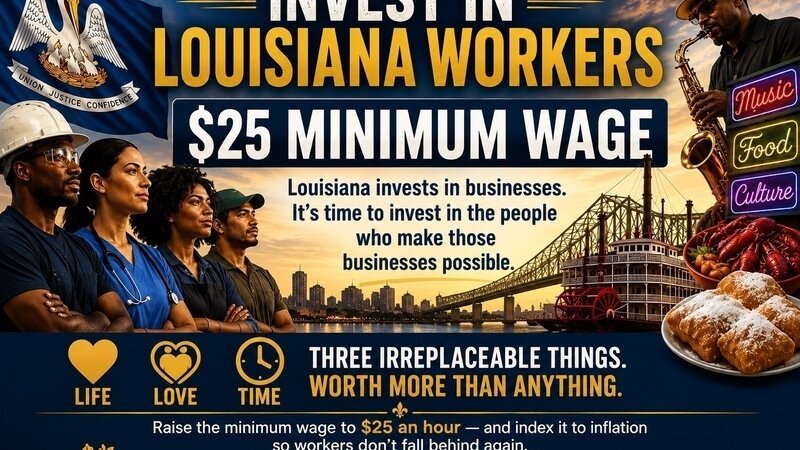
INVEST IN LOUISIANA WORKERS
Raise Louisiana’s Minimum Wage to $25 an Hour
In 1938, the United States made a decision to create a national minimum wage. This is why—and why it matters today.
Before we argue about whether Louisiana workers should earn $25 an hour, let’s go back to the beginning.
Why did America create a minimum wage in the first place?
In 1938, during the Great Depression era, Congress passed the Fair Labor Standards Act. It established a federal minimum wage of 25 cents an hour, limited working hours for covered workers, and prohibited oppressive child labor.
But the important part isn’t just the 25 cents.
It’s why America did it.
President Franklin D. Roosevelt told Congress that wages and the economy were connected. Workers needed enough purchasing power to participate in the economy. He argued that America should provide “a fair day’s pay for a fair day’s work” and that government had a responsibility to address excessively low wages, excessive hours, child labor, and exploitation of workers.
There was another problem.
A responsible business could pay its workers fairly, only to compete against another business that cut wages and extended working hours to sell its products more cheaply. Roosevelt argued that individual employers couldn’t solve that problem by themselves because businesses doing the right thing could be undercut by competitors that refused to do the same.
That’s why a floor mattered.
It established a minimum standard beneath which competition should not be allowed to push working people.
And policymakers understood something else that is remarkably relevant today:
Workers are also customers.
When working people have money, they buy groceries. They pay rent. They repair their cars. They eat at restaurants. They buy clothes. They pay for childcare. They use local businesses.
Their paycheck doesn’t disappear. It moves through the economy.
Roosevelt specifically warned Congress that undercutting the wages of the poorest-paid workers damaged buying power, and he connected workers’ purchasing power with businesses’ ability to sell what they produced.
So here’s our question:
When did we stop advancing that logic?
America didn’t create the minimum wage because 25 cents was some magical number.
Twenty-five cents was the starting point.
In fact, only a few years later, Roosevelt argued that the existing minimum had already become obsolete because the cost of living and national wage structure had changed. He called for the minimum to be substantially increased so that the original objectives of federal wage protections could continue to be achieved.
Think about that.
The people implementing this policy understood that the number had to change when economic conditions changed.
Yet today, the federal minimum wage remains $7.25 an hour.
At $7.25 an hour, working 40 hours every week for 52 weeks produces only:
$15,080 a year before taxes.
At $25 an hour, the same 2,080 hours produces:
$52,000 a year before taxes.
So before somebody tells us that $25 is “too much,” we want Louisiana to have a much bigger conversation.
What is an hour of a Louisiana worker’s life worth in today’s economy?
Every hour someone works is an hour of their life they cannot purchase back.
Workers build our homes. Care for patients. Teach children. Prepare food. Drive trucks. Stock stores. Clean buildings. Repair equipment. Answer phones. Work construction. Serve customers. Produce goods. Maintain our communities.
They are not merely a business expense.
They are part of the investment that makes the business possible.
And Louisiana already understands the concept of investing to create economic growth.
Our state uses tax incentives, abatements, grants, workforce programs, infrastructure and other public resources to attract and retain businesses.
That can be good economic policy if Louisiana receives a good return on its investment.
But taxpayers are investors too.
People contribute through different layers of taxation—federal, state and local—and through taxes on the things they purchase.
Those dollars build and maintain the roads, schools, infrastructure, workforce and communities businesses depend upon.
Then public resources may be used again to encourage companies to locate or expand here.
So Louisiana needs to start asking:
WHAT ARE LOUISIANA’S PEOPLE RECEIVING IN RETURN?
When public resources support private economic development, we believe Louisiana should measure more than the number of jobs announced.
We should measure how many jobs were actually created, what those jobs pay, how many went to Louisiana residents, how much public support the company received, how much payroll stays in Louisiana, whether Louisiana-owned businesses benefited, whether promised investments actually occurred, and what measurable return Louisiana communities received.
And when taxpayer-supported incentives are involved, Louisiana should consider stronger requirements involving Louisiana hiring, wages, workforce development, transparency, community investment, and accountability when promised benefits aren’t delivered.
This is not Louisiana versus business.
Successful businesses matter.
Entrepreneurs matter.
Small businesses matter.
Employers matter.
And workers matter.
We don’t want to destroy somebody else’s dream in order to build ours.
We want an economy where people can build dreams together.
For generations, states have asked:
“What do we need to offer this company to bring jobs here?”
We’re asking Louisiana to add another question:
“WHAT SHOULD THAT INVESTMENT RETURN TO THE PEOPLE OF LOUISIANA?”
RAISE IT—AND DON’T LET IT FALL BEHIND AGAIN
We are calling for Louisiana to raise its minimum wage to $25 an hour and permanently index the wage to inflation.
That means we should not have to fight the same political battle every time prices rise.
When the cost of goods and services rises, the minimum wage would automatically adjust according to a clearly defined inflation measure, such as the Consumer Price Index, on a regular schedule established by law.
If inflation goes up, the wage floor goes up with it.
If $25 buys a certain amount of food, housing, transportation and other necessities when this law takes effect, workers should not gradually lose that purchasing power simply because lawmakers fail to update the number.
We already know what happens when a wage is written into law as a fixed dollar amount and then allowed to sit for years while prices continue changing.
We don’t want to raise the number once. We want to fix the mechanism that allowed the number to fall behind.
Louisiana should establish a wage floor that moves with the economy instead of repeatedly falling decades behind it.
We also call for greater transparency and accountability surrounding major publicly supported economic-development projects so Louisiana residents can see what we invested, what was promised, what was delivered, who received the jobs, what those jobs paid, and what Louisiana ultimately received in return.
A higher wage isn’t without economic tradeoffs. Research has found that substantial minimum-wage increases can raise earnings for millions of workers while also potentially reducing employment for some workers; the size of those effects remains an important economic question.
That’s exactly why we want this conversation based on evidence—not slogans.
Go back to 1938.
Understand why America established the minimum wage.
Look at what happened afterward.
Look at what $7.25 buys today.
Look at what Louisiana workers produce.
Look at what Louisiana invests in economic development.
Follow the public money.
Measure the return.
And then ask:
ARE WE STILL ACCOMPLISHING WHAT WE CREATED THE MINIMUM WAGE TO DO?
If the answer is no, we don’t have to blame the worker.
We don’t have to blame the business owner.
We update the system.
INVEST IN LOUISIANA WORKERS.
RAISE LOUISIANA’S MINIMUM WAGE TO $25 AN HOUR.
Sign this petition if you believe it’s time for Louisiana to have this conversation—and help us build the policy together.

639
The Issue
INVEST IN LOUISIANA WORKERS
Raise Louisiana’s Minimum Wage to $25 an Hour
In 1938, the United States made a decision to create a national minimum wage. This is why—and why it matters today.
Before we argue about whether Louisiana workers should earn $25 an hour, let’s go back to the beginning.
Why did America create a minimum wage in the first place?
In 1938, during the Great Depression era, Congress passed the Fair Labor Standards Act. It established a federal minimum wage of 25 cents an hour, limited working hours for covered workers, and prohibited oppressive child labor.
But the important part isn’t just the 25 cents.
It’s why America did it.
President Franklin D. Roosevelt told Congress that wages and the economy were connected. Workers needed enough purchasing power to participate in the economy. He argued that America should provide “a fair day’s pay for a fair day’s work” and that government had a responsibility to address excessively low wages, excessive hours, child labor, and exploitation of workers.
There was another problem.
A responsible business could pay its workers fairly, only to compete against another business that cut wages and extended working hours to sell its products more cheaply. Roosevelt argued that individual employers couldn’t solve that problem by themselves because businesses doing the right thing could be undercut by competitors that refused to do the same.
That’s why a floor mattered.
It established a minimum standard beneath which competition should not be allowed to push working people.
And policymakers understood something else that is remarkably relevant today:
Workers are also customers.
When working people have money, they buy groceries. They pay rent. They repair their cars. They eat at restaurants. They buy clothes. They pay for childcare. They use local businesses.
Their paycheck doesn’t disappear. It moves through the economy.
Roosevelt specifically warned Congress that undercutting the wages of the poorest-paid workers damaged buying power, and he connected workers’ purchasing power with businesses’ ability to sell what they produced.
So here’s our question:
When did we stop advancing that logic?
America didn’t create the minimum wage because 25 cents was some magical number.
Twenty-five cents was the starting point.
In fact, only a few years later, Roosevelt argued that the existing minimum had already become obsolete because the cost of living and national wage structure had changed. He called for the minimum to be substantially increased so that the original objectives of federal wage protections could continue to be achieved.
Think about that.
The people implementing this policy understood that the number had to change when economic conditions changed.
Yet today, the federal minimum wage remains $7.25 an hour.
At $7.25 an hour, working 40 hours every week for 52 weeks produces only:
$15,080 a year before taxes.
At $25 an hour, the same 2,080 hours produces:
$52,000 a year before taxes.
So before somebody tells us that $25 is “too much,” we want Louisiana to have a much bigger conversation.
What is an hour of a Louisiana worker’s life worth in today’s economy?
Every hour someone works is an hour of their life they cannot purchase back.
Workers build our homes. Care for patients. Teach children. Prepare food. Drive trucks. Stock stores. Clean buildings. Repair equipment. Answer phones. Work construction. Serve customers. Produce goods. Maintain our communities.
They are not merely a business expense.
They are part of the investment that makes the business possible.
And Louisiana already understands the concept of investing to create economic growth.
Our state uses tax incentives, abatements, grants, workforce programs, infrastructure and other public resources to attract and retain businesses.
That can be good economic policy if Louisiana receives a good return on its investment.
But taxpayers are investors too.
People contribute through different layers of taxation—federal, state and local—and through taxes on the things they purchase.
Those dollars build and maintain the roads, schools, infrastructure, workforce and communities businesses depend upon.
Then public resources may be used again to encourage companies to locate or expand here.
So Louisiana needs to start asking:
WHAT ARE LOUISIANA’S PEOPLE RECEIVING IN RETURN?
When public resources support private economic development, we believe Louisiana should measure more than the number of jobs announced.
We should measure how many jobs were actually created, what those jobs pay, how many went to Louisiana residents, how much public support the company received, how much payroll stays in Louisiana, whether Louisiana-owned businesses benefited, whether promised investments actually occurred, and what measurable return Louisiana communities received.
And when taxpayer-supported incentives are involved, Louisiana should consider stronger requirements involving Louisiana hiring, wages, workforce development, transparency, community investment, and accountability when promised benefits aren’t delivered.
This is not Louisiana versus business.
Successful businesses matter.
Entrepreneurs matter.
Small businesses matter.
Employers matter.
And workers matter.
We don’t want to destroy somebody else’s dream in order to build ours.
We want an economy where people can build dreams together.
For generations, states have asked:
“What do we need to offer this company to bring jobs here?”
We’re asking Louisiana to add another question:
“WHAT SHOULD THAT INVESTMENT RETURN TO THE PEOPLE OF LOUISIANA?”
RAISE IT—AND DON’T LET IT FALL BEHIND AGAIN
We are calling for Louisiana to raise its minimum wage to $25 an hour and permanently index the wage to inflation.
That means we should not have to fight the same political battle every time prices rise.
When the cost of goods and services rises, the minimum wage would automatically adjust according to a clearly defined inflation measure, such as the Consumer Price Index, on a regular schedule established by law.
If inflation goes up, the wage floor goes up with it.
If $25 buys a certain amount of food, housing, transportation and other necessities when this law takes effect, workers should not gradually lose that purchasing power simply because lawmakers fail to update the number.
We already know what happens when a wage is written into law as a fixed dollar amount and then allowed to sit for years while prices continue changing.
We don’t want to raise the number once. We want to fix the mechanism that allowed the number to fall behind.
Louisiana should establish a wage floor that moves with the economy instead of repeatedly falling decades behind it.
We also call for greater transparency and accountability surrounding major publicly supported economic-development projects so Louisiana residents can see what we invested, what was promised, what was delivered, who received the jobs, what those jobs paid, and what Louisiana ultimately received in return.
A higher wage isn’t without economic tradeoffs. Research has found that substantial minimum-wage increases can raise earnings for millions of workers while also potentially reducing employment for some workers; the size of those effects remains an important economic question.
That’s exactly why we want this conversation based on evidence—not slogans.
Go back to 1938.
Understand why America established the minimum wage.
Look at what happened afterward.
Look at what $7.25 buys today.
Look at what Louisiana workers produce.
Look at what Louisiana invests in economic development.
Follow the public money.
Measure the return.
And then ask:
ARE WE STILL ACCOMPLISHING WHAT WE CREATED THE MINIMUM WAGE TO DO?
If the answer is no, we don’t have to blame the worker.
We don’t have to blame the business owner.
We update the system.
INVEST IN LOUISIANA WORKERS.
RAISE LOUISIANA’S MINIMUM WAGE TO $25 AN HOUR.
Sign this petition if you believe it’s time for Louisiana to have this conversation—and help us build the policy together.
The Decision Makers


Supporter Voices
Petition Updates
Share this petition
Petition created on February 6, 2026