
Purposes. As an "away-from-home" toilet room, a public toilet can provide far more than access to the toilet for urination and defecation. People also wash their hands, use the mirrors for grooming, get drinking water (e.g. refilling water bottles), attend to menstrual hygiene needs, and use the waste bins.
Wikipedia › wiki › Public_toilet
Public toilet - Wikipedia
Open main menu
Public toilet
This article is about a room or building available for public use. For a room in a private house, see Toilet (room). For the film, see Public Toilet (film).
A public toilet on the Boise River Greenbelt featuring public art.
A public toilet is a room or small building with toilets (or urinals) and sinks that does not belong to a particular household. Rather, the toilet is available for use by the general public, customers, travellers, employees of a business, school pupils, prisoners etc. Public toilets are commonly separated into male and female facilities, although some are unisex, especially for small or single-occupancy public toilets. Increasingly, public toilets are accessible to people with disabilities. Public toilets are known by many other names depending on the country. Examples are: restroom, bathroom, men's room, women's room in the US, washroom in Canada, and toilets, lavatories, water closet (W.C.), ladies and gents in Europe. In some parts of the world, they are referred to as the loo.
Some public toilets are free of charge while others charge a fee. In the latter case they are also called pay toilets and sometimes have a charging turnstile.
Local authorities or commercial businesses may provide public toilet facilities. Some are unattended while others are staffed by an attendant. In many cultures, it is customary to tip the attendant, especially if they provide a specific service, such as might be the case at upscale nightclubs or restaurants.
Public toilets are typically found in many different places: inner-city locations, offices, factories, schools, universities and other places of work and study. Similarly, museums, cinemas, bars, restaurants, entertainment venues usually provide public toilets. Railway stations, filling stations, and long distance public transport vehicles such as trains, ferries, and planes usually provide toilets for general use. Portable toilets are often available at large outdoor events.
Alternative names
Types
Purposes
As an "away-from-home" toilet room, a public toilet can provide far more than access to the toilet for urination and defecation. People also wash their hands, use the mirrors for grooming, get drinking water (e.g. refilling water bottles), attend to menstrual hygiene needs, and use the waste bins. Public toilets may also become places for harassment of others or illegal activities, particularly if principles of Crime prevention through environmental design (CPTED) are not applied in the design of the facility.
Health aspects
Public toilets play a role in community health and individual well-being. Where toilets are available, people can enjoy outings and physical activities in their communities. By letting people get out of their cars and onto their feet, bicycles and mass transit, public toilets can contribute to improved environmental health. Mental well-being is enhanced when people are out with families and friends and know a place "to go" is available.
Public toilets serve people who are "toilet challenged". First, some people need to go very frequently, including young and old people, females who are pregnant or menstruating, and those with some medical conditions. Second, some people need toilet access urgently, suddenly and without warning: such as those with chronic conditions such as Crohn's disease and colitis, and those temporarily afflicted with food-borne illnesses.
The inability to satisfy essential physiological needs because no toilet is available contributes to health issues such as urinary tract infections, kidney infections, and digestive problems which can later develop into severe health problems.[11] Inadequate access to a public toilets when required can lead to substantial problems for men with prostate problems, women who are menstruating or going through the menopause and anyone with urinary and fecal incontinence.
If bus and truck drivers on timed schedules have difficulty in accessing toilets, this puts them at risk of bladder and digestive health problems. Furthermore, if the concentration of a driver in urgent need is compromised, it becomes a broader public safety concern.
Workers therefore have legal rights to access a toilet during their work day. In the United States, the Department of Labor's Occupational Health and Safety protects workers' rights to toilet breaks because of the documented health risks.[12] This protected right to a toilet is a function of the workplace and is lost when workers leave the workplace.[13]
According to the Government of Australia, more than 3.8 million Australians of all ages are estimated to suffer continence issues.[14] This represents 18% of the Australian population. Therefore, the Department of Health and Ageing maintains the National Public Toilet Map to enable the public to find the closest facility.
The Bill & Melinda Gates Foundation has funded several research projects for provision of community, shared or school toilets in developing countries since 2011 when they launched their "Reinvent the Toilet Challenge".[15][16]
Entry
Doorless entryEdit
Modern public toilets may be designed with a labyrinth entrance (doorless entry), which prevents the spread of disease that might otherwise occur when coming in contact with a door. Doorless entry provides visual privacy while simultaneously offering a measure of security by allowing the passage of sound. Doorless entry also helps deter vandalism; fewer audible clues to another person entering discourages some vandals. Doorless entry may also be achieved simply by keeping an existing door propped open, closed only when necessary.
Coin operated entry
Pay toilets usually have some form of coin operated turnstile, or they have an attendant who collects the fee.
Privacy
People often expect a high level of privacy when using public toilets. Privacy expectations may include toilet cubicles, cubicle doors, urinal partitions and similar.
The World Health Organization states that toilets should be "suitable, private and safe to use for all intended users, taking into consideration their gender, age and physical mobility (e.g. disabled, sick etc.)" and "All shared or public toilets should have [...] doors that can be locked from the inside, and lights".[17]
Service access
Modern public toilets often have a service entrance, utilities passage, and the like, that run behind all the fixtures. Sensors are installed in a separate room, behind the fixtures. Usually the separate room is just a narrow corridor or passageway.
Sensor
Sensor-operated fixtures (faucets, soap dispensers, hand dryers, paper towel dispensers) prevent the spread of disease by allowing patrons to circumvent the need to touch common surfaces. Sensor-operated toilets also help conserve water by limiting the amount used per flush, and require less routine maintenance. Each sensor views through a small window into each fixture. Sometimes the metal plates that house the sensor windows are bolted on from behind, to prevent tampering. Additionally, all of the electrical equipment is safely behind the walls, so that there is no danger of electric shock. However, a RCCB must be used for all such electrical equipment.
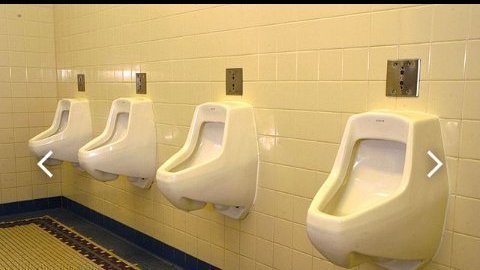
Urinals for males are common in public toilets as they are more space efficient than toilets (for urination). Urinals in public toilets are common in Western countries but less so in Muslim countries, partly due to Islamic toilet etiquette rules. Urinals for females exist but are rare. Urinals can be with automatic or manual flushing, or without flush water as is the case for waterless urinals. They can be arranged as single sanitary fixtures (with or without privacy walls) or in a trough design without privacy walls. The body posture for users of urinals is specifically the standing position. Compared with urination in a general-purpose toilet, usage is faster and more sanitary because at the urinal there are no fecal germs, no additional doors or locks to touch, and no seat to turn up. A urinal takes less space, is simpler, and consumes less water per flush (or even no water at all) than a flush toilet.
LightingEdit
Service lighting consisting of windows that run all the way around the outside of the toilet using electric lights behind the windows, to create the illusion of extensive natural light, even when the toilets are underground or otherwise do not have access to natural light. The windows are sometimes made of glass brick, permanently cemented in place. Lighting installed in service tunnels that run around the outside of the toilets provides optimum safety from electrical shock (keeping the lights outside the toilet), hygiene (no cracks or openings), security (no way for vandals to access the light bulbs), and aesthetics (clean architectural lines that maintain a continuity of whatever aesthetic design is present, e.g., the raw industrial urban aesthetic that works well with glass brick).
Cisterns (tanks)Edit
Older toilets infrequently have service ducts and often in old toilets that have been modernized, the toilet cistern is hidden in a tiled over purpose-built 'box'. Often old toilets still have high-level cisterns in the service ducts. On the outside, the toilet is flushed by a handle (just like an ordinary low-level cistern toilet) although behind the wall this handle activates a chain. Sometimes a long flushing trough is used to allow closets to be flushed repeatedly without waiting for the cistern to refill. This trend of hiding cisterns and fittings behind the walls started in the late 1930s in the United States and in the United Kingdom from the 1950s, and by the late 1960s it was unusual for toilet cisterns to be visible in public toilets. In some buildings such as schools, however, a cistern can still be visible, although high-level cisterns had become outdated by the 1970s. Many schools now have low-level cisterns.
FixturesEdit
Public toilets by their nature see heavy usage, so they may rely on a flushometer with a stronger and louder flush than a home toilet. Some high-vandalism settings, such as beaches or stadiums, will use metal toilets. Public toilets generally contain several of the following fixtures.
Toilet with toilet seat; whereas a home toilet seat has a lid, a public toilet may or may not
Toilet paper, often within a lockable dispenser
Coat hook
"Pull-down" purse holder
Sanpro bin for menstrual products; this may be classified as clinical waste and be subject to special regulations concerning disposal
Dispenser for flushable paper toilet seat covers
At the point of handwashingEdit
Faucets (taps), note some are at a lower level for children and wheelchair users
Antiseptic handwash dispenser or soap dispensers, pump bottles or auto dispensers
Mirror (usually over sinks)
Paper towel dispenser (sometimes they have auto-sensors for touchless dispensing)
Garbage can (a rubbish bin)
Hand dryer (used manually or with auto-sensors)
Urinals (almost exclusively in public toilets for males; although see female urinal)
Vending machines dispensing condoms, diapers (nappies), painkillers, energy drinks, perfume, breath mints, facial tissue, confectionery, undergarments, swimwear, soap, sex toys, or sanitary napkins or tampons
Air fresheners or odour control systems
Infant changing table, often fold-down (usually in women's rooms, but increasingly also in men/s rooms)[18]
Sometimes showers are also present, often with soap, shampoo, or similar dispensers (often at truck stops)Urinals (almost exclusively in public toilets for males; although see female urinal)
Vending machines dispensing condoms, diapers (nappies), painkillers, energy drinks, perfume, breath mints, facial tissue, confectionery, undergarments, swimwear, soap, sex toys, or sanitary napkins or tampons
Air fresheners or odour control systems
Infant changing table, often fold-down (usually in women's rooms, but increasingly also in men/s rooms)[18]
Sometimes showers are also present, often with soap, shampoo, or similar dispensers (often at truck stops)