“Jingu Stadium should be renovated, not torn down” --- architect Satoko Ohashi

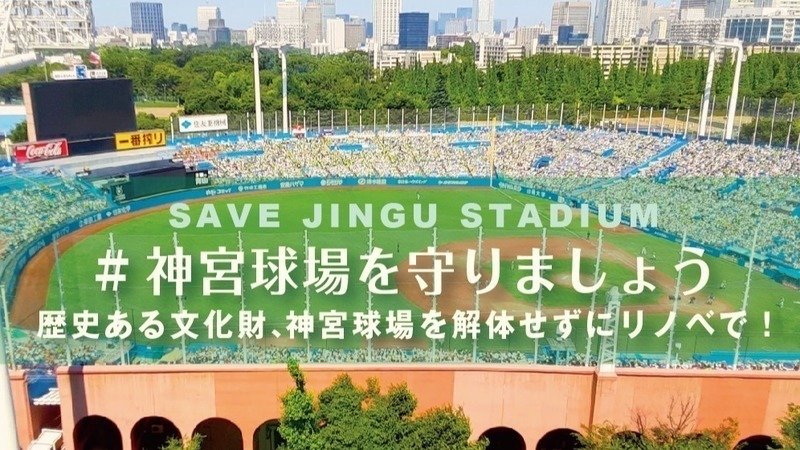
Today we have a guest post about Jingu Stadium by architect Satoko Ohashi, introducing the history of Jingu Stadium and its value as a cultural asset from an expert’s perspective.
Jingu Stadium is loved by many fans and should be renovated, preserved, and utilized, not demolished.
If you would like to learn more about the fascinating history Jingu Stadium, there will be an online seminar tomorrow morning at 10:00 a.m. Japan time, with author Robert Whiting. Please join us. Sign up here: https://us02web.zoom.us/webinar/register/WN_g6IasByGSOS6OBVAjj93xA
★ ★ ★ ★ ★ ★ ★ ★ ★ ★ ★ ★ ★ ★ ★ ★ ★ ★
Jingu Stadium was built in 1926 (Taisho 15), the same year as the nearby Meiji Memorial Picture Gallery, which is designated an Important Cultural Property. It was designed by the same architect as the Picture Gallery, Kobayashi Masakazu. Kobayashi was an engineer in the Meiji Shrine Construction Bureau at the time and played a supervisory role in the construction of the inner and outer gardens of Meiji Shrine. He later became president of the Architectural Institute of Japan and president of Chiba University.
While the construction of Meiji Shrine was being planned, the Great Kanto Earthquake hit the Kanto region in 1923, causing extensive damage to the capital, but the city was able to recover within seven years. 117 reconstructed elementary schools and public buildings, including apartment buildings known as the Aoyama and Daikanyama Dojunkai Apartments, were constructed of reinforced concrete, drawing on lessons learned from the Great Kanto Earthquake. Jingu Stadium was also constructed during this period. Although nearly 100 years have already passed since then, various empirical studies have been conducted and methods of preservation and utilization have been created.
In the past, the evaluation criteria for seismic diagnosis of reinforced concrete buildings were concrete strength and the extent to which neutralization has progressed from the surface. Based on this, buildings were classified as "deteriorated". However, recent studies have proven that "neutralization" alone is not enough to deem a building "deteriorated," and the criteria have been rewritten.
A non-specialist might think that "concrete that has aged 100 years will deteriorate over time, and the concrete will become brittle and crumbling, just like osteoporosis in human bones."
However, that is not the case.
If the concrete is of good quality at the time of construction, the strength of the concrete will not deteriorate significantly even after 100 years. At the time Jingu Stadium was built, concrete buildings were not designed by just anyone, only a few highly educated designers were involved in the design process, and quality, hard concrete was used.
Even if neutralization of the concrete has progressed, the strength of the building will not be reduced if water is kept out. Protection with appropriate paint, etc., will stop further neutralization from occurring. If water has not entered the concrete, the rebar will not rust. Rather, it is the equipment piping, etc. that will "age" but that can easily be replaced and updated.
Jingu Stadium was seismically reinforced in 2014 to ensure its safety according to current codes and standards. This means that the concrete of Jingu Stadium is strong enough to meet current regulations. This is because concrete core removal surveys are conducted during seismic reinforcement.
Koshien Stadium, which was built two years before Jingu Stadium, was recently renovated. The renovation took a total of four years to complete, with construction taking place only during the off-season, and seismic reinforcement and functional upgrades were carried out without interrupting games. This is a good precedent for Jingu Stadium.
Satoko Ohashi