

Protect Anza-Borrego: Keep the Golden Pacific Powerlink Out of Protected Lands
The Issue
For many of us, Anza-Borrego is more than just a desert.
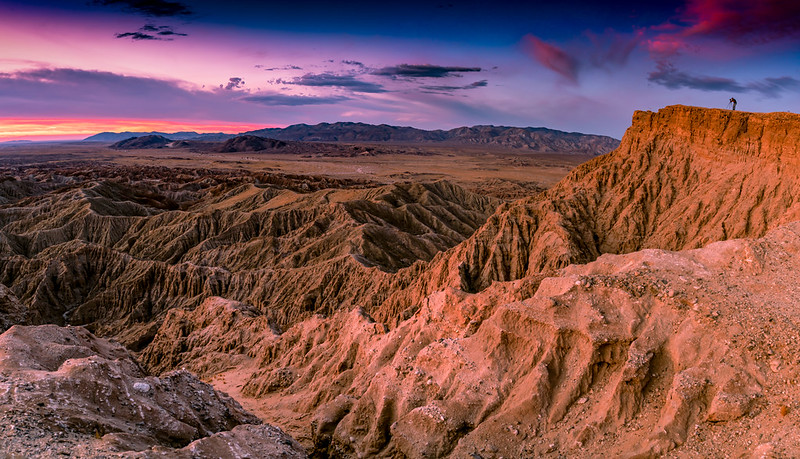
It is the first glimpse of the desert opening below Montezuma Grade. It is watching the mountains turn purple at sunset. It is standing beneath a night sky so dark that the Milky Way feels close enough to touch. It is hiking through canyons, hearing nothing but wind and birds, watching bighorn sheep move across the slopes, and returning year after year to a landscape that still feels genuinely wild.
People come here to hike, camp, photograph, study, explore, recover, reconnect, and remember what undeveloped California once looked like.
That experience exists because generations before us made a deliberate decision to protect this place.
Today, Anza-Borrego Desert State Park encompasses more than 650,000 acres, making it California’s largest state park. More than two-thirds of the Park is designated State Wilderness, and Anza-Borrego contains approximately 85 percent of the designated State Wilderness acreage within the California State Park system.
The Park also contains:
- Eight designated Cultural Preserves
- Critical habitat and wildlife corridors, including habitat for the endangered Peninsular bighorn sheep
- Thousands of documented cultural and archaeological resources
- One of the most significant continuous fossil records in North America
- International recognition for its extraordinary dark skies
- Vast areas valued for their quiet, scenic beauty, recreation, biodiversity, and intact desert character
These protections are not symbolic. They represent decisions made over decades that some landscapes are important enough to preserve—not just until development becomes convenient, but especially when those protections are tested.
And now they are being tested.
SDG&E is developing the proposed Golden Pacific Powerlink, a new approximately 140-mile, 500-kilovolt transmission project connecting the Imperial Valley with the transmission system near the San Diego–Orange County region. Multiple routes and alternatives are being considered. Some could affect Anza-Borrego Desert State Park and surrounding protected landscapes. A recently introduced alternative would bring the project through the Borrego Springs area, up Montezuma Grade and toward Culp Valley.
No final route has been approved.
That is why this moment matters.
We should not wait until a decision has already been made to ask whether there was a better way.
We are not opposed to California’s energy future. California needs a reliable electric grid. We need to modernize infrastructure and plan responsibly for changing energy needs. But meeting our energy goals should not require abandoning our conservation goals. Those goals are not mutually exclusive.
Before California commits to a new 500-kV corridor with permanent impacts to protected public lands, wildlife habitat, scenic landscapes, recreation areas and surrounding communities, decision-makers should require a full and transparent examination of reasonable alternatives. That should include serious evaluation of whether grid needs can be met through solutions such as:
- Increasing capacity within existing transmission corridors
- Upgrading existing infrastructure
- Advanced reconductoring
- Grid-enhancing technologies
- Additional circuits or corridor reinforcement
- Storage and other grid-support technologies
- Alternative routes that avoid the most sensitive, protected landscapes and communities
- Other feasible technologies and approaches that could reduce the need for a completely new corridor
The question should not simply be: Which community or protected landscape should the new line cross?
The question should also be: Is there a better way to meet the need with fewer permanent impacts?
Anza-Borrego has faced this choice before. Nearly two decades ago, routes for SDG&E’s Sunrise Powerlink were proposed through Anza-Borrego Desert State Park. After extensive environmental review, the California Public Utilities Commission rejected routes through the Park and ultimately approved a route outside Anza-Borrego. That history matters. It demonstrates why environmental review, public participation and serious examination of alternatives are so important.
The Golden Pacific Powerlink deserves that same scrutiny.
This is also bigger than the Park. Communities across San Diego and Riverside counties are now raising concerns about proposed and alternative routes. Residents have organized efforts including Save Borrego/Anza-Borrego advocates, Save Temecula, Save Fallbrook, Save Warner Springs, Save Palomar Mountain and Save Ocotillo Wells. Local governments and elected officials have also begun weighing in.
This should not become a fight in which one community tries to push the impacts onto another.
Moving a major transmission corridor from one sensitive landscape to another is not a solution. We need a process that asks what is best for California as a whole—its communities, its ratepayers, its energy system and the public lands that belong to all of us.
Public lands are held in trust for the people. Anza-Borrego does not belong to a utility company.
It belongs to Californians.
Its wilderness, wildlife, cultural history, dark skies and silence are part of a public inheritance that we have a responsibility to pass forward.
The Park’s enormous size does not make portions of it expendable.
In fact, its scale and continuity are part of what make it so extraordinary.
If one of California’s most protected landscapes can become the path of industrial least resistance simply because there is space on a map, we have to ask: What does protected actually mean?
We are asking SDG&E and the California Public Utilities Commission to:
- Protect Anza-Borrego Desert State Park and surrounding sensitive landscapes from the Golden Pacific Powerlink.
- Conduct a full, transparent examination of project and route alternatives.
- Give meaningful consideration to solutions that use existing infrastructure and corridors where feasible.
- Consider the cumulative impacts to wildlife, wilderness, cultural resources, recreation, dark skies, scenic landscapes and surrounding communities.
- Ensure the public has meaningful opportunities to participate before irreversible decisions are made.
California can meet its energy goals while protecting the landscapes generations of Californians fought to preserve.
We should expect nothing less. If Anza-Borrego has ever inspired you, restored you, surprised you, challenged you or reminded you of what wild California can still be, please stand with us.
Sign this petition and call on decision-makers to protect Anza-Borrego, fully examine the alternatives and choose a better path.
Protected should mean protected.

374
The Issue
For many of us, Anza-Borrego is more than just a desert.
It is the first glimpse of the desert opening below Montezuma Grade. It is watching the mountains turn purple at sunset. It is standing beneath a night sky so dark that the Milky Way feels close enough to touch. It is hiking through canyons, hearing nothing but wind and birds, watching bighorn sheep move across the slopes, and returning year after year to a landscape that still feels genuinely wild.
People come here to hike, camp, photograph, study, explore, recover, reconnect, and remember what undeveloped California once looked like.
That experience exists because generations before us made a deliberate decision to protect this place.
Today, Anza-Borrego Desert State Park encompasses more than 650,000 acres, making it California’s largest state park. More than two-thirds of the Park is designated State Wilderness, and Anza-Borrego contains approximately 85 percent of the designated State Wilderness acreage within the California State Park system.
The Park also contains:
- Eight designated Cultural Preserves
- Critical habitat and wildlife corridors, including habitat for the endangered Peninsular bighorn sheep
- Thousands of documented cultural and archaeological resources
- One of the most significant continuous fossil records in North America
- International recognition for its extraordinary dark skies
- Vast areas valued for their quiet, scenic beauty, recreation, biodiversity, and intact desert character
These protections are not symbolic. They represent decisions made over decades that some landscapes are important enough to preserve—not just until development becomes convenient, but especially when those protections are tested.
And now they are being tested.
SDG&E is developing the proposed Golden Pacific Powerlink, a new approximately 140-mile, 500-kilovolt transmission project connecting the Imperial Valley with the transmission system near the San Diego–Orange County region. Multiple routes and alternatives are being considered. Some could affect Anza-Borrego Desert State Park and surrounding protected landscapes. A recently introduced alternative would bring the project through the Borrego Springs area, up Montezuma Grade and toward Culp Valley.
No final route has been approved.
That is why this moment matters.
We should not wait until a decision has already been made to ask whether there was a better way.
We are not opposed to California’s energy future. California needs a reliable electric grid. We need to modernize infrastructure and plan responsibly for changing energy needs. But meeting our energy goals should not require abandoning our conservation goals. Those goals are not mutually exclusive.
Before California commits to a new 500-kV corridor with permanent impacts to protected public lands, wildlife habitat, scenic landscapes, recreation areas and surrounding communities, decision-makers should require a full and transparent examination of reasonable alternatives. That should include serious evaluation of whether grid needs can be met through solutions such as:
- Increasing capacity within existing transmission corridors
- Upgrading existing infrastructure
- Advanced reconductoring
- Grid-enhancing technologies
- Additional circuits or corridor reinforcement
- Storage and other grid-support technologies
- Alternative routes that avoid the most sensitive, protected landscapes and communities
- Other feasible technologies and approaches that could reduce the need for a completely new corridor
The question should not simply be: Which community or protected landscape should the new line cross?
The question should also be: Is there a better way to meet the need with fewer permanent impacts?
Anza-Borrego has faced this choice before. Nearly two decades ago, routes for SDG&E’s Sunrise Powerlink were proposed through Anza-Borrego Desert State Park. After extensive environmental review, the California Public Utilities Commission rejected routes through the Park and ultimately approved a route outside Anza-Borrego. That history matters. It demonstrates why environmental review, public participation and serious examination of alternatives are so important.
The Golden Pacific Powerlink deserves that same scrutiny.
This is also bigger than the Park. Communities across San Diego and Riverside counties are now raising concerns about proposed and alternative routes. Residents have organized efforts including Save Borrego/Anza-Borrego advocates, Save Temecula, Save Fallbrook, Save Warner Springs, Save Palomar Mountain and Save Ocotillo Wells. Local governments and elected officials have also begun weighing in.
This should not become a fight in which one community tries to push the impacts onto another.
Moving a major transmission corridor from one sensitive landscape to another is not a solution. We need a process that asks what is best for California as a whole—its communities, its ratepayers, its energy system and the public lands that belong to all of us.
Public lands are held in trust for the people. Anza-Borrego does not belong to a utility company.
It belongs to Californians.
Its wilderness, wildlife, cultural history, dark skies and silence are part of a public inheritance that we have a responsibility to pass forward.
The Park’s enormous size does not make portions of it expendable.
In fact, its scale and continuity are part of what make it so extraordinary.
If one of California’s most protected landscapes can become the path of industrial least resistance simply because there is space on a map, we have to ask: What does protected actually mean?
We are asking SDG&E and the California Public Utilities Commission to:
- Protect Anza-Borrego Desert State Park and surrounding sensitive landscapes from the Golden Pacific Powerlink.
- Conduct a full, transparent examination of project and route alternatives.
- Give meaningful consideration to solutions that use existing infrastructure and corridors where feasible.
- Consider the cumulative impacts to wildlife, wilderness, cultural resources, recreation, dark skies, scenic landscapes and surrounding communities.
- Ensure the public has meaningful opportunities to participate before irreversible decisions are made.
California can meet its energy goals while protecting the landscapes generations of Californians fought to preserve.
We should expect nothing less. If Anza-Borrego has ever inspired you, restored you, surprised you, challenged you or reminded you of what wild California can still be, please stand with us.
Sign this petition and call on decision-makers to protect Anza-Borrego, fully examine the alternatives and choose a better path.
Protected should mean protected.
Supporter Voices
Petition Updates
Share this petition
Petition created on September 15, 2026