
Don’t forget lessons long ago learnt: PROTECT renters and ensure housing is AFFORDABLE – it’s BETTER for community prosperity.
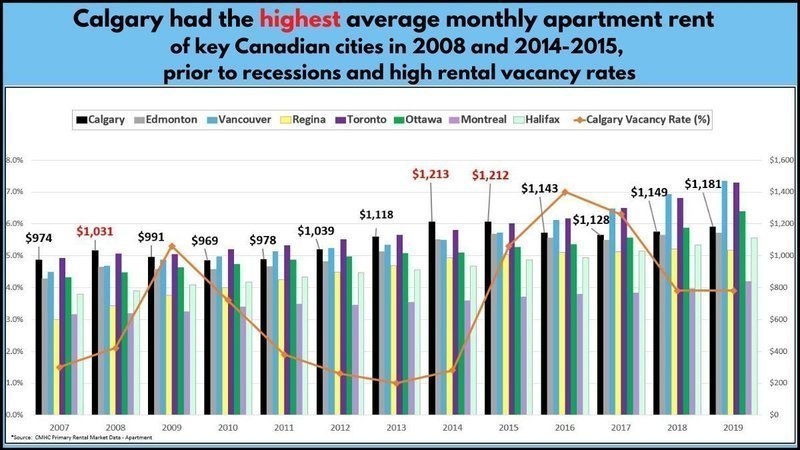
1. Calgary had the highest average apartment rent in Canada among major cities in 2008 and 2014-2015, prior to recessions when apartment rental vacancy rates increased and rental rates fell. See the CHART above. Source: CMHC Primary Rental Market data at the CMHC Housing Market Information Portal.
2. A rental market correction occurred in Calgary in 2016-2017 when rents dropped by as much as 20-25%+, with the highest vacancy rates in decades (see NOTE1).
3. The “market” long ago wanted rental protection/rental caps in Calgary and in Alberta. The Alberta Residential Tenancies Act allows landlords to increase rent by as much as they want one time per year. In 2007, at the peak of large rent increases and when Calgary’s rent was the highest of major cities across Canada (see NOTE 2), an IPSOS REID poll of citizens in Calgary and Edmonton determined that the majority of the market – 92 per cent of tenants and 78 per cent of home owners - wanted rent protection/rental caps (see NOTE 3).
4. Over an approximately two-week period (February 16 to March 2, 2007) an ALL party Alberta Affordable Housing Task Force held public meetings in 9 locations across Alberta: Calgary; Edmonton; Red Deer; Grande Prairie; Fort McMurray; Lethbridge; Hinton; Medicine Hat; and Elk Point (see NOTE 4). The Affordable Housing Task’s force report was delivered to the Alberta Government on March 20, 2007 approximately 45 days after the task force was formed on February 1, 2007 and stated the following in the Alberta Government News Release dated March 20, 2007 (see NOTES 5 and 6):
“The consistent message we heard from Albertans is that without affordable housing, our province’s economic growth cannot be sustained.”
5. The 2007 Alberta Affordable Housing Task Force recommended caps on rent increases of inflation + 2% for a two year period (see NOTE 6, page 16). However, apparently after a meeting by then Premier Stelmach with the largest landlords, the Alberta Government voted against rental caps that the majority of Albertans desired (see NOTES 7, 8 and 11). Instead, rental subsidies were implemented in Alberta that were apparently a benefit to landlords at the expense of Alberta’s taxpayers and that served to keep rents high. This occurred at a time that rent increases of $1,000 per month were occurring (see NOTE 7) and angry renters had stormed the housing minister’s office (see NOTE 9). This also occurred at a time of high profits by landlord REITs– including Boardwalk REIT – that as a Real Estate Investment Trust (REIT) does NOT pay income tax, but distributes profits to unitholders trading on the stock exchange (see NOTE 10).
6. The rent subsidies ran out after 5,000 Calgary households received assistance through the $15 million rental aid program, at a time of high demand. The 2009 recession worsened; job losses hit record highs with personal bankruptcies reaching the highest level in nearly two decades - Calgarians were hit particularly hard (see NOTE 11). Rents, which skyrocketed during Calgary’s boom, did not fall with the recession (see NOTE 11). Alberta’s 2009 job losses were much worse than government predicted (see NOTE 12).
7. Fraud charges were laid for inappropriate use of rental aid funds (see NOTES 13 and 14).
8. Rents remained HIGH.
- As stated in the Calgary Herald in September 2007: “Average rent for a two-bedroom apartment is now $1,075, almost $300 more than two years ago. The vacancy rate hovers at about 0.6 per dent. Many people who move to the city who cannot afford to buy a condo or house are exactly the kind of people Calgary needs – workers and immigrants who are willing to come here at least temporarily to work. There are also long-time residents who rent on a permanent basis. They make up about a quarter of the city’s population and many of them are young families, singles or seniors…” (see NOTE 15). [Emphasis added]
- A graphic designer reported that when new owners took over his small one-bedroom apartment in the inner-city, rent jumped to $950 from $575 (see NOTE 15).
- Rents in the Mission community of Calgary soared from $700 to $1,900 (see NOTE 16).
- A Calgary tenant whose rent was nearly tripled blasted the Stelmach government for not protecting renters after a provincial investigation found her landlord did not break Alberta rules for condo conversions. Rent increased to $1,500 per month from $600 per month at a time that condo conversion was suspected (see NOTE 17).
- Calgary’s apartment vacancy rate increased, but so did rent (see NOTE 18).
- Calgary’s apartment vacancy rate increased to 2% in April 2008 from 0.5% in April 2007 (due to an easing in net migration) but Calgary’s rent was $1,096 for a two bedroom apartment – the highest of 35 major centres across Canada (see NOTE 18).
- Tenants’ world got madder by the month (see NOTE 19). “…This is free enterprise Alberta, folks, where nobody can find workers to fill all those low-paying service jobs. If you’re new here and looking for a cheap place to stay, I hear there’s a nice culvert with a few hay bales in Nose Creek that isn’t taken…”
- Condo conversions depleted rental stock (see NOTE 20). Rental conversions forced out tenants, a tenant suspected huge rent hikes were sign of condo conversion and condo conversion complaint sparked probe (see NOTES 21, 22 and 23.). Average rent for a two-bedroom unit in the city was up 34 per cent from 2005 (see NOTE 21).
9. Calgary’s tenants paid the highest average monthly rent in Canada for a two-bedroom apartment (October 2007): $1,089 in Calgary; $1,084 in Vancouver; $1,061 in Toronto; $961 in Ottawa; and $958 in Edmonton (see NOTE 2). But Premier Stelmach continued to reject calls for rent controls and a moratorium on condo conversions (see NOTE 8).
10. Calgary became unaffordable, people left – and vital workers moved to British Columbia and Saskatchewan (see NOTE 24). Alberta migration numbers showed a startling reversal (see NOTE 25). Alberta faced labour shortages affecting key projects (see NOTE 26).
11. Calgary became on the brink of being unlivable (see NOTE 27). The Boom left many behind; the quality of life in Calgary got only a passing grade (see NOTE 28). The Calgary price explosion locked out the middle class (see NOTE 29). Petro-prosperity left many Calgarians behind: single parents, immigrants and even the average worker were being battered by the roaring economy: “From poverty, homelessness and a lack of affordable housing, to traffic congestion, rampant crime, health care and school woes, the darker underbelly of the boom has taken its toll” (see NOTE 30).
12. Homeless families were on the rise in Calgary (see NOTE 31).
- “The recession is going to change all our lives in some fashion, and for people on lower income or become unemployed, this can mean homelessness”: Homeless numbers on verge of exploding, conference told – CBC – February 18, 2009 (see NOTE 32 )
- Homeless numbers were on the verge of exploding – at approximately 4,000 (see NOTE 32).
- In British Columbia, it was determined that the costs to taxpayers to assist a homeless person on the street was $55,000/year but only $37,000/year to provide permanent housing with supports to a homeless person (see NOTE 33). And it was further determined that a capital investment of $784 million was needed to provide adequate housing to the 11,750 homeless people and a further $148 million per year to provide housing-related support services (see NOTE 33).
- In 2008, an ambitious 10-year plan to end homelessness was launched that could save taxpayers $4B- to help 3,400 homeless people in Calgary (2006 count) (see NOTE 34).
- Calgary had approximately 3,000 homeless people as of 2018 (see NOTE 35).
13. Calgary’s Mayor wanted the province and the federal government to do more to ease rental woes (see NOTE 20):
“’Calgary is in desperate need of rental housing, but the province and federal government need to do more to encourage the construction of those units’, the mayor says. ‘It’s a crisis,’ Mayor Dave Bronconnier said, reacting to a report that found the rent for a two-bedroom apartment in Calgary is the highest among major Canadian cities. ‘We are concerned as a city, about the affordable aspect. If we don’t have a supply of rental accommodation, we’re not going to have people move to the city to help build it.’ Canada Mortgage and Housing Corp. said Thursday that Calgary has lost more than 2,500 rental units over the past year, three-quarters because they were converted into condominiums. By April this year, 550 units had become condos. But Bronconnier said the Municipal Government Act doesn’t allow the city to prevent building from being turned into condos. ‘The city can only do so much,’ he said. ‘All orders of government, not just the city, should be encouraging the private sector to invest in rental housing….’”
14. A rich landlord - Boardwalk REIT- got richer during the recession (see NOTE 36) and Calgary’s tenants fought to maintain affordability of their apartments and terms of their rental lease with Boardwalk REIT (see NOTE 37). In 2009, in the midst of the recession, Sam and Van Kolias became in the top 100 wealthiest in Canada by growing their fortune at Boardwalk REIT by 42.6% to $550 million (see NOTE 36) at a time that its rental units decreased from 36,785 (2008) to 35,277 (2009) (see NOTE 38).
Boardwalk REIT rode the Prairie boom – with rental revenue in 2007 up 18 per cent to 94.2 million from the same period of 2006 (see NOTE 39). “Although, Alberta has no rent controls, Boardwalk implemented its own policy limiting hikes to $150 once a year" (see NOTE 39).[Emphasis added]
NOTE: $150/month increase on $1,000/month rent is a 15% increase – an exorbitant amount. Apparently, Boardwalk no longer has a “rent protection policy” that limits increases to $150/month and Boardwalk’s financial documents earlier than 2014 are apparently no longer located at the Boardwalk REIT investor website: https://www.bwalk.com/en-ca/investors/. See PROTECT RENTERS – “Market rent” increased 48% despite the poor economy: from $979 to $1,449 per mo. (Prior update to this petition.)
Don’t forget lessons long ago learnt. PROTECT RENTERS and ensure AFFORDABLE HOUSING – it’s BETTER for the Community.
THANK YOU, fellow Canadians, for signing the petition!! It really does help. Let’s PROTECT RENTERS: let’s make it a WIN-WIN-WIN solution for Renters and Community as well as Landlords. Please pass the petition on to others!
Stay safe, stay healthy!
Anne
We the Courageous
Not all of the references below are currently available online.
NOTE 1: Calgary’s rental vacancy rate reaches highest level in over two decades – CTV – November 28, 2016.
NOTE 2: Calgary tenants pay most in the nation - $1,089 rent highest among major centres – Calgary Herald – December 14, 2007.
NOTE 3: Big City Support for rent control – 92 per cent of tenants, 78 per cent of home owners want Tories to act – Calgary Herald – May 15, 2007.
NOTE 4: Nine Locations Across the Province - Alberta Affordable Housing Task Force community meetings – Government of Alberta Municipal Affairs & Housing - website printout dated December 15, 2007.
NOTE 5: Affordable Housing Task Force delivers report – Recommendations to guide government solutions to affordable housing availability – Alberta Government Newsroom – March 20, 2007.
NOTE 6: See the Alberta Affordable Housing Task Force Report: Housing First – An Investment with a Return in Prosperity – March 2007.
NOTE 7: Tories reject rent control. Vote almost unanimous – Calgary Herald – May 6, 2007.
NOTE 8: Stelmach won’t back rent control. Group calls for halt on condo conversions – Calgary Herald – December 14, 2007.
NOTE 9: Angry renters storm Tory office Premier wants to hear stories of housing crisis – Calgary Herald - May 9, 2007.
NOTE 10: See The Boardwalk Story at https://www.bwalk.com/en-ca/our-story/ - 2004: “Transitioning to REIT. With 31,780 suites, Boardwalk converted to a Real Estate Investment Trust (REIT). A REIT is a corporation that is not taxed because it distributes most of its net taxable income to unitholders.”
NOTE 11: Rental aid fund out of money. Province’s $15M program turning away new applicants – Calgary Herald – August 15, 2009.
NOTE 12: Alberta’s 2009 job losses ‘much worse than government predicted’ – Edmonton Journal – January 8, 2010.
NOTE 13: Fraud charges laid over rental aid – Calgary Herald - November 8, 2007.
NOTE 14: Six more Calgarians charged in rental support fraud – Calgary Herald – November 9, 2007.
NOTE 15: Huge hikes give rise to rent cap debates. Stelmach government says controls no answer - Calgary Herald – September 30, 2007.
NOTE 16: Mission rents soar from $700 to $1,900. Tenants suspect condo conversion – Calgary Herald – May 21, 2007.
NOTE 17: Rent hike of 150% doesn’t break law. Ruling favours landlord in condo dispute – Calgary Herald – January 19, 2008.
NOTE 18: Calgary’s apartment vacancy rate increases, but so does rent – Calgary Herald – June 5, 2008. Calgary’s average rent of $1,096 for a two bedroom apartment was highest among 35 major centres in Canada including Toronto ($1,075), Vancouver ($1,071) and Edmonton ($1,000). "….Across Alberta, the apartment vacancy rate in centres with a population of 10,000 or more increased from 0.9 per cent in April 2007 to 2.9 per cent in April 2008 and the two-bedroom rent averaged $1,049 per month, up from $932 average reported in the April 2007 survey.”
NOTE 19: Tenants’ world gets madder by the month – Calgary Herald – December 14, 2007.
NOTE 20: Ottawa, province must do more to ease rental woes, mayor says – Calgary Herald – December 14, 2007. “…Canada Mortgage and Housing Corp. said Thursday that Calgary lost more then 2,500 rental units over the year, three-quarters because they were converted into condominiums. By April this year, 550 units had become condos…”
NOTE 21: Rental conversions forcing out tenants – Calgary Herald – October 1, 2007.
NOTE 22: Tenant suspects huge rent hike is sign of condo conversion – Calgary Herald – December 13, 2007.
NOTE 23: Condo conversion complaint sparks probe – Calgary Herald – December 14, 2007.
NOTE 24: Climbing costs cool migration to Alberta. Vital workers moving to B.C,. Saskatchewan – Calgary Herald – June 29, 2007.
NOTE 25: Alberta migration numbers show startling reversal. StatsCan reports more people leaving province – Calgary Herald – December 20, 2007.
NOTE 26: Alberta falling short 100,000 workers. Labour crunch jeopardizes mega projects – Calgary Herald – July 11, 2007.
NOTE 27: Calgary on brink of being unlivable – Calgary Herald – October 3, 2007.
NOTE 28: Boom leaves many behind. Quality of life in city gets only passing grade. – Calgary Herald – October 3, 2007.
NOTE 29: Gimme Shelter: Housing special report Part 1: Calgary price explosion locks out middle class – Calgary Herald – September 29, 2007.
NOTE 30: Petro-prosperity leaves many Calgarians behind. Single parents, immigrants and even the average worker are being battered by the roaring economy – Calgary Herald – January 4, 2008.
NOTE 31: Homeless families on the rise in Calgary – CBC – July 15, 2008. “More than 4,000 people in Calgary do not have a home, including almost 200 families with one or more children, according to a new city survey.”
NOTE 32: Homeless numbers on verge of exploding, conference told – CBC – February 18, 2009: “…The recession is going to change all of our lives in some fashion, and for people on lower income or become unemployed, this can mean homelessness.”
NOTE 33: The cost of homelessness. B.C. spends $644 million a year on services for those on the street. A study says the same amount would buy supported housing for all. – Vancouver Sun – March 22, 2008. Referred to the 150-page report entitled Housing and Support for Adults with Severe Addictions and/or Mental Illness in British Columbia that was commissioned by the Ministry of Health in April 2006 and written by 5 academics at Simon Fraser University, the University of B.C. and the University of Calgary. The report concluded it cost BC taxpayers $55,000 per homeless person per year(costs related to health, corrections and social services) but cost LESS - $37,000 to provide housing and supports.
NOTE 34: Tab for housing cure in millions. Homeless plan could save taxpayers $4B. – Calgary Herald – January 26, 2008. “An ambitious 10-year plan aims to move more people into homes of their own, reduce the number of emergency shelter beds by half within five years and recommends acquiring more then 40 hectares for affordable housing according to sources and a briefing document obtained by the Herald. Steve Snyder, chairman of the Calgary Committee to End Homelessness, said in an interview before the Herald obtained the document that the plan could save governments $4 billion….And ending homelessness not only requires a buy-in from all three levels of government, but all Calgarians, Snyder said…A one-day count in 2006 found more than 3,400 people living without permanent shelter. Projections expect that number to hit more than 4,000 when the next count is conducted this spring.”
NOTE 35: Housing Needs Assessment 2018 – The City of Calgary, page 2.
NOTE 36: Rich get richer while Canada sheds jobs – Calgary Herald - November 9, 2009.
NOTE 37: Rental giant backs off on separate billing – Calgary Herald – March 11, 2009.
NOTE 38: Boardwalk REIT 2019 Annual Report, at page 3.
NOTE 39: Boardwalk rides Prairie boom – The Globe and Mail – August 11, 2007, pg. B8.