Petition for Stronger U.S. Food Safety Standards and Greater Consumer Protection
The Issue
To the United States Congress, the U.S. Food and Drug Administration, the U.S. Department of Agriculture, and other responsible federal agencies:
We, the undersigned, call for comprehensive reform of food-safety and food-ingredient standards across the United States, with the goal of bringing American consumer protections closer to the rigorous standards applied in the European Union.
The United States is one of the wealthiest and most technologically advanced countries in the world. Americans should reasonably expect that the food sold to their families reflects that prosperity.
Food safety should not be determined by what is cheapest to manufacture, easiest to market, or most profitable to sell. Public health and consumer protection should come first.
Why Reform Is Needed
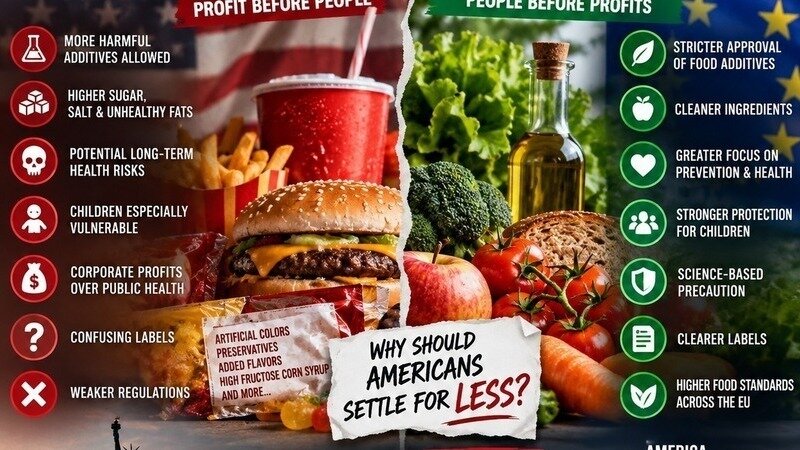
The United States and European Union regulate food differently.
In the European Union, food additives must be specifically authorized and placed on an approved list before they may be used. Authorization considers safety, technological necessity, and whether an additive could mislead consumers. EU food law also permits application of the precautionary principle in particular circumstances where there are reasonable grounds for health concerns but scientific information remains incomplete.
The United States has a different regulatory structure, including the Generally Recognized as Safe (GRAS) system. Historically, companies have been able to introduce substances they determine qualify as GRAS without mandatory FDA notification or review.
The FDA itself has recognized the need for stronger oversight and in 2026 proposed reforms intended to require notification of new substances claimed to be GRAS and increase transparency.
These reforms are welcome, but Americans deserve a comprehensive food-safety system designed around prevention, transparency and continuing scientific review.
What We Are Asking For
We call on federal policymakers and regulators to consider nationwide reforms that would:
1. Require independent pre-market safety review of food additives.
Substances intentionally added to food should be subject to appropriate scientific review before entering widespread use, rather than relying primarily on manufacturer determinations where current law permits them.
2. Reform the GRAS system.
Manufacturers should be required to disclose new substances added to food and provide the FDA with adequate safety evidence. Safety determinations should be transparent and subject to meaningful independent oversight.
3. Move toward an EU-style positive-list approach for food additives.
Instead of consumers having to question why particular substances remain in the food supply, permitted additives should have clearly defined uses, limits and safety requirements.
4. Establish mandatory periodic reassessment of previously approved substances.
Scientific knowledge changes. An ingredient considered acceptable decades ago should not automatically remain acceptable indefinitely. Regulators should systematically reevaluate substances as new toxicological, epidemiological and exposure evidence becomes available.
5. Strengthen protections for children.
Children have different body weights, developmental stages and consumption patterns. Foods heavily marketed to children deserve particularly careful scrutiny regarding colors, preservatives, contaminants and other additives.
6. Evaluate cumulative and long-term exposure.
Consumers do not encounter chemicals one at a time. Regulators should continue developing methods for assessing cumulative exposure to related substances and repeated exposure over a lifetime where scientifically appropriate.
7. Strengthen oversight of food-contact materials and packaging.
Food safety does not end with the ingredient list. Chemicals that can migrate into food from packaging, processing equipment and other food-contact materials should receive rigorous and continuing scientific evaluation.
8. Require clearer, more understandable labeling.
Consumers should be able to understand what is in their food and why it is there. Ingredient labeling should promote meaningful transparency rather than technically satisfying disclosure requirements while remaining difficult for ordinary consumers to understand.
9. Increase transparency and reduce conflicts of interest.
Safety evidence, regulatory decisions and relevant industry submissions should be publicly accessible to the greatest extent possible. Decisions affecting the health of hundreds of millions of Americans should inspire public confidence that health—not commercial pressure—is the primary consideration.
10. Give regulators sufficient resources and authority to act quickly.
Identifying a potential problem is not enough. The FDA and other responsible agencies need adequate scientific staff, laboratory capacity, inspection resources, funding and legal authority to investigate emerging risks and respond when evidence warrants action.
Public Health Before Corporate Profit
Food companies have an important role in the American economy, employ millions of people and provide products consumers depend upon every day. Profit itself is not the problem.
The problem arises when economic incentives conflict with public health and the regulatory system does not provide sufficient independent safeguards.
Companies should compete on taste, quality, innovation, affordability and nutrition—not on their ability to use cheaper ingredients or regulatory gaps that would face greater restrictions elsewhere.
American consumers should not have to become toxicologists to decide whether the food in their grocery cart is appropriate for their families.
America Can Do Better
The United States possesses extraordinary scientific institutions, universities, laboratories, agricultural resources, food manufacturers and technological capabilities.
A country with these resources should be capable of establishing one of the world's most rigorous, transparent and scientifically advanced food-safety systems.
The goal should not be to copy every European regulation word for word. The goal should be to adopt or exceed the strongest evidence-based protections available—including independent safety review, transparent authorization, periodic reassessment and precaution when credible evidence warrants it.
American families deserve food standards that reflect the country's resources and scientific capabilities.
We therefore call upon Congress, the FDA, USDA and other responsible federal authorities to undertake comprehensive reform of U.S. food regulation and establish stronger nationwide standards for food additives, contaminants, processing aids, food-contact substances, labeling and chemical safety.
America is one of the richest countries in the world. The quality and safety standards of its food supply should reflect that.
Put public health first. Put transparency first. Put American consumers first.

29
The Issue
To the United States Congress, the U.S. Food and Drug Administration, the U.S. Department of Agriculture, and other responsible federal agencies:
We, the undersigned, call for comprehensive reform of food-safety and food-ingredient standards across the United States, with the goal of bringing American consumer protections closer to the rigorous standards applied in the European Union.
The United States is one of the wealthiest and most technologically advanced countries in the world. Americans should reasonably expect that the food sold to their families reflects that prosperity.
Food safety should not be determined by what is cheapest to manufacture, easiest to market, or most profitable to sell. Public health and consumer protection should come first.
Why Reform Is Needed
The United States and European Union regulate food differently.
In the European Union, food additives must be specifically authorized and placed on an approved list before they may be used. Authorization considers safety, technological necessity, and whether an additive could mislead consumers. EU food law also permits application of the precautionary principle in particular circumstances where there are reasonable grounds for health concerns but scientific information remains incomplete.
The United States has a different regulatory structure, including the Generally Recognized as Safe (GRAS) system. Historically, companies have been able to introduce substances they determine qualify as GRAS without mandatory FDA notification or review.
The FDA itself has recognized the need for stronger oversight and in 2026 proposed reforms intended to require notification of new substances claimed to be GRAS and increase transparency.
These reforms are welcome, but Americans deserve a comprehensive food-safety system designed around prevention, transparency and continuing scientific review.
What We Are Asking For
We call on federal policymakers and regulators to consider nationwide reforms that would:
1. Require independent pre-market safety review of food additives.
Substances intentionally added to food should be subject to appropriate scientific review before entering widespread use, rather than relying primarily on manufacturer determinations where current law permits them.
2. Reform the GRAS system.
Manufacturers should be required to disclose new substances added to food and provide the FDA with adequate safety evidence. Safety determinations should be transparent and subject to meaningful independent oversight.
3. Move toward an EU-style positive-list approach for food additives.
Instead of consumers having to question why particular substances remain in the food supply, permitted additives should have clearly defined uses, limits and safety requirements.
4. Establish mandatory periodic reassessment of previously approved substances.
Scientific knowledge changes. An ingredient considered acceptable decades ago should not automatically remain acceptable indefinitely. Regulators should systematically reevaluate substances as new toxicological, epidemiological and exposure evidence becomes available.
5. Strengthen protections for children.
Children have different body weights, developmental stages and consumption patterns. Foods heavily marketed to children deserve particularly careful scrutiny regarding colors, preservatives, contaminants and other additives.
6. Evaluate cumulative and long-term exposure.
Consumers do not encounter chemicals one at a time. Regulators should continue developing methods for assessing cumulative exposure to related substances and repeated exposure over a lifetime where scientifically appropriate.
7. Strengthen oversight of food-contact materials and packaging.
Food safety does not end with the ingredient list. Chemicals that can migrate into food from packaging, processing equipment and other food-contact materials should receive rigorous and continuing scientific evaluation.
8. Require clearer, more understandable labeling.
Consumers should be able to understand what is in their food and why it is there. Ingredient labeling should promote meaningful transparency rather than technically satisfying disclosure requirements while remaining difficult for ordinary consumers to understand.
9. Increase transparency and reduce conflicts of interest.
Safety evidence, regulatory decisions and relevant industry submissions should be publicly accessible to the greatest extent possible. Decisions affecting the health of hundreds of millions of Americans should inspire public confidence that health—not commercial pressure—is the primary consideration.
10. Give regulators sufficient resources and authority to act quickly.
Identifying a potential problem is not enough. The FDA and other responsible agencies need adequate scientific staff, laboratory capacity, inspection resources, funding and legal authority to investigate emerging risks and respond when evidence warrants action.
Public Health Before Corporate Profit
Food companies have an important role in the American economy, employ millions of people and provide products consumers depend upon every day. Profit itself is not the problem.
The problem arises when economic incentives conflict with public health and the regulatory system does not provide sufficient independent safeguards.
Companies should compete on taste, quality, innovation, affordability and nutrition—not on their ability to use cheaper ingredients or regulatory gaps that would face greater restrictions elsewhere.
American consumers should not have to become toxicologists to decide whether the food in their grocery cart is appropriate for their families.
America Can Do Better
The United States possesses extraordinary scientific institutions, universities, laboratories, agricultural resources, food manufacturers and technological capabilities.
A country with these resources should be capable of establishing one of the world's most rigorous, transparent and scientifically advanced food-safety systems.
The goal should not be to copy every European regulation word for word. The goal should be to adopt or exceed the strongest evidence-based protections available—including independent safety review, transparent authorization, periodic reassessment and precaution when credible evidence warrants it.
American families deserve food standards that reflect the country's resources and scientific capabilities.
We therefore call upon Congress, the FDA, USDA and other responsible federal authorities to undertake comprehensive reform of U.S. food regulation and establish stronger nationwide standards for food additives, contaminants, processing aids, food-contact substances, labeling and chemical safety.
America is one of the richest countries in the world. The quality and safety standards of its food supply should reflect that.
Put public health first. Put transparency first. Put American consumers first.
The Decision Makers


Petition Updates
Share this petition
Petition created on September 16, 2026