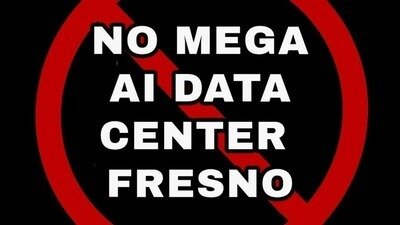

Petition for a Moratorium on Mega AI Data Center Construction in Fresno County, CA
The Issue
Fresno County sits at the heart of California's Central Valley, widely celebrated as a core part of the "breadbasket of the world" due to its multi-billion dollar agricultural output and over 300 commercial crops feeding dozens of countries globally. (ABC 30)
Fresno is a rich, fertile, beautiful land--our home, the place we choose to raise our families, educate our children, and invest our hearts and souls in living our best possible lives. For this reason, we vehemently oppose AI data centers in our backyards. Our families deserve to know all the facts and have the final say over any proposed data center projects. Both city and county elected officials must let our community know their stance on these potential centers before companies apply for conditional use permits.
California is losing an average of 47,000 to 50,000 acres of agricultural land every year due to urban growth, water scarcity, and stricter groundwater rules. This steady decline threatens local food production and rural economies across major farming regions like the Central Valley. (CA Dept. of Conservation)
California feeds the nation. It’s not an overstatement to say that California agriculture is vital for our food security. With more than $59 billion in agricultural sales in 2022, California remains the top producer of agricultural products in the United States and the world’s fifth largest producer. Unfortunately, we are losing farmland fast. (America Farmland Trust)
Fresno County remains the third-fastest county losing agricultural land in California due to general urban sprawl, residential megadevelopments, and industrial annexations. (America Farmland Trust) Though data centers are not yet a major threat in Fresno County, residents must take a proactive stance against this potential threat.
At a recent City of Fresno Planning Commission meeting last week, City Councilmember Miguel Arias said the SEDA plan is a way to get data centers into Fresno. In May 2025, Reuters reported data center developers have shown high interest in building in Fresno. After Arias’ comments raised the eyebrows of attendees and some commissioners alike, Clark said Fresno’s development code doesn’t allow data centers. Clark clarified to GV Wire after the meeting that rather than a explicit ban, they aren’t allowed in the city because Fresno’s development code doesn’t define or identify data centers. (GV Wire) Both the City of Fresno and Fresno County need to clarify, define, or identify data centers. The People of Fresno County demand to know how our local elected officials stand on AI data centers within our region.
Data centers are also being constructed at an unprecedentedly fast pace across the country. Their construction is often fast-tracked through generous tax incentives and permitting before communities or regulators fully understand the full effects on the local environment or economy. Data center moratoriums have been gaining traction across the country, and building on this momentum matters more than ever.
A single hyperscale facility can consume upward of 8 million gallons of water per year for cooling, placing direct pressure on regions already experiencing drought and climate-driven water stress. As climate change intensifies heatwaves and disrupts historic rainfall patterns, water that farmers and residents depend on is increasingly being redirected toward industrial cooling systems, with little public input into that tradeoff. On the electricity side, data centers already account for roughly 4.4% of U.S. power consumption — a share projected to climb toward 12% by 2028 — straining grids and driving up utility costs for everyday households. Developers are increasingly targeting farmland specifically, rezoning agricultural land into data center campuses — a conversion that is essentially permanent. Once that land is gone, it does not return to food production.
Data center moratoriums do not aim to block progress; instead they provide time for communities, developers, researchers, and lawmakers to fully investigate the effects that a data center may have on local residents and ecosystems. Moratoriums give community members an opportunity to weigh in on zoning decisions currently being rushed through council votes.
Counties that have already enacted moratoriums or strict ordinances have used that pause to negotiate better water-usage terms, protect agricultural zoning, and demand real transparency from developers before any shovel hits the ground. That's the model worth fighting for everywhere, including in Fresno County, the heart of Central California, the breadbasket of the world.

667
The Issue
Fresno County sits at the heart of California's Central Valley, widely celebrated as a core part of the "breadbasket of the world" due to its multi-billion dollar agricultural output and over 300 commercial crops feeding dozens of countries globally. (ABC 30)
Fresno is a rich, fertile, beautiful land--our home, the place we choose to raise our families, educate our children, and invest our hearts and souls in living our best possible lives. For this reason, we vehemently oppose AI data centers in our backyards. Our families deserve to know all the facts and have the final say over any proposed data center projects. Both city and county elected officials must let our community know their stance on these potential centers before companies apply for conditional use permits.
California is losing an average of 47,000 to 50,000 acres of agricultural land every year due to urban growth, water scarcity, and stricter groundwater rules. This steady decline threatens local food production and rural economies across major farming regions like the Central Valley. (CA Dept. of Conservation)
California feeds the nation. It’s not an overstatement to say that California agriculture is vital for our food security. With more than $59 billion in agricultural sales in 2022, California remains the top producer of agricultural products in the United States and the world’s fifth largest producer. Unfortunately, we are losing farmland fast. (America Farmland Trust)
Fresno County remains the third-fastest county losing agricultural land in California due to general urban sprawl, residential megadevelopments, and industrial annexations. (America Farmland Trust) Though data centers are not yet a major threat in Fresno County, residents must take a proactive stance against this potential threat.
At a recent City of Fresno Planning Commission meeting last week, City Councilmember Miguel Arias said the SEDA plan is a way to get data centers into Fresno. In May 2025, Reuters reported data center developers have shown high interest in building in Fresno. After Arias’ comments raised the eyebrows of attendees and some commissioners alike, Clark said Fresno’s development code doesn’t allow data centers. Clark clarified to GV Wire after the meeting that rather than a explicit ban, they aren’t allowed in the city because Fresno’s development code doesn’t define or identify data centers. (GV Wire) Both the City of Fresno and Fresno County need to clarify, define, or identify data centers. The People of Fresno County demand to know how our local elected officials stand on AI data centers within our region.
Data centers are also being constructed at an unprecedentedly fast pace across the country. Their construction is often fast-tracked through generous tax incentives and permitting before communities or regulators fully understand the full effects on the local environment or economy. Data center moratoriums have been gaining traction across the country, and building on this momentum matters more than ever.
A single hyperscale facility can consume upward of 8 million gallons of water per year for cooling, placing direct pressure on regions already experiencing drought and climate-driven water stress. As climate change intensifies heatwaves and disrupts historic rainfall patterns, water that farmers and residents depend on is increasingly being redirected toward industrial cooling systems, with little public input into that tradeoff. On the electricity side, data centers already account for roughly 4.4% of U.S. power consumption — a share projected to climb toward 12% by 2028 — straining grids and driving up utility costs for everyday households. Developers are increasingly targeting farmland specifically, rezoning agricultural land into data center campuses — a conversion that is essentially permanent. Once that land is gone, it does not return to food production.
Data center moratoriums do not aim to block progress; instead they provide time for communities, developers, researchers, and lawmakers to fully investigate the effects that a data center may have on local residents and ecosystems. Moratoriums give community members an opportunity to weigh in on zoning decisions currently being rushed through council votes.
Counties that have already enacted moratoriums or strict ordinances have used that pause to negotiate better water-usage terms, protect agricultural zoning, and demand real transparency from developers before any shovel hits the ground. That's the model worth fighting for everywhere, including in Fresno County, the heart of Central California, the breadbasket of the world.
The Decision Makers


Supporter Voices
Petition Updates
Share this petition
Petition created on August 22, 2026