Milton Keynes City Council commits to a significant (over 50%) reduction in the use of Pesticides

On 11th December 2025 Milton Keynes City presented its new Pesticide Policy to the Environment Scrutiny Committee. Our Pesticide free Milton Keynes Action group turned out in force to present our case.
Nick Mole, Policy Officer, Pesticide Action Network UK, has reviewed the MKCC Pesticide Policy and judges it to be a good strategic living document moving forward, especially as Milton Keynes City Council has agreed to an annual audit and he will continue to provide critical friend support in the delivery of the policy and the annual reviews which will evidence herbicide use reductions.
We are very pleased that MKCC has agreed to our following recommendations:-
- to include clear quantifiable targets in the policy so that the reduction in herbicide use by the MKCC is evidenced.
- to include the baseline figures of current herbicide use so that reductions can be measured moving forward.
- to include mechanical sweeping in the weed treatment plan for residential estates
- to produce a scorecard on herbicide use delivered annually by the landscaping operations and ecology teams.
- to develop a method of collaboration with schools, parish councils and the Parks Trust which manages 6000 acres of our green spaces
- to invite Pesticide Action Network UK to review the Weed Management Plan from the MKCC contractor Glendale, which will include the use of pre-emergent herbicide.
- to focus particularly on reductions in MKCC managed playgrounds by pursuing preventative measures primarily and also using the flame technology to eradicate weeds.
- to consider stopping application of herbicides in wet conditions as part of its RAMs (Risk Assessment Method Statement)
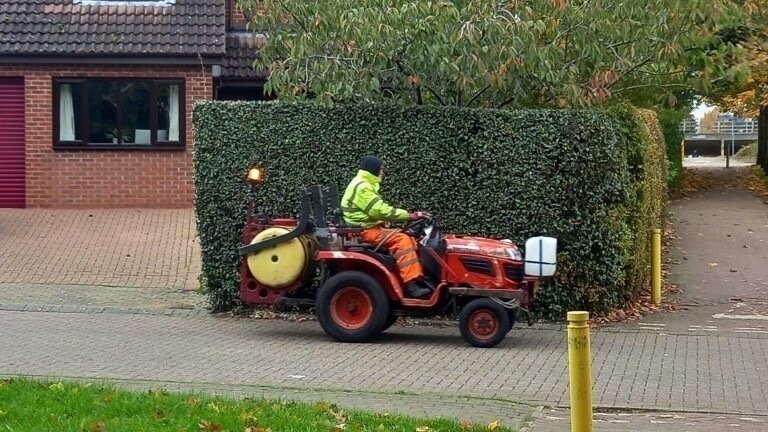
On the other hand it will be very difficult for our Pesticide free Milton Keynes group members to witness the mini spraying tractors still in action (3 times) in 2026 in our residential estates but we are hopeful that, with training, the operatives will only target individual weeds on hard landscaping and around drainage covers, street signs and lampposts using a controlled droplet application as specified in the Public Health section of the policy and there will no longer be continuous spraying along our garden boundaries, under hedges nor on bare earth and along weed free kerbs as we have witnessed so often in the past. We also welcome the introduction of a Pesticide Reporting Form whereby residents can report spraying in a constructive way which doesn’t conform to the standards of the policy.
Another big omission from the document is that there is no reference at all in the Public Health section of the risks of spraying herbicides, specifically glyphosate, to human health. We submitted our research, supported by Professor Antoniou, co author of the Glyphosate Study, and also included evidence from Parkinson’s UK and Breast Cancer UK. MKCC’s response to this major concern is - It is a policy paper and not a science paper and therefore to ensure that it appears as up to date as possible then MKCC has not included any scientific information – merely references. Our group will continue to lobby both MKCC and the Parks Trust that they acknowledge the harm which spraying of herbicides causes to human health and these risks are included in the Human Health section alongside the acknowledged harm that herbicides containing glyphosate causes to non target plants, soil microbes and aquatic life.
In conclusion, this pesticide policy is a big step forward, and if it is delivered on the ground, we will see a significant reduction in the amount of weedkillers which are sprayed in our city. Our Pesticide free Milton Keynes action group will continue to try to build a positive partnership with MKCC and to support with the delivery of the MKCC Pesticide Policy.
For your information, this is the speech which I delivered to the MKCC Environment Scrutiny Committee on 11th December 2025 :-
Good evening - your new draft pesticide policy which commits to actively minimise the use of pesticides is welcomed by our Pesticide free MK action group. Our petition today has 26,350 signatures. We are very pleased that last week Nick Mole of PAN UK was invited to review the document and that moving forward he will continue to give critical friend support.
We welcome the acknowledgement that pesticides are harmful to our natural world. The document’s focus on nature based solutions as an alternative to spraying is very positive, for example, wildflower margins, hedgerows, mulching. There will be no more spraying around our trees and CMK and 7 other shopping centres will see a significant reduction in spraying. We welcome the plan to support residents by informing us when spraying is taking place and what the monthly herbicide usage is so that we can map reductions.
But we believe there are major concerns and ambitions which are not addressed in the policy and these are some of our recommendations :-
1. We recommend that the possible risks to human health from spraying glyphosate, are included. For example, Parkinson’s UK, Breast Cancer UK and Professor Antoniou, co author of the Global Glyphosate Study and a strong supporter of our work, are all convinced of the link between exposure to pesticides and neurological disorders and tumours.
2. We recommend that mini tractors with low drift nozzles are not deployed in our residential estates. They are designed for spraying of large areas and have no place near our homes.
3. We recommend that baseline figures of herbicide use this year are included so it is possible to measure progress going forward.
4. We recommend that the policy specifies no spraying at all in your parks and playgrounds. Children and pregnant women are the most vulnerable to toxic load and the precautionary principle should be applied for their health and safely.
5. For the same reasons, we recommend that the policy includes an action plan to reduce and ultimately stop the widespread spraying in our 115 schools.
6. We recommend that quantifiable targets are included so that reductions are evidenced. The only concrete target in the document is a 50% reduction in herbicide use on shrub beds by 2028. (The overall herbicide use target states only - A significant reduction by 2030)
7. We recommend that you consult with PAN UK regarding your plan to mix pre emergent herbicide with glyphosate. PAN UK tells us that the pre emergent is less toxic to bees, mammals and human health and it is not actually necessary to mix with glyphosate.
Our group is very keen as always to work with the council moving forward so that the delivery of this policy is successful and the council achieves its stated aim to reduce pesticide use to as close to zero as possible.