Open Letter to the ASPCA: NYC rescuers are struggling
The Issue
NYC rescuers are struggling and the cat overpopulation crisis is intensifying as spay/neuter appointment capacity falls.
To ASPCA leadership and NYC Community Medicine team · November 2026
Dear: Matt Bershadker, ASPCA President and CEO
We are writing as trap-neuter-return (TNR) rescuers, community cat/colony caretakers, and animal welfare organizations in NYC who depend on the rescuer spay/neuter services offered at your veterinary clinics. This is an open letter, signed by the volunteer workforce toiling daily to help cats in our communities, because NYC is in a cat crisis — and the problem described here is not one organization’s problem, nor just the rescue community’s. It is shared by everyone doing this work in NYC, and by the caretakers, fosters, and neighbors living with the colonies that keep growing while cats wait for surgery — and it reaches beyond all of us, to the city as a whole. The main focus of this letter is NYC cats, but the lack of spay/neuter appointments also has a profound effect on NYC dogs, their owners, and the organizations that work with them.
This is not a complaint about the people who work at the ASPCA Community Veterinary Clinics in NYC. The staff we work with are kind and professional, clearly devoted to the shared mission to help NYC’s animals. This is a request for help with a problem that is now hurting NYC’s animals and the people who work so hard to care for them.
Capacity has fallen sharply in the last four months
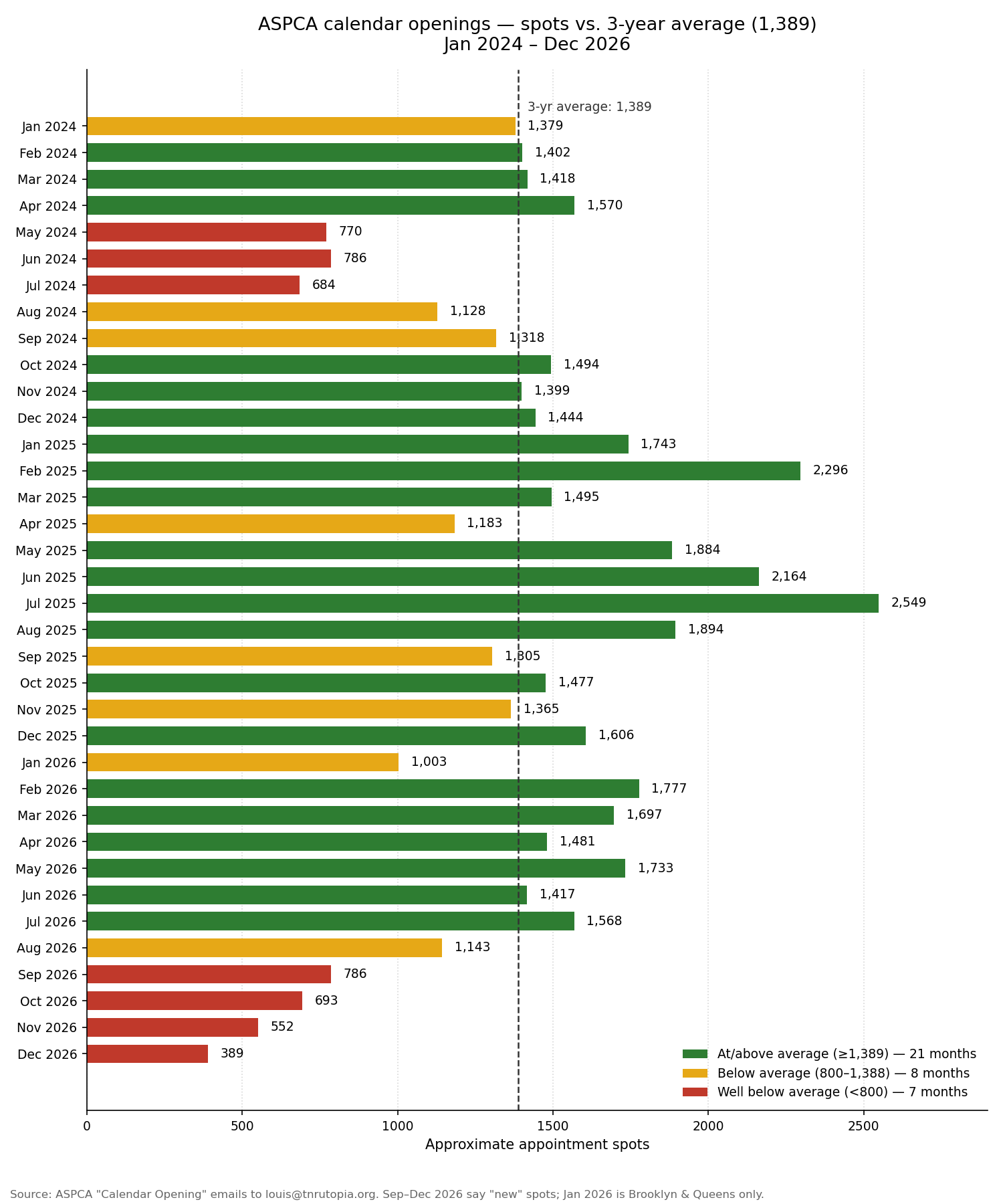
We have tracked every monthly calendar opening email from snc@aspca.org since January 2024. Over those 36 months, you opened an average of about 1,389 appointments a month. In 2025 that average was 1,747. This year it has fallen to 1,187 — and the last four months are far worse: 786 in September, 693 in October, 552 in November, and 389 in December. That is an average of 605 a month, 44% of the long-run average, and December’s 389 appointments are shared among more than 1,500 eligible rescuers. Appointments are gone in seconds is an understatement.
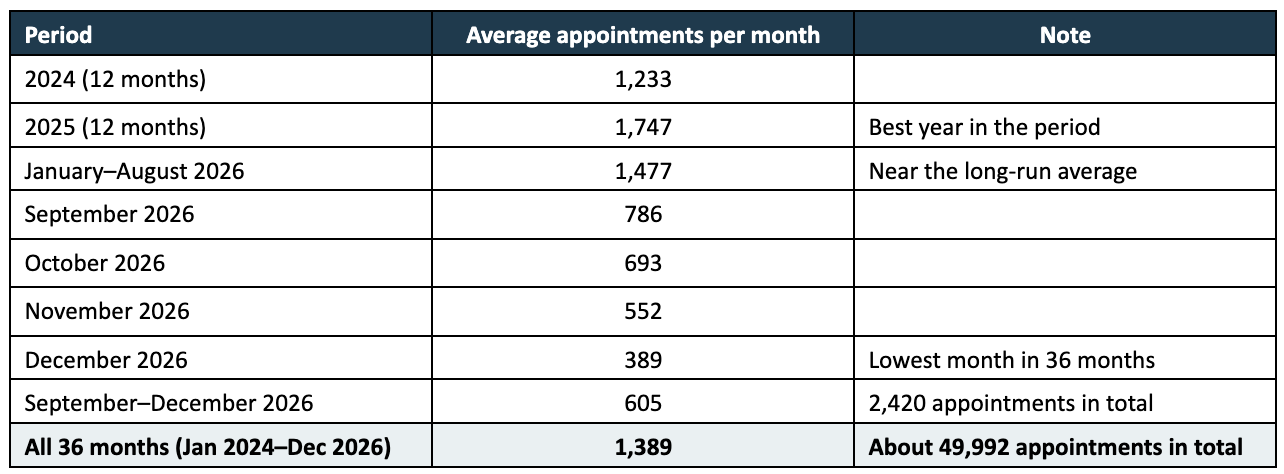
Source: ASPCA calendar opening emails from snc@aspca.org, January 2024 through December 2026. Figures are the approximate number of new appointments announced in each monthly opening.
Holiday closures explain only a small part of December’s drop
Emails from Community Medicine say the cause is staffing, and we believe you. But we want to be clear about what the numbers show, because this is not a holiday problem. December 2025 and December 2026 have the same calendar: 31 days, 23 weekdays each. Last December, with the clinics closed December 24, 25, and 31, you still opened 1,606 appointments — about 80 per open day. This December you list five closed days in the month, leaving 18 open weekdays, and 389 appointments — about 22 per open day. The two extra closed days account for roughly 160 appointments. The drop from 1,606 to 389 is 1,217 appointments. The closures explain a small fraction of it. What explains the rest is that on the days the clinics are open, they are doing about a quarter of the surgeries they did a year ago. That is a staffing and capacity problem, not a calendar problem. We want your staff to take time off and enjoy it with their friends and families, like they do every year. But this is more than vacation time. Staffing is low, and the CVCs are limping along each day — it is obvious in the numbers. The same pattern shows in the mobile clinics: two Staten Island dates last December, one this December.
In the past 2 years, the New York City Council has included funding for spay/neuter in their annual budget. Although this has been a huge win for NYC animals, it was always in the context that this funding would be added on top of what was already being provided by institutions like the ASPCA. Because NYC is stepping up does not mean that the ASPCA can take a step back.
What this means on the ground
The effect is that colonies we support and monitor keep growing — females continue to have litter after litter — while friendly cats we have prepared for surgery wait weeks for an opening. Once per month we spend the morning, at 6 am, competing for a handful of slots, and our caretakers — many of them neighbors feeding cats every day — are losing faith that help is coming. This is a cat crisis, and it is getting worse with every month appointments stay this low.
Something else this means on the ground: when we rescue cats and kittens, we cannot adopt them out until they have been spayed or neutered — New York law requires it. The lack of appointments is also dampening rescue efforts, because it undercuts our ability to adopt cats out. Cats and kittens who are ready for homes sit waiting in foster care instead, taking up space that could go to the next cat who needs rescuing.
Staffing is the real problem — and the real fix
We understand that the ASPCA recently lost multiple veterinary staff who moved on to other opportunities. And we understand that attracting and retaining veterinarians is difficult when you are competing with for-profit practices.
While we all discuss the "vet shortage," community cats continue to multiply, and while the goalpost is always off in the distance, it is getting further and further out of sight with the recent dive in capacity. We want to be clear about what we are seeing: this is not only a staff shortage. Staff are leaving, and that is a retention problem. Until it is fixed, capacity cannot come back.
As the ASPCA, you have the institutional presence, respect, and resources to attract and retain all medical staff — not just veterinarians. You know what it takes to keep them. This is a moment to ask why staff are leaving — and to change how you recruit and keep them, so you can get back to the critical role the ASPCA plays in spaying/neutering animals in NYC.
What we are asking for:
- A realistic timeline for when staffing and capacity will recover, even if it is months down the line, with updates along the way. It is better for us to be prepared.
- A fairer way to share scarce appointments during this period of extremely limited capacity — such as dividing the month into two calendar openings, as was done during the pandemic — so no one is shut out for the entire month when appointments fill in seconds.
- Grants and/or reimbursement for rescuers who have no choice but to go elsewhere while ASPCA appointments are so scarce. While ASPCA appointments are not available, we ask the ASPCA to provide grants and/or reimbursements for the cost of surgeries performed at other rescue-friendly practices such as Cat Cafe, Halo Veterinary Hospital, and Flatbush Vet, etc. — similar to the Neighborhood Cats' SNAP program, except funded by the ASPCA.
- Regular meetings with rescuers: We ask the ASPCA to meet, at least once a year, with a core group of rescuers from each borough. Building a relationship between staff and rescuers will allow both parties to work more productively together. We can tell you where the system breaks down and what would help rescuers do more; you can tell us what you need to run the clinics better. That conversation should be happening before a crisis, not after one.
Thank you for reading. We rely on the life-changing spay/neuter services provided by the ASPCA. We look forward to hearing back from you regarding the requests made above.
Signed,
Louis Lotito
Director of Communications and Community Engagement, TNR Utopia
(347) 850-2287 | louis@tnrutopia.org | www.tnrutopia.org
If you are a TNR rescuer, a community cat/colony caretaker, a NYC pet owner, or an organization affected by the fall in spay/neuter appointment capacity, you can sign this letter to show your support. Thank you for caring about community cats!

764
The Issue
NYC rescuers are struggling and the cat overpopulation crisis is intensifying as spay/neuter appointment capacity falls.
To ASPCA leadership and NYC Community Medicine team · November 2026
Dear: Matt Bershadker, ASPCA President and CEO
We are writing as trap-neuter-return (TNR) rescuers, community cat/colony caretakers, and animal welfare organizations in NYC who depend on the rescuer spay/neuter services offered at your veterinary clinics. This is an open letter, signed by the volunteer workforce toiling daily to help cats in our communities, because NYC is in a cat crisis — and the problem described here is not one organization’s problem, nor just the rescue community’s. It is shared by everyone doing this work in NYC, and by the caretakers, fosters, and neighbors living with the colonies that keep growing while cats wait for surgery — and it reaches beyond all of us, to the city as a whole. The main focus of this letter is NYC cats, but the lack of spay/neuter appointments also has a profound effect on NYC dogs, their owners, and the organizations that work with them.
This is not a complaint about the people who work at the ASPCA Community Veterinary Clinics in NYC. The staff we work with are kind and professional, clearly devoted to the shared mission to help NYC’s animals. This is a request for help with a problem that is now hurting NYC’s animals and the people who work so hard to care for them.
Capacity has fallen sharply in the last four months
We have tracked every monthly calendar opening email from snc@aspca.org since January 2024. Over those 36 months, you opened an average of about 1,389 appointments a month. In 2025 that average was 1,747. This year it has fallen to 1,187 — and the last four months are far worse: 786 in September, 693 in October, 552 in November, and 389 in December. That is an average of 605 a month, 44% of the long-run average, and December’s 389 appointments are shared among more than 1,500 eligible rescuers. Appointments are gone in seconds is an understatement.
Source: ASPCA calendar opening emails from snc@aspca.org, January 2024 through December 2026. Figures are the approximate number of new appointments announced in each monthly opening.
Holiday closures explain only a small part of December’s drop
Emails from Community Medicine say the cause is staffing, and we believe you. But we want to be clear about what the numbers show, because this is not a holiday problem. December 2025 and December 2026 have the same calendar: 31 days, 23 weekdays each. Last December, with the clinics closed December 24, 25, and 31, you still opened 1,606 appointments — about 80 per open day. This December you list five closed days in the month, leaving 18 open weekdays, and 389 appointments — about 22 per open day. The two extra closed days account for roughly 160 appointments. The drop from 1,606 to 389 is 1,217 appointments. The closures explain a small fraction of it. What explains the rest is that on the days the clinics are open, they are doing about a quarter of the surgeries they did a year ago. That is a staffing and capacity problem, not a calendar problem. We want your staff to take time off and enjoy it with their friends and families, like they do every year. But this is more than vacation time. Staffing is low, and the CVCs are limping along each day — it is obvious in the numbers. The same pattern shows in the mobile clinics: two Staten Island dates last December, one this December.
In the past 2 years, the New York City Council has included funding for spay/neuter in their annual budget. Although this has been a huge win for NYC animals, it was always in the context that this funding would be added on top of what was already being provided by institutions like the ASPCA. Because NYC is stepping up does not mean that the ASPCA can take a step back.
What this means on the ground
The effect is that colonies we support and monitor keep growing — females continue to have litter after litter — while friendly cats we have prepared for surgery wait weeks for an opening. Once per month we spend the morning, at 6 am, competing for a handful of slots, and our caretakers — many of them neighbors feeding cats every day — are losing faith that help is coming. This is a cat crisis, and it is getting worse with every month appointments stay this low.
Something else this means on the ground: when we rescue cats and kittens, we cannot adopt them out until they have been spayed or neutered — New York law requires it. The lack of appointments is also dampening rescue efforts, because it undercuts our ability to adopt cats out. Cats and kittens who are ready for homes sit waiting in foster care instead, taking up space that could go to the next cat who needs rescuing.
Staffing is the real problem — and the real fix
We understand that the ASPCA recently lost multiple veterinary staff who moved on to other opportunities. And we understand that attracting and retaining veterinarians is difficult when you are competing with for-profit practices.
While we all discuss the "vet shortage," community cats continue to multiply, and while the goalpost is always off in the distance, it is getting further and further out of sight with the recent dive in capacity. We want to be clear about what we are seeing: this is not only a staff shortage. Staff are leaving, and that is a retention problem. Until it is fixed, capacity cannot come back.
As the ASPCA, you have the institutional presence, respect, and resources to attract and retain all medical staff — not just veterinarians. You know what it takes to keep them. This is a moment to ask why staff are leaving — and to change how you recruit and keep them, so you can get back to the critical role the ASPCA plays in spaying/neutering animals in NYC.
What we are asking for:
- A realistic timeline for when staffing and capacity will recover, even if it is months down the line, with updates along the way. It is better for us to be prepared.
- A fairer way to share scarce appointments during this period of extremely limited capacity — such as dividing the month into two calendar openings, as was done during the pandemic — so no one is shut out for the entire month when appointments fill in seconds.
- Grants and/or reimbursement for rescuers who have no choice but to go elsewhere while ASPCA appointments are so scarce. While ASPCA appointments are not available, we ask the ASPCA to provide grants and/or reimbursements for the cost of surgeries performed at other rescue-friendly practices such as Cat Cafe, Halo Veterinary Hospital, and Flatbush Vet, etc. — similar to the Neighborhood Cats' SNAP program, except funded by the ASPCA.
- Regular meetings with rescuers: We ask the ASPCA to meet, at least once a year, with a core group of rescuers from each borough. Building a relationship between staff and rescuers will allow both parties to work more productively together. We can tell you where the system breaks down and what would help rescuers do more; you can tell us what you need to run the clinics better. That conversation should be happening before a crisis, not after one.
Thank you for reading. We rely on the life-changing spay/neuter services provided by the ASPCA. We look forward to hearing back from you regarding the requests made above.
Signed,
Louis Lotito
Director of Communications and Community Engagement, TNR Utopia
(347) 850-2287 | louis@tnrutopia.org | www.tnrutopia.org
If you are a TNR rescuer, a community cat/colony caretaker, a NYC pet owner, or an organization affected by the fall in spay/neuter appointment capacity, you can sign this letter to show your support. Thank you for caring about community cats!
The Decision Makers
Supporter Voices
Petition Updates
Share this petition
Petition created on November 25, 2026