

Objection to unnecessary EV Charge forecourt in residential area (Waltham Forest)
The Issue
Formal Community Objection and Petition against Planning Application 261830
Location: GARAGES 1 TO 3 REAR OF 16 Forest Drive East (accessed from James Lane)
Proposal: Demolition of existing single storey garages (Prior Demolition Notice)
Note - this notice (see picture) was posted on a lamppost on James Lane, Leyton on the opposite side of the road to the majority of pedestrian traffic, and was not directly sent to any local residents who may be affected, so the reason for this petition is to raise awareness and objections of this notice on the basis of the plans the company behind it have for the plot of land.
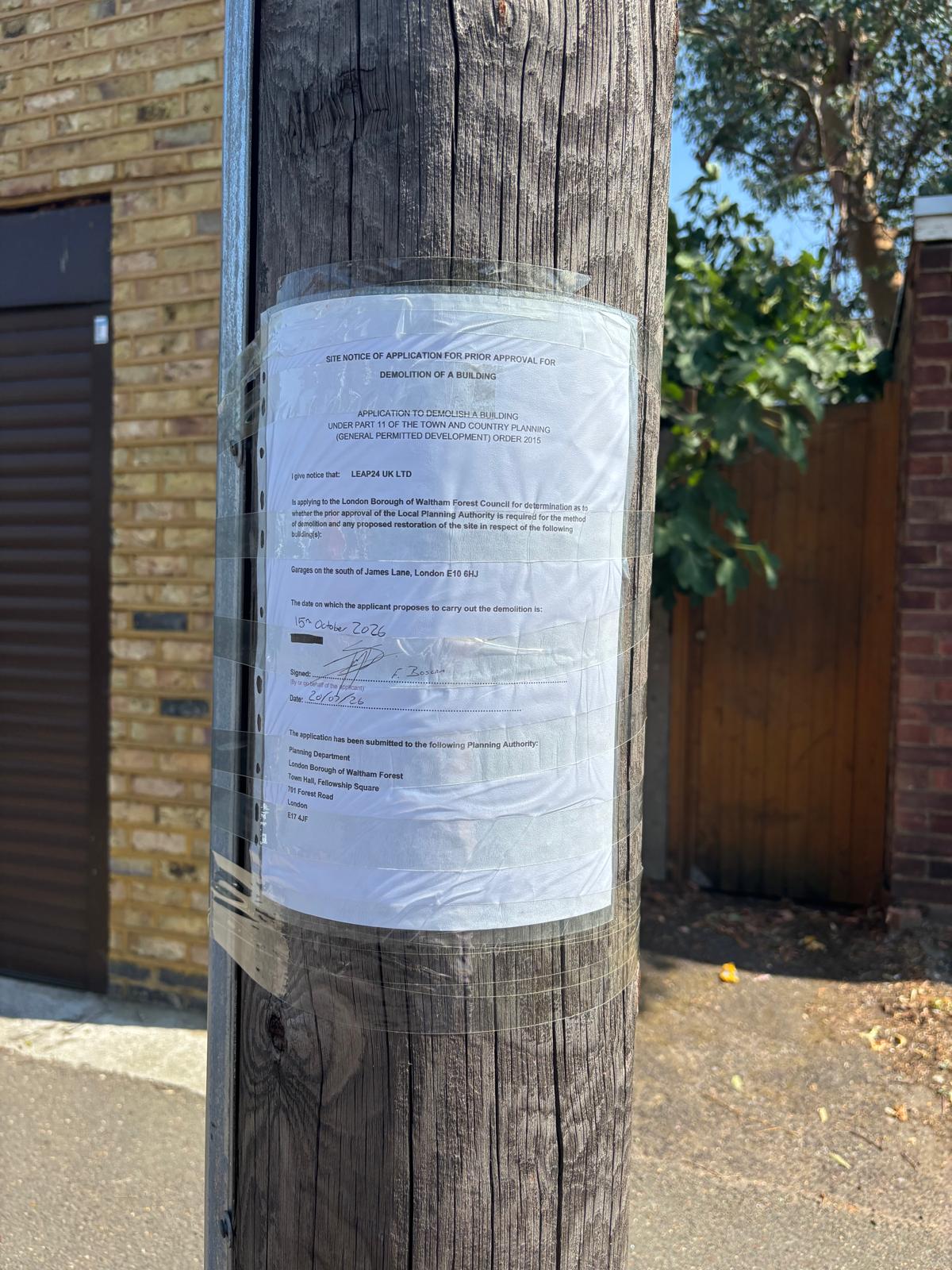
While the applicant frames this as a simple demolition notice, the community is aware that this site is being targeted by the applicant Leap24 UK for commercial redevelopment into a forecourt-style Electric Vehicle (EV) ultra-fast charging hub. We urge the Council to evaluate this demolition notice not in isolation, but in the context of its commercial intent, which presents severe material detriments to our neighbourhood, and without any evidence available of local resident demand or benefit for such an installation.
As detailed in the attached petition, our core planning objections focus on the severe visual impact of industrialising a quiet backland space, unmanageable additional traffic generation on an already highly utilised residential road, noise disruption from high-voltage cooling fans and vehicles, and a flagrant loss of privacy for adjacent family homes.
Furthermore, we submit that the local authority should reject speculative, corporate infrastructure that is not in the interest of the local community and conflicts with the Borough’s, and wider London’s policies and values with regard to cost of living and affordable, cleaner forms of transport. Instead, the council must prioritise low-cost, low-impact residential solutions that protect local communities.
Specifically, we urge Waltham Forest to review their outdated and ill-informed position[1] that it out of step with the vast majority of other UK and London councils[2] and accelerate plans to make pavement charge cable gullies more readily available to local households, which would have a measurably greater impact on the Borough residents’ ability to shift to greener forms of vehicle than an over-priced commercial hub. This can be clearly evidenced by the disproportionate lack of EV adoption despite the number of public DC and AC chargers the Borough has already installed in street parking spaces or other hubs.
Central government guidance and legislation[3] expected to be approved in the coming months introduces Permitted Development Rights for cross-pavement charging solutions and cable gullies. This national policy shift is explicitly designed to bypass lengthy planning hurdles and allow everyday families without driveways to safely run cables beneath the pavement (preventing trip hazards, unlike kerbside chargers), supported by overwhelmingly successful trials in numerous locations across the country and a growing number of high quality suppliers who can support safe and robust installations [4][5]. This lets residents plug vehicles directly into their homes to access affordable domestic overnight utility rates (as low as 6.5p–7.5p per kWh, or even free with solar or other home energy solutions), reduce residents exposure to cable theft (gullies can be locked), are cost effective to install (funded by the resident), low maintenance, and most importantly future proof.
By contrast, speculative commercial rapid hubs charge hyper-inflated rates of up to 75p to 79p per kWh[6] and are widely underutilised across London, and further disincentivise potential EV adopters in an area of the country that is already disadvantaged due to the lower proportion of off-street parking opportunities (90% of EV users charge at home for lower costs and convenience, but 60-75% of Londoners lack off-street parking to allow them to do this [2][5]). Forcing an expensive, underutilised commercial asset into our neighbourhood completely disregards recent government policy trends which prioritise safe, affordable, and convenient at-home kerbside charging over localised industrial hubs. Making the cost of EV recharging ‘fair’ [1] or on-par with petrol or diesel will not be enough to encourage drivers to invest in EV’s that come with a significantly higher cost of entry to buy.
[1] Electric vehicle charging points | London Borough of Waltham Forest
[2] 11 London councils snub cable gully funding
[3] Cross-pavement solutions for charging electric vehicles - GOV.UK
[4] EV kerb chargers in Suffolk are a game-changer, say drivers - BBC News
[6] https://chargefinder.uk/network/shell-recharge
----------------------------------------------------------------------
GROUP PETITION
PETITION AGAINST PLANNING APPLICATION NO: 261830
Recipient: Kurt Henry (Planning Case Officer) / London Borough of Waltham Forest
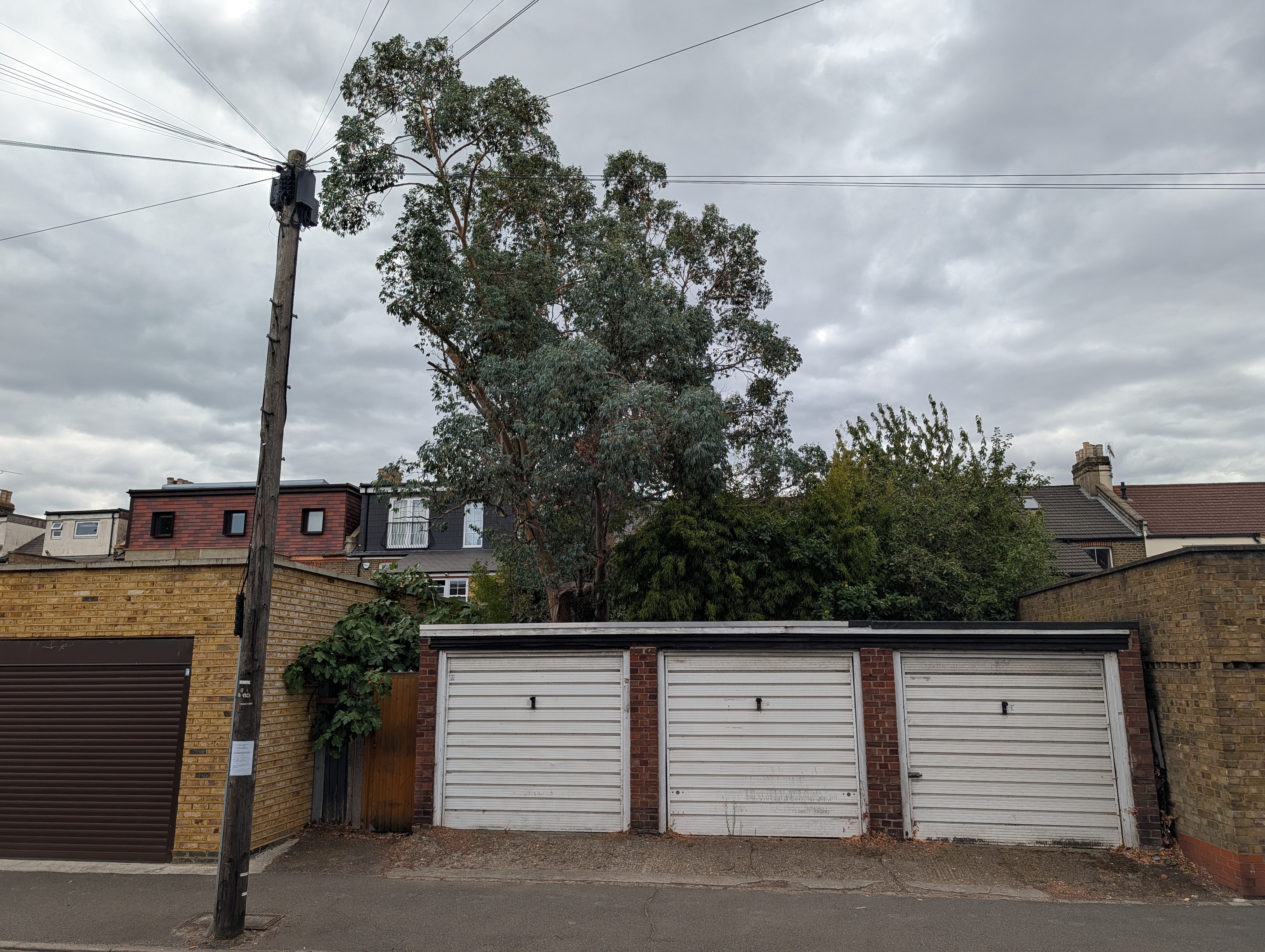
We, the undersigned residents and community members, formally lodge our strongest collective objection to Planning Application 261830 for the demolition of the garages to the rear of 16 Forest Drive East, intended to make way for an Electric Vehicle Charging forecourt. Such a high-turnover industrial development is completely inappropriate for a quiet, backland residential site and will cause severe, irreversible harm to our family-oriented neighbourhood.
Current garages:
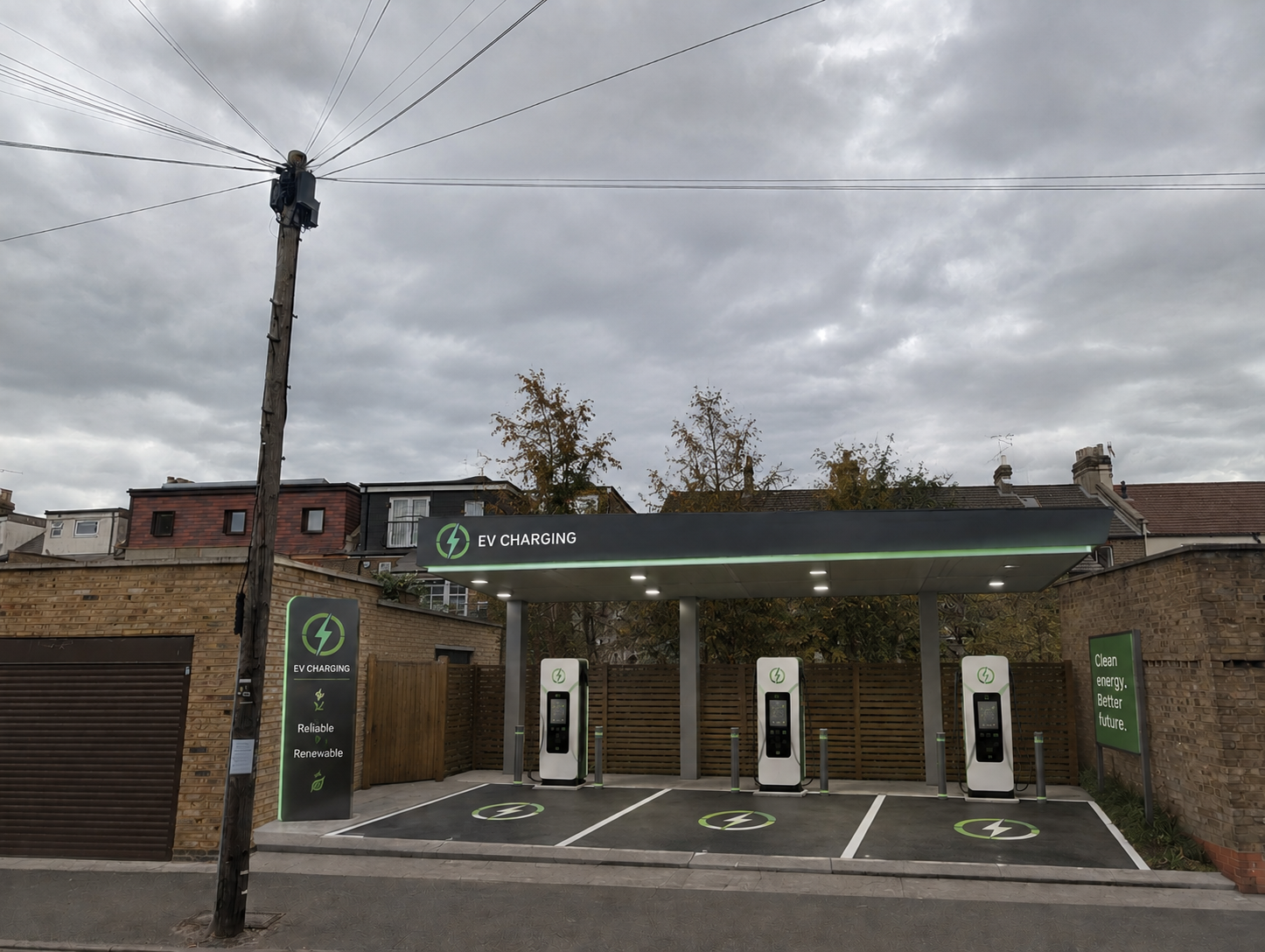
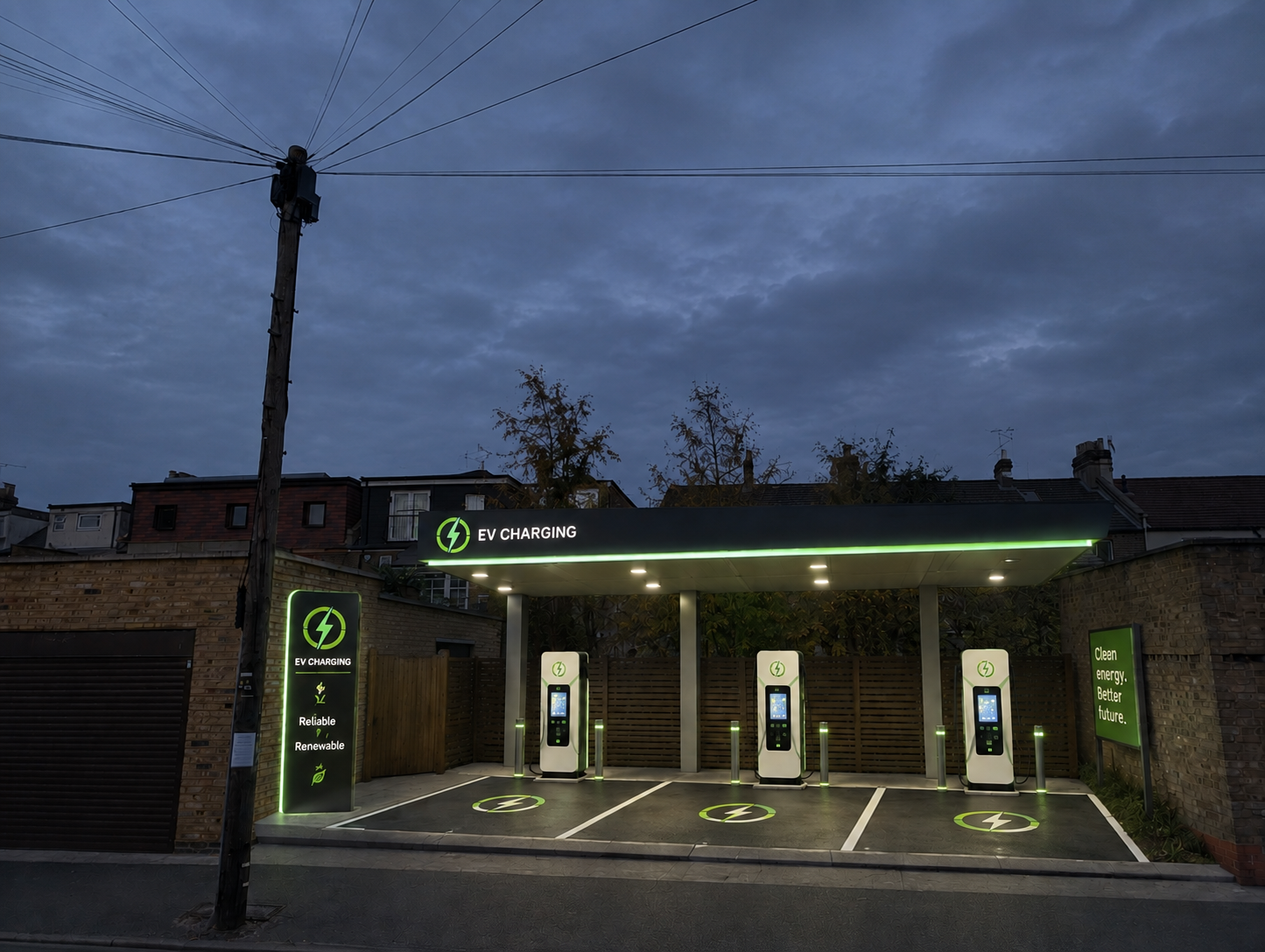
Mock up of possible forecourt impact:
GROUNDS FOR COLLECTIVE OBJECTION:
- Noise and Light Pollution: Commercial rapid-charging hubs require high-voltage transformers and cooling fans. These emit a constant, low-frequency hum that disturbs the peace of nearby homes. Additionally the chargers are often illuminated with bright LED lighting and screens. A 24/7 commercial operation would also introduce security lighting, lights from the vehicles themselves, door slamming, and other late-night disturbances.
- Traffic Generation and Road Safety: This section of James Lane is a single lane, highly congested residential road that also is on the main bus routes and the route to the nearby hospital. Attracting additional transient traffic into an already busy road will further impact this critical route and increase road safety hazards, especially for local children. Vehicles entering and exiting will also have to cross the existing walkway to enter the site.
- Loss of Resident Parking: Demolishing these garages removes viable parking spaces. This will displace cars onto surrounding streets, as well as visitors to the hub waiting to use it causing congestion or using local street parking, worsening the local parking shortage.
- Environmental Harm: The heavy excavation and underground trenching required to lay high-voltage commercial cables present a direct threat to the root systems of the mature trees bordering the site.
- Visual impact and Loss of Privacy: Replacing traditional brick garages with a commercial forecourt and heavy branding destroys the visual character of our neighbourhood. Drivers parked and loitering for 30–45 minutes may have direct, elevated views into the private windows and rear gardens of adjacent homes, destroying domestic privacy.
- No Community Benefit & Policy Conflict: Public rapid charging hubs across London (such as Shell Recharge) face high underutilisation due to hyper-inflated pricing (often up to 75p to 79p+ per kWh, a higher cost per mile than petrol or diesel vehicles). If the Borough is serious about encouraging EV adoption over combustion engine vehicles, local families need affordable, low-impact, home charging solutions—such as under-pavement cable gullies, and lamppost chargers—not a high-cost commercial hub that destroys residential amenity for corporate profit. Charge gullies in particular, offer the best value for both the Borough and residents in terms of installation, low maintenance, and future proof.
By signing below, we urge the London Borough of Waltham Forest Planning Department to REFUSE this application and protect our community.

71
The Issue
Formal Community Objection and Petition against Planning Application 261830
Location: GARAGES 1 TO 3 REAR OF 16 Forest Drive East (accessed from James Lane)
Proposal: Demolition of existing single storey garages (Prior Demolition Notice)
Note - this notice (see picture) was posted on a lamppost on James Lane, Leyton on the opposite side of the road to the majority of pedestrian traffic, and was not directly sent to any local residents who may be affected, so the reason for this petition is to raise awareness and objections of this notice on the basis of the plans the company behind it have for the plot of land.
While the applicant frames this as a simple demolition notice, the community is aware that this site is being targeted by the applicant Leap24 UK for commercial redevelopment into a forecourt-style Electric Vehicle (EV) ultra-fast charging hub. We urge the Council to evaluate this demolition notice not in isolation, but in the context of its commercial intent, which presents severe material detriments to our neighbourhood, and without any evidence available of local resident demand or benefit for such an installation.
As detailed in the attached petition, our core planning objections focus on the severe visual impact of industrialising a quiet backland space, unmanageable additional traffic generation on an already highly utilised residential road, noise disruption from high-voltage cooling fans and vehicles, and a flagrant loss of privacy for adjacent family homes.
Furthermore, we submit that the local authority should reject speculative, corporate infrastructure that is not in the interest of the local community and conflicts with the Borough’s, and wider London’s policies and values with regard to cost of living and affordable, cleaner forms of transport. Instead, the council must prioritise low-cost, low-impact residential solutions that protect local communities.
Specifically, we urge Waltham Forest to review their outdated and ill-informed position[1] that it out of step with the vast majority of other UK and London councils[2] and accelerate plans to make pavement charge cable gullies more readily available to local households, which would have a measurably greater impact on the Borough residents’ ability to shift to greener forms of vehicle than an over-priced commercial hub. This can be clearly evidenced by the disproportionate lack of EV adoption despite the number of public DC and AC chargers the Borough has already installed in street parking spaces or other hubs.
Central government guidance and legislation[3] expected to be approved in the coming months introduces Permitted Development Rights for cross-pavement charging solutions and cable gullies. This national policy shift is explicitly designed to bypass lengthy planning hurdles and allow everyday families without driveways to safely run cables beneath the pavement (preventing trip hazards, unlike kerbside chargers), supported by overwhelmingly successful trials in numerous locations across the country and a growing number of high quality suppliers who can support safe and robust installations [4][5]. This lets residents plug vehicles directly into their homes to access affordable domestic overnight utility rates (as low as 6.5p–7.5p per kWh, or even free with solar or other home energy solutions), reduce residents exposure to cable theft (gullies can be locked), are cost effective to install (funded by the resident), low maintenance, and most importantly future proof.
By contrast, speculative commercial rapid hubs charge hyper-inflated rates of up to 75p to 79p per kWh[6] and are widely underutilised across London, and further disincentivise potential EV adopters in an area of the country that is already disadvantaged due to the lower proportion of off-street parking opportunities (90% of EV users charge at home for lower costs and convenience, but 60-75% of Londoners lack off-street parking to allow them to do this [2][5]). Forcing an expensive, underutilised commercial asset into our neighbourhood completely disregards recent government policy trends which prioritise safe, affordable, and convenient at-home kerbside charging over localised industrial hubs. Making the cost of EV recharging ‘fair’ [1] or on-par with petrol or diesel will not be enough to encourage drivers to invest in EV’s that come with a significantly higher cost of entry to buy.
[1] Electric vehicle charging points | London Borough of Waltham Forest
[2] 11 London councils snub cable gully funding
[3] Cross-pavement solutions for charging electric vehicles - GOV.UK
[4] EV kerb chargers in Suffolk are a game-changer, say drivers - BBC News
[6] https://chargefinder.uk/network/shell-recharge
----------------------------------------------------------------------
GROUP PETITION
PETITION AGAINST PLANNING APPLICATION NO: 261830
Recipient: Kurt Henry (Planning Case Officer) / London Borough of Waltham Forest
We, the undersigned residents and community members, formally lodge our strongest collective objection to Planning Application 261830 for the demolition of the garages to the rear of 16 Forest Drive East, intended to make way for an Electric Vehicle Charging forecourt. Such a high-turnover industrial development is completely inappropriate for a quiet, backland residential site and will cause severe, irreversible harm to our family-oriented neighbourhood.
Current garages:
Mock up of possible forecourt impact:
GROUNDS FOR COLLECTIVE OBJECTION:
- Noise and Light Pollution: Commercial rapid-charging hubs require high-voltage transformers and cooling fans. These emit a constant, low-frequency hum that disturbs the peace of nearby homes. Additionally the chargers are often illuminated with bright LED lighting and screens. A 24/7 commercial operation would also introduce security lighting, lights from the vehicles themselves, door slamming, and other late-night disturbances.
- Traffic Generation and Road Safety: This section of James Lane is a single lane, highly congested residential road that also is on the main bus routes and the route to the nearby hospital. Attracting additional transient traffic into an already busy road will further impact this critical route and increase road safety hazards, especially for local children. Vehicles entering and exiting will also have to cross the existing walkway to enter the site.
- Loss of Resident Parking: Demolishing these garages removes viable parking spaces. This will displace cars onto surrounding streets, as well as visitors to the hub waiting to use it causing congestion or using local street parking, worsening the local parking shortage.
- Environmental Harm: The heavy excavation and underground trenching required to lay high-voltage commercial cables present a direct threat to the root systems of the mature trees bordering the site.
- Visual impact and Loss of Privacy: Replacing traditional brick garages with a commercial forecourt and heavy branding destroys the visual character of our neighbourhood. Drivers parked and loitering for 30–45 minutes may have direct, elevated views into the private windows and rear gardens of adjacent homes, destroying domestic privacy.
- No Community Benefit & Policy Conflict: Public rapid charging hubs across London (such as Shell Recharge) face high underutilisation due to hyper-inflated pricing (often up to 75p to 79p+ per kWh, a higher cost per mile than petrol or diesel vehicles). If the Borough is serious about encouraging EV adoption over combustion engine vehicles, local families need affordable, low-impact, home charging solutions—such as under-pavement cable gullies, and lamppost chargers—not a high-cost commercial hub that destroys residential amenity for corporate profit. Charge gullies in particular, offer the best value for both the Borough and residents in terms of installation, low maintenance, and future proof.
By signing below, we urge the London Borough of Waltham Forest Planning Department to REFUSE this application and protect our community.
The Decision Makers

Supporter Voices
Petition Updates
Share this petition
Petition created on 11 August 2026