
Please, be careful of the information being messaged.
Misleading information is abundant. It is important to seek factual information. A strong community is an informed community.
TIF is not a marketing campaign. No one “wins” in rushed decisions based on limited or misleading information.
PLEASE NOTE: RESIDENTS DO NOT GET A VOTE! This decision is made by the seven Village Trustees.
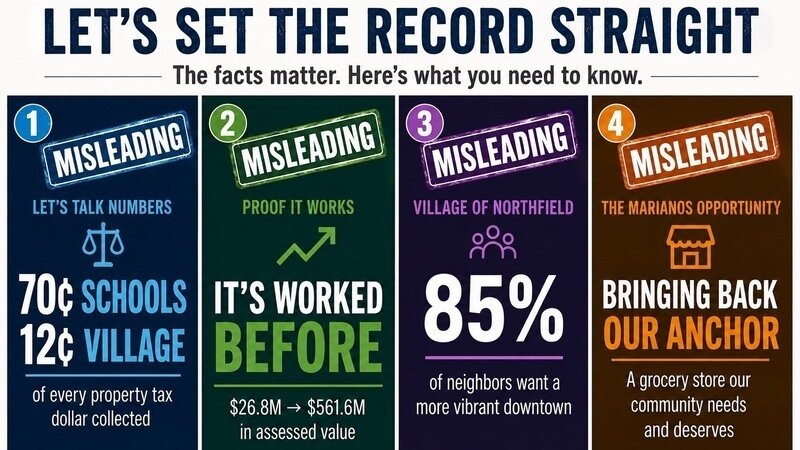
#1) This graphic is misleading in two important ways. The 70¢/12¢ comparison may describe how an ordinary Northfield property-tax dollar is currently divided among taxing bodies, but it does not describe what happens to the growth in property-tax revenue inside a TIF.
Under Illinois TIF law, taxing districts continue receiving taxes attributable to the base EAV. But the property-tax revenue generated by increases in EAV above that base—the tax increment—is deposited into the municipality’s special TIF allocation fund rather than being distributed in the ordinary way to the schools, parks, library and other overlapping taxing districts. Illinois law also provides for later distribution of TIF surplus funds, but only to the extent money is determined to be surplus.
Northfield’s own proposed TIF plan confirms that incremental property taxes are intended to finance redevelopment costs. It authorizes an estimated $175 million in eligible redevelopment project costs and projects the taxable EAV of the proposed district rising from about $82 million to $282 million by tax year 2049. That increase in EAV is precisely what generates the increment available for the TIF.
So the statement “that split doesn’t change—not by a penny” obscures the central feature of TIF. A clearer explanation would be:
Schools continue receiving their taxes on the frozen base value, but they generally do not receive their normal share of the new property-tax increment generated inside the TIF while that increment is being captured for TIF purposes.
The second claim—“state law requires extra reimbursement for any new students the plan brings”—is also much broader than the statute. Illinois law does provide reimbursement for certain increased school costs, but it applies specifically to students attributable to TIF-assisted housing units—housing receiving municipal/TIF financial assistance or certain TIF-funded infrastructure assistance. The law does not simply say that every new student living anywhere in the TIF automatically triggers full reimbursement.
And even where the provision applies, reimbursement is calculated under a statutory formula and is capped. For qualifying districts in the applicable category, the statute limits reimbursement to no more than 27% of the increment generated by the assisted housing for an elementary district and 13% for a secondary district, rather than guaranteeing reimbursement of every dollar of the school’s actual costs. Reimbursement is tied to qualifying TIF-assisted housing and statutory formulas/limitations, not automatically to every new student anywhere in the TIF.
LET’S ACTUALLY TALK NUMBERS.
The issue isn’t whether schools currently receive roughly 70¢ of an ordinary property-tax dollar.
The issue is what happens to future tax growth inside the TIF.
Under TIF, schools continue receiving taxes attributable to the existing base EAV, while much of the new property-tax revenue generated above that base is deposited into the TIF fund instead of flowing normally to schools and other taxing bodies.
And Illinois law does not guarantee full reimbursement for “any new student.” The statutory reimbursement applies to qualifying TIF-assisted housing, follows a formula, and is subject to statutory caps.
“The split doesn’t change—not by a penny” is therefore not an accurate explanation of how TIF works.
Northfield’s own proposal anticipates EAV in the district increasing from approximately $82 million to $282 million and authorizes up to $175 million in eligible TIF project costs. The treatment of that future increment—not today’s 70¢/12¢ graphic—is the financial question residents and taxing districts should be examining.
#2) MISLEADING COMPARISON: THE GLEN ≠ NORTHFIELD
Glenview’s experience does not prove that Northfield’s proposed TIF will work.
The Glen involved redevelopment of a closed U.S. Naval Air Station—hundreds of acres requiring demolition of more than 300 acres of runways and taxiways and approximately one million square feet of Navy buildings. Glenview also acted as the master developer, used proceeds from land sales, and spent 4½ years on community-based planning involving more than 180 public meetings before approving its land-use plan.
That is fundamentally different from pointing to an increase from $26.8 million to $561.6 million in assessed value and concluding, “TIF worked before.”
Most importantly, correlation is not causation. Growth in assessed value does not establish how much of that growth was caused by the TIF, how much would have occurred without it, or whether another community with different land ownership, existing development, market conditions, infrastructure needs, and redevelopment plans will obtain comparable results.
The statement about Glenview’s “downtown” is also potentially confusing. The Glen and Downtown Glenview are not the same redevelopment area. Glenview states that its current downtown revitalization incentives are being financed through its Permanent Fund, which is specifically used for economic development and capital projects outside The Glen.
And “the schools came out ahead” requires context. During the life of The Glen TIF, taxing districts did not directly receive the property taxes generated by the increment; Glenview itself says that when the TIF closed at the end of 2021, its closure allowed the taxing districts to begin directly receiving property taxes generated from The Glen. A favorable statement from one superintendent about Glenview’s management is evidence of that superintendent’s assessment—not proof that TIFs inherently benefit schools or that Northfield’s proposed TIF will do so.
THE GLEN IS NOT NORTHFIELD.
A decommissioned Naval Air Station
≠
Northfield’s existing Village Center.
The Glen had:
• Hundreds of acres of former military property
• 300+ acres of runways/taxiways to remove
• ~1 million sq. ft. of Navy buildings
• Village control as master developer
• Land-sale revenues
• 4½ years of planning
• 180+ public meetings
One successful TIF does not prove another TIF is necessary—or that it will produce the same results.
Evaluate Northfield’s TIF on Northfield’s facts.
#3) That graphic is misleading as stated. The key problem is not necessarily that an “85%” figure never appeared somewhere in Northfield’s planning process; it is that the graphic converts a planning-survey result into a sweeping statement about “neighbors” and then implicitly connects that preference to the current TIF proposal.
Northfield’s Vision Plan 2040 was adopted in 2020 and was designed as a long-range guide for land use and development—not as a referendum on the proposed 2026 TIF. The Village’s current planning materials continue to describe Vision Plan 2040 as the framework guiding zoning, design guidelines and development decisions.
So even if 85% of respondents to a particular survey question expressed interest in a “more vibrant” Village Center, that does not establish that:
85% of Northfield residents support the proposed TIF.
It does not show that 85% support higher-density development, a 23-year TIF district, particular redevelopment agreements, borrowing, property acquisition, or any specific TIF-funded project. And “survey respondents” should not be casually relabeled “neighbors” if the survey was voluntary and not a statistically representative poll of the entire Village.
MISLEADING. Wanting a vibrant downtown is not the same as supporting a TIF.
An old planning survey about community aspirations does not demonstrate 85% support for Northfield’s proposed 2026 TIF, its financing, its boundaries, higher-density development, or its 23-year consequences.
Ask the real question:
What percentage of Northfield residents support THIS TIF proposal after being fully informed of its costs, risks and alternatives?
#4) MISLEADING: A Vacant Mariano’s Does Not Prove Northfield Needs a 23-Year TIF. It uses a legitimate vacancy problem to imply that the proposed TIF is necessary, without demonstrating that causal link.
There is a major contradiction in this argument.
If the former Mariano’s property already has interested tenants and “the obstacle isn’t demand,” then Northfield should first establish exactly what financial gap exists and whether redevelopment can occur through the private market or a narrowly tailored incentive.
That is the fundamental “but-for” question behind TIF.
And this proposal is much bigger than Mariano’s.
Northfield is considering a 106-acre TIF lasting up to 23 years, with as much as $175 million in authorized eligible redevelopment costs — including building rehabilitation, property acquisition/site preparation, public improvements, professional services and developer/property-owner interest costs.
The frequently cited $350,000–$400,000 sales-tax figure has also been publicly described as estimated revenue lost from empty storefronts generally, not conclusively documented as Mariano’s alone.
Most importantly, a TIF does not create sales-tax revenue. A successful business does.
Northfield absolutely should work to refill the Mariano’s property.
But before creating a 23-year TIF affecting 106 acres, residents deserve answers:
• What is the actual Mariano’s financing gap?
• How much public assistance is really necessary?
• Would the tenants proceed without TIF?
• What alternatives have been evaluated?
• And why does one vacant anchor justify a $175 million district-wide redevelopment authorization?
Supporting redevelopment and supporting this particular TIF are not the same thing.
Please, seek factual information. Our residents deserve to be heard. What is the rush?
Thank you for caring about our community.
References
https://www.northfieldil.org/DocumentCenter/View/3253/June-2026-Business-Newsletter
https://www.glenview.il.us/612/Naval-Air-Station-Glenview
file:///var/mobile/Library/SMS/Attachments/b7/07/7D891F0B-A2E5-40E7-A6BB-FC5B10EFA1A3/Downtown-Revitalization-FAQ-PDF.pdf
https://www.glenview.il.us/656/Downtown-Glenview-Revitalization
https://www.northfieldil.org/DocumentCenter/View/1869/Vision-Plan-2040
https://www.facebook.com/groups/812661968589372/