
No Kings, No Idols: Take the Faces Off Our Money
The Issue
The Cult of Personality in Your Pocket
America was founded on a radical idea: that no man is above the nation. Yet every day, we carry a pantheon of individual men in our pockets, trading their portraits like relics of a state religion. It is time to end the cult of personality on American currency — not because these figures achieved nothing, but because no single person, however accomplished, can carry the weight of representing all of us without eventually buckling under the scrutiny of history.
The Current Roster: An Indictment
Consider who we venerate, and why each fails the standard a portrait on money demands:
- George Washington ($1 bill, quarter) — Enslaved hundreds at Mount Vernon and relentlessly pursued Ona Judge, a woman who escaped his household, for years. Ordered the 1779 Sullivan Expedition, which systematically destroyed some forty Haudenosaunee towns and their winter food stores. Personally led an army against his own citizens in the Whiskey Rebellion — a tax revolt of the very kind he had once championed against Britain.
- Thomas Jefferson ($2 bill, nickel) — Enslaved over 600 people and fathered children with Sally Hemings, a teenager he owned. Wrote pseudo-scientific racial hierarchies into Notes on the State of Virginia that poisoned American thought for a century. Died in colossal debt from lavish spending, resulting in the auction of the families he had enslaved — separating them forever.
- Abraham Lincoln ($5 bill, penny) — Suspended habeas corpus and jailed critics, including newspaper editors, without trial. Approved the largest mass execution in U.S. history: 38 Dakota men hanged at Mankato in 1862. Long promoted "colonization" — resettling Black Americans abroad — reflecting his stated view that the races should remain separate.
- Alexander Hamilton ($10 bill) — Never held elected office; he is on our money largely because he designed the money. Openly distrusted popular democracy, favoring a president and senate serving for life. Conducted an affair, then paid blackmail from his own pocket while serving as Treasury Secretary — a scandal he confessed in humiliating public detail.
- Andrew Jackson ($20 bill) — Signed the Indian Removal Act, setting the Trail of Tears in motion and killing thousands of Cherokee, Choctaw, Creek, Chickasaw, and Seminole people. Defied the Supreme Court's authority when its rulings did not suit him. Killed a man in a duel — and, in the ultimate irony, so despised paper currency that he destroyed the national bank. He would hate the $20 bill himself.
- Ulysses S. Grant ($50 bill) — Issued General Order No. 11, expelling Jews from his military district: the most overtly antisemitic official act in American history. Presided over an administration drowning in corruption — Crédit Mobilier, the Whiskey Ring, the Black Friday gold scandal. Broke the Fort Laramie Treaty within a decade, opening the sacred Black Hills to gold miners.
- Benjamin Franklin ($100 bill) — Owned enslaved people and ran advertisements for their sale in his newspaper for decades before his late conversion to abolitionism. Publicly ridiculed German immigrants as "Palatine boors" who could never assimilate. Abandoned his common-law wife Deborah for years of European living; she died without seeing him for the final decade of her life.
- Franklin D. Roosevelt (dime) — Signed Executive Order 9066, imprisoning more than 120,000 Japanese Americans, most of them citizens, without charge or trial. Turned away the MS St. Louis and its Jewish refugees fleeing the Third Reich. Attempted to pack the Supreme Court to remove the obstacle of an independent judiciary.
- John F. Kennedy (half dollar) — Authorized the Bay of Pigs fiasco and greenlit the coup that led to President Diem's assassination in Vietnam. Concealed serious illness and heavy medication from the public while holding the nuclear codes. Was placed on the half dollar within months of Dallas — an act of grief, not judgment, which is precisely the kind of impulsive canonization currency should avoid.
- Sacagawea (dollar coin) — The portrait is pure invention: no image of her exists, so the coin venerates a fiction. She was a captive teenager on the expedition, not a volunteer — celebrating her "service" launders the circumstances. And the coin barely circulates: an honor designed to cost nothing and be seen by no one.
The Proposed Replacements Fare No Better
The instinct to fix the roster by swapping in better names only proves the deeper problem.
- Donald Trump — Federal law bars any living person from appearing on currency; the rule exists precisely to prevent cult-of-personality money, and Washington himself refused to have his image on coins while alive. He is among the most polarizing figures in American history — twice impeached and criminally convicted, unprecedented baggage for a national icon. And money that roughly half the country resents handling fails at its one symbolic job.
- Harriet Tubman — Her courage exceeds that of every man currently on our bills, and that is exactly why the medium insults her. She spent her life fighting a system that priced human beings; printing her face on cash inverts her legacy into irony. A portrait swap is a costless symbolic gesture standing in for the reparative substance she actually fought for. And her nomination restarts the exact roster war this campaign ends — if Jackson can be swapped out by one administration, Tubman can be swapped back by the next.
- Susan B. Anthony — After the Civil War she allied with the openly racist financier George Francis Train and argued that educated white women deserved the vote before Black men, opposing the 15th Amendment and splitting the suffrage movement along racial lines for a generation. And her coin was a famous failure — constantly mistaken for a quarter, rejected by the public, minted for barely three years.
The point is not that these were uniquely wicked people. The point is that every individual is compromised, contested, and claimed by some Americans while resented by others. Even the replacements we reach for immediately accumulate their own asterisks. A portrait on currency is not a history lesson — it is an honor, a daily act of national veneration. And veneration of individuals will always divide us, because no individual belongs to all of us.
What Belongs to Every American
But you know what does?
The Grand Canyon. The bald eagle and the bison. The grizzly bear, the American alligator, the pronghorn — the fastest land animal in the Western Hemisphere, found nowhere else on Earth. The California condor — driven to the brink of extinction and brought back by American hands, a living emblem of national renewal — and the black-footed ferret, once declared extinct and rescued from a single last colony on the plains. The wild mustang. The Virginia opossum, the continent's only marsupial, an original American if ever there was one. The redwoods and giant sequoias, the oldest and largest living things on the planet. The Joshua trees of the Mojave and the saguaros of the Sonoran Desert. The Venus flytrap, one of the wonders of the natural world, growing wild nowhere on Earth but a small stretch of Carolina coastal plain — alongside the trumpet pitcher plants of the Southeast's bogs and savannas. The Great Plains and the Great Lakes. The Mississippi River. The geysers of Yellowstone, the world's first national park — an idea America gave to the world — the granite face of Half Dome, the peaks of Denali and the Great Smoky Mountains. The Everglades. The volcanoes of Hawaii. The moon landing. The signing of the Declaration of Independence — the event, the collective act, not any one signer. Ellis Island. The Rocky Mountains at dawn.
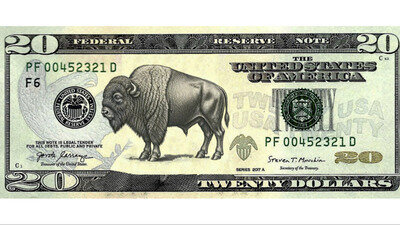
These belong to every American equally. A child of immigrants, a member of the Cherokee Nation, a tenth-generation New Englander — all can look at a bison thundering across a $20 bill and see their country, without asterisk or apology. The European Union understood this when it put bridges and windows on the Euro rather than fight over which nation's heroes deserved the honor. Norway prints the sea. New Zealand prints its birds alongside its people. We can do better than all of them, because no nation on Earth has landscapes, wildlife, and shared achievements as breathtaking as ours.
Our money should look like our country — not like a mausoleum.
The Proposal
This is not a complaint; it is a blueprint. A complete redesign, every denomination, no portrait anywhere — and where a figure departs, his own greatest legacy takes his place:
Bills (face / reverse):
- $1 — The bald eagle / the Great Plains. The two most universal American images on the world's most recognized note.
- $2 — The signing of the Declaration of Independence / first flight at Kitty Hawk. The nation declared, then the nation ascendant.
- $5 — The giant sequoias / Half Dome. In 1864, Lincoln signed the Yosemite Grant — the first time any government on Earth set aside wild land for the people. Both sides of this bill are that grant. His face departs; his gift remains.
- $10 — Ellis Island / Angel Island and the Golden Gate. The Atlantic gateway and the Pacific gateway — every American arrival story on one note.
- $20 — The bison / the Great Smoky Mountains. The national mammal, nearly exterminated and restored, thundering across our most-used bill.
- $50 — The geysers of Yellowstone / the grizzly bear. In 1872, Grant signed the world's first national park into law. This bill is his best legacy, front and back.
- $100 — The Grand Canyon / the California condor in flight. Condors soar over the canyon today, released there during their rescue from extinction — one continuous story on our flagship note.
Coins (face / reverse):
- Penny — The Venus flytrap / the trumpet pitcher plants: two wonders that grow wild nowhere else on Earth, on the coin every child holds first.
- Nickel — The black-footed ferret / the Virginia opossum: the survivors' coin, honoring the buffalo-nickel tradition of wildlife on the five-cent piece.
- Dime — The pronghorn / the saguaro: the hemisphere's fastest animal on our quickest coin.
- Quarter — The Rocky Mountains at dawn / a rotating series of natural landmarks — Crater Lake, Niagara Falls, the Everglades, Mammoth Cave, White Sands, Devils Tower, the Badlands, and dozens more, one for every state, continuing the beloved state-quarters tradition. No landmark with a fixed place elsewhere in the lineup appears in the rotation; every design in the system is exclusive.
- Half dollar — The Apollo 11 moon landing / the volcanoes of Hawaii, where the astronauts trained on lava fields for the lunar surface. President Kennedy's portrait departs; his moonshot, fulfilled, takes its place.
- Dollar coin — Denali, the Great One / the moose of the north country.
No person appears twice in this system because no person appears at all. Nothing appears twice, period — fifty states, one shared gallery, every design exclusive. And the three men most beloved on our current money — Lincoln, Grant, Kennedy — are not erased but translated: the sequoias, Yellowstone, and the Moon are their monuments, grander than any engraving of a face.
Join the Campaign
Sign the petition. Write your representative. Tell the Treasury: America's face is not one man's face. It is purple mountains and fruited plains, and it is long past time our currency said so.

16
The Issue
The Cult of Personality in Your Pocket
America was founded on a radical idea: that no man is above the nation. Yet every day, we carry a pantheon of individual men in our pockets, trading their portraits like relics of a state religion. It is time to end the cult of personality on American currency — not because these figures achieved nothing, but because no single person, however accomplished, can carry the weight of representing all of us without eventually buckling under the scrutiny of history.
The Current Roster: An Indictment
Consider who we venerate, and why each fails the standard a portrait on money demands:
- George Washington ($1 bill, quarter) — Enslaved hundreds at Mount Vernon and relentlessly pursued Ona Judge, a woman who escaped his household, for years. Ordered the 1779 Sullivan Expedition, which systematically destroyed some forty Haudenosaunee towns and their winter food stores. Personally led an army against his own citizens in the Whiskey Rebellion — a tax revolt of the very kind he had once championed against Britain.
- Thomas Jefferson ($2 bill, nickel) — Enslaved over 600 people and fathered children with Sally Hemings, a teenager he owned. Wrote pseudo-scientific racial hierarchies into Notes on the State of Virginia that poisoned American thought for a century. Died in colossal debt from lavish spending, resulting in the auction of the families he had enslaved — separating them forever.
- Abraham Lincoln ($5 bill, penny) — Suspended habeas corpus and jailed critics, including newspaper editors, without trial. Approved the largest mass execution in U.S. history: 38 Dakota men hanged at Mankato in 1862. Long promoted "colonization" — resettling Black Americans abroad — reflecting his stated view that the races should remain separate.
- Alexander Hamilton ($10 bill) — Never held elected office; he is on our money largely because he designed the money. Openly distrusted popular democracy, favoring a president and senate serving for life. Conducted an affair, then paid blackmail from his own pocket while serving as Treasury Secretary — a scandal he confessed in humiliating public detail.
- Andrew Jackson ($20 bill) — Signed the Indian Removal Act, setting the Trail of Tears in motion and killing thousands of Cherokee, Choctaw, Creek, Chickasaw, and Seminole people. Defied the Supreme Court's authority when its rulings did not suit him. Killed a man in a duel — and, in the ultimate irony, so despised paper currency that he destroyed the national bank. He would hate the $20 bill himself.
- Ulysses S. Grant ($50 bill) — Issued General Order No. 11, expelling Jews from his military district: the most overtly antisemitic official act in American history. Presided over an administration drowning in corruption — Crédit Mobilier, the Whiskey Ring, the Black Friday gold scandal. Broke the Fort Laramie Treaty within a decade, opening the sacred Black Hills to gold miners.
- Benjamin Franklin ($100 bill) — Owned enslaved people and ran advertisements for their sale in his newspaper for decades before his late conversion to abolitionism. Publicly ridiculed German immigrants as "Palatine boors" who could never assimilate. Abandoned his common-law wife Deborah for years of European living; she died without seeing him for the final decade of her life.
- Franklin D. Roosevelt (dime) — Signed Executive Order 9066, imprisoning more than 120,000 Japanese Americans, most of them citizens, without charge or trial. Turned away the MS St. Louis and its Jewish refugees fleeing the Third Reich. Attempted to pack the Supreme Court to remove the obstacle of an independent judiciary.
- John F. Kennedy (half dollar) — Authorized the Bay of Pigs fiasco and greenlit the coup that led to President Diem's assassination in Vietnam. Concealed serious illness and heavy medication from the public while holding the nuclear codes. Was placed on the half dollar within months of Dallas — an act of grief, not judgment, which is precisely the kind of impulsive canonization currency should avoid.
- Sacagawea (dollar coin) — The portrait is pure invention: no image of her exists, so the coin venerates a fiction. She was a captive teenager on the expedition, not a volunteer — celebrating her "service" launders the circumstances. And the coin barely circulates: an honor designed to cost nothing and be seen by no one.
The Proposed Replacements Fare No Better
The instinct to fix the roster by swapping in better names only proves the deeper problem.
- Donald Trump — Federal law bars any living person from appearing on currency; the rule exists precisely to prevent cult-of-personality money, and Washington himself refused to have his image on coins while alive. He is among the most polarizing figures in American history — twice impeached and criminally convicted, unprecedented baggage for a national icon. And money that roughly half the country resents handling fails at its one symbolic job.
- Harriet Tubman — Her courage exceeds that of every man currently on our bills, and that is exactly why the medium insults her. She spent her life fighting a system that priced human beings; printing her face on cash inverts her legacy into irony. A portrait swap is a costless symbolic gesture standing in for the reparative substance she actually fought for. And her nomination restarts the exact roster war this campaign ends — if Jackson can be swapped out by one administration, Tubman can be swapped back by the next.
- Susan B. Anthony — After the Civil War she allied with the openly racist financier George Francis Train and argued that educated white women deserved the vote before Black men, opposing the 15th Amendment and splitting the suffrage movement along racial lines for a generation. And her coin was a famous failure — constantly mistaken for a quarter, rejected by the public, minted for barely three years.
The point is not that these were uniquely wicked people. The point is that every individual is compromised, contested, and claimed by some Americans while resented by others. Even the replacements we reach for immediately accumulate their own asterisks. A portrait on currency is not a history lesson — it is an honor, a daily act of national veneration. And veneration of individuals will always divide us, because no individual belongs to all of us.
What Belongs to Every American
But you know what does?
The Grand Canyon. The bald eagle and the bison. The grizzly bear, the American alligator, the pronghorn — the fastest land animal in the Western Hemisphere, found nowhere else on Earth. The California condor — driven to the brink of extinction and brought back by American hands, a living emblem of national renewal — and the black-footed ferret, once declared extinct and rescued from a single last colony on the plains. The wild mustang. The Virginia opossum, the continent's only marsupial, an original American if ever there was one. The redwoods and giant sequoias, the oldest and largest living things on the planet. The Joshua trees of the Mojave and the saguaros of the Sonoran Desert. The Venus flytrap, one of the wonders of the natural world, growing wild nowhere on Earth but a small stretch of Carolina coastal plain — alongside the trumpet pitcher plants of the Southeast's bogs and savannas. The Great Plains and the Great Lakes. The Mississippi River. The geysers of Yellowstone, the world's first national park — an idea America gave to the world — the granite face of Half Dome, the peaks of Denali and the Great Smoky Mountains. The Everglades. The volcanoes of Hawaii. The moon landing. The signing of the Declaration of Independence — the event, the collective act, not any one signer. Ellis Island. The Rocky Mountains at dawn.
These belong to every American equally. A child of immigrants, a member of the Cherokee Nation, a tenth-generation New Englander — all can look at a bison thundering across a $20 bill and see their country, without asterisk or apology. The European Union understood this when it put bridges and windows on the Euro rather than fight over which nation's heroes deserved the honor. Norway prints the sea. New Zealand prints its birds alongside its people. We can do better than all of them, because no nation on Earth has landscapes, wildlife, and shared achievements as breathtaking as ours.
Our money should look like our country — not like a mausoleum.
The Proposal
This is not a complaint; it is a blueprint. A complete redesign, every denomination, no portrait anywhere — and where a figure departs, his own greatest legacy takes his place:
Bills (face / reverse):
- $1 — The bald eagle / the Great Plains. The two most universal American images on the world's most recognized note.
- $2 — The signing of the Declaration of Independence / first flight at Kitty Hawk. The nation declared, then the nation ascendant.
- $5 — The giant sequoias / Half Dome. In 1864, Lincoln signed the Yosemite Grant — the first time any government on Earth set aside wild land for the people. Both sides of this bill are that grant. His face departs; his gift remains.
- $10 — Ellis Island / Angel Island and the Golden Gate. The Atlantic gateway and the Pacific gateway — every American arrival story on one note.
- $20 — The bison / the Great Smoky Mountains. The national mammal, nearly exterminated and restored, thundering across our most-used bill.
- $50 — The geysers of Yellowstone / the grizzly bear. In 1872, Grant signed the world's first national park into law. This bill is his best legacy, front and back.
- $100 — The Grand Canyon / the California condor in flight. Condors soar over the canyon today, released there during their rescue from extinction — one continuous story on our flagship note.
Coins (face / reverse):
- Penny — The Venus flytrap / the trumpet pitcher plants: two wonders that grow wild nowhere else on Earth, on the coin every child holds first.
- Nickel — The black-footed ferret / the Virginia opossum: the survivors' coin, honoring the buffalo-nickel tradition of wildlife on the five-cent piece.
- Dime — The pronghorn / the saguaro: the hemisphere's fastest animal on our quickest coin.
- Quarter — The Rocky Mountains at dawn / a rotating series of natural landmarks — Crater Lake, Niagara Falls, the Everglades, Mammoth Cave, White Sands, Devils Tower, the Badlands, and dozens more, one for every state, continuing the beloved state-quarters tradition. No landmark with a fixed place elsewhere in the lineup appears in the rotation; every design in the system is exclusive.
- Half dollar — The Apollo 11 moon landing / the volcanoes of Hawaii, where the astronauts trained on lava fields for the lunar surface. President Kennedy's portrait departs; his moonshot, fulfilled, takes its place.
- Dollar coin — Denali, the Great One / the moose of the north country.
No person appears twice in this system because no person appears at all. Nothing appears twice, period — fifty states, one shared gallery, every design exclusive. And the three men most beloved on our current money — Lincoln, Grant, Kennedy — are not erased but translated: the sequoias, Yellowstone, and the Moon are their monuments, grander than any engraving of a face.
Join the Campaign
Sign the petition. Write your representative. Tell the Treasury: America's face is not one man's face. It is purple mountains and fruited plains, and it is long past time our currency said so.
The Decision Makers

Petition Updates
Share this petition
Petition created on August 7, 2026