
No Child Should Sleep in Floodwater: Demand U.S. Pressure to Allow Winter Aid into Gaza
The Issue
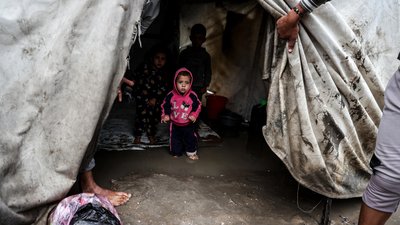
On November 7, the first winter storm of the season hit the Gaza Strip. Within twelve hours, about 70,000 tents sheltering displaced families had flooded, according to Gaza's Government Media Office. The civil defense service received about 1,500 distress calls in a single night. Parents carried their children out of tents standing in water, and mattresses, blankets and clothing were soaked through. Across Gaza, displaced children are now being forced to try to sleep in floodwater.
According to the UN and leading aid organizations, Israel is keeping out the very supplies these families need: tents, timber, shelter kits and mobile homes. That also means this crisis can still be eased. If our government presses Israel to let shelter and aid in now, many lives can be saved before the worst of winter arrives.
Families are facing a fourth winter without real shelter
• 1.2 million people, including more than 560,000 children, are living in "critical or catastrophic" shelter conditions, according to the Palestine Shelter Cluster, the UN-coordinated body for shelter aid in Gaza.
• Two-thirds of Gaza's population lives in tents and makeshift shelters made of materials that wear out within a few months, according to the Norwegian Refugee Council.
• About 950,000 displaced people live in areas exposed to flooding, according to the UN.
• 84 percent of families surveyed by the Shelter Cluster say they have no effective way to heat their shelters.
• Disease is spreading. The UN reports that overcrowding, poor shelter and lack of clean water are driving respiratory infections and acute diarrhea, and health workers expect illness to rise as winter sets in. When floodwater mixes with sewage, Save the Children has warned, children are exposed to hepatitis, diarrhea and gastroenteritis.
The help exists. It is being kept out.
As of November 1, the UN found that Gaza had only about 2 percent of the tents families need, and less than 1 percent of the mattresses.
The supplies to close that gap are waiting at the border. The UN reports that emergency shelter kits are being turned away at the crossings, and that the timber needed to build them continues to be rejected. The Norwegian Refugee Council, which leads shelter aid in Gaza, reports that tents, tarpaulins, timber, rope and even duct tape have been classified in ways that delay or block their entry.
The ceasefire called for mobile homes to replace worn-out tents. According to Save the Children, Israeli authorities have repeatedly blocked them. Israel has also said it will not allow permanent homes to be rebuilt until Hamas disarms. The result is that families cannot rebuild, cannot get mobile homes, and cannot get enough material even to repair a tent. They have been left to live in tents for years, with no end in sight.
The organizations doing this work are clear about the cause. "This is not simply the result of bad weather," said Save the Children. The Norwegian Refugee Council called it "not an unavoidable natural disaster."
This is an American responsibility
Israel is the largest cumulative recipient of U.S. foreign aid since World War II: about $298 billion in today's dollars, according to the Congressional Research Service. Under a 2016 agreement, the United States provides $3.8 billion in military assistance every year. On top of that, a Brown University and Quincy Institute study found that the U.S. provided at least $21.7 billion in military aid to Israel in the two years after October 2023.
We can agree on this: a government receiving that level of American support must allow tents, timber and mattresses to reach children sleeping in floodwater.
U.S. law already requires it. Section 620I of the Foreign Assistance Act (22 U.S.C. § 2378-1) prohibits U.S. security assistance to any country that "prohibits or otherwise restricts, directly or indirectly, the transport or delivery of United States humanitarian assistance." We are not asking for a new policy. We are asking our government to apply the law it already has.
Our request
We respectfully call on our government to use its full influence with Israel to secure the immediate entry of winter shelter and aid at the scale the UN has identified: tents, tarpaulins, timber and shelter kits, mattresses, blankets, heating supplies, and the mobile homes promised under the ceasefire. This includes pressing Israel to open the crossings every day, so that shelter and aid can reach families without delay.
Winter has only just begun. The shelter kits are already packed, and the tents are already waiting. What is missing is enough American pressure on Israel to honor the humanitarian commitments of the ceasefire and meet the most basic humanitarian standard: a dry place for Palestinian children to sleep.
1,061
The Issue
On November 7, the first winter storm of the season hit the Gaza Strip. Within twelve hours, about 70,000 tents sheltering displaced families had flooded, according to Gaza's Government Media Office. The civil defense service received about 1,500 distress calls in a single night. Parents carried their children out of tents standing in water, and mattresses, blankets and clothing were soaked through. Across Gaza, displaced children are now being forced to try to sleep in floodwater.
According to the UN and leading aid organizations, Israel is keeping out the very supplies these families need: tents, timber, shelter kits and mobile homes. That also means this crisis can still be eased. If our government presses Israel to let shelter and aid in now, many lives can be saved before the worst of winter arrives.
Families are facing a fourth winter without real shelter
• 1.2 million people, including more than 560,000 children, are living in "critical or catastrophic" shelter conditions, according to the Palestine Shelter Cluster, the UN-coordinated body for shelter aid in Gaza.
• Two-thirds of Gaza's population lives in tents and makeshift shelters made of materials that wear out within a few months, according to the Norwegian Refugee Council.
• About 950,000 displaced people live in areas exposed to flooding, according to the UN.
• 84 percent of families surveyed by the Shelter Cluster say they have no effective way to heat their shelters.
• Disease is spreading. The UN reports that overcrowding, poor shelter and lack of clean water are driving respiratory infections and acute diarrhea, and health workers expect illness to rise as winter sets in. When floodwater mixes with sewage, Save the Children has warned, children are exposed to hepatitis, diarrhea and gastroenteritis.
The help exists. It is being kept out.
As of November 1, the UN found that Gaza had only about 2 percent of the tents families need, and less than 1 percent of the mattresses.
The supplies to close that gap are waiting at the border. The UN reports that emergency shelter kits are being turned away at the crossings, and that the timber needed to build them continues to be rejected. The Norwegian Refugee Council, which leads shelter aid in Gaza, reports that tents, tarpaulins, timber, rope and even duct tape have been classified in ways that delay or block their entry.
The ceasefire called for mobile homes to replace worn-out tents. According to Save the Children, Israeli authorities have repeatedly blocked them. Israel has also said it will not allow permanent homes to be rebuilt until Hamas disarms. The result is that families cannot rebuild, cannot get mobile homes, and cannot get enough material even to repair a tent. They have been left to live in tents for years, with no end in sight.
The organizations doing this work are clear about the cause. "This is not simply the result of bad weather," said Save the Children. The Norwegian Refugee Council called it "not an unavoidable natural disaster."
This is an American responsibility
Israel is the largest cumulative recipient of U.S. foreign aid since World War II: about $298 billion in today's dollars, according to the Congressional Research Service. Under a 2016 agreement, the United States provides $3.8 billion in military assistance every year. On top of that, a Brown University and Quincy Institute study found that the U.S. provided at least $21.7 billion in military aid to Israel in the two years after October 2023.
We can agree on this: a government receiving that level of American support must allow tents, timber and mattresses to reach children sleeping in floodwater.
U.S. law already requires it. Section 620I of the Foreign Assistance Act (22 U.S.C. § 2378-1) prohibits U.S. security assistance to any country that "prohibits or otherwise restricts, directly or indirectly, the transport or delivery of United States humanitarian assistance." We are not asking for a new policy. We are asking our government to apply the law it already has.
Our request
We respectfully call on our government to use its full influence with Israel to secure the immediate entry of winter shelter and aid at the scale the UN has identified: tents, tarpaulins, timber and shelter kits, mattresses, blankets, heating supplies, and the mobile homes promised under the ceasefire. This includes pressing Israel to open the crossings every day, so that shelter and aid can reach families without delay.
Winter has only just begun. The shelter kits are already packed, and the tents are already waiting. What is missing is enough American pressure on Israel to honor the humanitarian commitments of the ceasefire and meet the most basic humanitarian standard: a dry place for Palestinian children to sleep.
Supporter Voices
Petition Updates
Share this petition
Petition created on November 8, 2026