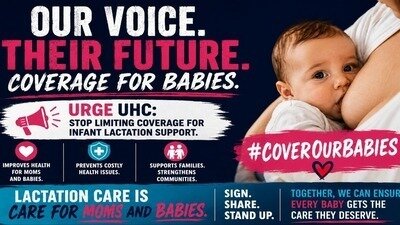

NATIONAL PETITION: Protect Infant Feeding Care—Stop UnitedHealthcare's S9443 Coverage Cuts
The Issue
NATIONAL POLICY PETITION
Preservation of Preventive Infant Feeding Care Through Continued Reimbursement of HCPCS Code S9443
UnitedHealthcare Reimbursement Policy Update (Effective September 1, 2026)
To: UnitedHealthcare Executive Leadership, Medical Policy Committee, Reimbursement Policy Leadership, Provider Relations, and Clinical Policy Teams
EXECUTIVE SUMMARY
We, the undersigned healthcare professionals, International Board Certified Lactation Consultants (IBCLCs), and maternal-child health advocates, respectfully request reconsideration of UnitedHealthcare's reimbursement policy update scheduled to take effect September 1, 2026, which limits reimbursement for HCPCS Code S9443 to services billed under the mother, eliminating reimbursement for clinically appropriate infant-billed encounters that have historically been recognized within outpatient lactation care.
This policy change directly affects access to preventive lactation education and infant feeding support during one of the most medically significant periods of early life.
Many outpatient visits are initiated because of infant feeding concerns that require timely assessment and intervention. Limiting reimbursement to maternal billing alone does not reflect how lactation care is delivered in clinical practice and may unintentionally reduce access to medically necessary services.
We recognize that administrative claims-processing edits exist within the Medicare program; however, those edits do not establish clinical standards or require commercial insurers to eliminate reimbursement pathways that have historically supported medically necessary preventive lactation care.
We respectfully request that UnitedHealthcare:
Preserve reimbursement pathways for mother and infant medically necessary lactation services when clinically appropriate.
Delay implementation pending further clinical review.
Engage frontline maternal-child health providers in policy evaluation.
Assess the downstream impact of this policy on member access, healthcare utilization, and infant outcomes.
1. PURPOSE OF HCPCS CODE S9443 IN CLINICAL PRACTICE
HCPCS Code S9443 supports structured lactation education and infant feeding support delivered by healthcare professionals during the critical newborn period.
These services are commonly provided in response to infant feeding concerns, including:
Ineffective milk transfer
Excessive weight loss or poor weight gain
Feeding fatigue
Inefficient feeding patterns
Oral coordination difficulties
Difficulty maintaining latch
Bottle refusal
Jaundice associated with inadequate intake
Prematurity-related feeding immaturity
These conditions often emerge rapidly during the early postpartum period, when timely intervention is essential to support safe feeding, appropriate growth, and continued breastfeeding.
2. CLINICAL CONTEXT OF LACTATION CARE
Breastfeeding care is unique because successful feeding depends on both members of the breastfeeding dyad.
Many outpatient visits are initiated because of infant feeding problems. Evaluation often includes assessment of infant feeding effectiveness, milk transfer, weight trends, oral function, and maternal factors that together determine feeding success.
Clinical care therefore requires evaluation of both mother and infant, even when preventive counseling and education is directed toward the mother. Reimbursement policies should recognize this integrated model of care rather than restricting reimbursement.
3. ACCESS IMPACT
When reimbursement no longer reflects how care is delivered, the need for services does not disappear—it becomes more difficult for families to obtain timely care.
Potential consequences include:
Delayed access to lactation support
Increased reliance on emergency or urgent care
Higher rates of neonatal readmission for feeding-related conditions
Earlier formula supplementation due to unresolved feeding challenges
Reduced breastfeeding duration and exclusivity
Because infant feeding problems are highly time-sensitive, even short delays can significantly affect clinical outcomes.
4. REIMBURSEMENT POLICY SHOULD REFLECT CLINICAL PRACTICE
HCPCS Code S9443 is a standardized billing code used by commercial insurers to report lactation education and support provided by healthcare professionals.
While coding systems establish standardized reporting mechanisms, they do not independently determine how commercial insurers reimburse medically necessary services.
UnitedHealthcare has indicated that this policy change is based, in part, on CMS age edits associated with HCPCS Code S9443. However, CMS age edits are administrative claims-processing edits developed for the Medicare program. They are designed to support automated claims adjudication and are not clinical practice guidelines or national reimbursement mandates for commercial insurers.
Administrative claims edits are intended to support claims processing and should not be interpreted as independent determinations of medical necessity or as national reimbursement requirements for commercial insurers.
Breastfeeding care is unique because successful treatment often requires evaluation of both members of the breastfeeding dyad. Reimbursement policies should therefore reflect how lactation care is delivered in clinical practice rather than relying solely on administrative billing edits developed for a different payment system.
For many years, outpatient lactation providers have relied on established reimbursement pathways that recognized the clinical realities of infant feeding care. This longstanding practice has allowed UnitedHealthcare members to access timely outpatient services during the critical newborn period. A significant reimbursement change should therefore be supported by a transparent clinical rationale, stakeholder engagement, and evaluation of its impact on member access and health outcomes.
5. ALIGNMENT WITH PREVENTIVE CARE GOALS
Early lactation intervention aligns with nationally recognized preventive healthcare priorities and value-based care initiatives, including:
Preventive care
Early intervention
Improved maternal and infant health outcomes
Continuity of postpartum care
Health equity
Value-based care
Reduction of avoidable healthcare utilization
Timely lactation support has consistently been associated with improved breastfeeding success, fewer feeding complications, and reduced need for higher-acuity medical services.
6. MEMBER IMPACT
UnitedHealthcare members and their families will experience the greatest effects of this policy change.
The policy change affects not only providers, but also the availability, timeliness, and continuity of preventive services available to UnitedHealthcare members during the postpartum period.
Potential impacts include:
Reduced appointment availability
Longer wait times during the newborn period
Decreased participation by lactation providers in UnitedHealthcare networks
Reduced access in rural and underserved communities
Increased out-of-pocket costs
Fragmented postpartum care
7. CLINICAL OUTCOMES AND HEALTHCARE UTILIZATION
Clinical experience and published maternal-child health literature consistently demonstrate that timely outpatient lactation intervention improves infant feeding outcomes while helping prevent escalation to higher-acuity care.
Providers routinely observe:
Reduced emergency department utilization for feeding-related concerns
Fewer hospital readmissions for dehydration and jaundice
Improved breastfeeding continuation
Improved infant weight gain
Reduced need for specialty feeding referrals
Earlier resolution of feeding concerns
Early outpatient intervention functions as preventive healthcare during a narrow developmental window when prompt treatment can prevent more serious complications.
8. PROVIDER CAPACITY AND NETWORK ADEQUACY
Outpatient lactation providers play an essential role in maternal-child healthcare by providing:
Comprehensive feeding assessments
Individualized education
Care coordination with pediatric and obstetric providers
Ongoing postpartum support
Policies that substantially reduce reimbursement for infant feeding services may decrease provider participation, reduce appointment availability, and create additional barriers to care for UnitedHealthcare members.
9. NATIONAL CLINICAL ENGAGEMENT
This policy has generated widespread concern among:
International Board Certified Lactation Consultants (IBCLCs)
Pediatric providers
Obstetric clinicians
Family physicians
Midwives
Hospital lactation programs
Maternal-child health advocates
10. EVIDENCE-BASED POLICY DEVELOPMENT
We respectfully request that reimbursement policy changes affecting preventive maternal-child health services be supported by transparent clinical evidence, meaningful stakeholder engagement, and evaluation of member impact.
Policies that substantially alter access to care should reflect current standards of clinical practice, consider real-world care delivery models, and incorporate input from qualified maternal-child health professionals before implementation.
11. PRACTICAL CONSIDERATIONS
In outpatient practice, lactation visits may originate from pediatric referrals, maternal referrals, or concerns affecting both members of the breastfeeding dyad.
Documentation, referral patterns, and insurance coverage vary based on the clinical circumstances.
Policies that limit reimbursement to a single billing pathway may unintentionally create barriers to medically necessary preventive care for UnitedHealthcare members.
12. REQUEST FOR ACTION
We respectfully request that UnitedHealthcare:
Delay implementation of the September 1, 2026 reimbursement change while additional clinical and operational review is completed.
Preserve reimbursement pathways for medically necessary lactation services, including clinically appropriate infant feeding encounters.
Engage frontline providers to evaluate real-world care delivery, infant feeding presentations, and member access barriers.
Develop a reimbursement framework that supports preventive care, evidence-based clinical practice, network adequacy, value-based care, and improved maternal and infant health outcomes.
13. CLOSING STATEMENT
Lactation care is among the earliest preventive health services families receive after childbirth. Timely access to qualified providers improves breastfeeding success, supports infant health, strengthens maternal outcomes, and helps reduce avoidable healthcare utilization.
We respectfully request that UnitedHealthcare suspend implementation of this policy while engaging clinical experts and frontline providers to develop a reimbursement approach that reflects evidence-based practice, preserves member access, and supports the long-term health of mothers and infants.
Preserving access to preventive lactation services is an investment in healthier families, stronger communities, and a more effective, prevention-focused healthcare system.
HEALTHCARE PROFESSIONAL SIGNATURES
By signing below, I support this petition and respectfully request that UnitedHealthcare reconsider its reimbursement policy regarding HCPCS Code S9443 and preserve access to medically necessary preventive lactation services for mother and baby.

466
The Issue
NATIONAL POLICY PETITION
Preservation of Preventive Infant Feeding Care Through Continued Reimbursement of HCPCS Code S9443
UnitedHealthcare Reimbursement Policy Update (Effective September 1, 2026)
To: UnitedHealthcare Executive Leadership, Medical Policy Committee, Reimbursement Policy Leadership, Provider Relations, and Clinical Policy Teams
EXECUTIVE SUMMARY
We, the undersigned healthcare professionals, International Board Certified Lactation Consultants (IBCLCs), and maternal-child health advocates, respectfully request reconsideration of UnitedHealthcare's reimbursement policy update scheduled to take effect September 1, 2026, which limits reimbursement for HCPCS Code S9443 to services billed under the mother, eliminating reimbursement for clinically appropriate infant-billed encounters that have historically been recognized within outpatient lactation care.
This policy change directly affects access to preventive lactation education and infant feeding support during one of the most medically significant periods of early life.
Many outpatient visits are initiated because of infant feeding concerns that require timely assessment and intervention. Limiting reimbursement to maternal billing alone does not reflect how lactation care is delivered in clinical practice and may unintentionally reduce access to medically necessary services.
We recognize that administrative claims-processing edits exist within the Medicare program; however, those edits do not establish clinical standards or require commercial insurers to eliminate reimbursement pathways that have historically supported medically necessary preventive lactation care.
We respectfully request that UnitedHealthcare:
Preserve reimbursement pathways for mother and infant medically necessary lactation services when clinically appropriate.
Delay implementation pending further clinical review.
Engage frontline maternal-child health providers in policy evaluation.
Assess the downstream impact of this policy on member access, healthcare utilization, and infant outcomes.
1. PURPOSE OF HCPCS CODE S9443 IN CLINICAL PRACTICE
HCPCS Code S9443 supports structured lactation education and infant feeding support delivered by healthcare professionals during the critical newborn period.
These services are commonly provided in response to infant feeding concerns, including:
Ineffective milk transfer
Excessive weight loss or poor weight gain
Feeding fatigue
Inefficient feeding patterns
Oral coordination difficulties
Difficulty maintaining latch
Bottle refusal
Jaundice associated with inadequate intake
Prematurity-related feeding immaturity
These conditions often emerge rapidly during the early postpartum period, when timely intervention is essential to support safe feeding, appropriate growth, and continued breastfeeding.
2. CLINICAL CONTEXT OF LACTATION CARE
Breastfeeding care is unique because successful feeding depends on both members of the breastfeeding dyad.
Many outpatient visits are initiated because of infant feeding problems. Evaluation often includes assessment of infant feeding effectiveness, milk transfer, weight trends, oral function, and maternal factors that together determine feeding success.
Clinical care therefore requires evaluation of both mother and infant, even when preventive counseling and education is directed toward the mother. Reimbursement policies should recognize this integrated model of care rather than restricting reimbursement.
3. ACCESS IMPACT
When reimbursement no longer reflects how care is delivered, the need for services does not disappear—it becomes more difficult for families to obtain timely care.
Potential consequences include:
Delayed access to lactation support
Increased reliance on emergency or urgent care
Higher rates of neonatal readmission for feeding-related conditions
Earlier formula supplementation due to unresolved feeding challenges
Reduced breastfeeding duration and exclusivity
Because infant feeding problems are highly time-sensitive, even short delays can significantly affect clinical outcomes.
4. REIMBURSEMENT POLICY SHOULD REFLECT CLINICAL PRACTICE
HCPCS Code S9443 is a standardized billing code used by commercial insurers to report lactation education and support provided by healthcare professionals.
While coding systems establish standardized reporting mechanisms, they do not independently determine how commercial insurers reimburse medically necessary services.
UnitedHealthcare has indicated that this policy change is based, in part, on CMS age edits associated with HCPCS Code S9443. However, CMS age edits are administrative claims-processing edits developed for the Medicare program. They are designed to support automated claims adjudication and are not clinical practice guidelines or national reimbursement mandates for commercial insurers.
Administrative claims edits are intended to support claims processing and should not be interpreted as independent determinations of medical necessity or as national reimbursement requirements for commercial insurers.
Breastfeeding care is unique because successful treatment often requires evaluation of both members of the breastfeeding dyad. Reimbursement policies should therefore reflect how lactation care is delivered in clinical practice rather than relying solely on administrative billing edits developed for a different payment system.
For many years, outpatient lactation providers have relied on established reimbursement pathways that recognized the clinical realities of infant feeding care. This longstanding practice has allowed UnitedHealthcare members to access timely outpatient services during the critical newborn period. A significant reimbursement change should therefore be supported by a transparent clinical rationale, stakeholder engagement, and evaluation of its impact on member access and health outcomes.
5. ALIGNMENT WITH PREVENTIVE CARE GOALS
Early lactation intervention aligns with nationally recognized preventive healthcare priorities and value-based care initiatives, including:
Preventive care
Early intervention
Improved maternal and infant health outcomes
Continuity of postpartum care
Health equity
Value-based care
Reduction of avoidable healthcare utilization
Timely lactation support has consistently been associated with improved breastfeeding success, fewer feeding complications, and reduced need for higher-acuity medical services.
6. MEMBER IMPACT
UnitedHealthcare members and their families will experience the greatest effects of this policy change.
The policy change affects not only providers, but also the availability, timeliness, and continuity of preventive services available to UnitedHealthcare members during the postpartum period.
Potential impacts include:
Reduced appointment availability
Longer wait times during the newborn period
Decreased participation by lactation providers in UnitedHealthcare networks
Reduced access in rural and underserved communities
Increased out-of-pocket costs
Fragmented postpartum care
7. CLINICAL OUTCOMES AND HEALTHCARE UTILIZATION
Clinical experience and published maternal-child health literature consistently demonstrate that timely outpatient lactation intervention improves infant feeding outcomes while helping prevent escalation to higher-acuity care.
Providers routinely observe:
Reduced emergency department utilization for feeding-related concerns
Fewer hospital readmissions for dehydration and jaundice
Improved breastfeeding continuation
Improved infant weight gain
Reduced need for specialty feeding referrals
Earlier resolution of feeding concerns
Early outpatient intervention functions as preventive healthcare during a narrow developmental window when prompt treatment can prevent more serious complications.
8. PROVIDER CAPACITY AND NETWORK ADEQUACY
Outpatient lactation providers play an essential role in maternal-child healthcare by providing:
Comprehensive feeding assessments
Individualized education
Care coordination with pediatric and obstetric providers
Ongoing postpartum support
Policies that substantially reduce reimbursement for infant feeding services may decrease provider participation, reduce appointment availability, and create additional barriers to care for UnitedHealthcare members.
9. NATIONAL CLINICAL ENGAGEMENT
This policy has generated widespread concern among:
International Board Certified Lactation Consultants (IBCLCs)
Pediatric providers
Obstetric clinicians
Family physicians
Midwives
Hospital lactation programs
Maternal-child health advocates
10. EVIDENCE-BASED POLICY DEVELOPMENT
We respectfully request that reimbursement policy changes affecting preventive maternal-child health services be supported by transparent clinical evidence, meaningful stakeholder engagement, and evaluation of member impact.
Policies that substantially alter access to care should reflect current standards of clinical practice, consider real-world care delivery models, and incorporate input from qualified maternal-child health professionals before implementation.
11. PRACTICAL CONSIDERATIONS
In outpatient practice, lactation visits may originate from pediatric referrals, maternal referrals, or concerns affecting both members of the breastfeeding dyad.
Documentation, referral patterns, and insurance coverage vary based on the clinical circumstances.
Policies that limit reimbursement to a single billing pathway may unintentionally create barriers to medically necessary preventive care for UnitedHealthcare members.
12. REQUEST FOR ACTION
We respectfully request that UnitedHealthcare:
Delay implementation of the September 1, 2026 reimbursement change while additional clinical and operational review is completed.
Preserve reimbursement pathways for medically necessary lactation services, including clinically appropriate infant feeding encounters.
Engage frontline providers to evaluate real-world care delivery, infant feeding presentations, and member access barriers.
Develop a reimbursement framework that supports preventive care, evidence-based clinical practice, network adequacy, value-based care, and improved maternal and infant health outcomes.
13. CLOSING STATEMENT
Lactation care is among the earliest preventive health services families receive after childbirth. Timely access to qualified providers improves breastfeeding success, supports infant health, strengthens maternal outcomes, and helps reduce avoidable healthcare utilization.
We respectfully request that UnitedHealthcare suspend implementation of this policy while engaging clinical experts and frontline providers to develop a reimbursement approach that reflects evidence-based practice, preserves member access, and supports the long-term health of mothers and infants.
Preserving access to preventive lactation services is an investment in healthier families, stronger communities, and a more effective, prevention-focused healthcare system.
HEALTHCARE PROFESSIONAL SIGNATURES
By signing below, I support this petition and respectfully request that UnitedHealthcare reconsider its reimbursement policy regarding HCPCS Code S9443 and preserve access to medically necessary preventive lactation services for mother and baby.
The Decision Makers


Supporter Voices
Petition Updates
Share this petition
Petition created on July 2, 2026