
National Park Service - Statue of Liberty Restoration To French-American True Meaning
The Issue
PETITION TO THE NATIONAL PARK SERVICE
REMOVE THE 1903 EMMA LAZARUS PLAQUE FROM THE STATUE OF LIBERTY
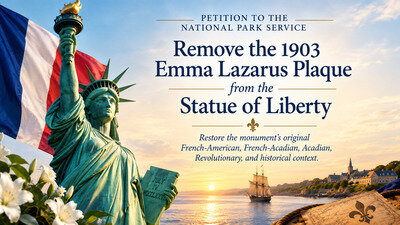
We respectfully petition the National Park Service to permanently remove the 1903 Emma Lazarus plaque from the interior of the Statue of Liberty's pedestal and restore greater public recognition of the monument's original French-American historical context through interpretation, education, documentation, and preservation.
THE ACADIAN AND FRENCH-AMERICAN HISTORY
The Statue of Liberty was created as a French monument presented to the United States. Its original French name was La Liberté éclairant le monde — Liberty Enlightening the World. Its conception developed from the historical relationship between France and the United States, including the American Revolution, the French-American alliance, American independence, republican government, liberty, emancipation, and nineteenth-century French-American relations.
The monument also belongs within the longer history of French North America and Acadia. This history includes French settlement, Acadian communities, the Grand Dérangement, Acadian displacement and diaspora, and the continuing French-speaking communities of northern New England. These historical connections deserve greater recognition in the interpretation of the Statue of Liberty.
French settlement developed throughout northeastern North America during the seventeenth century. Acadia encompassed areas corresponding broadly to present-day Nova Scotia, New Brunswick, Prince Edward Island, portions of Maine, and surrounding regions.
Beginning in 1755, British authorities forcibly removed thousands of Acadians from their homes. Families were separated, homes and farms were confiscated, and Acadian communities were dispersed throughout British North America, England, and France. This period became known as Le Grand Dérangement and created an enduring Acadian diaspora.
The history of Acadia forms much of the larger French North American history that preceded the American Revolution. France later became a major ally of the American revolutionary cause. On February 6, 1778, France formally recognized the United States and entered into an alliance with the new nation.
France provided military, naval, financial, diplomatic, and material assistance during the American Revolution. French troops participated directly in the Yorktown campaign, and French naval forces contributed to American independence. The French-American relationship continued after the Revolution and became an important part of the historical relationship between France and the United States.
THE CREATION OF THE STATUE OF LIBERTY
Édouard René de Laboulaye proposed a monument that France could present to the United States. Frédéric-Auguste Bartholdi became the sculptor, and the Statue was constructed in France before being transported to the United States.
The Statue was dedicated on October 28, 1886. Its original title was La Liberté éclairant le monde — Liberty Enlightening the World.
The monument contains its own symbolic language. The torch represents enlightenment and liberty. The tablet bears JULY IV MDCCLXXVI, identifying the date of American independence. Broken chains appear at the feet of the figure, and the National Park Service associates those chains with the abolition of slavery.
These elements existed as part of the monument before the Emma Lazarus plaque was installed.
EMMA LAZARUS AND THE NEW COLOSSUS
Emma Lazarus wrote The New Colossus in 1883, three years before the Statue's dedication. The poem was written as part of a fundraising effort for the Statue's pedestal and introduced themes of exile, refuge, immigration, displacement, poverty, welcome, and opportunity.
Lazarus's literary history was connected with Jewish refugees arriving in the United States from the Russian Empire and Eastern Europe. She became involved in relief and advocacy work through the Hebrew Emigrant Aid Society.
Lazarus died in 1887. Her poem remained separate from the physical monument for many years after the Statue's dedication.
Around 1901, Georgina Schuyler, a friend of Lazarus, revived public attention to the poem. In 1903, selected lines from The New Colossus were permanently installed on a bronze plaque inside the Statue's pedestal.
The plaque was therefore added seventeen years after the Statue's dedication.
WHY THE 1903 PLAQUE SHOULD BE REMOVED
This petition asks the National Park Service to recognize the chronology of the monument.
The original Statue developed from the French-American relationship, the American Revolution, French assistance to American independence, French republican thought, liberty, emancipation, and the French gift to the United States.
The Lazarus poem developed from a later literary history involving exile, immigration, refuge, displacement, and the experiences of Jewish refugees.
The 1903 plaque physically attached that later literary interpretation to a monument that had already been completed and dedicated.
Removing the plaque from the physical monument would preserve the historical distinction between the 1886 Statue and the 1903 addition.
The poem can remain preserved as an important work of American literature. Emma Lazarus's history can remain fully documented. Jewish-American immigration history can remain a part of American history. The plaque itself can be preserved within the National Park Service's museum and archival collections.
WHAT WE ARE ASKING THE NATIONAL PARK SERVICE TO DO
We respectfully request that the National Park Service:
Permanently remove the 1903 Emma Lazarus plaque from the interior of the Statue of Liberty's pedestal.
Preserve the plaque as a historical artifact.
Provide visitors with a complete historical explanation of the plaque's 1903 installation.
Clearly distinguish the 1886 Statue from the 1903 addition.
Restore greater public recognition of the monument's original French-American identity.
Recognize La Liberté éclairant le monde — Liberty Enlightening the World as the original title and conception of the monument.
Expand interpretation concerning French North America and Acadia.
Include the history of the Grand Dérangement and Acadian displacement.
Recognize Acadian and French-speaking history in Maine and northern New England.
Explain the French-American alliance during the American Revolution.
Explain French military, naval, financial, diplomatic, and material assistance to the United States.
Preserve the historical roles of Laboulaye and Bartholdi.
Explain the 1884 transfer of the French gift to the United States.
Explain the original symbolism of the torch, crown, tablet, July 4, 1776 inscription, broken chains, and classical imagery.
Present Emma Lazarus's history separately and accurately.
Explain the chronology connecting Lazarus, The New Colossus, Georgina Schuyler, and the 1903 plaque.
Conduct archival research concerning the authorization and installation of the 1903 plaque.
Research surviving French and American records concerning Bartholdi's knowledge of the plaque.
Research contemporary French and American newspaper coverage surrounding the installation.
Preserve the historical chronology concerning Lazarus, Russian-Jewish refugees, the 1903 plaque, the Bolshevik political movement, and the 1917 Russian Revolution.
PRESERVE THE HISTORY — RESTORE THE CHRONOLOGY
This petition seeks the proper historical placement of Emma Lazarus's contribution.
The 1903 plaque can be preserved as a historical artifact. The poem can remain part of American literary history. Emma Lazarus's history can remain fully documented, and Jewish-American immigration history can remain a part of American history.
The history of the Statue can include every historical layer. The French-American origin came first. The Lazarus poem came later. The plaque came later still.
The Statue of Liberty deserves a complete historical presentation that recognizes its French-American origins, the history of French North America and Acadia, the Grand Dérangement, the American Revolution, the French-American alliance, Laboulaye, Bartholdi, the 1886 dedication, Emma Lazarus, The New Colossus, Georgina Schuyler, and the 1903 plaque.
We therefore respectfully petition the National Park Service to permanently remove the 1903 Emma Lazarus plaque from the Statue of Liberty, preserve the plaque as a historical artifact, and restore comprehensive public interpretation of the Statue's original French-American, French-Acadian, Acadian, Revolutionary, and historical context.
PETITION ORGANIZED BY
French-American Historical Project

1
The Issue
PETITION TO THE NATIONAL PARK SERVICE
REMOVE THE 1903 EMMA LAZARUS PLAQUE FROM THE STATUE OF LIBERTY
We respectfully petition the National Park Service to permanently remove the 1903 Emma Lazarus plaque from the interior of the Statue of Liberty's pedestal and restore greater public recognition of the monument's original French-American historical context through interpretation, education, documentation, and preservation.
THE ACADIAN AND FRENCH-AMERICAN HISTORY
The Statue of Liberty was created as a French monument presented to the United States. Its original French name was La Liberté éclairant le monde — Liberty Enlightening the World. Its conception developed from the historical relationship between France and the United States, including the American Revolution, the French-American alliance, American independence, republican government, liberty, emancipation, and nineteenth-century French-American relations.
The monument also belongs within the longer history of French North America and Acadia. This history includes French settlement, Acadian communities, the Grand Dérangement, Acadian displacement and diaspora, and the continuing French-speaking communities of northern New England. These historical connections deserve greater recognition in the interpretation of the Statue of Liberty.
French settlement developed throughout northeastern North America during the seventeenth century. Acadia encompassed areas corresponding broadly to present-day Nova Scotia, New Brunswick, Prince Edward Island, portions of Maine, and surrounding regions.
Beginning in 1755, British authorities forcibly removed thousands of Acadians from their homes. Families were separated, homes and farms were confiscated, and Acadian communities were dispersed throughout British North America, England, and France. This period became known as Le Grand Dérangement and created an enduring Acadian diaspora.
The history of Acadia forms much of the larger French North American history that preceded the American Revolution. France later became a major ally of the American revolutionary cause. On February 6, 1778, France formally recognized the United States and entered into an alliance with the new nation.
France provided military, naval, financial, diplomatic, and material assistance during the American Revolution. French troops participated directly in the Yorktown campaign, and French naval forces contributed to American independence. The French-American relationship continued after the Revolution and became an important part of the historical relationship between France and the United States.
THE CREATION OF THE STATUE OF LIBERTY
Édouard René de Laboulaye proposed a monument that France could present to the United States. Frédéric-Auguste Bartholdi became the sculptor, and the Statue was constructed in France before being transported to the United States.
The Statue was dedicated on October 28, 1886. Its original title was La Liberté éclairant le monde — Liberty Enlightening the World.
The monument contains its own symbolic language. The torch represents enlightenment and liberty. The tablet bears JULY IV MDCCLXXVI, identifying the date of American independence. Broken chains appear at the feet of the figure, and the National Park Service associates those chains with the abolition of slavery.
These elements existed as part of the monument before the Emma Lazarus plaque was installed.
EMMA LAZARUS AND THE NEW COLOSSUS
Emma Lazarus wrote The New Colossus in 1883, three years before the Statue's dedication. The poem was written as part of a fundraising effort for the Statue's pedestal and introduced themes of exile, refuge, immigration, displacement, poverty, welcome, and opportunity.
Lazarus's literary history was connected with Jewish refugees arriving in the United States from the Russian Empire and Eastern Europe. She became involved in relief and advocacy work through the Hebrew Emigrant Aid Society.
Lazarus died in 1887. Her poem remained separate from the physical monument for many years after the Statue's dedication.
Around 1901, Georgina Schuyler, a friend of Lazarus, revived public attention to the poem. In 1903, selected lines from The New Colossus were permanently installed on a bronze plaque inside the Statue's pedestal.
The plaque was therefore added seventeen years after the Statue's dedication.
WHY THE 1903 PLAQUE SHOULD BE REMOVED
This petition asks the National Park Service to recognize the chronology of the monument.
The original Statue developed from the French-American relationship, the American Revolution, French assistance to American independence, French republican thought, liberty, emancipation, and the French gift to the United States.
The Lazarus poem developed from a later literary history involving exile, immigration, refuge, displacement, and the experiences of Jewish refugees.
The 1903 plaque physically attached that later literary interpretation to a monument that had already been completed and dedicated.
Removing the plaque from the physical monument would preserve the historical distinction between the 1886 Statue and the 1903 addition.
The poem can remain preserved as an important work of American literature. Emma Lazarus's history can remain fully documented. Jewish-American immigration history can remain a part of American history. The plaque itself can be preserved within the National Park Service's museum and archival collections.
WHAT WE ARE ASKING THE NATIONAL PARK SERVICE TO DO
We respectfully request that the National Park Service:
Permanently remove the 1903 Emma Lazarus plaque from the interior of the Statue of Liberty's pedestal.
Preserve the plaque as a historical artifact.
Provide visitors with a complete historical explanation of the plaque's 1903 installation.
Clearly distinguish the 1886 Statue from the 1903 addition.
Restore greater public recognition of the monument's original French-American identity.
Recognize La Liberté éclairant le monde — Liberty Enlightening the World as the original title and conception of the monument.
Expand interpretation concerning French North America and Acadia.
Include the history of the Grand Dérangement and Acadian displacement.
Recognize Acadian and French-speaking history in Maine and northern New England.
Explain the French-American alliance during the American Revolution.
Explain French military, naval, financial, diplomatic, and material assistance to the United States.
Preserve the historical roles of Laboulaye and Bartholdi.
Explain the 1884 transfer of the French gift to the United States.
Explain the original symbolism of the torch, crown, tablet, July 4, 1776 inscription, broken chains, and classical imagery.
Present Emma Lazarus's history separately and accurately.
Explain the chronology connecting Lazarus, The New Colossus, Georgina Schuyler, and the 1903 plaque.
Conduct archival research concerning the authorization and installation of the 1903 plaque.
Research surviving French and American records concerning Bartholdi's knowledge of the plaque.
Research contemporary French and American newspaper coverage surrounding the installation.
Preserve the historical chronology concerning Lazarus, Russian-Jewish refugees, the 1903 plaque, the Bolshevik political movement, and the 1917 Russian Revolution.
PRESERVE THE HISTORY — RESTORE THE CHRONOLOGY
This petition seeks the proper historical placement of Emma Lazarus's contribution.
The 1903 plaque can be preserved as a historical artifact. The poem can remain part of American literary history. Emma Lazarus's history can remain fully documented, and Jewish-American immigration history can remain a part of American history.
The history of the Statue can include every historical layer. The French-American origin came first. The Lazarus poem came later. The plaque came later still.
The Statue of Liberty deserves a complete historical presentation that recognizes its French-American origins, the history of French North America and Acadia, the Grand Dérangement, the American Revolution, the French-American alliance, Laboulaye, Bartholdi, the 1886 dedication, Emma Lazarus, The New Colossus, Georgina Schuyler, and the 1903 plaque.
We therefore respectfully petition the National Park Service to permanently remove the 1903 Emma Lazarus plaque from the Statue of Liberty, preserve the plaque as a historical artifact, and restore comprehensive public interpretation of the Statue's original French-American, French-Acadian, Acadian, Revolutionary, and historical context.
PETITION ORGANIZED BY
French-American Historical Project
Petition Updates
Share this petition
Petition created on September 21, 2026