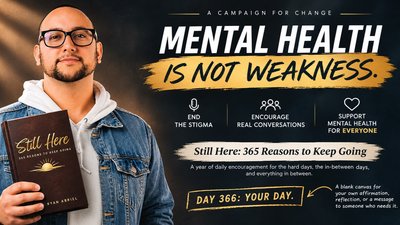

Mental Health Is Not Weakness: Hold Media Leaders Accountable for Mental Health Stigma
The Issue
To major television networks, streaming platforms, broadcasters, and media executives:
Stop treating mental health struggles as a punchline. Commit to responsible conversations about mental health, challenge harmful stereotypes, and help create a culture where seeking support is recognized as an act of courage, not weakness.
Why I’m starting this petition
My name is Ryan, and I’m a husband, father, basketball coach, and author of Still Here: 365 Reasons to Keep Going.
On February 12, 2013, I experienced my first panic attack. What should have been an ordinary evening became the beginning of a journey with anxiety, depression, and panic attacks that has lasted more than 13 years.
For years, I struggled with things that other people couldn’t see. I showed up to work. I coached basketball. I supported my family. I did my best to fulfill the responsibilities people counted on me for.
But showing up didn’t always mean I was okay.
And one of the hardest parts wasn’t just what I was experiencing. It was the pressure to appear strong while struggling internally.
That’s why it troubles me when influential media personalities, celebrities, and public commentators ridicule men for discussing their mental health or portray emotional vulnerability as weakness.
When someone with a massive platform mocks a man for admitting he’s struggling, the message reaches far beyond the person being criticized.
It reaches the father who’s afraid to tell his family he’s depressed.
The teenager who’s been taught that crying makes him less masculine.
The husband who feels guilty asking his partner for support.
The friend who desperately needs someone to talk to but is terrified of being judged.
And the countless people who have convinced themselves that suffering in silence is somehow a sign of strength.
We need to stop confusing emotional silence with emotional strength.
This isn’t about men versus women
Let me be absolutely clear: women’s mental health matters just as much as men’s mental health.
Women experience anxiety, depression, trauma, discrimination, and countless other challenges that deserve attention, compassion, and meaningful support.
Advocating for men doesn’t require diminishing those experiences.
This petition focuses on the stigma surrounding men’s emotional vulnerability because it’s a specific cultural expectation I want to help change.
But the larger message applies to everyone.
Nobody should be mocked for struggling with their mental health.
Nobody should feel ashamed for seeking help.
And nobody should have to prove their strength by pretending they’re okay.
Mental health is a human issue, not a competition between genders.
What we’re asking media organizations to do
We’re calling on major media networks, broadcasters, streaming platforms, and influential media organizations to:
Adopt clear mental health anti-stigma standards. Establish editorial guidance that discourages mocking, degrading, or stereotyping people because of their mental health struggles or decision to seek support.
Provide mental health awareness education. Offer appropriate training and resources for hosts, contributors, producers, and editorial teams to encourage more informed conversations.
Challenge harmful stereotypes about masculinity. Recognize that emotional vulnerability, therapy, and asking for help do not make someone less of a man.
Promote responsible, compassionate conversations. Encourage programming and public discussions that help audiences better understand mental health, including the experiences of men and women.
Demonstrate meaningful accountability. Establish ways to address harmful or stigmatizing commentary while respecting freedom of expression and allowing thoughtful, good-faith discussion.
We’re not asking organizations to silence disagreement or prohibit difficult conversations.
We’re asking them to recognize the influence they have and use that influence responsibly.
Why this matters to me personally
After more than a decade of struggling with my mental health, I wrote Still Here: 365 Reasons to Keep Going.
I didn’t write it because I had everything figured out.
I wrote it because I knew what it felt like to need encouragement, reassurance, and a reason to keep moving forward when life felt overwhelming.
The book contains 365 daily reflections and affirmations inspired by my experiences and the lessons I’ve learned along the way.
But one of its most meaningful parts is what comes after those 365 days.
Day 366: Your Day.
It’s a blank canvas.
A space where readers can write their own affirmation, reflect on their journey, or leave a message for someone else.
Maybe it’s a letter to themselves.
Maybe it’s something they’ve needed to hear for years.
Or maybe it’s a message to someone they love, written before passing the book along to another person who could benefit from reading it.
Because I never wanted my story to be where the conversation ended.
I wanted it to help someone else begin theirs.
And that’s what this petition represents to me.
Another opportunity to remind people that their experiences matter, their voices deserve to be heard, and they should never feel ashamed for being human.
Help us change the conversation
If you believe mental health struggles should be met with compassion rather than ridicule, I hope you’ll sign this petition.
If you’ve ever been afraid to tell someone you’re struggling, this is for you.
If you’ve watched someone you love suffer in silence, this is for you.
If you’re a parent, partner, friend, coach, teacher, or simply someone who believes people deserve to be treated with dignity, this is for you.
Let’s create a culture where speaking up about mental health is recognized as courage, not weakness.
Sign this petition. Share it with someone who needs to hear this message. And help us remind the people shaping public conversations that their words have consequences.
Our mental health deserves better.
And so do we.
Still here. Still speaking up. Still giving people reasons to keep going.
Ryan Abriel
Author, Still Here: 365 Reasons to Keep Going

157
The Issue
To major television networks, streaming platforms, broadcasters, and media executives:
Stop treating mental health struggles as a punchline. Commit to responsible conversations about mental health, challenge harmful stereotypes, and help create a culture where seeking support is recognized as an act of courage, not weakness.
Why I’m starting this petition
My name is Ryan, and I’m a husband, father, basketball coach, and author of Still Here: 365 Reasons to Keep Going.
On February 12, 2013, I experienced my first panic attack. What should have been an ordinary evening became the beginning of a journey with anxiety, depression, and panic attacks that has lasted more than 13 years.
For years, I struggled with things that other people couldn’t see. I showed up to work. I coached basketball. I supported my family. I did my best to fulfill the responsibilities people counted on me for.
But showing up didn’t always mean I was okay.
And one of the hardest parts wasn’t just what I was experiencing. It was the pressure to appear strong while struggling internally.
That’s why it troubles me when influential media personalities, celebrities, and public commentators ridicule men for discussing their mental health or portray emotional vulnerability as weakness.
When someone with a massive platform mocks a man for admitting he’s struggling, the message reaches far beyond the person being criticized.
It reaches the father who’s afraid to tell his family he’s depressed.
The teenager who’s been taught that crying makes him less masculine.
The husband who feels guilty asking his partner for support.
The friend who desperately needs someone to talk to but is terrified of being judged.
And the countless people who have convinced themselves that suffering in silence is somehow a sign of strength.
We need to stop confusing emotional silence with emotional strength.
This isn’t about men versus women
Let me be absolutely clear: women’s mental health matters just as much as men’s mental health.
Women experience anxiety, depression, trauma, discrimination, and countless other challenges that deserve attention, compassion, and meaningful support.
Advocating for men doesn’t require diminishing those experiences.
This petition focuses on the stigma surrounding men’s emotional vulnerability because it’s a specific cultural expectation I want to help change.
But the larger message applies to everyone.
Nobody should be mocked for struggling with their mental health.
Nobody should feel ashamed for seeking help.
And nobody should have to prove their strength by pretending they’re okay.
Mental health is a human issue, not a competition between genders.
What we’re asking media organizations to do
We’re calling on major media networks, broadcasters, streaming platforms, and influential media organizations to:
Adopt clear mental health anti-stigma standards. Establish editorial guidance that discourages mocking, degrading, or stereotyping people because of their mental health struggles or decision to seek support.
Provide mental health awareness education. Offer appropriate training and resources for hosts, contributors, producers, and editorial teams to encourage more informed conversations.
Challenge harmful stereotypes about masculinity. Recognize that emotional vulnerability, therapy, and asking for help do not make someone less of a man.
Promote responsible, compassionate conversations. Encourage programming and public discussions that help audiences better understand mental health, including the experiences of men and women.
Demonstrate meaningful accountability. Establish ways to address harmful or stigmatizing commentary while respecting freedom of expression and allowing thoughtful, good-faith discussion.
We’re not asking organizations to silence disagreement or prohibit difficult conversations.
We’re asking them to recognize the influence they have and use that influence responsibly.
Why this matters to me personally
After more than a decade of struggling with my mental health, I wrote Still Here: 365 Reasons to Keep Going.
I didn’t write it because I had everything figured out.
I wrote it because I knew what it felt like to need encouragement, reassurance, and a reason to keep moving forward when life felt overwhelming.
The book contains 365 daily reflections and affirmations inspired by my experiences and the lessons I’ve learned along the way.
But one of its most meaningful parts is what comes after those 365 days.
Day 366: Your Day.
It’s a blank canvas.
A space where readers can write their own affirmation, reflect on their journey, or leave a message for someone else.
Maybe it’s a letter to themselves.
Maybe it’s something they’ve needed to hear for years.
Or maybe it’s a message to someone they love, written before passing the book along to another person who could benefit from reading it.
Because I never wanted my story to be where the conversation ended.
I wanted it to help someone else begin theirs.
And that’s what this petition represents to me.
Another opportunity to remind people that their experiences matter, their voices deserve to be heard, and they should never feel ashamed for being human.
Help us change the conversation
If you believe mental health struggles should be met with compassion rather than ridicule, I hope you’ll sign this petition.
If you’ve ever been afraid to tell someone you’re struggling, this is for you.
If you’ve watched someone you love suffer in silence, this is for you.
If you’re a parent, partner, friend, coach, teacher, or simply someone who believes people deserve to be treated with dignity, this is for you.
Let’s create a culture where speaking up about mental health is recognized as courage, not weakness.
Sign this petition. Share it with someone who needs to hear this message. And help us remind the people shaping public conversations that their words have consequences.
Our mental health deserves better.
And so do we.
Still here. Still speaking up. Still giving people reasons to keep going.
Ryan Abriel
Author, Still Here: 365 Reasons to Keep Going
Supporter Voices
Petition Updates
Share this petition
Petition created on November 8, 2026