
Memorandum to the 7th Pay Commission of West Bengal, India
The Issue
This memorandum to the 7th Pay Commission of West Bengal, placed below, has been prepared by me, Pranab Bhattacharjee (District Compensation Officer, Rtd. - North 24 PGS). This covers the benefits of the entire employees & officers of the Govt. of West Bengal, such as - DA/DR, Family Pension, Commutation of Pension, OROP, Health Scheme and others.
I earnestly request all the readers to consider the memorandum stated below wisely and if he/she coincides with the prayers, he/she may accept/agree with the content of the statement which will be submitted before the Commissioner of the 7th Pay Commission, on or before the dated, 05=30 PM of 30/10/2026.
[পশ্চিমবঙ্গের সপ্তম বেতন কমিশনের নিকট পেশ করার জন্য নিম্নলিখিত স্মারকলিপিটি আমি, প্রণব ভট্টাচার্য (জেলা ক্ষতিপূরণ আধিকারিক, অবসরপ্রাপ্ত — উত্তর ২৪ পরগনা), প্রস্তুত করেছি। এই স্মারকলিপিতে পশ্চিমবঙ্গ সরকারের সমগ্র কর্মচারী ও আধিকারিকদের স্বার্থসংশ্লিষ্ট বিভিন্ন বিষয়, যেমন— মহার্ঘ ভাতা (DA/DR), পারিবারিক পেনশন, পেনশন কমিউটেশন, ওয়ান র্যাঙ্ক ওয়ান পেনশন (OROP), স্বাস্থ্য প্রকল্প এবং অন্যান্য সুযোগ-সুবিধার বিষয়গুলি অন্তর্ভুক্ত করা হয়েছে।
আমি সমস্ত পাঠক-পাঠিকাদের কাছে আন্তরিকভাবে আবেদন জানাচ্ছি, তাঁরা যেন নিম্নে উল্লিখিত স্মারকলিপিটি বিবেচনা করে দেখেন। স্মারকলিপিতে উত্থাপিত দাবিদাওয়া ও প্রার্থনাগুলির সঙ্গে যদি তাঁরা সহমত পোষণ করেন, তাহলে আগামী ৩০/১০/২০২৬ তারিখ বিকেল ৫টা ৩০ মিনিটের মধ্যে পশ্চিমবঙ্গের সপ্তম বেতন কমিশনের মাননীয় কমিশনারের নিকট পেশ করার জন্য নির্ধারিত এই বক্তব্যের বিষয়বস্তুর সঙ্গে সম্মতি জ্ঞাপন করে তা গ্রহণ ও সমর্থন করার জন্য এগিয়ে আসেন। সকলের সক্রিয় সহযোগিতা ও সমর্থন একান্তভাবে কামনা করি।]
Submission of Memorandum for Revision of Benefits, Before The 7th Pay Commission for the State Government Employees & Other Category of Employees, 2026
In addition to my earlier Memorandum, I do hereby submit my submission and explanation in support of my statements. As a singular entity, this Petition is made on my behalf, as well as, on behalf of all retired employees irrespective of their ranks. The point-wise analysis is placed below :
I) Retirement Pension Benefit -vs- NPS
I beg to justify the demand for Retirement Pension for the State Government Employees on several counts. It is not a God-gifted Rule, nor a Rule determined by the Nature, but the Rule is framed and bestowed upon himself by the Human being just like the clothes are chosen to cover their body. In prehistoric age, the clothes and garments were not essential part of livelihood, those were used in the winter only. The term modesty also came into civilization in the sixth century BC. Similarly, the need of Retirement Pension is not a contribution of the Welfare State, nor it is an achievement evolved in the age of Democratic States, but it has a root in the ancient history. There are some examples :
The Retirement Pension, as a benefit, is first traceable in Egypt. In the reign of Thutmose III (1479 BC - 1425 BC) the retired persons were allowed to have monthly food-grains like other old-age pension. But some good workers were offered some dignitary posts. Maya, a gallant soldier, was awarded the post of Governor and Chief of the Prophets. Another gallant soldier, Amenemone was rewarded the post of Steward of the funerary Temple of Thutmose III. There are several other examples of allowing benefits to the State employees after the retirement in that period. (www.touregypt.net/ featurestories/oldage.htm)
The Retirement Pension may also be traced in the Han Dynasty (206 BC - 220 AD) of China when retirement age was fixed at 70 yrs and the Pension is determined at one-third of the salary (if it were 2,000 dan) drawn at the end of one’s service, as shown by Jinfan Zhang in his book “The Tradition & Modern Transition of Chinese Law,” (Springer, NY, 2014).
In Europe, quoting texts of 1st Century historian Gaius Suetonius, Sara Elise Phang in her book “Roman Military Service,” (Cambridge University Press, 2008) showed that the Roman soldiers, in the 2nd and 1st century BC, were given an ad hoc Retirement Pension equivalent to twelve years’ salary. In 13 BC, Augustus formalised a pension plan for veteran legionnaires after completion of 20 years in service.
In India, the Retirement Pension is found dated back to the 8th Century AD, in the Sloka No. 2413 of “Sukraneeti” written by Sukracharya.
C G Lewin, in his book “Pensions and Insurance Before 1800 A Social History,” showed that the Retirement Pension was accorded to a Sergeant by Henry III in the 1269 AD. Later, in 1684 AD, another instance of granting Retirement Pension to a Senior Officer of Port of London is also available.
Instances of Retirement Pension are aplenty in the medieval period too. Records are also available that The East India Company granted Retirement Pensions to their Laskars even in colonial era of India. All these examples establish :
(1) The fact that the human being bestowed the Retirement Pension upon himself not only to protect the Government Servants after his retirement from service parallel to the old-age benefits but also devised to minimize competition in other field of businesses.
(2) It has gained the Right of an employee to have the benefit of pension on retirement.
(3) Alternatively, the National Pension Scheme, which follows the Bismarck Principle, is a concept which is almost regressive in nature and contradictory to the Human Civilization.
(4) The Pay of an employee is worked out on the basis of the Cost Price Index (CPI) and there is no room left in the CPI to accommodate the contribution to the NPS. Generally, the actual Pay paid to the employees is less than the Pay worked out mathematically.
Hence, it is prayed before the Commission not to suggest the NPS for the State Govt. Employees, instead of advising continuation of Retirement Pension.
II) Date of Effect and the Actual Benefit
From our bitter experience, I beg to mention that the Actual Benefit of the Pay Commission, in past, is not given to the Employees and Pensioners from the Date of Effect. We have a pathetic experience of forfeiting the arrear amount in the name of “Notional Fixation” at the hand of previous Government.
In past, during fixation of Pay, the previous Government re-fixed the Scale of Pay of the employees “Notionally” in terms of recommendations of the Pay Commissions. While the lexicographical meaning of “Notional” is ad valorum or ad hoc, the Pay of an employee was never fixed whimsically. It has a sound mathematical foundation and continuity and hence the forfeiture of Arrears by the State in the name of Notional Fixation is arbitrary and contradictory to the Right of Pay of an employee.
I beg to mention here that the Arrear paid to the Employees and the Pensioners causes a Big Push to the economy as a whole, as it is generally spent on the consumer goods and services which by turn gives an impetus to the production sector as well as local markets. Finally, it generates additional income and employment. Therefore this type of payment is to be considered as a “social investment” instead of expenditure.
I demand that the revised rate of Pay & Pension should be given from the 01 January, 2016, irrespective of date of publication of the Report of the 7th Pay Commission. It is further demanded that the Actual Effect be given on the Date of Effect with full Arrear Payment from the Date of Effect from the stand point of all logical grounds as well as a Big Push to the State Economy.
III) Procedural Method of Determination of Pension
In my earlier Memorandum, I have criticised the procedure of determination of Basic Pension. I do not find any sane and thoughtful logic behind the halving (50%) of the Last Pay Drawn on the date of retirement. The need of a person cannot be halved on the day immediate after retirement. Their bill for the electric consumption shall not be halved, their bill for the domestic help shall not be halved or their social responsibilities shall not be halved. Then, why the Pension shall be halved? It might be thought that the retired persons do not contribute anything to the State. But the Government has already admitted the amount paid to a retired person is not a salary, it is a kind of deferred payment, and then why it is curtailed?
It is expected that the 7th Pay Commission shall show its deep insight on this point and recommend better Pension structure of a Two-Third (66.6%) of the Last Pay Drawn.
IV) Full Pension Benefit
As the social crises are increasing in a faster pace and the age of entry into the Service is time to time relaxed, the Full Pension Benefit may suitably be awarded to an employee after completion of 15 years of continuous service or 60 years of age, whichever is earlier.
V) Restoration of Commuted Value of Pension
It is presumed that a retiree shall invest his money received as the Gratuity and commutation of Pension and earn sufficient amount of interest and dividend by investing the same. But the fact is that a retired person are generally burdened at the time of retirement with the marriage of his daughter(s), higher education of his son and daughter, maintenance of the dwelling house, treatment of ailing parent or wife etc. All these historically evolved responsibilities make the fund volatile and their hands tied with a knot. From the very beginning of their service, the State Govt. Employees are not conversant with the share-market mechanism as their job does not permit it. They invest their small fund in the Fixed Deposits and MIS, the rate of interest of which has shrunk enormously (from 11.25% in the nineties to 7.75% on FDs and 13% in the nineties to 7.3% on MIS at present). Since the value of money is increasingly falling on the face of rising prices and the purchasing power is depreciated, the Commuted Value of Pension may be restored after seven (7) years of retirement to enable the retiree to cope with the inflationary threat.
The State admits the depreciation of money value of pension by allowing an Additional Pension (AP) on the fractured Basic Pension after certain age. Before allowing AP, it is suggested that the Basic Pension (BP) should be restored on the same logic and I do hereby demand the restoration of Basic Pension (BP) at the age of 67 year.
VI) Enhancing Gratuity Ceiling
Since the Gross Pay of the employees shall be increased after implementation of the Recommendations of the Pay Commission, the Ceiling of the Gratuity should simultaneously be raised to Rupees 20/- lakh to maintain the Natural Justice.
VII) Additional Pension
The Additional Pension (AP), as currently available on the fractured Basic Pension, should be restructured.
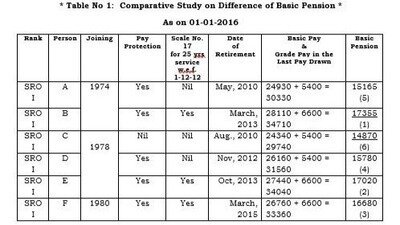
At present, the Additional Pension (AP) and the Additional Family Pension (AFP) are available to the original pensioner and family pensioner, as the case may be, in a manner that the benefits do not reach the Retired Persons or their dependants. The 20% AP is allowed to a retired person who lives 80 years and above. While the ‘National Average Expectation of Life’ is no more than 67 years, then, how could it be expected to benefit the retired persons? The 100% AP is allowed to a retired person who lives 100 years or more. The number of such lucky persons might be 1 in 1 crore of national population. The number of Centurion Retired Government Employee is hard to trace out. If it were not a joke and there was no lack of foresight, then your Honour must admit that the matter was nothing but a political gimmick. To reach the actual benefit of AP to the Retired Persons, I beg to suggest a restructured enhancement of AP, in the following manner : (see the attached image 1)
It is also suggested that the Government may be advised to prepare and publish a Database annually for each rank as on the 1st January of each calendar showing the structure of Pension or Family Pension of the persons retired / died during last twelve (12) months.
VIII) Fixation of Pension for those who retired before the Date of Revised Pay Scale
The Pension of the employees, retired before the date of effect of revised pay scale and pension, should be revised in accordance to the CPC formula, i.e, Firstly, the pension fixed under ROPA 2009 may be directly multiplied by 2.57 (assuming it as conversion factor) and Secondly, the pay may notionally be fixed in the pay matrix by adding No. of increments, he/she enjoyed in the unrevised pay scale / pay band before retirement @ 3% and 50% of such notional pay shall be taken into account.
Higher of the two will be fixed as his / her revised pension.
IX) House Rent Allowance
During fixation of the Basic Pension of a Retiree, the House Rent Allowance is not considered.
An employee is allowed House Rent Allowance (HRA) throughout its service period irrespective of its dwelling condition, excepting for those using the Government Quarters. Those who live in his own house, in his ancestral house or in his in-law’s house are allowed to receive HRA. It is supposed that the dwelling house is required to be maintained, the Municipal Taxes are to be paid etc. Hence, the HRA is allowed to all kinds of employees. The HRA, by thus, becomes a part of one’s Gross Pay and the employee has maintained a standard of living on the basis of such Gross Pay. After the retirement, abolition of HRA leaves the retired person in a great distress. Their Pay is halved, their Medical expense is soaring up, the Municipal Taxes are soaring up, their dwelling house is going to decay and the HRA is abolished! It is highly painful to the retired persons to maintain their livelihood.
In this circumstance, I strongly demand that the House Rent Allowance (HRA) should be considered in determination of Basic Pension as per the Last Pay Drawn.
X) Dearer Dearness Relief (DR)
Due to economic exigency, the State Government defers payment of regular DA to the tune of the same announced for the Central Government Employees. It should be borne in mind that the liabilities, as well as, establishment expenses of the family of the Retired Persons increases with time and their earnings (Pension) is halved. A part of the Medical Expenses may be meted out by the Health Scheme, but it does not eliminate the Medical Expenses totally till now. In many cases the Health Scheme does not benefit the Retired Persons due to absence of Empanelled Clinics in the vicinity. The delay in payment of DR causes hardship to all the Employees and Officers, but it affects the Retired Persons harshly.
Therefore, we demand that the Commission should make a suggestion for payment of the DA and DR to all the Employees and Retired persons
1) At the rate of the DA and DR announced by the Central Government,
2) The DA and DR be announced from the date of announcement of the Central Government.
3) The DA and DR be calculated on the basis of the AICPI and not any other fictitious Base Period or Mark.
XI) Family Pension
In India, the Family Pension has a root in the scriptures of Sukracharya in his Sloka No. 2414 of “Sukraneeti”, written in the 8th Century AD.
Mirza Nasrullah Baig Khan, the uncle and guardian of poet Mirza Ghalib after the death of his father, was the governor of Agra under the Marathas. The British appointed him an officer of 400 cavalrymen and fixed his salary at Rs.1700/- per month, and awarded him 2 parganas in Mathura. When he died in 1806, the British took away the parganas and fixed his pension at Rs.10,000/- per year, linked to the state of Firozepur Jhirka (Mewat, Haryana). The Nawab of Ferozepur Jhirka, however, reduced the pension to Rs.3000/- per year. Ghalib's share was Rs. 62.50 per month.
Like Pension, the Family Pension has its root in the history. The colonial Government awarded family pension to the successors of Nasrullah Baig Khan, including Mirza Ghalib, to the tune of 50% of his monthly salary. But the fact at present is somehow pathetic.
At present, the Family Pension of an employee who died within seven (7) years of his retirement is fixed at 30% of the Last Basic Pay (G O No.1020-F (Pen), dated 31-12-2007, No.1127-F (Pen), dated 27-10-1998). This process of calculation of Basic Family Pension is very regressive and oppressive. The Pension of an Employee after Retirement is a Right he earned through his service during his tenure. Therefore it cannot be curtailed with a simple logic of his death and it should be revised keeping pace with time.
After the death of a retired person within seven (7) years who have already lost his wife/husband, the Family Pension is distributed equally among the eligible children. On attainment of 25 yrs of age or marriage of a daughter, or having an employment, the son or daughter is disqualified for the benefit and the amount is forfeited by the state. It is not comprehensible why the state should forfeit the share of family-pension when there existed a spouse of the retired person. The BFP should be refixed and divided among the eligible persons after maturity of a son or marriage of a daughter. The change of stance be made to felicitate entire sum to the eligible spouse of the Retired Employee.
Hence, I strongly demand the specific Recommendations from the Pay Commission to abolish the present practice of curtailment of Basic Pension after the death of the Retired Employee even on or within the seven (7) year period. The Pension as fixed after retirement of an employee must be fully inherited by its eligible children in absence of his spouse.
XII) One Rank One Pension (OROP)
There are several practical reasons which force to create anomalies of Pension at the time of retirement among the employees of same rank.
(1) The first cause of anomalies is the length of service of an individual employee. The age of entering into the Govt. service spans over a long period of time (18 yrs to 40 yrs) with a fixed age of retirement which creates a difference of length of service among the employees. Greater the length of service, higher is the benefit of increment he earns.
(2) Secondly, the greater length of service of an employee gives him greater avenues of benefits, such as, having benefit of a Pay Commission in service, promotional benefit or an enhancement of scale of pay which do not have retrospective effect.
(3) Thirdly, promotion to the higher post is a subject of availability of berths. Hence, during promotion, all the candidates of one Batch may not get an opportunity of promotion at a time. This creates a difference in tenure of holding a rank which is another reason of causing anomalies.
(4) Fourthly, the structure of Pay changes as per recommendations of the Pay Commission and an employee is required to exercise his option of date of effect. Exercising option by an employee, based on inadequate information, at the time of Fixation of Pay causes difference in Pay.
All these reasons create difference in Last Pay Drawn by an employee at the time of retirement, but the standard of living of all employees of any rank is same as the structure of pay is devised in the same manner. Moreover the less amount of Pension of an employee to a junior one creates a humiliating and disgraceful condition among the seniors. To eliminate the anomalies of pay at the time of retirement, the “One Rank One Pension” (OROP) is a useful instrument which is demanded by the defence personnel for long since. Though the civil servants in all sectors felt the need of a redress of the anomalies, it is for the first time, the civil servants demanded the OROP before the Central Pay Commission and, as reported by the Times of India, the Central Pay Commission has recommended the One Rank One Pension (OROP) for all types of employee of the Defence and Civil departments. However, the Central Govt. has introduced OROP in the Defence Sector in a selective manner which I strongly condemn as it is a mean to divide-and-rule the struggling retired persons.
In the civilian sector, the OROP is introduced too in a sectarian manner. In 2008, the Prime Minister Manmohan Singh rewarded senior IAS, IFS and IPS officers with OROP at the apex scale in the government. The decision to grant OROP to the senior-most government servants was taken, not by the parliament, nor by any ministerial committee, but by the bureaucrats in the Department of Pensions and Pensioners' Welfare (DOP&PW), and the Prime Minister's Office. According to Avay Shukla, a former officer of the Indian Administrative Service, (1975 batch, Himachal Pradesh cadre), at the height of the OROP protests, in a newspaper article in 2015, revealed that Apex-OROP for the civil services was done slyly. As 'Apex-OROP 2008' was done secretly it has neither been discussed or scrutinized by the media, or the Ministry of Finance, and for this reason the matter remained little known, and only gained salience after the veterans started their protests. Apex grade OROP covers thousands of retired, serving, and future Civil Service officers, including 4802 IAS officers, 600 IFS officers and 4720 the IPS officers majority of whom because of their cadre structures are guaranteed that they will retire at the apex scale, not withstanding what their responsibilities or duties entail. J.K. Khanna, an IPS officer, who retired as DGP, and Avay Shukla, IAS, confirmed in 2015 that they, like other IAS and IPS officers, are getting Apex OROP. (Quoted from Wikipedia).
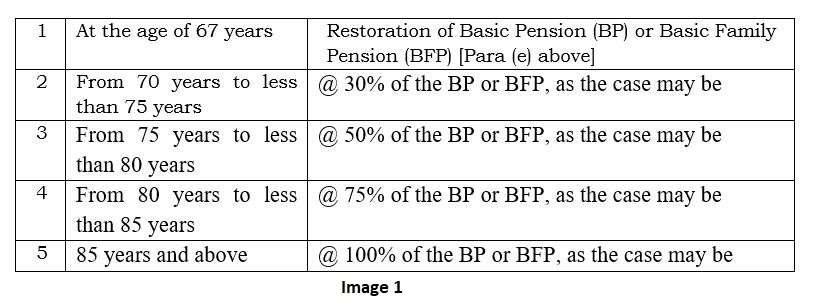
A comparative analysis of difference of pension for a particular rank may help understanding of the anomalies : (see the attached image 2)
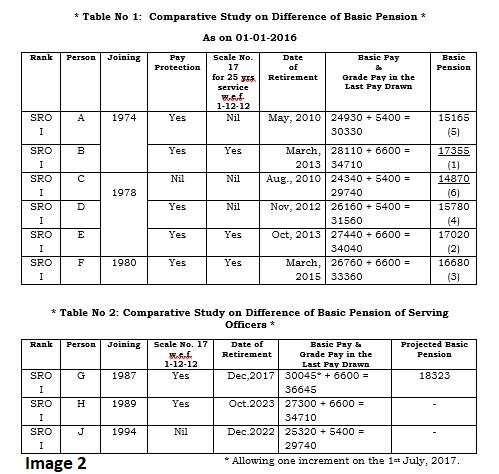
From the above comparative statement, it is evident that an employee is blessed with better salary on the date of retirement due to his birth being late. An order for the benefit of the employee without giving retrospective effect, benefits them who are born later. But crediting or discrediting an employee for his date of birth being earlier or later cannot be said a wise option. Moreover, allowing the Pay Protection, as per present system, is a matter of personal responsibility of the employee whereas giving the Pay is sole responsibility of the Government. I strongly object to this method as there is little scope for an employee to access the data of all persons superseding him in the State.
So long a person is in service, whenever a junior colleague supersedes him, his Pay is enhanced by an order (of Pay Protection) issued by the State Government. Thus the Pay of an employee is protected. Then, why the Pension of a Retired Employee shall not be protected when the Pension amount of a junior colleague supersedes his Pension? What is wrong with it? It must be borne in mind when a junior colleague or subordinate earns better Pension Amount than that he earns, a Senior Employee suffers “not only financially but also psychologically”. It is a question of dignity also. At present, the State Government has no singular database to provide information to its employees of the superseding colleagues or subordinates. Therefore it has become very difficult for an employee for making prayer for Pay Protection and to getting it approved in due time. (The undersigned and several others lost 2 increments in this process). Moreover, the Government announced a benefit of higher scale of Pay (Scale No. 17) after 25 years of continuous service to the Group -A & B Officers without giving any retrospective benefit. (This makes the undersigned or others to deprive of another 2 increments).
After retirement when the pay is halved, the said differences in Pension play a vital role in determining the livelihood. To avoid such anomalies, the One Rank One Pension is the best way out. The need of OROP is not only a requirement of the Defence Personnel or some selected IAS, IPS or IFS officers, but it is the need of the civil employees as a whole. This will help restore the Natural Justice.
As such, I strongly demand the introduction of OROP for the State Government (Civil) Employees and Other Category of Employees irrespective of the length of service and the tenure of holding the rank. I further demand the revision of Basic Pension of the retired employees as on the 1st January of each calendar year.
XIII) Health Scheme
The State Government has introduced a health insurance policy through the West Bengal Health Scheme, 2008 and West Bengal Health for all Employees and Pensioners Cashless Medical Treatment Scheme, 2014. These Schemes have benefited the employees and the pensioners marginally, as
1) The Empanelled Clinics are located in distant places and all the clinics do not have all the facilities needed.
2) There are two (2) Empanelled Clinics, in Barasat, North 24-Parganas, out of which one provides out-door clinic and the other does not. Even in the aforesaid out-door clinic, the physicians are not reputed ones and nor there is any infrastructure for all kind of treatments.
3) The Indoor Treatment and the expenses made on it are declared cashless by the West Bengal Health for all Employees and Pensioners Cashless Medical Treatment Scheme, 2014, but the Outdoor Treatment is left out of the ambit of the Scheme. There is no reason why the Empanelled Clinics shall not be allowed to Cashless Scheme for Outdoor Treatment.
4) The process of Reimbursement of Medical Bills is too cumbersome and in some cases it requires clarifications. In the absence of such clarifications, the Bills are pending at the hand of the ‘Medical Cell’ for a long period. For an example, the Root Canal Treatment with Crown (Code No. 01008068, costs Rs.3600/-) is a treatment for a dental disease. It is a package of treatments. In professional practice, the rate is closely resembles to the single tooth. But the Government Order does not clearly explain whether it is for one tooth or for a number of teeth and this is for this silly reason, Bills are not reimbursed for a period of 8 years. There are many other cases.
This compels the Govt. Employees to run to Kolkata for better treatment which is not practicable in all senses. If it be the case in Barasat, only 26 km away from Kolkata, then what happens in distant places may easily be presumed. Generally, the Employees and Pensioners have to go to non-panelled clinics for the sake of treatment at the time of crisis. But there is no avenue to reimbursement of these expenses even when the disease is listed one.
Hence, I beg to suggest that the Honourable Pay Commission should recommend for
1) The Cashless Scheme be extended to the Outdoor Treatment in the Empanelled Clinics, including free medicines,
2) Sufficient number of clinics in small towns should be encouraged to come under the umbrella of Health Scheme enabling the Govt. employees and retired persons to avail themselves of the benefits,
3) The Medical Bills for Outdoor Treatment for listed diseases should be reimbursed and the list should be extended to cover more diseases including chronic diseases,
4) The DDOs should be empowered to accord sanctions Medical Bills on the basis of generic names of the medicines available at the medical guides on the net,
5) Speedy disposal of the Reimbursement of Bills within 30 days of submission including quick supply of clarification in case of any ambiguity, and
6) Liquidation of large number of pending bills immediately.
On conclusion, I beg to pray before the Honourable 7th Pay Commission that it should recommend in a manner so that the sufferings and plight of an employee after retirement is lessened.
In general, I demand that the commission should suggest the State Govt. in a suitable way that an employee is not penalised or credited for his length of service which are beyond their control, protecting him by the way of “One Rank One Pension” formula.
The Memorandum is prepared and placed on good-faith and not to harm or dishonour or disrespect to anybody or any institution.
Sincerely Yours,
Pranab Bhattacharjee,
District Compensation Officer (Retired),
Retired Officers’ Association, WB (Unregistered),
North 24-Parganas
Dated, Barasat,
25-10-2026
Mob: 94330 30826

38
The Issue
This memorandum to the 7th Pay Commission of West Bengal, placed below, has been prepared by me, Pranab Bhattacharjee (District Compensation Officer, Rtd. - North 24 PGS). This covers the benefits of the entire employees & officers of the Govt. of West Bengal, such as - DA/DR, Family Pension, Commutation of Pension, OROP, Health Scheme and others.
I earnestly request all the readers to consider the memorandum stated below wisely and if he/she coincides with the prayers, he/she may accept/agree with the content of the statement which will be submitted before the Commissioner of the 7th Pay Commission, on or before the dated, 05=30 PM of 30/10/2026.
[পশ্চিমবঙ্গের সপ্তম বেতন কমিশনের নিকট পেশ করার জন্য নিম্নলিখিত স্মারকলিপিটি আমি, প্রণব ভট্টাচার্য (জেলা ক্ষতিপূরণ আধিকারিক, অবসরপ্রাপ্ত — উত্তর ২৪ পরগনা), প্রস্তুত করেছি। এই স্মারকলিপিতে পশ্চিমবঙ্গ সরকারের সমগ্র কর্মচারী ও আধিকারিকদের স্বার্থসংশ্লিষ্ট বিভিন্ন বিষয়, যেমন— মহার্ঘ ভাতা (DA/DR), পারিবারিক পেনশন, পেনশন কমিউটেশন, ওয়ান র্যাঙ্ক ওয়ান পেনশন (OROP), স্বাস্থ্য প্রকল্প এবং অন্যান্য সুযোগ-সুবিধার বিষয়গুলি অন্তর্ভুক্ত করা হয়েছে।
আমি সমস্ত পাঠক-পাঠিকাদের কাছে আন্তরিকভাবে আবেদন জানাচ্ছি, তাঁরা যেন নিম্নে উল্লিখিত স্মারকলিপিটি বিবেচনা করে দেখেন। স্মারকলিপিতে উত্থাপিত দাবিদাওয়া ও প্রার্থনাগুলির সঙ্গে যদি তাঁরা সহমত পোষণ করেন, তাহলে আগামী ৩০/১০/২০২৬ তারিখ বিকেল ৫টা ৩০ মিনিটের মধ্যে পশ্চিমবঙ্গের সপ্তম বেতন কমিশনের মাননীয় কমিশনারের নিকট পেশ করার জন্য নির্ধারিত এই বক্তব্যের বিষয়বস্তুর সঙ্গে সম্মতি জ্ঞাপন করে তা গ্রহণ ও সমর্থন করার জন্য এগিয়ে আসেন। সকলের সক্রিয় সহযোগিতা ও সমর্থন একান্তভাবে কামনা করি।]
Submission of Memorandum for Revision of Benefits, Before The 7th Pay Commission for the State Government Employees & Other Category of Employees, 2026
In addition to my earlier Memorandum, I do hereby submit my submission and explanation in support of my statements. As a singular entity, this Petition is made on my behalf, as well as, on behalf of all retired employees irrespective of their ranks. The point-wise analysis is placed below :
I) Retirement Pension Benefit -vs- NPS
I beg to justify the demand for Retirement Pension for the State Government Employees on several counts. It is not a God-gifted Rule, nor a Rule determined by the Nature, but the Rule is framed and bestowed upon himself by the Human being just like the clothes are chosen to cover their body. In prehistoric age, the clothes and garments were not essential part of livelihood, those were used in the winter only. The term modesty also came into civilization in the sixth century BC. Similarly, the need of Retirement Pension is not a contribution of the Welfare State, nor it is an achievement evolved in the age of Democratic States, but it has a root in the ancient history. There are some examples :
The Retirement Pension, as a benefit, is first traceable in Egypt. In the reign of Thutmose III (1479 BC - 1425 BC) the retired persons were allowed to have monthly food-grains like other old-age pension. But some good workers were offered some dignitary posts. Maya, a gallant soldier, was awarded the post of Governor and Chief of the Prophets. Another gallant soldier, Amenemone was rewarded the post of Steward of the funerary Temple of Thutmose III. There are several other examples of allowing benefits to the State employees after the retirement in that period. (www.touregypt.net/ featurestories/oldage.htm)
The Retirement Pension may also be traced in the Han Dynasty (206 BC - 220 AD) of China when retirement age was fixed at 70 yrs and the Pension is determined at one-third of the salary (if it were 2,000 dan) drawn at the end of one’s service, as shown by Jinfan Zhang in his book “The Tradition & Modern Transition of Chinese Law,” (Springer, NY, 2014).
In Europe, quoting texts of 1st Century historian Gaius Suetonius, Sara Elise Phang in her book “Roman Military Service,” (Cambridge University Press, 2008) showed that the Roman soldiers, in the 2nd and 1st century BC, were given an ad hoc Retirement Pension equivalent to twelve years’ salary. In 13 BC, Augustus formalised a pension plan for veteran legionnaires after completion of 20 years in service.
In India, the Retirement Pension is found dated back to the 8th Century AD, in the Sloka No. 2413 of “Sukraneeti” written by Sukracharya.
C G Lewin, in his book “Pensions and Insurance Before 1800 A Social History,” showed that the Retirement Pension was accorded to a Sergeant by Henry III in the 1269 AD. Later, in 1684 AD, another instance of granting Retirement Pension to a Senior Officer of Port of London is also available.
Instances of Retirement Pension are aplenty in the medieval period too. Records are also available that The East India Company granted Retirement Pensions to their Laskars even in colonial era of India. All these examples establish :
(1) The fact that the human being bestowed the Retirement Pension upon himself not only to protect the Government Servants after his retirement from service parallel to the old-age benefits but also devised to minimize competition in other field of businesses.
(2) It has gained the Right of an employee to have the benefit of pension on retirement.
(3) Alternatively, the National Pension Scheme, which follows the Bismarck Principle, is a concept which is almost regressive in nature and contradictory to the Human Civilization.
(4) The Pay of an employee is worked out on the basis of the Cost Price Index (CPI) and there is no room left in the CPI to accommodate the contribution to the NPS. Generally, the actual Pay paid to the employees is less than the Pay worked out mathematically.
Hence, it is prayed before the Commission not to suggest the NPS for the State Govt. Employees, instead of advising continuation of Retirement Pension.
II) Date of Effect and the Actual Benefit
From our bitter experience, I beg to mention that the Actual Benefit of the Pay Commission, in past, is not given to the Employees and Pensioners from the Date of Effect. We have a pathetic experience of forfeiting the arrear amount in the name of “Notional Fixation” at the hand of previous Government.
In past, during fixation of Pay, the previous Government re-fixed the Scale of Pay of the employees “Notionally” in terms of recommendations of the Pay Commissions. While the lexicographical meaning of “Notional” is ad valorum or ad hoc, the Pay of an employee was never fixed whimsically. It has a sound mathematical foundation and continuity and hence the forfeiture of Arrears by the State in the name of Notional Fixation is arbitrary and contradictory to the Right of Pay of an employee.
I beg to mention here that the Arrear paid to the Employees and the Pensioners causes a Big Push to the economy as a whole, as it is generally spent on the consumer goods and services which by turn gives an impetus to the production sector as well as local markets. Finally, it generates additional income and employment. Therefore this type of payment is to be considered as a “social investment” instead of expenditure.
I demand that the revised rate of Pay & Pension should be given from the 01 January, 2016, irrespective of date of publication of the Report of the 7th Pay Commission. It is further demanded that the Actual Effect be given on the Date of Effect with full Arrear Payment from the Date of Effect from the stand point of all logical grounds as well as a Big Push to the State Economy.
III) Procedural Method of Determination of Pension
In my earlier Memorandum, I have criticised the procedure of determination of Basic Pension. I do not find any sane and thoughtful logic behind the halving (50%) of the Last Pay Drawn on the date of retirement. The need of a person cannot be halved on the day immediate after retirement. Their bill for the electric consumption shall not be halved, their bill for the domestic help shall not be halved or their social responsibilities shall not be halved. Then, why the Pension shall be halved? It might be thought that the retired persons do not contribute anything to the State. But the Government has already admitted the amount paid to a retired person is not a salary, it is a kind of deferred payment, and then why it is curtailed?
It is expected that the 7th Pay Commission shall show its deep insight on this point and recommend better Pension structure of a Two-Third (66.6%) of the Last Pay Drawn.
IV) Full Pension Benefit
As the social crises are increasing in a faster pace and the age of entry into the Service is time to time relaxed, the Full Pension Benefit may suitably be awarded to an employee after completion of 15 years of continuous service or 60 years of age, whichever is earlier.
V) Restoration of Commuted Value of Pension
It is presumed that a retiree shall invest his money received as the Gratuity and commutation of Pension and earn sufficient amount of interest and dividend by investing the same. But the fact is that a retired person are generally burdened at the time of retirement with the marriage of his daughter(s), higher education of his son and daughter, maintenance of the dwelling house, treatment of ailing parent or wife etc. All these historically evolved responsibilities make the fund volatile and their hands tied with a knot. From the very beginning of their service, the State Govt. Employees are not conversant with the share-market mechanism as their job does not permit it. They invest their small fund in the Fixed Deposits and MIS, the rate of interest of which has shrunk enormously (from 11.25% in the nineties to 7.75% on FDs and 13% in the nineties to 7.3% on MIS at present). Since the value of money is increasingly falling on the face of rising prices and the purchasing power is depreciated, the Commuted Value of Pension may be restored after seven (7) years of retirement to enable the retiree to cope with the inflationary threat.
The State admits the depreciation of money value of pension by allowing an Additional Pension (AP) on the fractured Basic Pension after certain age. Before allowing AP, it is suggested that the Basic Pension (BP) should be restored on the same logic and I do hereby demand the restoration of Basic Pension (BP) at the age of 67 year.
VI) Enhancing Gratuity Ceiling
Since the Gross Pay of the employees shall be increased after implementation of the Recommendations of the Pay Commission, the Ceiling of the Gratuity should simultaneously be raised to Rupees 20/- lakh to maintain the Natural Justice.
VII) Additional Pension
The Additional Pension (AP), as currently available on the fractured Basic Pension, should be restructured.
At present, the Additional Pension (AP) and the Additional Family Pension (AFP) are available to the original pensioner and family pensioner, as the case may be, in a manner that the benefits do not reach the Retired Persons or their dependants. The 20% AP is allowed to a retired person who lives 80 years and above. While the ‘National Average Expectation of Life’ is no more than 67 years, then, how could it be expected to benefit the retired persons? The 100% AP is allowed to a retired person who lives 100 years or more. The number of such lucky persons might be 1 in 1 crore of national population. The number of Centurion Retired Government Employee is hard to trace out. If it were not a joke and there was no lack of foresight, then your Honour must admit that the matter was nothing but a political gimmick. To reach the actual benefit of AP to the Retired Persons, I beg to suggest a restructured enhancement of AP, in the following manner : (see the attached image 1)
It is also suggested that the Government may be advised to prepare and publish a Database annually for each rank as on the 1st January of each calendar showing the structure of Pension or Family Pension of the persons retired / died during last twelve (12) months.
VIII) Fixation of Pension for those who retired before the Date of Revised Pay Scale
The Pension of the employees, retired before the date of effect of revised pay scale and pension, should be revised in accordance to the CPC formula, i.e, Firstly, the pension fixed under ROPA 2009 may be directly multiplied by 2.57 (assuming it as conversion factor) and Secondly, the pay may notionally be fixed in the pay matrix by adding No. of increments, he/she enjoyed in the unrevised pay scale / pay band before retirement @ 3% and 50% of such notional pay shall be taken into account.
Higher of the two will be fixed as his / her revised pension.
IX) House Rent Allowance
During fixation of the Basic Pension of a Retiree, the House Rent Allowance is not considered.
An employee is allowed House Rent Allowance (HRA) throughout its service period irrespective of its dwelling condition, excepting for those using the Government Quarters. Those who live in his own house, in his ancestral house or in his in-law’s house are allowed to receive HRA. It is supposed that the dwelling house is required to be maintained, the Municipal Taxes are to be paid etc. Hence, the HRA is allowed to all kinds of employees. The HRA, by thus, becomes a part of one’s Gross Pay and the employee has maintained a standard of living on the basis of such Gross Pay. After the retirement, abolition of HRA leaves the retired person in a great distress. Their Pay is halved, their Medical expense is soaring up, the Municipal Taxes are soaring up, their dwelling house is going to decay and the HRA is abolished! It is highly painful to the retired persons to maintain their livelihood.
In this circumstance, I strongly demand that the House Rent Allowance (HRA) should be considered in determination of Basic Pension as per the Last Pay Drawn.
X) Dearer Dearness Relief (DR)
Due to economic exigency, the State Government defers payment of regular DA to the tune of the same announced for the Central Government Employees. It should be borne in mind that the liabilities, as well as, establishment expenses of the family of the Retired Persons increases with time and their earnings (Pension) is halved. A part of the Medical Expenses may be meted out by the Health Scheme, but it does not eliminate the Medical Expenses totally till now. In many cases the Health Scheme does not benefit the Retired Persons due to absence of Empanelled Clinics in the vicinity. The delay in payment of DR causes hardship to all the Employees and Officers, but it affects the Retired Persons harshly.
Therefore, we demand that the Commission should make a suggestion for payment of the DA and DR to all the Employees and Retired persons
1) At the rate of the DA and DR announced by the Central Government,
2) The DA and DR be announced from the date of announcement of the Central Government.
3) The DA and DR be calculated on the basis of the AICPI and not any other fictitious Base Period or Mark.
XI) Family Pension
In India, the Family Pension has a root in the scriptures of Sukracharya in his Sloka No. 2414 of “Sukraneeti”, written in the 8th Century AD.
Mirza Nasrullah Baig Khan, the uncle and guardian of poet Mirza Ghalib after the death of his father, was the governor of Agra under the Marathas. The British appointed him an officer of 400 cavalrymen and fixed his salary at Rs.1700/- per month, and awarded him 2 parganas in Mathura. When he died in 1806, the British took away the parganas and fixed his pension at Rs.10,000/- per year, linked to the state of Firozepur Jhirka (Mewat, Haryana). The Nawab of Ferozepur Jhirka, however, reduced the pension to Rs.3000/- per year. Ghalib's share was Rs. 62.50 per month.
Like Pension, the Family Pension has its root in the history. The colonial Government awarded family pension to the successors of Nasrullah Baig Khan, including Mirza Ghalib, to the tune of 50% of his monthly salary. But the fact at present is somehow pathetic.
At present, the Family Pension of an employee who died within seven (7) years of his retirement is fixed at 30% of the Last Basic Pay (G O No.1020-F (Pen), dated 31-12-2007, No.1127-F (Pen), dated 27-10-1998). This process of calculation of Basic Family Pension is very regressive and oppressive. The Pension of an Employee after Retirement is a Right he earned through his service during his tenure. Therefore it cannot be curtailed with a simple logic of his death and it should be revised keeping pace with time.
After the death of a retired person within seven (7) years who have already lost his wife/husband, the Family Pension is distributed equally among the eligible children. On attainment of 25 yrs of age or marriage of a daughter, or having an employment, the son or daughter is disqualified for the benefit and the amount is forfeited by the state. It is not comprehensible why the state should forfeit the share of family-pension when there existed a spouse of the retired person. The BFP should be refixed and divided among the eligible persons after maturity of a son or marriage of a daughter. The change of stance be made to felicitate entire sum to the eligible spouse of the Retired Employee.
Hence, I strongly demand the specific Recommendations from the Pay Commission to abolish the present practice of curtailment of Basic Pension after the death of the Retired Employee even on or within the seven (7) year period. The Pension as fixed after retirement of an employee must be fully inherited by its eligible children in absence of his spouse.
XII) One Rank One Pension (OROP)
There are several practical reasons which force to create anomalies of Pension at the time of retirement among the employees of same rank.
(1) The first cause of anomalies is the length of service of an individual employee. The age of entering into the Govt. service spans over a long period of time (18 yrs to 40 yrs) with a fixed age of retirement which creates a difference of length of service among the employees. Greater the length of service, higher is the benefit of increment he earns.
(2) Secondly, the greater length of service of an employee gives him greater avenues of benefits, such as, having benefit of a Pay Commission in service, promotional benefit or an enhancement of scale of pay which do not have retrospective effect.
(3) Thirdly, promotion to the higher post is a subject of availability of berths. Hence, during promotion, all the candidates of one Batch may not get an opportunity of promotion at a time. This creates a difference in tenure of holding a rank which is another reason of causing anomalies.
(4) Fourthly, the structure of Pay changes as per recommendations of the Pay Commission and an employee is required to exercise his option of date of effect. Exercising option by an employee, based on inadequate information, at the time of Fixation of Pay causes difference in Pay.
All these reasons create difference in Last Pay Drawn by an employee at the time of retirement, but the standard of living of all employees of any rank is same as the structure of pay is devised in the same manner. Moreover the less amount of Pension of an employee to a junior one creates a humiliating and disgraceful condition among the seniors. To eliminate the anomalies of pay at the time of retirement, the “One Rank One Pension” (OROP) is a useful instrument which is demanded by the defence personnel for long since. Though the civil servants in all sectors felt the need of a redress of the anomalies, it is for the first time, the civil servants demanded the OROP before the Central Pay Commission and, as reported by the Times of India, the Central Pay Commission has recommended the One Rank One Pension (OROP) for all types of employee of the Defence and Civil departments. However, the Central Govt. has introduced OROP in the Defence Sector in a selective manner which I strongly condemn as it is a mean to divide-and-rule the struggling retired persons.
In the civilian sector, the OROP is introduced too in a sectarian manner. In 2008, the Prime Minister Manmohan Singh rewarded senior IAS, IFS and IPS officers with OROP at the apex scale in the government. The decision to grant OROP to the senior-most government servants was taken, not by the parliament, nor by any ministerial committee, but by the bureaucrats in the Department of Pensions and Pensioners' Welfare (DOP&PW), and the Prime Minister's Office. According to Avay Shukla, a former officer of the Indian Administrative Service, (1975 batch, Himachal Pradesh cadre), at the height of the OROP protests, in a newspaper article in 2015, revealed that Apex-OROP for the civil services was done slyly. As 'Apex-OROP 2008' was done secretly it has neither been discussed or scrutinized by the media, or the Ministry of Finance, and for this reason the matter remained little known, and only gained salience after the veterans started their protests. Apex grade OROP covers thousands of retired, serving, and future Civil Service officers, including 4802 IAS officers, 600 IFS officers and 4720 the IPS officers majority of whom because of their cadre structures are guaranteed that they will retire at the apex scale, not withstanding what their responsibilities or duties entail. J.K. Khanna, an IPS officer, who retired as DGP, and Avay Shukla, IAS, confirmed in 2015 that they, like other IAS and IPS officers, are getting Apex OROP. (Quoted from Wikipedia).
A comparative analysis of difference of pension for a particular rank may help understanding of the anomalies : (see the attached image 2)
From the above comparative statement, it is evident that an employee is blessed with better salary on the date of retirement due to his birth being late. An order for the benefit of the employee without giving retrospective effect, benefits them who are born later. But crediting or discrediting an employee for his date of birth being earlier or later cannot be said a wise option. Moreover, allowing the Pay Protection, as per present system, is a matter of personal responsibility of the employee whereas giving the Pay is sole responsibility of the Government. I strongly object to this method as there is little scope for an employee to access the data of all persons superseding him in the State.
So long a person is in service, whenever a junior colleague supersedes him, his Pay is enhanced by an order (of Pay Protection) issued by the State Government. Thus the Pay of an employee is protected. Then, why the Pension of a Retired Employee shall not be protected when the Pension amount of a junior colleague supersedes his Pension? What is wrong with it? It must be borne in mind when a junior colleague or subordinate earns better Pension Amount than that he earns, a Senior Employee suffers “not only financially but also psychologically”. It is a question of dignity also. At present, the State Government has no singular database to provide information to its employees of the superseding colleagues or subordinates. Therefore it has become very difficult for an employee for making prayer for Pay Protection and to getting it approved in due time. (The undersigned and several others lost 2 increments in this process). Moreover, the Government announced a benefit of higher scale of Pay (Scale No. 17) after 25 years of continuous service to the Group -A & B Officers without giving any retrospective benefit. (This makes the undersigned or others to deprive of another 2 increments).
After retirement when the pay is halved, the said differences in Pension play a vital role in determining the livelihood. To avoid such anomalies, the One Rank One Pension is the best way out. The need of OROP is not only a requirement of the Defence Personnel or some selected IAS, IPS or IFS officers, but it is the need of the civil employees as a whole. This will help restore the Natural Justice.
As such, I strongly demand the introduction of OROP for the State Government (Civil) Employees and Other Category of Employees irrespective of the length of service and the tenure of holding the rank. I further demand the revision of Basic Pension of the retired employees as on the 1st January of each calendar year.
XIII) Health Scheme
The State Government has introduced a health insurance policy through the West Bengal Health Scheme, 2008 and West Bengal Health for all Employees and Pensioners Cashless Medical Treatment Scheme, 2014. These Schemes have benefited the employees and the pensioners marginally, as
1) The Empanelled Clinics are located in distant places and all the clinics do not have all the facilities needed.
2) There are two (2) Empanelled Clinics, in Barasat, North 24-Parganas, out of which one provides out-door clinic and the other does not. Even in the aforesaid out-door clinic, the physicians are not reputed ones and nor there is any infrastructure for all kind of treatments.
3) The Indoor Treatment and the expenses made on it are declared cashless by the West Bengal Health for all Employees and Pensioners Cashless Medical Treatment Scheme, 2014, but the Outdoor Treatment is left out of the ambit of the Scheme. There is no reason why the Empanelled Clinics shall not be allowed to Cashless Scheme for Outdoor Treatment.
4) The process of Reimbursement of Medical Bills is too cumbersome and in some cases it requires clarifications. In the absence of such clarifications, the Bills are pending at the hand of the ‘Medical Cell’ for a long period. For an example, the Root Canal Treatment with Crown (Code No. 01008068, costs Rs.3600/-) is a treatment for a dental disease. It is a package of treatments. In professional practice, the rate is closely resembles to the single tooth. But the Government Order does not clearly explain whether it is for one tooth or for a number of teeth and this is for this silly reason, Bills are not reimbursed for a period of 8 years. There are many other cases.
This compels the Govt. Employees to run to Kolkata for better treatment which is not practicable in all senses. If it be the case in Barasat, only 26 km away from Kolkata, then what happens in distant places may easily be presumed. Generally, the Employees and Pensioners have to go to non-panelled clinics for the sake of treatment at the time of crisis. But there is no avenue to reimbursement of these expenses even when the disease is listed one.
Hence, I beg to suggest that the Honourable Pay Commission should recommend for
1) The Cashless Scheme be extended to the Outdoor Treatment in the Empanelled Clinics, including free medicines,
2) Sufficient number of clinics in small towns should be encouraged to come under the umbrella of Health Scheme enabling the Govt. employees and retired persons to avail themselves of the benefits,
3) The Medical Bills for Outdoor Treatment for listed diseases should be reimbursed and the list should be extended to cover more diseases including chronic diseases,
4) The DDOs should be empowered to accord sanctions Medical Bills on the basis of generic names of the medicines available at the medical guides on the net,
5) Speedy disposal of the Reimbursement of Bills within 30 days of submission including quick supply of clarification in case of any ambiguity, and
6) Liquidation of large number of pending bills immediately.
On conclusion, I beg to pray before the Honourable 7th Pay Commission that it should recommend in a manner so that the sufferings and plight of an employee after retirement is lessened.
In general, I demand that the commission should suggest the State Govt. in a suitable way that an employee is not penalised or credited for his length of service which are beyond their control, protecting him by the way of “One Rank One Pension” formula.
The Memorandum is prepared and placed on good-faith and not to harm or dishonour or disrespect to anybody or any institution.
Sincerely Yours,
Pranab Bhattacharjee,
District Compensation Officer (Retired),
Retired Officers’ Association, WB (Unregistered),
North 24-Parganas
Dated, Barasat,
25-10-2026
Mob: 94330 30826
Petition Updates
Share this petition
Petition created on 25 October 2026