
MD Students & Residents Request the Establishment of a "CDU COM Silent Exam Prep Room"
The Issue
Medical students (MD students) and physician residents within Charles R. Drew University of Medicine and Science’s College of Medicine (CDU COM) are currently struggling to find consistent quiet spaces to prepare for STEP, Shelf exams, and other major exams. This makes it challenging for MD students and physician residents to complete uninterrupted practice exams or maintain a focused study environment without relying on noise canceling headphones or other measures to block out distractions. It especially adds another barrier to succeeding for neurodivergent students and those who require studying accommodations.
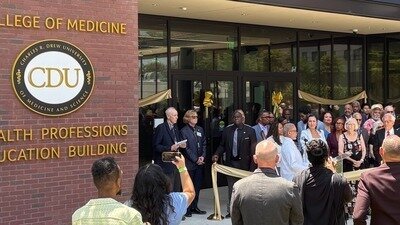
At CDU, there are currently no designated silent study spaces and only two quiet study spaces available to all CDU students that include the 4th floor in the new Health Professions Education Building (HPEB), which has housed CDU COM since July 2026, and the CDU Library in the Cobb Building. Unfortunately, neither space consistently provides a quiet, distraction free environment. Although quiet study rules are posted throughout these spaces and CDU leadership has sent multiple reminders by email, the rules are not consistently respected by students. The location of the HPEB quiet space also presents an additional challenge. It is situated directly in front of the student lounge and rooftop terrace, areas that are intentionally designed for students to gather and socialize. Although a wall separates the quiet space from these areas, sound carries easily, particularly during high traffic periods such as lunch. As a result, students who are actively taking an exam or preparing for STEP, shelf exams, or other major examinations experience frequent distractions that interfere with their ability to study and test effectively, including doors opening and closing, conversations, and students walking through or around the space.
Although CDU COM offers proctored practice testing on Fridays, this provides students with only one day per week with temporary access to a consistent and silent practice exam environment. Additionally, as of August 10, 2026, MD students no longer have access to reserve the CDU Testing Center for proctored practice exams due to limited space. As a result, students preparing for major exams often have to move between different locations, both on and off campus to find a silent space. This makes it difficult to establish a consistent study routine and find a reliable location where students can complete practice exams in testing conditions without interruptions or the use of items not allowed during actual test day.
Under the current study space reservation system, HPEB allows CDU MD students to make one 4-hour reservation per day, and reservations can only be made on the same day through an Ad Astra QR code designated specifically for MD students. In comparison, the Cobb Building allows students to make one 4-hour reservation up to 24 hours in advance through the university-wide Ad Astra system, while the CDU Library allows reservations of up to 2 hours. Neither building currently permits recurring room reservations. Although these limitations are intended to promote fair access and equitable use of study spaces, they make it difficult for MD students and physician residents to plan ahead and maintain a consistent study environment. This is particularly challenging during dedicated periods of exam preparation, when students may need to study for prolonged and intensive periods each day.
The current 4-hour reservation limit is not sufficient for students engaged in intensive exam preparation. MD students currently in dedicated STEP 1 preparation often must rely on classmates to reserve the same room immediately before or after their own reservation in order to extend their access for up to 8 hours. When this is not possible, students must pack their materials and relocate to another study space, disrupting their concentration, study flow, and continuity. Repeatedly changing study environments can make it more difficult to maintain a consistent and productive study routine during an already demanding period of exam preparation.
Additionally, some students have entered study spaces at Cobb that appeared to be available on the Ad Astra calendars and door screens without completing a reservation through the Ad Astra system because same day reservations at Cobb are not offered. These students were then approached by CDU faculty during their study sessions and reminded that a formal reservation was required. When asked why a reservation was required, CDU faculty explained that reservations are necessary for data collection purposes. We understand the value of collecting data on how study spaces are being used, similar to the CDU Library's practice of requiring students to check in for this purpose. However, this has created confusion because CDU Leadership sent an email on August 13, 2026 regarding HPEB that stated, “We recognize that some of the most productive study sessions extend well beyond four hours. If no one has reserved the room after your scheduled block ends, you are welcome to continue using the space. You may also use a room that appears empty, check the door panel to confirm no reservation is listed, and please yield the space if someone arrives with a reservation.” Although this email specifically addressed HPEB, students applied the same principle to study spaces in Cobb. We understand that HPEB and Cobb are managed by different teams, but we hope CDU can establish consistent reservation policies across all study spaces so students have clear and consistent expectations regarding the use of available study spaces.
According to a 2024 study, 44.6% of medical students reported studying 9- 11 hours per day during their dedicated STEP 1 preparation period. This substantially exceeds the current 4-hour daily reservation limit and highlights the need for students to have more consistent access to a silent dedicated study environment (Source: Wang, 2024).
Additionally, a 2018 study surveyed the impact of a new medical school building on student experiences emphasized the importance of considering how physical space can influence and shape students’ learning experiences and professional identity development. The authors highlighted that these considerations are particularly important when planning new medical school learning spaces or modifying existing ones (Source: Hawick, 2018).
In 2025, when CDU COM was located in Cobb and quiet study spaces were primarily limited to the CDU Library, Cobb Workrooms A- D were made exclusively available to the Class of 2027 during their STEP 1 dedicated period. These spaces were available as drop- in study spaces and did not require individual reservations from students. Although this arrangement was not provided to the Class of 2028, it demonstrates that CDU has previously provided MD students with consistent and accessible silent study spaces during intensive exam preparation.
A similar system could be implemented today to allow multiple MD students and physician residents to use a designated space throughout an entire study day, which can typically range from approximately 9 to 11 hours during dedicated exam preparation. CDU could also designate a specific room exclusively for students actively preparing for STEP, shelf exams, or other major examinations. Another option would be to designate an entire floor of HPEB as a silent study floor. Alternatively, the current quiet room could be re-designated as a collaborative workroom instead of a quiet room, which may better align with its location near the student lounge and rooftop terrace, while a separate room on another floor could be established as a dedicated silent study space.
After speaking with CDU physician residents and MD students at medical schools across the United States, such as the University of Texas and UC Davis, we learned that it is common for medical schools to restrict access to designated study spaces by requiring visitors to present an MD student or physician resident ID either to security or by scanning. These access policies help establish study environments specifically designated for MD students and physician residents. This demonstrates that dedicated study spaces with controlled access for MD students and physician residents are already being implemented at other medical school institutions.
Given that the MD program has the highest annual tuition at CDU at $69,000 per student, with approximately 240 students, as well as the highest number of national board examinations required for graduation among CDU’s health programs, the CDU COM Classes of 2027 through 2030 are requesting the establishment of a dedicated “CDU COM Silent Exam Prep Room” in HPEB. This space would be available to medical students and physician residents who are actively preparing for or scheduled to take STEP, a shelf examination, or another major examination.
Establishing this space would not require additional costs unless CDU chooses to add dedicated signage, similar to the existing LA Care room. One potential space that could be designated for this purpose is the Stovall Foundation Study Room on the second floor of HPEB which can accommodate 15 people. The room is already equipped with a security access device, which could allow CDU to provide designated access cards to students and physician residents who are actively preparing for STEP, a shelf examination, or another major examination.
The proposed space would provide medical students and physician residents with a consistent, silent, and distraction free environment where they could study for extended periods and complete non proctored practice examinations. We hope that establishing this space would provide additional support for students and residents preparing for major examinations while also supporting CDU’s commitment to student success and meeting the national board examination standards associated with LCME accreditation.
Thank you,
The CDU COM Classes of 2027- 2030
__________________________________
PLEASE NOTE: While this petition is intended to support CDU MD students and resident physicians, we welcome support from everyone in the CDU community and beyond.
No donation is required to sign or support this petition. If you choose to make a donation, your contribution will go directly to Change.org and will not be received by or benefit the organizers of this petition.

80
The Issue
Medical students (MD students) and physician residents within Charles R. Drew University of Medicine and Science’s College of Medicine (CDU COM) are currently struggling to find consistent quiet spaces to prepare for STEP, Shelf exams, and other major exams. This makes it challenging for MD students and physician residents to complete uninterrupted practice exams or maintain a focused study environment without relying on noise canceling headphones or other measures to block out distractions. It especially adds another barrier to succeeding for neurodivergent students and those who require studying accommodations.
At CDU, there are currently no designated silent study spaces and only two quiet study spaces available to all CDU students that include the 4th floor in the new Health Professions Education Building (HPEB), which has housed CDU COM since July 2026, and the CDU Library in the Cobb Building. Unfortunately, neither space consistently provides a quiet, distraction free environment. Although quiet study rules are posted throughout these spaces and CDU leadership has sent multiple reminders by email, the rules are not consistently respected by students. The location of the HPEB quiet space also presents an additional challenge. It is situated directly in front of the student lounge and rooftop terrace, areas that are intentionally designed for students to gather and socialize. Although a wall separates the quiet space from these areas, sound carries easily, particularly during high traffic periods such as lunch. As a result, students who are actively taking an exam or preparing for STEP, shelf exams, or other major examinations experience frequent distractions that interfere with their ability to study and test effectively, including doors opening and closing, conversations, and students walking through or around the space.
Although CDU COM offers proctored practice testing on Fridays, this provides students with only one day per week with temporary access to a consistent and silent practice exam environment. Additionally, as of August 10, 2026, MD students no longer have access to reserve the CDU Testing Center for proctored practice exams due to limited space. As a result, students preparing for major exams often have to move between different locations, both on and off campus to find a silent space. This makes it difficult to establish a consistent study routine and find a reliable location where students can complete practice exams in testing conditions without interruptions or the use of items not allowed during actual test day.
Under the current study space reservation system, HPEB allows CDU MD students to make one 4-hour reservation per day, and reservations can only be made on the same day through an Ad Astra QR code designated specifically for MD students. In comparison, the Cobb Building allows students to make one 4-hour reservation up to 24 hours in advance through the university-wide Ad Astra system, while the CDU Library allows reservations of up to 2 hours. Neither building currently permits recurring room reservations. Although these limitations are intended to promote fair access and equitable use of study spaces, they make it difficult for MD students and physician residents to plan ahead and maintain a consistent study environment. This is particularly challenging during dedicated periods of exam preparation, when students may need to study for prolonged and intensive periods each day.
The current 4-hour reservation limit is not sufficient for students engaged in intensive exam preparation. MD students currently in dedicated STEP 1 preparation often must rely on classmates to reserve the same room immediately before or after their own reservation in order to extend their access for up to 8 hours. When this is not possible, students must pack their materials and relocate to another study space, disrupting their concentration, study flow, and continuity. Repeatedly changing study environments can make it more difficult to maintain a consistent and productive study routine during an already demanding period of exam preparation.
Additionally, some students have entered study spaces at Cobb that appeared to be available on the Ad Astra calendars and door screens without completing a reservation through the Ad Astra system because same day reservations at Cobb are not offered. These students were then approached by CDU faculty during their study sessions and reminded that a formal reservation was required. When asked why a reservation was required, CDU faculty explained that reservations are necessary for data collection purposes. We understand the value of collecting data on how study spaces are being used, similar to the CDU Library's practice of requiring students to check in for this purpose. However, this has created confusion because CDU Leadership sent an email on August 13, 2026 regarding HPEB that stated, “We recognize that some of the most productive study sessions extend well beyond four hours. If no one has reserved the room after your scheduled block ends, you are welcome to continue using the space. You may also use a room that appears empty, check the door panel to confirm no reservation is listed, and please yield the space if someone arrives with a reservation.” Although this email specifically addressed HPEB, students applied the same principle to study spaces in Cobb. We understand that HPEB and Cobb are managed by different teams, but we hope CDU can establish consistent reservation policies across all study spaces so students have clear and consistent expectations regarding the use of available study spaces.
According to a 2024 study, 44.6% of medical students reported studying 9- 11 hours per day during their dedicated STEP 1 preparation period. This substantially exceeds the current 4-hour daily reservation limit and highlights the need for students to have more consistent access to a silent dedicated study environment (Source: Wang, 2024).
Additionally, a 2018 study surveyed the impact of a new medical school building on student experiences emphasized the importance of considering how physical space can influence and shape students’ learning experiences and professional identity development. The authors highlighted that these considerations are particularly important when planning new medical school learning spaces or modifying existing ones (Source: Hawick, 2018).
In 2025, when CDU COM was located in Cobb and quiet study spaces were primarily limited to the CDU Library, Cobb Workrooms A- D were made exclusively available to the Class of 2027 during their STEP 1 dedicated period. These spaces were available as drop- in study spaces and did not require individual reservations from students. Although this arrangement was not provided to the Class of 2028, it demonstrates that CDU has previously provided MD students with consistent and accessible silent study spaces during intensive exam preparation.
A similar system could be implemented today to allow multiple MD students and physician residents to use a designated space throughout an entire study day, which can typically range from approximately 9 to 11 hours during dedicated exam preparation. CDU could also designate a specific room exclusively for students actively preparing for STEP, shelf exams, or other major examinations. Another option would be to designate an entire floor of HPEB as a silent study floor. Alternatively, the current quiet room could be re-designated as a collaborative workroom instead of a quiet room, which may better align with its location near the student lounge and rooftop terrace, while a separate room on another floor could be established as a dedicated silent study space.
After speaking with CDU physician residents and MD students at medical schools across the United States, such as the University of Texas and UC Davis, we learned that it is common for medical schools to restrict access to designated study spaces by requiring visitors to present an MD student or physician resident ID either to security or by scanning. These access policies help establish study environments specifically designated for MD students and physician residents. This demonstrates that dedicated study spaces with controlled access for MD students and physician residents are already being implemented at other medical school institutions.
Given that the MD program has the highest annual tuition at CDU at $69,000 per student, with approximately 240 students, as well as the highest number of national board examinations required for graduation among CDU’s health programs, the CDU COM Classes of 2027 through 2030 are requesting the establishment of a dedicated “CDU COM Silent Exam Prep Room” in HPEB. This space would be available to medical students and physician residents who are actively preparing for or scheduled to take STEP, a shelf examination, or another major examination.
Establishing this space would not require additional costs unless CDU chooses to add dedicated signage, similar to the existing LA Care room. One potential space that could be designated for this purpose is the Stovall Foundation Study Room on the second floor of HPEB which can accommodate 15 people. The room is already equipped with a security access device, which could allow CDU to provide designated access cards to students and physician residents who are actively preparing for STEP, a shelf examination, or another major examination.
The proposed space would provide medical students and physician residents with a consistent, silent, and distraction free environment where they could study for extended periods and complete non proctored practice examinations. We hope that establishing this space would provide additional support for students and residents preparing for major examinations while also supporting CDU’s commitment to student success and meeting the national board examination standards associated with LCME accreditation.
Thank you,
The CDU COM Classes of 2027- 2030
__________________________________
PLEASE NOTE: While this petition is intended to support CDU MD students and resident physicians, we welcome support from everyone in the CDU community and beyond.
No donation is required to sign or support this petition. If you choose to make a donation, your contribution will go directly to Change.org and will not be received by or benefit the organizers of this petition.
The Decision Makers

Petition Updates
Share this petition
Petition created on September 15, 2026