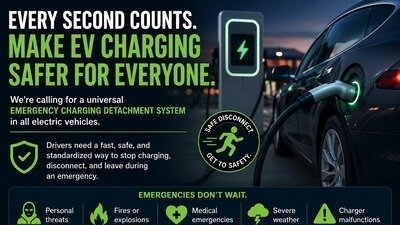

Mandate emergency breakaway disconnects at all EV chargers
The Issue
You are parked at a public charging station. It's dark. Someone is walking toward your car, and something is wrong.
Your instinct is the one you've had your entire driving life: get in, lock the doors, go.
You can't. Your car will not move.
Every electric vehicle sold in the United States is electrically immobilized while the charging connector is latched into the port. Press the brake, shift into Drive, and the car refuses — a Tesla simply displays "Unable to Drive — Check Charge Port." This isn't a defect and it isn't one company's decision. It's a hard interlock between the charge port and the drive system, written into the industry standard nearly every EV follows.
To leave, you have to stop the charging session, unlock the port, get out of your vehicle, walk around to the charge port, press the release, pull the cable free, and get back in.
There is no version of that sequence that works when someone is already at your window.
Gasoline cars solved this decades ago. Drive off with the nozzle still in your tank and the hose separates at a breakaway coupling, seals itself on both ends, and you leave. That isn't luck — it's required by fire code, because the industry recognized long ago that a driver might need to leave immediately and the fueling equipment must never be the thing that stops them.
Electric charging reversed that principle without telling anyone. The connector became a kill switch on the drivetrain.
Here is what makes this fixable today: the safety objection has already been answered. The National Electrical Code has required since at least 2008 that EV charging cables automatically cut power the instant they're placed under enough strain to separate. The current shuts off before anything comes apart. Purpose-built breakaway connectors go further still, using shorter signal pins so the charging session ends before any power pin ever moves. No arcing. No live cable.
A small company already sells a breakaway adapter that does exactly this — it lets a driver disconnect and pull away without ever leaving the vehicle, splitting cleanly at a designed seam so neither the car nor the charging station is damaged. Their own stated goal is that this should be built into every EV from the factory.
We agree. Personal safety should not be a paid accessory available only to drivers who happened to hear about it.
To be clear: this is not an argument that electric vehicles are dangerous. Sweden's national civil protection agency found EVs catch fire roughly twenty times less often than gasoline and diesel cars. EVs are the safer vehicle. This is one specific gap — created not by the battery, but by an interlock that quietly removed a driver's ability to flee.
We are asking regulators and standards bodies to require that every new electric vehicle and every public charging station allow a driver to disconnect and depart in an emergency without exiting the vehicle — with the charging session safely terminated and the connector released or broken away, exactly as fuel dispensers have worked for decades.
The hardware exists. The safety code exists. The gas pump precedent exists. The only thing missing is a rule.
No driver should have to get out of their car to escape.
Please sign, and share this with anyone who charges in a parking garage, at a rest stop, or anywhere after dark.

15
The Issue
You are parked at a public charging station. It's dark. Someone is walking toward your car, and something is wrong.
Your instinct is the one you've had your entire driving life: get in, lock the doors, go.
You can't. Your car will not move.
Every electric vehicle sold in the United States is electrically immobilized while the charging connector is latched into the port. Press the brake, shift into Drive, and the car refuses — a Tesla simply displays "Unable to Drive — Check Charge Port." This isn't a defect and it isn't one company's decision. It's a hard interlock between the charge port and the drive system, written into the industry standard nearly every EV follows.
To leave, you have to stop the charging session, unlock the port, get out of your vehicle, walk around to the charge port, press the release, pull the cable free, and get back in.
There is no version of that sequence that works when someone is already at your window.
Gasoline cars solved this decades ago. Drive off with the nozzle still in your tank and the hose separates at a breakaway coupling, seals itself on both ends, and you leave. That isn't luck — it's required by fire code, because the industry recognized long ago that a driver might need to leave immediately and the fueling equipment must never be the thing that stops them.
Electric charging reversed that principle without telling anyone. The connector became a kill switch on the drivetrain.
Here is what makes this fixable today: the safety objection has already been answered. The National Electrical Code has required since at least 2008 that EV charging cables automatically cut power the instant they're placed under enough strain to separate. The current shuts off before anything comes apart. Purpose-built breakaway connectors go further still, using shorter signal pins so the charging session ends before any power pin ever moves. No arcing. No live cable.
A small company already sells a breakaway adapter that does exactly this — it lets a driver disconnect and pull away without ever leaving the vehicle, splitting cleanly at a designed seam so neither the car nor the charging station is damaged. Their own stated goal is that this should be built into every EV from the factory.
We agree. Personal safety should not be a paid accessory available only to drivers who happened to hear about it.
To be clear: this is not an argument that electric vehicles are dangerous. Sweden's national civil protection agency found EVs catch fire roughly twenty times less often than gasoline and diesel cars. EVs are the safer vehicle. This is one specific gap — created not by the battery, but by an interlock that quietly removed a driver's ability to flee.
We are asking regulators and standards bodies to require that every new electric vehicle and every public charging station allow a driver to disconnect and depart in an emergency without exiting the vehicle — with the charging session safely terminated and the connector released or broken away, exactly as fuel dispensers have worked for decades.
The hardware exists. The safety code exists. The gas pump precedent exists. The only thing missing is a rule.
No driver should have to get out of their car to escape.
Please sign, and share this with anyone who charges in a parking garage, at a rest stop, or anywhere after dark.
The Decision Makers

Supporter Voices
Petition Updates
Share this petition
Petition created on August 12, 2026