
Make Gardening Education Mandatory in Georgia Schools
The Issue
Knowing how to grow food should be as fundamental as knowing your ABCs.
My name is Karee Upendo. I'm a Georgia farmer, a mother of five, a former educator, and someone who knows firsthand what it means to survive without the resources so many people take for granted. I was once a homeless teenage parent.
At an age when most young people were figuring out who they wanted to become, I was figuring out how to survive and provide for a child of my own.
That experience changed how I see the world. It taught me that access to basic necessities can never be taken for granted. And it left me with a question that has followed me into adulthood. How is it that food is one of the few things every human being needs to survive, yet so many of us are never taught how to produce it?
We teach children mathematics, reading, writing, and history. We prepare them for careers, college, and the future. But somewhere along the way, we've overlooked one of the most fundamental life skills a person can possess: understanding where their food comes from and how to grow it.
And I believe that deserves to change. I've spent my life working toward a solution. Before becoming a farmer, I spent nearly a decade working as an educator.
Today, I own Upendo Estates Farm in Georgia, where I've built one of the largest online farming and gardening communities, sharing agricultural knowledge with millions of people.
But my work doesn't stop at the farm or on social media.
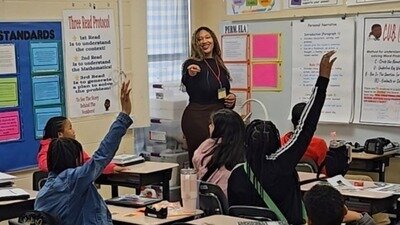
I volunteer as a resident farmer, bringing hands-on agricultural education into schools in low-income communities. I teach children how to plant seeds, care for living things, understand soil, and experience the extraordinary process of growing their own food.
I've watched children light up the first time they pull a carrot from the earth. I've seen the excitement of a child realizing that the tiny seed they planted can become something their family can eat.
Those moments are bigger than gardening. They're moments of discovery, confidence, independence, and possibility. I also established a seed library at Lovejoy Library, providing families with access to free seeds and gardening education. Why?
Because I believe the ability to grow food should never be reserved for people who own acres of land, have money for expensive gardening supplies, or grew up in families that passed agricultural knowledge down through generations. A child living in an apartment deserves this knowledge just as much as a child growing up on a farm.
And growing food doesn't always require a farm. Microgreens can be grown on a windowsill and harvested in as little as 5 days, depending on the variety. These tiny plants can provide nutrient-dense fresh greens using very little space.
Imagine what it would mean for a child to learn that fresh food doesn't always have to begin with a trip to the grocery store. Sometimes, it can begin with a seed, a little water, sunlight, and knowledge.
This isn't about turning every child into a farmer. It's about giving every child the opportunity to understand a system their life depends on. Gardening education can teach biology, chemistry, environmental science, nutrition, responsibility, patience, problem-solving, and resourcefulness.
It can introduce children to careers in agriculture, environmental science, food production, and entrepreneurship that they may never have considered. And for children growing up in communities with limited access to fresh produce, these lessons can be especially meaningful.
I know because I've lived through hardship. I've worked in classrooms. I've taught children to grow food. And I've witnessed what happens when knowledge becomes something a child can actually hold in their hands.
We cannot expect the next generation to care for our food systems if we never give them the opportunity to understand them. Georgia has already taken a step. Now let's discuss making access universal.
Georgia has an elementary agricultural education program, but participation is not guaranteed for every public school student. An opportunity that depends on which school a child attends is not the same as an opportunity available to every child.
According to the USDA's Census of Agriculture, Georgia's number of farms declined from 42,439 in 2017 to 39,264 in 2022—a loss of 3,175 farms.
School gardens alone will not reverse farmland loss. But introducing young people to agriculture can help develop awareness, skills, and interest in the future of food production.
What we're asking Georgia lawmakers to do. I am calling on the Georgia General Assembly to establish funded, age-appropriate, hands-on gardening and food-growing education as a required part of public school learning.
Specifically, I am asking Georgia's legislative leadership and education policymakers to consider legislation that provides:
1. Practical agricultural education for every student. Age-appropriate instruction in planting, soil health, water conservation, growing, harvesting, and understanding how food reaches our tables, beginning in elementary school and building on those skills through later grades.
2. Funding for schools and educators. Dedicated resources for teacher training, supplies, safe growing spaces, and ongoing maintenance, with particular attention to schools in under-resourced communities. This should not become another unfunded mandate placed on teachers.
3. Flexible growing opportunities for every campus. Schools should be able to use outdoor gardens, raised beds, container gardening, indoor growing systems, and partnerships with local farms. Activities must be accessible to students with disabilities and adaptable to schools without available land.
4. Partnerships with local agricultural communities. Create opportunities for working farmers, agricultural educators, community gardens, libraries, and agricultural organizations to support schools through mentorship, demonstrations, and hands-on learning.
I started life as a teenage mother trying to survive. Today, I'm a farmer, an educator, a mother, and a woman who has built a community of millions around the simple but powerful act of growing things. I've learned that a seed represents far more than a future plant. It represents possibility.
And while growing food cannot solve every challenge a family faces, the knowledge of how food is produced is something no child should be denied the opportunity to learn. My hope is to begin this conversation in Georgia, build a practical and sustainable model, and eventually help bring similar educational opportunities to children in Wisconsin and communities across the country.
I'm asking Georgia's lawmakers to work toward a funded legislative proposal with a clear implementation timeline. Every child deserves to know where food comes from. Every child deserves the opportunity to grow something. And every child deserves an education that prepares them not just to make a living, but to understand the things that sustain life.
It starts with a seed. And it starts with education!
Paid partnership. Upendo Estates Farm is a Change Ambassador who receives compensation in connection with this petition.

943
The Issue
Knowing how to grow food should be as fundamental as knowing your ABCs.
My name is Karee Upendo. I'm a Georgia farmer, a mother of five, a former educator, and someone who knows firsthand what it means to survive without the resources so many people take for granted. I was once a homeless teenage parent.
At an age when most young people were figuring out who they wanted to become, I was figuring out how to survive and provide for a child of my own.
That experience changed how I see the world. It taught me that access to basic necessities can never be taken for granted. And it left me with a question that has followed me into adulthood. How is it that food is one of the few things every human being needs to survive, yet so many of us are never taught how to produce it?
We teach children mathematics, reading, writing, and history. We prepare them for careers, college, and the future. But somewhere along the way, we've overlooked one of the most fundamental life skills a person can possess: understanding where their food comes from and how to grow it.
And I believe that deserves to change. I've spent my life working toward a solution. Before becoming a farmer, I spent nearly a decade working as an educator.
Today, I own Upendo Estates Farm in Georgia, where I've built one of the largest online farming and gardening communities, sharing agricultural knowledge with millions of people.
But my work doesn't stop at the farm or on social media.
I volunteer as a resident farmer, bringing hands-on agricultural education into schools in low-income communities. I teach children how to plant seeds, care for living things, understand soil, and experience the extraordinary process of growing their own food.
I've watched children light up the first time they pull a carrot from the earth. I've seen the excitement of a child realizing that the tiny seed they planted can become something their family can eat.
Those moments are bigger than gardening. They're moments of discovery, confidence, independence, and possibility. I also established a seed library at Lovejoy Library, providing families with access to free seeds and gardening education. Why?
Because I believe the ability to grow food should never be reserved for people who own acres of land, have money for expensive gardening supplies, or grew up in families that passed agricultural knowledge down through generations. A child living in an apartment deserves this knowledge just as much as a child growing up on a farm.
And growing food doesn't always require a farm. Microgreens can be grown on a windowsill and harvested in as little as 5 days, depending on the variety. These tiny plants can provide nutrient-dense fresh greens using very little space.
Imagine what it would mean for a child to learn that fresh food doesn't always have to begin with a trip to the grocery store. Sometimes, it can begin with a seed, a little water, sunlight, and knowledge.
This isn't about turning every child into a farmer. It's about giving every child the opportunity to understand a system their life depends on. Gardening education can teach biology, chemistry, environmental science, nutrition, responsibility, patience, problem-solving, and resourcefulness.
It can introduce children to careers in agriculture, environmental science, food production, and entrepreneurship that they may never have considered. And for children growing up in communities with limited access to fresh produce, these lessons can be especially meaningful.
I know because I've lived through hardship. I've worked in classrooms. I've taught children to grow food. And I've witnessed what happens when knowledge becomes something a child can actually hold in their hands.
We cannot expect the next generation to care for our food systems if we never give them the opportunity to understand them. Georgia has already taken a step. Now let's discuss making access universal.
Georgia has an elementary agricultural education program, but participation is not guaranteed for every public school student. An opportunity that depends on which school a child attends is not the same as an opportunity available to every child.
According to the USDA's Census of Agriculture, Georgia's number of farms declined from 42,439 in 2017 to 39,264 in 2022—a loss of 3,175 farms.
School gardens alone will not reverse farmland loss. But introducing young people to agriculture can help develop awareness, skills, and interest in the future of food production.
What we're asking Georgia lawmakers to do. I am calling on the Georgia General Assembly to establish funded, age-appropriate, hands-on gardening and food-growing education as a required part of public school learning.
Specifically, I am asking Georgia's legislative leadership and education policymakers to consider legislation that provides:
1. Practical agricultural education for every student. Age-appropriate instruction in planting, soil health, water conservation, growing, harvesting, and understanding how food reaches our tables, beginning in elementary school and building on those skills through later grades.
2. Funding for schools and educators. Dedicated resources for teacher training, supplies, safe growing spaces, and ongoing maintenance, with particular attention to schools in under-resourced communities. This should not become another unfunded mandate placed on teachers.
3. Flexible growing opportunities for every campus. Schools should be able to use outdoor gardens, raised beds, container gardening, indoor growing systems, and partnerships with local farms. Activities must be accessible to students with disabilities and adaptable to schools without available land.
4. Partnerships with local agricultural communities. Create opportunities for working farmers, agricultural educators, community gardens, libraries, and agricultural organizations to support schools through mentorship, demonstrations, and hands-on learning.
I started life as a teenage mother trying to survive. Today, I'm a farmer, an educator, a mother, and a woman who has built a community of millions around the simple but powerful act of growing things. I've learned that a seed represents far more than a future plant. It represents possibility.
And while growing food cannot solve every challenge a family faces, the knowledge of how food is produced is something no child should be denied the opportunity to learn. My hope is to begin this conversation in Georgia, build a practical and sustainable model, and eventually help bring similar educational opportunities to children in Wisconsin and communities across the country.
I'm asking Georgia's lawmakers to work toward a funded legislative proposal with a clear implementation timeline. Every child deserves to know where food comes from. Every child deserves the opportunity to grow something. And every child deserves an education that prepares them not just to make a living, but to understand the things that sustain life.
It starts with a seed. And it starts with education!
Paid partnership. Upendo Estates Farm is a Change Ambassador who receives compensation in connection with this petition.
The Decision Makers

Supporter Voices
Petition Updates
Share this petition
Petition created on October 13, 2026