Feb 21 Email from the Park with updated information

Hello,
You are receiving this email because you asked to be kept informed about the aquatic invasive species program at Riding Mountain National Park.
The first set of water samples collected from Clear Lake between January 8 and February 2, 2024, have all tested negative for zebra mussel environmental DNA (eDNA). Zebra Mussels may be present despite negative eDNA results. Water samples are being tested at the University of Manitoba Freshwater Institute operated by Fisheries and Oceans Canada. Earlier this week, another set of samples collected since February 3 were sent to the same lab for testing.
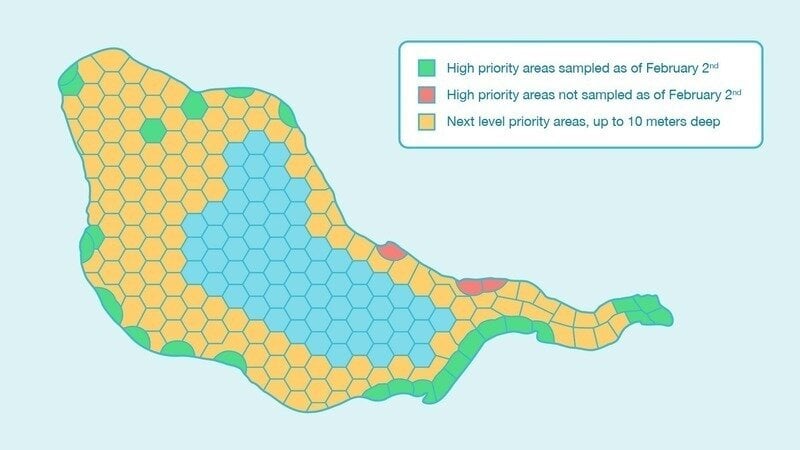
The attached map shows Clear Lake broken into 219 sections. Water samples are taken from each section based on priority. High-priority sections are closest to boat launches, beaches, and other areas of human use. Zebra mussels are most likely to first become established at these locations. Most high-priority sections (in green) were included in the first round of samples that were tested. The remaining high-priority sections (in red) have now been sampled and will be included in the samples shipped earlier this week.
Currently, samples are being collected from the bright yellow sections. These yellow sections are up to ten metres deep and zebra mussels could become established in these locations. Winter sampling will continue until all sections have been tested or as long as ice conditions permit.
Also attached is an image of an underwater remotely operated vehicle (ROV) that has been deployed for testing. This ROV has a camera to provide a visual inspection under the ice.
A potential infestation of zebra mussels in Clear Lake presents a real threat of significant and irreversible ecological damage to the lake and downstream waterbodies. Parks Canada’s legislation requires the maintenance and restoration of ecological integrity through protection of natural resources and natural processes be the priority when considering all aspects of the management of national parks. Parks Canada also understands the importance of Clear Lake to Indigenous Peoples, visitors, and the local community.
Full consideration will be given to all aspects of this situation before any decision is made about lake use for the summer of 2024.
Parks Canada will continue to provide updates on the situation as information becomes available. To stay up to date, please visit our website at https://parks.canada.ca/pn-np/mb/riding/nature/conserv/aqua/faq
What do you need to know?
In cold water, zebra mussels are less metabolically active and are much less likely to shed eDNA. If a water sample tests positive for eDNA, there is a high likelihood of a population of zebra mussels nearby.
Parks Canada remains committed to working with partners to reduce the risk of AIS spreading in the park and downstream through southern Manitoba, no matter the results of the winter monitoring.
The likelihood of success for any potential management action will depend on whether intervention can occur before significant reproduction and spread occurs within the lake. Determining with relatively high confidence where a population may exist in the lake will help inform management decisions.
Stay informed by connecting with Riding Mountain National Park’s website at https://parks.canada.ca/pn-np/mb/riding/nature/conserv/aqua/faq