
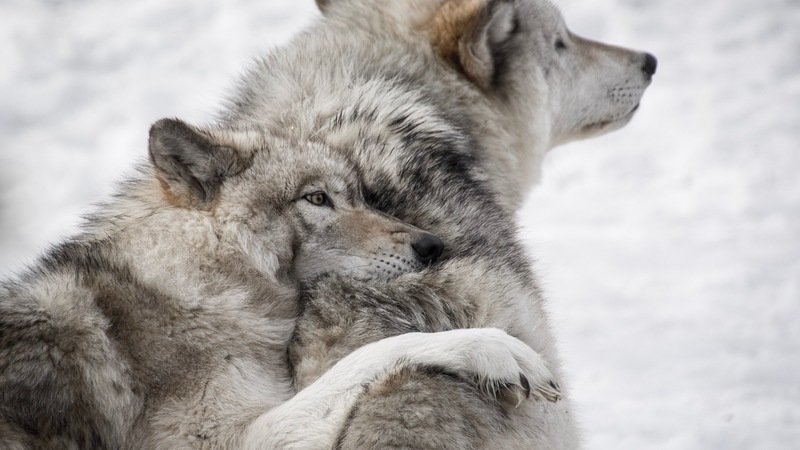
The gray wolf has a new threat.
Gray wolves are protected under the Endangered Species Act except in the Northern Rockies which includes the states of Idaho, Montana, most of Wyoming, and parts of eastern Oregon, Washington, and northern Utah AND NOW OTHER STATES want to delist the wolf from the Endangered Species Act.
A new bill was introduced in legislation by Representative Tiffany and Representative Boebert that would delist gray wolves from the federal Endangered Species Act and allow individual states to control and manage gray wolf populations.
Comparatively speaking, two million wolves once cohabited North America and currently their estimated population is at 6,000. The wolves that exist today make up only .3% of their historic population and they only occupy 10% of their historic range. To say the wolf population needs to be managed is egregious. Our responsibility is to provide the wolves the protection they deserve. Wolves are a vital and necessary part of the ecosystem. Their presence allows ecosystems to thrive and when ecosystems thrive, it is a recipe for sustaining the health of our planet.
There are arguments made to manage the wolf population because they a major contributor for cattle and sheep loss. Some states even consider the wolf a predator species. But according to government data, wolves have a negligible effect on cattle and sheep industries. In fact, it is found in the states where wolves live, they cause far fewer than one percent of unwanted cattle and sheep losses. (1). In 2015, the USDA reported wolves killed 4,360 cattle in the Northern Rockies, while the Fish and Wildlife Service verified only 161 such losses.
Furthermore, to allow individual states to hunt the wolves in tandem with the wolves' already limited population has many adverse effects on their future viability;
· Skewing population structures which reduces reproductive success (2)
· Risk of local extirpation of the species (3)
· Genetic erosion (4)
· Destabilization of populations as key individuals are killed who had social and ecological knowledge that is critical for survival and reproduction (5)
· Reducing population size, health, and resilience
Additionally, I would like to add that according to a 2022 survey, in the United States, more than 75% of Americans oppose trophy hunting.
With so many people opposing trophy hunting, we have the ability to ensure the continued survival of the iconic North American wolf.
Please contact your federal legislators stating you want the wolf to remain on the federal Endangered Species Act and to restore protections for the wolf populations in Montana, Idaho, Wyoming, Washington, Utah, and Oregon.
To find your federal legislator, go to https://www.usa.gov/elected-officials
Please continue to share this petition.
Thank you!!
Resources:
1. Humane Society of the United States. Government data confirm that wolves have a negligible effect on U.S. cattle & sheep industries https://www.humanesociety.org/sites/default/files/docs/HSUS-Wolf-Livestock-6.Mar_.19Final.pdf March 6, 2019.
2. Creel, s., M’soka, J., Drroge, E., Rosenblatt, E., Becker, M. S., Matandiki, W. and Simpamba, T. (2016). “Assessing the Sustainability of African lion trophy hunting, with recommendations for policy.” Ecological Applications 26(7): 2347-2357
3. Milner, J. M., E.B. and Andreassen, H.P. (2007). “Demographic side effects of selective hunting in ungulates and carnivores.” Conservation Biology 21(1): 36-47.
4. Dures, S. G., Carbone, A. J. Loveridge, G. Maude, N. Midlane, O. Aschenbom and D. Gottelli (2019). “A century of decline: loss of genetic diversity in a southern African lion-conservation stronghold.” Diversity and Distributions 25(6): 870-879.
5. McComb, K., Shannon, G., Durant, S. M., Sayialel, K., Slotow, R., Poole, J. and Moss, C. (2011). “Leadership in elephants: the adaptive calue of age.” Proceedings of the Royal Society B: Biological Sciences 278 (1722): 3270-3276.
Photo by Yannick Menard on Unsplash