
Keep public hearings for large housing projects in Santa Cruz. No Overlay District!
The Issue
If you are a resident of the City of Santa Cruz, please sign this petition that will be presented to the Santa Cruz City Council. If you live in Live Oak or Bonny Doon, please enter those as the name of the City where you live.
You do NOT need to log in to Change.org to sign the petition. Logging in is only for creating or editing a change.org petition.
We are continuing to collect signatures. As of July 7th, 2026 there are 850 people who have signed our online and paper petitions as residents of the City of Santa Cruz.
---------------------------------------------------------------------------------------------------------
1. There was an online only “community meeting” hosted by Clara Stanger of the City's Community Development Department to present and discuss the City’s proposed Overlay District on July 9th. Here is a link to the recorded video of the meeting:
Video of July 9th online "community meeting"
2. The City of Santa Cruz is moving ahead with its Overlay District Plan which will get rid of public hearings for 100% affordable housing projects and remove current protection for heritage trees.
For more information and to see a map of the proposed Overlay District see:
Permitting-Process-for-100-Affordable-Housing
3. For additional background on the City's proposed Overlay District you can listen to the KSQD interview from June 30th where city planner Clara Stanger first presents the City's proposed Overlay District followed by Gillian Greensite challenging the City's position.
Here is the link to the KSQD 2-week archive:
https://ksqd.org/two-week-archive/#gsc.tab=0
Then click on the link for Tuesday June 30th 5PM ""Talk of the Bay".
The City makes it sound necessary to create an Overlay District for building more affordable housing, but that is misleading. We are way ahead on construction of new 100% affordable housing projects with others already permitted and ready to build. The State is NOT requiring this proposed Overlay District. Don’t let the City take away our democratic right to have a public hearing on large housing projects! Such projects can be six stories or higher adjacent to or deep into established neighborhoods.
----------------------------------------------------------------------------------------------------------
PROTECT OUR NEIGHBORHOODS!
KEEP PUBLIC HEARINGS FOR LARGE HOUSING PROJECTS IN SANTA CRUZ.
The City Planning Department is asking the City Council for sole authority to approve permits for one hundred percent affordable housing developments over a wide area of the City and eliminate formal public hearings by creating a new Ministerial Approval Overlay District.
The proposed Overlay District:
• Is NOT required by State law
• Eliminates public hearings at Planning Commission and City Council
(regardless of project size or impacts)
• Gives City Planning Department sole authority to approve these developments
• Eliminates current heritage tree protection for these developments
NO OVERLAY DISTRICT!
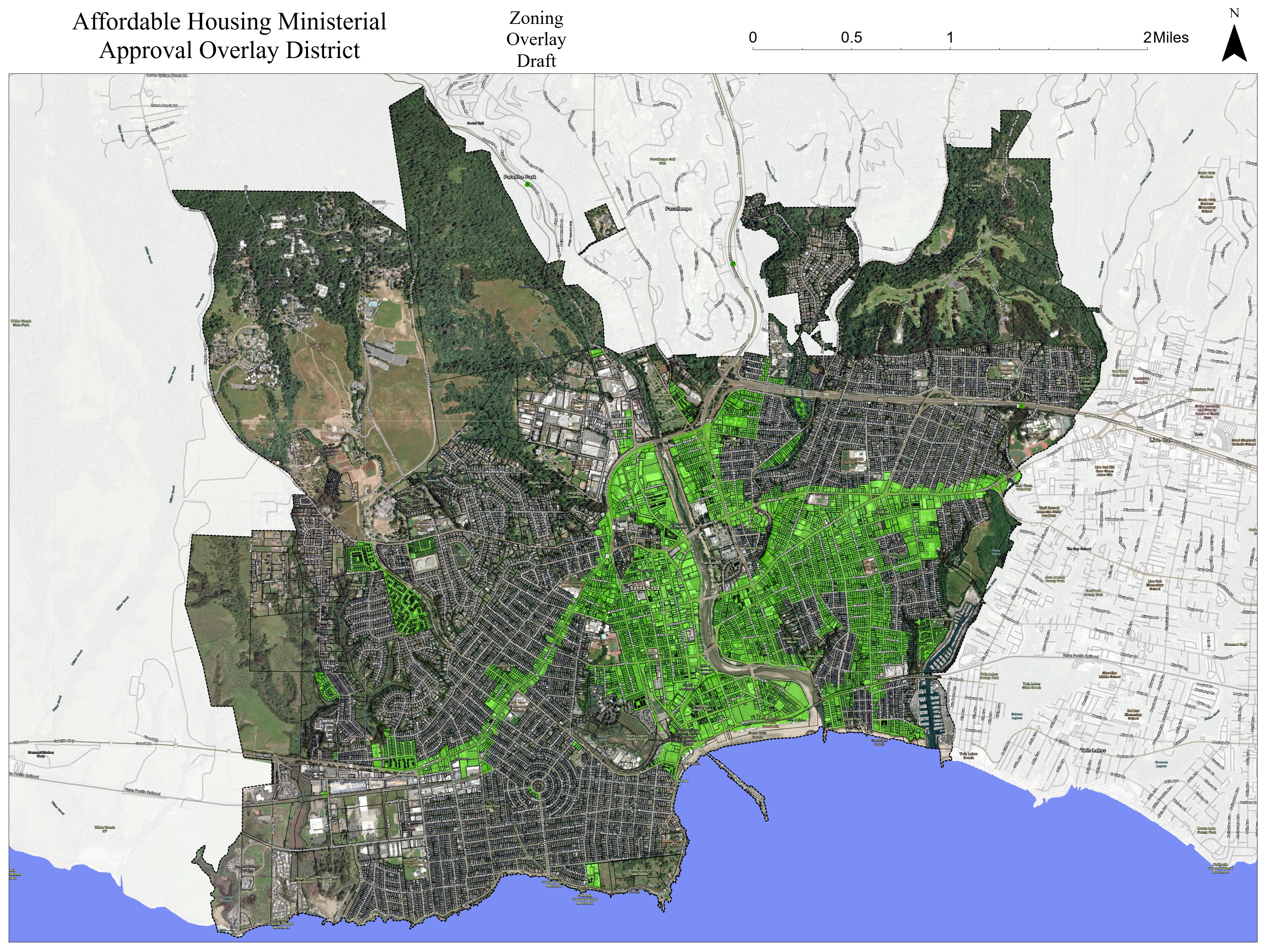
The areas in green on the map above are threatened by the proposed Overlay District.
Here is a link to the Lookout Letter To the Editor "No trees, no voice: How the City of Santa Cruz is green-lighting development without the public", published January 13th, 2026.
Below is the text of the Lookout article by Gillian Greensite
Lookout Quick Take
After Santa Cruz's planning commission approved doing away with public hearings for some large affordable housing projects and moved a special zoning area forward, activist Gillian Greensite warns that the public could not only be robbed of its voice but of some of the city's heritage trees, too.
What happens when development decisions no longer require public hearings?
In the City of Santa Cruz, it means thousands of dense housing units can be approved by planning staff without a single public hearing — and without protections for heritage trees — across large swaths of the city. That is the reality of the newly proposed Affordable Housing Ministerial Overlay District, developed with little notice and even less public input.
The green areas in the above map of Santa Cruz comprise this new overlay district unveiled by city planning staff at the planning commission meeting on Dec. 18. It passed on a 4-2 vote.
What this new overlay district means is that within the green area, a developer of a 100% affordable housing project can avoid formal public hearings and get staff approval of the project “by-right.” This is also called ministerial approval as opposed to the current discretionary approval that requires public hearings before a commission or the city council.
While state laws for 100% affordable housing projects seek to streamline approval for affordable housing, the exact area that a city may choose to fit into the overlay district is up to the individual cities so long as they don’t include land zoned for other uses such as industrial. The main criterion is that there must be sufficient land zoned to accommodate the required Regional Housing Needs Allocation, also known as RHNA numbers.
The city of Santa Cruz is required to provide five times the number of affordable housing units for the latest eight-year RHNA cycle (2023-2031) compared to the previous cycle and far above many similar-sized cities. For example, Petaluma, with a population of 60,000, is required to provide 1,910 additional housing units, whereas Santa Cruz city, with a population of 62,000, is required to provide 3,736 additional housing units.
We are also one of the few cities (total 6%) that met all required RHNA numbers in all income categories for the previous cycle. Some California cities have pushed back at what they view as unrealistic or disproportionate allocations, but Santa Cruz is not one of them.
Staff has determined that all areas of town that are currently zoned for mixed use or multi-family shall be in this new overlay district. As you can see from the map, that includes a sizable portion of the town, 15.27% to be exact, especially affecting the Eastside, downtown and along major corridors.
Other cities are taking a more cautious approach, determining “by-right” decisions on a project-by-project basis or delineating far smaller overlay zones.
Under current state housing laws, the state has determined that only objective standards can apply to new housing projects, whether 100% affordable or 100% market rate. That means subjective terms such as “fits in with the character or scale of the neighborhood” are not allowed to be considered.
That requirement plus state-required density bonuses and waivers is why you see all the new housing projects at heights and densities never imagined in Santa Cruz. The irony is that despite heights of six and eight stories, the number of affordable units is no greater than if the project were capped at three or four stories.
Whether the flurry of new housing lowers the cost of rents is an open question. I doubt it will since the demand is bottomless and new residents tend to be higher-income, raising the area median income (AMI) on which all other income levels are based.
For example, state law allows 100% affordable projects to include the moderate-income level. In Santa Cruz, that is 120% of the AMI, or $111,500 for an individual’s annual salary. That is a six-figure salary. Hardly what is commonly thought of as “affordable,” but I guess even a mansion is “affordable” to someone.
Los Angeles capped the percentage of moderate-income units allowed in a 100% affordable project at 20%. The Santa Cruz city staff proposal has no cap.
At the Santa Cruz Planning Commission meeting, those who spoke against the ending of public hearings cited important changes that were sometimes made at such hearings to respond to neighborhood concerns. Two planning commissioners cited the democratic process and the right of the public to have a voice. One voiced support for preserving heritage trees.
Tacked onto the staff proposal to end public hearings is the removal of the Heritage Tree Ordinance (HTO) standards within the overlay zone. In other words, no heritage tree protection. The staff report wording is designed to make it appear that they are substituting objective standards to comply with state law, but that is misleading.
Currently, our HTO standards require the protection of a healthy, sound, heritage tree in a project site and allow its removal only “if a project design cannot be altered to accommodate the tree.” That requires staff to share this legal standard at the outset with a developer. It obligates the developer to make the effort to design the project to preserve the heritage tree or trees. State law makes it clear that such standards are objective.
The planning staff have a track record of ignoring this standard – for example, Lot 4, the downtown library site, and the Clocktower Center project. This might explain why they are quick to propose getting rid of it. An admirer of the majestic big trees that grace our neighborhoods, particularly on the Eastside and downtown, you will share my dismay at what staff are proposing. Developers always want a cleared piece of land for a project. If there is no requirement for them to consider designing a project to preserve a heritage tree, and no staff to advise them that it is our local law and objective standard, then the trees will be bulldozed before there’s even a plan on paper.
Despite state cautions that cities should conduct “robust public outreach when updating the housing element or zoning code since getting rid of public hearings for large affordable housing projects will not be well received” and “the public should be given a chance to discuss it,” there has been no such outreach in the City of Santa Cruz other than a Zoom attended by 12 people. The planning commission meeting on Dec. 18 was the first presentation to a hearing body and to the public.
We passed Measure C. We will give the city money to build affordable housing for newcomers with six-figure incomes. And now we learn we may lose the democratic right to a public hearing before a decision-making body and lose our heritage trees in the process.
It’s hard to avoid cynicism.
Gillian Greensite is a longtime local activist with a love of trees and a supporter of sensible development.
Sign this petition to advocate for No Overlay District in the City of Santa Cruz.
See our website NoOverlayDistrict.org for more information.

2,042
The Issue
If you are a resident of the City of Santa Cruz, please sign this petition that will be presented to the Santa Cruz City Council. If you live in Live Oak or Bonny Doon, please enter those as the name of the City where you live.
You do NOT need to log in to Change.org to sign the petition. Logging in is only for creating or editing a change.org petition.
We are continuing to collect signatures. As of July 7th, 2026 there are 850 people who have signed our online and paper petitions as residents of the City of Santa Cruz.
---------------------------------------------------------------------------------------------------------
1. There was an online only “community meeting” hosted by Clara Stanger of the City's Community Development Department to present and discuss the City’s proposed Overlay District on July 9th. Here is a link to the recorded video of the meeting:
Video of July 9th online "community meeting"
2. The City of Santa Cruz is moving ahead with its Overlay District Plan which will get rid of public hearings for 100% affordable housing projects and remove current protection for heritage trees.
For more information and to see a map of the proposed Overlay District see:
Permitting-Process-for-100-Affordable-Housing
3. For additional background on the City's proposed Overlay District you can listen to the KSQD interview from June 30th where city planner Clara Stanger first presents the City's proposed Overlay District followed by Gillian Greensite challenging the City's position.
Here is the link to the KSQD 2-week archive:
https://ksqd.org/two-week-archive/#gsc.tab=0
Then click on the link for Tuesday June 30th 5PM ""Talk of the Bay".
The City makes it sound necessary to create an Overlay District for building more affordable housing, but that is misleading. We are way ahead on construction of new 100% affordable housing projects with others already permitted and ready to build. The State is NOT requiring this proposed Overlay District. Don’t let the City take away our democratic right to have a public hearing on large housing projects! Such projects can be six stories or higher adjacent to or deep into established neighborhoods.
----------------------------------------------------------------------------------------------------------
PROTECT OUR NEIGHBORHOODS!
KEEP PUBLIC HEARINGS FOR LARGE HOUSING PROJECTS IN SANTA CRUZ.
The City Planning Department is asking the City Council for sole authority to approve permits for one hundred percent affordable housing developments over a wide area of the City and eliminate formal public hearings by creating a new Ministerial Approval Overlay District.
The proposed Overlay District:
• Is NOT required by State law
• Eliminates public hearings at Planning Commission and City Council
(regardless of project size or impacts)
• Gives City Planning Department sole authority to approve these developments
• Eliminates current heritage tree protection for these developments
NO OVERLAY DISTRICT!
The areas in green on the map above are threatened by the proposed Overlay District.
Here is a link to the Lookout Letter To the Editor "No trees, no voice: How the City of Santa Cruz is green-lighting development without the public", published January 13th, 2026.
Below is the text of the Lookout article by Gillian Greensite
Lookout Quick Take
After Santa Cruz's planning commission approved doing away with public hearings for some large affordable housing projects and moved a special zoning area forward, activist Gillian Greensite warns that the public could not only be robbed of its voice but of some of the city's heritage trees, too.
What happens when development decisions no longer require public hearings?
In the City of Santa Cruz, it means thousands of dense housing units can be approved by planning staff without a single public hearing — and without protections for heritage trees — across large swaths of the city. That is the reality of the newly proposed Affordable Housing Ministerial Overlay District, developed with little notice and even less public input.
The green areas in the above map of Santa Cruz comprise this new overlay district unveiled by city planning staff at the planning commission meeting on Dec. 18. It passed on a 4-2 vote.
What this new overlay district means is that within the green area, a developer of a 100% affordable housing project can avoid formal public hearings and get staff approval of the project “by-right.” This is also called ministerial approval as opposed to the current discretionary approval that requires public hearings before a commission or the city council.
While state laws for 100% affordable housing projects seek to streamline approval for affordable housing, the exact area that a city may choose to fit into the overlay district is up to the individual cities so long as they don’t include land zoned for other uses such as industrial. The main criterion is that there must be sufficient land zoned to accommodate the required Regional Housing Needs Allocation, also known as RHNA numbers.
The city of Santa Cruz is required to provide five times the number of affordable housing units for the latest eight-year RHNA cycle (2023-2031) compared to the previous cycle and far above many similar-sized cities. For example, Petaluma, with a population of 60,000, is required to provide 1,910 additional housing units, whereas Santa Cruz city, with a population of 62,000, is required to provide 3,736 additional housing units.
We are also one of the few cities (total 6%) that met all required RHNA numbers in all income categories for the previous cycle. Some California cities have pushed back at what they view as unrealistic or disproportionate allocations, but Santa Cruz is not one of them.
Staff has determined that all areas of town that are currently zoned for mixed use or multi-family shall be in this new overlay district. As you can see from the map, that includes a sizable portion of the town, 15.27% to be exact, especially affecting the Eastside, downtown and along major corridors.
Other cities are taking a more cautious approach, determining “by-right” decisions on a project-by-project basis or delineating far smaller overlay zones.
Under current state housing laws, the state has determined that only objective standards can apply to new housing projects, whether 100% affordable or 100% market rate. That means subjective terms such as “fits in with the character or scale of the neighborhood” are not allowed to be considered.
That requirement plus state-required density bonuses and waivers is why you see all the new housing projects at heights and densities never imagined in Santa Cruz. The irony is that despite heights of six and eight stories, the number of affordable units is no greater than if the project were capped at three or four stories.
Whether the flurry of new housing lowers the cost of rents is an open question. I doubt it will since the demand is bottomless and new residents tend to be higher-income, raising the area median income (AMI) on which all other income levels are based.
For example, state law allows 100% affordable projects to include the moderate-income level. In Santa Cruz, that is 120% of the AMI, or $111,500 for an individual’s annual salary. That is a six-figure salary. Hardly what is commonly thought of as “affordable,” but I guess even a mansion is “affordable” to someone.
Los Angeles capped the percentage of moderate-income units allowed in a 100% affordable project at 20%. The Santa Cruz city staff proposal has no cap.
At the Santa Cruz Planning Commission meeting, those who spoke against the ending of public hearings cited important changes that were sometimes made at such hearings to respond to neighborhood concerns. Two planning commissioners cited the democratic process and the right of the public to have a voice. One voiced support for preserving heritage trees.
Tacked onto the staff proposal to end public hearings is the removal of the Heritage Tree Ordinance (HTO) standards within the overlay zone. In other words, no heritage tree protection. The staff report wording is designed to make it appear that they are substituting objective standards to comply with state law, but that is misleading.
Currently, our HTO standards require the protection of a healthy, sound, heritage tree in a project site and allow its removal only “if a project design cannot be altered to accommodate the tree.” That requires staff to share this legal standard at the outset with a developer. It obligates the developer to make the effort to design the project to preserve the heritage tree or trees. State law makes it clear that such standards are objective.
The planning staff have a track record of ignoring this standard – for example, Lot 4, the downtown library site, and the Clocktower Center project. This might explain why they are quick to propose getting rid of it. An admirer of the majestic big trees that grace our neighborhoods, particularly on the Eastside and downtown, you will share my dismay at what staff are proposing. Developers always want a cleared piece of land for a project. If there is no requirement for them to consider designing a project to preserve a heritage tree, and no staff to advise them that it is our local law and objective standard, then the trees will be bulldozed before there’s even a plan on paper.
Despite state cautions that cities should conduct “robust public outreach when updating the housing element or zoning code since getting rid of public hearings for large affordable housing projects will not be well received” and “the public should be given a chance to discuss it,” there has been no such outreach in the City of Santa Cruz other than a Zoom attended by 12 people. The planning commission meeting on Dec. 18 was the first presentation to a hearing body and to the public.
We passed Measure C. We will give the city money to build affordable housing for newcomers with six-figure incomes. And now we learn we may lose the democratic right to a public hearing before a decision-making body and lose our heritage trees in the process.
It’s hard to avoid cynicism.
Gillian Greensite is a longtime local activist with a love of trees and a supporter of sensible development.
Sign this petition to advocate for No Overlay District in the City of Santa Cruz.
See our website NoOverlayDistrict.org for more information.
The Decision Makers


Supporter Voices
Petition Updates
Share this petition
Petition created on January 13, 2026