Greyhound trainer disqualified for causing “prolonged, unnecessary, avoidable suffering”

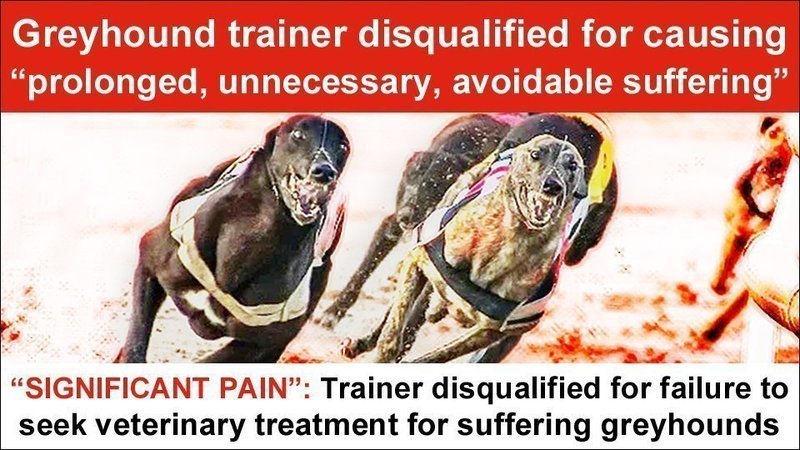
A trainer involved in greyhound racing for 47 years has been disqualified “for an indefinite period” after he was found to have caused “prolonged unnecessary and avoidable suffering to greyhounds in his care”.
Among the dogs affected were Irish greyhounds Attykitt Fire, O’Malley Star and Mallogs Lucky.
Horrendous details of the case are highlighted in the Greyhound Board of Great Britain’s latest “Calendar” publication (26 March 2021).
It reports that at a meeting this month of the GBGB’s Disciplinary Committee, trainer Stuart Walton was found to be in breach of Rule 2 (relating to greyhound welfare), Rule 152(i) (failing to take action which he was required to take), Rule 152(ii) (acted in a manner prejudicial to the integrity, proper conduct or good reputation of greyhound racing) and 174(xi) (treated any greyhound or caused or permitted any greyhound to be treated with cruelty or in such a manner as causes or is likely as to cause the greyhound unnecessary suffering).
The committee “wholly rejected his assertion that his care and husbandry of the retired greyhounds in his care had been to a satisfactory standard” and found that he had caused suffering to greyhounds in his care over a period of several months by:
• His failure to seek necessary veterinary treatment for greyhounds Bodell Earl, Attykitt Fire and O’Malley Star prior to an unannounced visit to his kennels on 8 January 2020 by Area Stipendiary Steward and vet Tiffany Blackett and failing to provide those greyhounds with adequate nutrition before 8 January and up to 5 August 2020.
• Allowing all three greyhounds to develop advanced dental disease and failing to seek appropriate and timely veterinary treatment, whereby the greyhounds would have been caused significant pain.
• Failing to obtain treatment / pain relief for O’Malley Star’s lameness whereby that greyhound was left in avoidable and unnecessary pain.
• Ignoring the advice of Ms Blackett that the greyhounds Mallogs Lucky and Bodell Swift needed immediate veterinary treatment for lameness with the consequence that those greyhounds were left untreated and in pain.
• Ignoring the advice of Ms Blackett regarding the need to obtain an effective tick remedy so that advice had to be repeated on three occasions, with the consequence that tick infestation was a recurrent problem in his kennels.
• Failing to provide Bodell Earl with treatment for pain notwithstanding that he had been provided with free Metacam.
• Failing to provide adequate accommodation and bedding such that the health problems suffered by greyhounds in his care were exacerbated.
On her 8th January 2020 visit to Walton’s kennels, Area Stipendiary Steward and vet Tiffany Blackett noted that units in which greyhounds were being kept were “quite dark”, that duvets used as bedding were dirty and one kennel had only carpet as bedding. She found that a separate greyhound “isolation unit”, which was housing one greyhound, had dark and cramped conditions and she concluded that this was not suitable accommodation for a greyhound.
One of the greyhounds in the kennels - Bodell Earl - had saliva staining on either side of his mouth, was “markedly thin with prominent pelvic and lumbar spinal bones and hind limb muscle atrophy” and was suffering from advanced dental disease. Ms Blackett said she observed a tick close to the greyhound’s right ear and advised Walton to obtain tick treatment from his vet. The GBGB report states that “Mr Walton failed to obtain tick treatment and Ms Blackett had to repeat this advice on two subsequent occasions.”
Greyhound O’Malley Star was also suffering with advanced dental disease. This greyhound was lame on the left forelimb and was receiving no treatment for the lameness. On a subsequent visit to the kennels, on 24 February, Ms Blackett “noted that O’Malley Star now had a hygroma on one elbow and several areas of skin inflammation on her front feet”. Walton was advised to ensure that her bedding was kept dry, suitably deep and comfortable and to take her to a vet if her condition worsened. Six weeks later on 6 April, O’Malley Star was found dead in her bed.
On 30 July 2020 - 204 days (29 weeks) after the 8th January visit - Walton was informed that the GBGB was going to “proceed with disciplinary action due to the lack of appropriate care for the retired greyhounds at his kennel”. In August, Bodell Earl, who was still very slim and with teeth in need of attention - and now with an abscess developing on his face - was removed to receive veterinary treatment. So too was Attykitt Fire who had a skin ulcer on his right elbow. It was noted that after treatment, their body weights increased.
The GBGB disciplinary report stated that Walton, who attended the inquiry by telephone, “made some unhelpful interventions, for example making wholly unwarranted suggestions that the GBGB wanted rid of him because he was a small trainer, that Tiffany Blackett was not up to the job, and that Karina Chapman MRCVS [who treated two greyhounds after they were removed], who qualified in 2017, was ‘just a girl’ who did not have the experience or ability to treat greyhounds.”
It added that “he also gave somewhat contradictory evidence about his role in caring for his greyhounds saying on the one hand that his care was adequate and that he had done everything he could to ensure their wellbeing and on the other hand that because he had spent £3,600 on improvements to his kennel, he could not afford veterinary treatment.”
Read the full details of the Disciplinary Committee report below.
The Greyhound Racing Ireland website shows that before ending up in the UK where he suffered and died, O’Malley Star was raced at Limerick stadium on 6 May 2010. The GRI site also shows that Attykitt Fire was used in racing at Clonmel track in August and October 2011. Mallogs Lucky was raced at Clonmel and Kilkenny tracks in 2017 and trialled at Waterford track.
Stuart Walton is listed as the owner of other greyhounds on the Greyhound Racing Ireland website, including Merry Bingo (trialled at Thurles Park track in 2009) and Jodanvic (raced at Kilkenny and Enniscorthy tracks in 2001 and 2002) as well as Six Ashes and Tapestry. The location and fate of these greyhounds is unknown.
Disciplinary Committee of the GBGB
https://s3-eu-west-1.amazonaws.com/gbgb-prod-assets/wp-content/uploads/2021/03/26165148/Calendar-26-March-2021-Vol-13-No-06.pdf
DISCIPLINARY COMMITTEE INQUIRIES
The Disciplinary Committee of the GBGB were in attendance at a meeting held on 16 March 2021:
Mr K Salmon (in the chair)
Mr R O’Donovan
Mr H Starte
1 MR STUART WALTON
Background
On 21 August 2019 greyhound trainer Mr Stuart Walton (as he then was) was served with an improvement notice following a kennel inspection by Area Stipendiary Steward Lorraine Sams, which required Mr Walton to address the size of the kennel units in which his greyhounds were housed.
On 8 January 2020 Area Stipendiary Steward Tiffany Blackett, a qualified veterinary surgeon with 25 years’ experience, carried out an unannounced visit to the kennels of Mr Stuart Walton to carry out a routine kennel inspection. No work had yet commenced pursuant to the improvement notice, but Mr Walton stated that he was going to enlarge the kennel units as per the notice.
Mr Walton’s greyhounds were housed in two blocks. There were three greyhounds in the bottom block. Ms Blackett found that the duvets used as bedding were dirty and one kennel had only carpet as bedding. The general standard of cleanliness needed improvement and the block was quite dark.
The top block consisted of four kennels housing eight greyhounds. The units were quite dark even with the doors open. With the doors closed light and ventilation would have been further restricted.
There was a further unit housing one greyhound. This was said to be an “isolation unit.” Ms Blackett observed dark and cramped conditions, with one bare breeze block wall. She concluded that this was not suitable accommodation for a greyhound and was certainly not suitable as an “isolation unit”, which required nonporous and easily cleanable internal surfaces and adequate lighting, temperature control and ventilation.
The Disciplinary Committee (DC) noted that the defects in Mr Walton’s kennelling arrangements might exacerbate health problems suffered by greyhounds in his care, for example inadequate bedding might render a greyhound with osteoarthritis less comfortable, even where they were not of themselves the cause of those health problems.
In the top unit Ms Blackett observed the retired greyhound BODELL EARL. She noted obvious saliva staining on either side of his mouth. This greyhound was markedly thin, with prominent pelvic and lumbar spinal bones and hind limb muscle atrophy. His teeth were in a very poor state and he was suffering from advanced dental disease. Ms Blackett observed a tick close to the greyhound’s right ear. She advised Mr Walton to take BODELL EARL for a veterinary check-up within 24 hours. She further advised that he should obtain appropriate tick treatment from his vet. Mr Walton failed to obtain tick treatment and Ms Blackett had to repeat this advice on two subsequent occasions.
In another kennel in the top unit Ms Blackett observed a greyhound identified by Mr Walton as O’MALLEY STAR. This greyhound was lame on the left forelimb and suffering from advanced dental disease. Mr Walton stated that the greyhound was receiving no treatment for lameness.
The DC found that on the evidence both these greyhounds should have received veterinary care well before Ms Blackett’s visit. The committee further noted that the failure to provide pain relief to greyhounds with evident orthopaedic problems (e.g. lameness, osteoarthritis) was a recurrent theme throughout Ms Blackett’s subsequent visits.
On 9 January, the day after Ms Blackett’s visit, Mr Walton informed her that he had taken three greyhounds BODELL EARL, O’MALLEY STAR, and ATTYKITT FIRE to see the track vet at Perry Barr stadium, Dr Michelle Tromans.
On 14 January 2020 Mr Walton’s licence was suspended for 14 days for failing to maintain his kennels in accordance with rules 212 and 213 and for failing to seek veterinary advice for greyhounds in his care. That suspension was extended due to Mr Walton’s failure to comply with GBGB requirements until the end of 2020, when his licence lapsed. He had made no application to renew his licence.
On 28 January Ms Blackett carried out a follow up visit and noted some improvement in the condition of the three greyhounds which Mr Walton had taken to the vet. However, she also noted that two further greyhounds BODELL SWIFT and MALLOG LUCKY were suffering from lameness. She advised Mr Walton to seek veterinary assistance for those greyhounds. He had failed to do so by the time of Ms Blackett’s subsequent visits on 24 February and 5 June.
On 24 February Ms Blackett made a further visit to the kennels. She noted that O’MALLEY STAR now had a hygroma on one elbow and several areas of skin inflammation on her front feet. Mr Walton was advised to ensure that her bedding was kept dry, suitably deep and comfortable and to take her to a vet if her condition worsened. BODELL EARL was still visibly thin. Mr Walton was advised that his weight must not be allowed to fall and that he should be taken for a further weight check with the vet. Ticks were found on two greyhounds in Mr Walton’s care. Mr Walton was advised for the third time to obtain a suitable tick treatment.
The next date of significance is 6 April when Mr Walton found O’MALLEY STAR dead in her bed. The DC were unable to make any finding as to the cause of death and although this greyhound’s lameness and advanced dental care were caused and/or exacerbated by Mr Walton’s failure to provide proper or adequate care there was no evidence before the committee that a lack of care caused or contributed to this greyhound’s death.
Ms Blackett visited the kennels again on 5 June 2020. The improvement works had largely been completed. However, the kennel floors were wet, some floors needed cleaning, and deeper paper bedding was recommended. BODELL EARL and ATTYKITT FIRE both appeared to have lost weight.
On 24 July Dr Tromans visited Mr Walton’s kennels, a veterinary report on the health status of Mr Walton’s greyhound having been requested by the Senior Stipendiary Steward. It was apparent that ATTYKITT FIRE had been unwell again, and Mr Walton was advised to take him to a vet. Mr Walton telephoned Tiffany Blackett to say that this had been done on 27 July, and that the greyhound had lost further weight. Following this conversation and having read Dr Troman’s report Ms Blackett contacted the Senior Stipendiary Steward to express her concern regarding ATTYKITT FIRE’S condition.
On 30 July Ms Blackett was instructed to attend Mr Walton’s kennel to inform him that the GBGB was going to proceed with disciplinary action due to the lack of appropriate care for the retired greyhounds at his kennel. An appointment was made for 5 August 2020.
On 5 August it was apparent that ATTYKITT FIRE’S bodyweight had visibly deteriorated since Ms Blackett’s visit on 5 June 2020. BODELL EARL was still very slim and his teeth were still in need of attention. A maxillary abscess was now developing on the left side of his face. A subsequent visual examination revealed that ATTYKITT FIRE had a skin ulcer on his right elbow, full skin thickness. Mr Walton was informed that his licence would remain suspended. He eventually agreed to allow the GBGB to remove the two greyhounds so that they could receive appropriate veterinary Attention.
The greyhounds’ treatment was then supervised by Karina Chapman MRCVS. Of particular note is the fact that by 29 September 2020 ATTYKITT FIRE’S weight had increased from 29.05 kgs on 7 August to 32.5kgs, a gain of 3.45kgs. Similarly, BODELL EARL’S weight had increased by 2.8kgs, to 28.2kgs on 5 October 2020.
Evidence
Dr Tromans gave evidence by telephone in which she confirmed her written evidence as to the condition of Mr Walton’s greyhounds when she examined them. When questioned by Mr Walton she confirmed that the care of geriatric greyhounds can be difficult and frustrating. It can be very hard to keep their teeth in proper condition. However, she emphasised that the condition of Mr Walton’s greyhounds was much poorer than she would have expected to see.
Ms Blackett gave oral evidence to the DC in which she confirmed the history as set out above. She stressed the deficiencies in Mr Walton’s care, the consistent lack of proactive veterinary care, the fact that he had to be advised three times regarding tick treatment, his failure to give BODELL EARL pain relief notwithstanding that Mr Walton had been given a free supply of Metacam, and his failure to provide good nutrition suitable for his greyhounds’ age and condition. She reminded the committee that dental disease would cause the greyhounds pain, could lead to weight loss, and can cause systemic disease. Likewise, osteoarthritis would cause pain.
She stressed that the visible weight loss she had seen was indicative of long-standing problems and that the greyhounds would have suffered pain over a long period. She also emphasised the marked improvement in the greyhounds’ condition observed after they had been removed from Mr Walton’s care, which wholly undermined his assertion that he had done everything necessary for these greyhounds.
She reminded the committee of Karina Chapman’s conclusion set out in an email from Ms Chapman to herself that in light of the progressive improvement of both dogs Karina Chapman would be confident in stating that the poor condition on initial examination on 7 August 2020 was primarily related to malnutrition and failure to provide adequate care and husbandry, especially that required by their advanced age, resulting in unnecessary suffering.
Their general condition could have been prevented with suitable food, bedding and necessary medications.
Mr Walton attended the inquiry by telephone. From time to time, he made some unhelpful interventions, for example making wholly unwarranted suggestions that the GBGB wanted rid of him because he was a small trainer, that Tiffany Blackett was not up to the job, and that Karina Chapman, who qualified in 2017, was “just a girl” who did not have the experience or ability to treat Greyhounds.
He also gave somewhat contradictory evidence about his role in caring for his greyhounds saying on the one hand that his care was adequate and that he had done everything he could to ensure their wellbeing and on the other hand that because he had spent £3,600 on improvements to his kennel, he could not afford veterinary Treatment.
Findings
The DC found Mr Walton in breach of rules 2, 152(i) and (ii), and 174(xi), and wholly rejected Mr Walton’s assertion that his care and husbandry of the retired greyhounds in his care had been to a satisfactory standard. They found that he had caused prolonged unnecessary and avoidable suffering to greyhounds in his care over a period of several months by:
• His failure to seek necessary veterinary treatment for BODELL EARL, ATTYKITT FIRE and O’MALLEYS STAR prior to Ms Blackett’s visit on 8 January 2020.
• Failing to provide those greyhounds with adequate nutrition before 8 January and up to 5 August 2020.
• Allowing all three greyhounds to develop advanced dental disease and failing to seek appropriate and timely veterinary treatment, whereby the greyhounds would have been caused significant pain.
• Failing to obtain treatment/ pain relief for O’MALLEYS STAR’s lameness whereby that greyhound was left in avoidable and unnecessary pain.
• Ignoring the advice of Ms Blackett that the greyhounds • MALLOGS LUCKY and BODELL SWIFT needed immediate veterinary treatment for lameness with the consequence that those greyhounds were left untreated and in pain.
• Ignoring the advice of Ms Blackett regarding the need to obtain an effective tick remedy so that advice had to be repeated on three occasions, with the consequence that tick infestation was a recurrent problem in his kennels.
• Failing to provide BODELL EARL with treatment for pain notwithstanding that he had been provided with free Metacam.
• Failing to provide adequate accommodation and bedding such that the health problems suffered by greyhounds in his care were exacerbated.
Penalty
Mr Walton had been involved in greyhound racing for 47 years. There were no previous breaches of the GBGB rules of racing recorded against him. The DC considered this to be a very sad end to his career in the sport. They were unable to say whether he genuinely, but mistakenly, believed his care of these retired greyhounds to have been adequate, or whether he found himself overwhelmed by the circumstances in which he found himself.
Whatever the reasons for it, Mr Walton had caused unnecessary and avoidable suffering to the retired greyhounds in his care. The DC was satisfied that he had not done this intentionally, nonetheless his conduct had fallen very far short of that required by a greyhound trainer, whose first priority, like that of any person licenced by GBGB, must be the welfare of greyhounds.
The extent and duration of the suffering caused by Mr Walton was such that the least penalty the DC could impose was disqualification for an indefinite period.