India's Cities Need Better Urban Planning, Not More Traffic: Build Cities for People, Not
The Issue
About the Issue
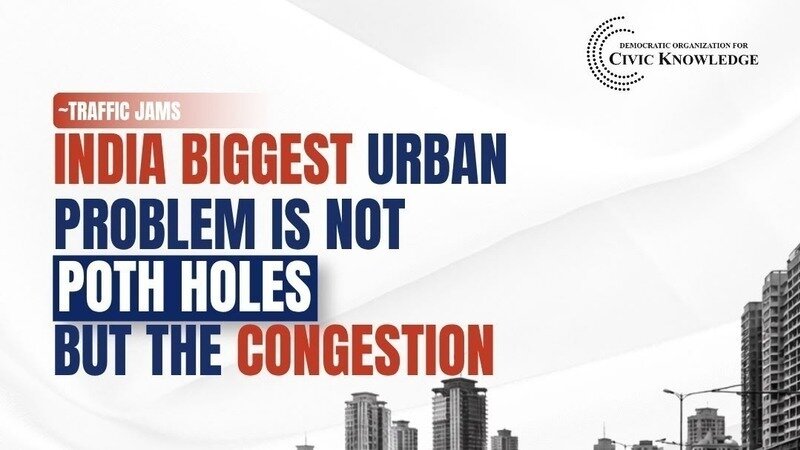
Every day, millions of Indians spend valuable hours stuck in traffic. What was once considered a peak-hour inconvenience has now become a daily reality in almost every major city. Traffic congestion affects everyone—students trying to reach school, employees commuting to work, businesses transporting goods, patients rushing to hospitals, and emergency services responding to critical situations. The time, money, and opportunities lost in traffic are significant, making congestion one of India's most pressing urban challenges.
However, congestion is not simply a traffic problem—it is an urban planning problem. As cities have expanded rapidly, transportation systems, land-use planning, and public infrastructure have struggled to keep pace. Instead of designing cities where people can conveniently access work, education, healthcare, and recreation, development has often encouraged long commutes and greater dependence on private vehicles.
Why is traffic congestion increasing?
Rapid urbanization without integrated city planning.
Too many private vehicles competing for limited road space.
Inadequate and unreliable public transportation.
Poorly designed intersections and inefficient traffic signal management.
Limited infrastructure for pedestrians and cyclists.
Urban development that places homes, workplaces, and services far apart.
Why does this matter?
Traffic congestion has consequences far beyond delayed travel. It affects the economy, the environment, public health, and the overall quality of life.
Some of the major impacts include:
Millions of productive hours lost every day.
Increased fuel consumption due to prolonged idling.
Higher commuting costs for individuals and businesses.
Rising air pollution and greenhouse gas emissions.
Delays in emergency services such as ambulances and fire departments.
Increased stress, fatigue, and mental health concerns among commuters.
Reduced time with family, education, recreation, and community activities.
Simply building more roads is not a long-term solution. Experience from cities around the world has shown that expanding road capacity alone often attracts more vehicles, eventually leading to the same level of congestion. Sustainable urban mobility requires a balanced approach that prioritizes moving people efficiently rather than simply accommodating more cars.
What needs to change?
We urge policymakers to adopt a people-first approach to urban development by:
Investing in reliable and affordable public transportation.
Designing safe, accessible, and walkable streets.
Developing dedicated cycling infrastructure.
Modernizing traffic management using smart technologies.
Promoting Transit-Oriented Development (TOD) to reduce travel distances.
Integrating land-use planning with transportation planning.
Encouraging sustainable mobility and reducing dependence on private vehicles.
Involving urban planners, transport experts, and citizens in shaping future city development.
India has the opportunity to build cities that are more efficient, inclusive, and sustainable. By recognizing traffic congestion as an urban planning challenge rather than merely a road issue, we can create communities where people spend less time in traffic and more time with their families, at work, in education, and contributing to society.
This petition calls upon the Government of India, State Governments, Urban Local Bodies, and all relevant authorities to adopt long-term, people-centric urban planning and mobility policies. Together, we can build cities that move people not just vehicles and ensure a better quality of life for present and future generations.

4
The Issue
About the Issue
Every day, millions of Indians spend valuable hours stuck in traffic. What was once considered a peak-hour inconvenience has now become a daily reality in almost every major city. Traffic congestion affects everyone—students trying to reach school, employees commuting to work, businesses transporting goods, patients rushing to hospitals, and emergency services responding to critical situations. The time, money, and opportunities lost in traffic are significant, making congestion one of India's most pressing urban challenges.
However, congestion is not simply a traffic problem—it is an urban planning problem. As cities have expanded rapidly, transportation systems, land-use planning, and public infrastructure have struggled to keep pace. Instead of designing cities where people can conveniently access work, education, healthcare, and recreation, development has often encouraged long commutes and greater dependence on private vehicles.
Why is traffic congestion increasing?
Rapid urbanization without integrated city planning.
Too many private vehicles competing for limited road space.
Inadequate and unreliable public transportation.
Poorly designed intersections and inefficient traffic signal management.
Limited infrastructure for pedestrians and cyclists.
Urban development that places homes, workplaces, and services far apart.
Why does this matter?
Traffic congestion has consequences far beyond delayed travel. It affects the economy, the environment, public health, and the overall quality of life.
Some of the major impacts include:
Millions of productive hours lost every day.
Increased fuel consumption due to prolonged idling.
Higher commuting costs for individuals and businesses.
Rising air pollution and greenhouse gas emissions.
Delays in emergency services such as ambulances and fire departments.
Increased stress, fatigue, and mental health concerns among commuters.
Reduced time with family, education, recreation, and community activities.
Simply building more roads is not a long-term solution. Experience from cities around the world has shown that expanding road capacity alone often attracts more vehicles, eventually leading to the same level of congestion. Sustainable urban mobility requires a balanced approach that prioritizes moving people efficiently rather than simply accommodating more cars.
What needs to change?
We urge policymakers to adopt a people-first approach to urban development by:
Investing in reliable and affordable public transportation.
Designing safe, accessible, and walkable streets.
Developing dedicated cycling infrastructure.
Modernizing traffic management using smart technologies.
Promoting Transit-Oriented Development (TOD) to reduce travel distances.
Integrating land-use planning with transportation planning.
Encouraging sustainable mobility and reducing dependence on private vehicles.
Involving urban planners, transport experts, and citizens in shaping future city development.
India has the opportunity to build cities that are more efficient, inclusive, and sustainable. By recognizing traffic congestion as an urban planning challenge rather than merely a road issue, we can create communities where people spend less time in traffic and more time with their families, at work, in education, and contributing to society.
This petition calls upon the Government of India, State Governments, Urban Local Bodies, and all relevant authorities to adopt long-term, people-centric urban planning and mobility policies. Together, we can build cities that move people not just vehicles and ensure a better quality of life for present and future generations.
Petition Updates
Share this petition
Petition created on 27 August 2026