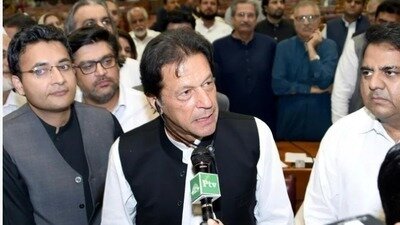

IMRAN KHAN: GLOBAL PETITION FOR IMMEDIATE JUDICIAL RELIEF AND INTERVENTION
The Issue
GLOBAL PETITION FOR IMMEDIATE JUDICIAL RELIEF AND INTERVENTION
Case Matter: The Life, Health, and Legal Rights of Former Prime Minister Imran Khan
TO THE ATTENTION OF:
Asif Ali Zardari, President of the Islamic Republic of Pakistan (Holding absolute constitutional authority to grant pardons, reprieves, and clemency under Article 45)
Shehbaz Sharif, Prime Minister of the Islamic Republic of Pakistan (Chief Executive holding administrative control over federal law enforcement and state detention facilities)
The Honorable Justice Yahya Afridi, Chief Justice of Pakistan (Head of the national judiciary with supreme oversight over constitutional rights, trial legality, and emergency legal relief)
The Honorable Justice Amin-ud-Din Khan (Pakistani jurist and the first Chief Justice of Pakistan’s Federal Constitutional Court.)
PREAMBLE
We, the undersigned members of the international community, human rights organizations, and concerned citizens, submit this formal petition to demand immediate legal, medical, and administrative intervention. The ongoing arbitrary detention of former Prime Minister Imran Khan under life-threatening conditions demands immediate remediation to prevent an irreversible miscarriage of justice.
Immediate International Intervention To Safeguard The Life, Health, and Legal Rights of Former Pakistani Prime Minister Imran Khan
Table of Contents
The Sentencing of Imran Khan
The Reality of Foreign-Imposed Regime Change
Immediate Core Demands
Strategic Rationale Behind the Demands
(Why Do We Want This?) - Call To Action Explained
The Political Target: Why Imran Khan is Imprisoned
Our Belief on Why Imran Khan is Imprisoned
Major Successes and Achievements as Prime Minister (2018–2022)
The Pre-2018 Status Quo
The Impact of Khan’s Governance
1. Economic Restructuring and Deficit Reduction
2. Export and Industrial Revival
3. Social Safety Net and Universal Health Cover
4. International Trust and Remittances
5. Long-Term Climate Resilience
Call to Action 1: Immediate Medical Care
Call to Action 2 & 3: Retrial vs. Full Pardon
Call to Action 2: Detailed Framework for a Fair Retrial
The Grounds for Retrial
Lack of Evidence and the Weaponization of Jurisprudence
Overview of the Alleged "Crimes"
The Total Failure of Credible Evidence
Reliance on Inadmissible Hearsay
Absence of Personal Enrichment
The Misapplication of Jurisprudence
Critical Considerations During the Trial Framework
Access to Adequate and Unrestricted Council
Equality of Arms
Binding Legal Reasoning for an Immediate Retrial
Violation of Article 10-A (Right to a Fair Trial)
Reversal of Burden of Proof
Demands for Re-trial
Striking Down "In-Camera" and Secret Jail Trials
Elimination of Fast-Track and "Hasty" Judgments
Consolidation of Overlapping Cases (The "Loophole" Block)
Direct Accountability and Oversight via Amicus Curiae
Call to Action 3: Detailed Terms for a Full Pardon and Immediate Release
Complete Restoration of Political and Civil Rights
General Amnesty for All Party Members and Supporters
Immediate Lifting of Free-Speech and Media Bans
Written Guarantees Against Political Exile
International Guarantors for Enforcement
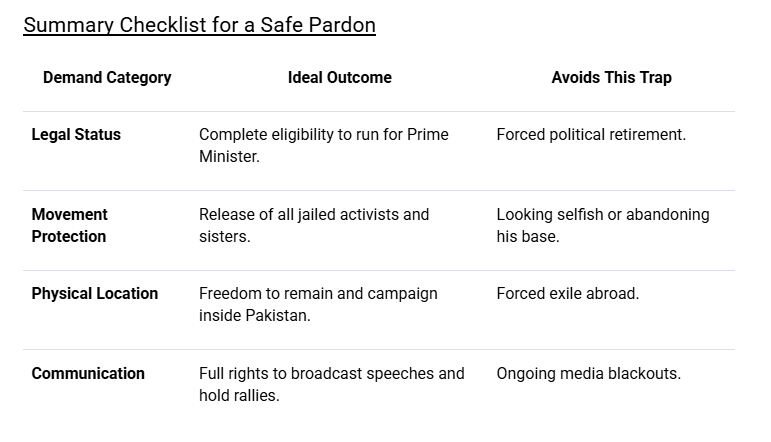
Summary Checklist for a Safe Pardon
Conclusion & International Mediation
Potential International Countries and Leaders to Mediate
The United States (via Backchannels & Expatriates)
Saudi Arabia and Qatar
How Past Leaders Used These Conditions
Nawaz Sharif (The 2000 Saudi Exile Deal)
Benazir Bhutto (The 2007 National Reconciliation Ordinance)
The Current Standoff
FINAL DECLARATION AND CALL TO ACTION
1.)The Sentencing of Imran Khan:
-In 2025 former Pakistani Prime Minister Imran Khan and his wife, Bushra Bibi, were sentenced to 17 years in prison regarding a state gifts corruption case. (Source 34)
-Khan was convicted and sentenced to 14-year sentence in 2025 over a land bribery case involving the Al-Qadir Trust. (Source 33)
The Reality of Foreign-Imposed Regime Change
Khan maintains that all charges are entirely politically motivated—a sentiment overwhelmingly shared by the Pakistani public. The backing of Khan's sentiment showcases that the push for imprisonment is driven by foreign geopolitical desires, deliberately outside the scope of Pakistani rule. We, those who stand with Imran Khan, believe that the affairs of every country rest within its borders and upon its people. It is not the authority of any foreign power to step in as a legal force against any foreign citizen without the support or the request of its people. Understanding that the country of Pakistan is in disagreement over this matter, one can only assume that this is not just politically motivated, but an outright act of invasion, in the form of foreign-imposed regime change at its highest degree.
Immediate Core Demands
Immediate Medical Transfer: We demand the urgent transfer of former Prime Minister Imran Khan from Adiala Jail to a specialized hospital to receive critical medical attention and remedy his rapidly deteriorating health.
Immediate Retrial: We demand a transparent, legally sound retrial to overturn his false imprisonment and fully vindicate his historical legacy.
Full Pardon and Dismissal: In the event that corrupt judicial tactics persist, we call for an immediate presidential pardon, his unconditional release, and the absolute dismissal of all manufactured charges.
2.) Strategic Rationale Behind the Demands
(Why Do We Want This?) - Call To Action Explained:
PM Khan has been held in prolonged detention since August 2023 under conditions that human rights organizations warn violate international law.
PM Khan's health has rapidly deteriorated.
Lack of evidence regarding his sentencing and the use of Islamic Jurisprudence.
These inhumane living conditions support the argument that his life is being used as an example to keep his countrymen in fear of ever becoming too effective of a leader, as doing so will irritate the egos of other powers. This outright display of what can be called attempted murder through prolonged harmful conditions opens the door to conversations surrounding global corruption as a whole. Many countries have ineffective leaders, and their countrymen and women struggle daily to make ends meet. Many are accused of taking bribes and are even caught red-handed disenfranchising their people and pocketing funds and resources allocated for their community. Many countries, especially in the African diaspora, have leaders that the country rejects, who carry out harmful regulations that leave many destitute. The depreciation of the Nigerian Naira, which was once greater than the US dollar only 40–50 years ago, and the declining infrastructure across the entire continent of Africa are prime examples of true corruption and bribery. However, those leaders are not imprisoned; they are not removed. There is not any intervention from foreign powers that could release the people from harsh conditions that keep them between the rock and the hard place of crime or indescribable poverty. The question we all should be asking ourselves is: Why Imran Khan? Why Pakistan? Why now?
3.) Why Imran Khan? - Why is he being targeted?
Our Belief of Why Imran Khan is Imprisoned
The following is a collection of successes gathered from outside sources of Imran Khan and why it can be seen how his leadership qualities may be troubling to other societies that would want to have dominance on the global stage. Sources will be linked below.
-National Pride and Athletic Legacy: Khan was already a household name and celebrity decades before entering politics. He cemented his status as a legendary figure by captaining Pakistan’s national team to its first and only Cricket World Cup victory in 1992. (Source 1)
-Philanthropy and Humanitarian Work: Following his retirement from cricket, he pivoted to massive charitable projects. He founded the Shaukat Khanum Memorial Cancer Hospital—providing free cancer care to low-income citizens—and established the Namal Institute, a STEM-focused college for rural youth. This proved to the public that his dedication to the country was genuine. (Source 2 & 3)
-Anti-Establishment and Anti-Corruption Stance: For over two decades, Khan positioned his political party, Pakistan Tehreek-e-Insaf (PTI), as the only alternative to the deeply entrenched, dynastic political families (like the Sharifs and Bhuttos) that had dominated Pakistan for generations. His relentless focus on fighting government corruption resonated heavily with citizens tired of the status quo. (Source 4)
-Defiant, Sovereign Foreign Policy: To his supporters, Khan represented a rare leader who refused to bow to Western superpowers. He consistently criticized the U.S.-led "War on Terror," vocally condemned drone strikes in Pakistan’s tribal areas, and strongly advocated against Islamophobia on global platforms like the United Nations. (Source 5)
Major Successes and Achievements as Prime Minister (2018–2022)
During his tenure, Khan focused heavily on turning Pakistan into an "Islamic welfare state," leaving behind a legacy of major social and environmental initiatives:
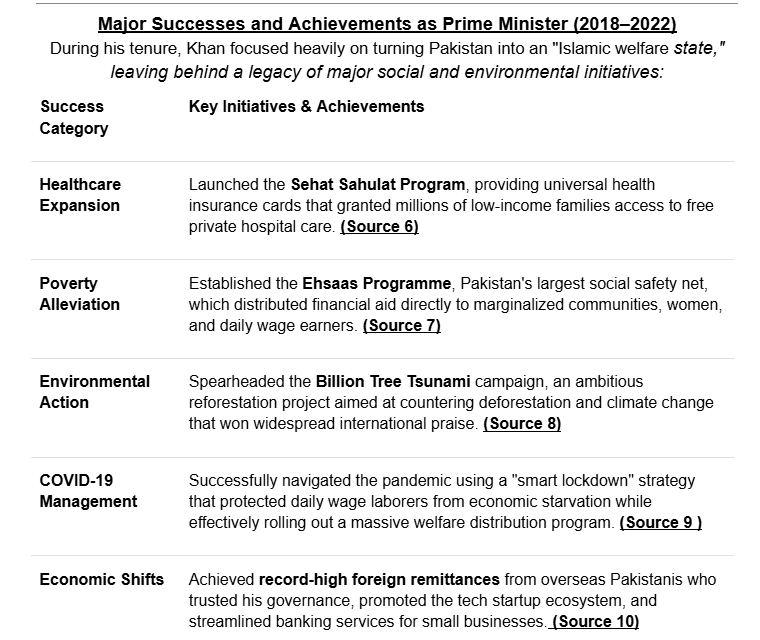
Through these efforts, Pakistan built the foundation to position itself as a true competitor on the global stage, liberating its people from hardships that once kept them too confined to the country, facing the inability to travel or seeking opportunities abroad, never to return to their homeland aside from visiting relatives.
The tie here to the previous section is that corruption leads to individuals seeking means of success outside of one's homeland. If countries remain continuously in a state of vulnerability and disenfranchisement, citizens of these countries will constantly look outside themselves and outside their countries' borders for opportunities, thus enhancing the economies of whichever country seems to have the best opportunities. The result of this is that their homelands never evolve, corrupt leaders continue to stay in power, the people left behind either have to face a life of crime or deep poverty, and the country with the best opportunities remains at the top of the global stage, holding the power to implement immigration laws that prioritize themselves and the businesses created on their soil. This is manipulation at its finest. And this is what we believe is the motivation behind discrediting true leaders who want their countries to be a home for expansion, innovation, and success for their people.
The Pre-2018 Status Quo
Let’s visit the state of Pakistan before PM Khan assumed office.
The following is a collection showcasing the state of Pakistan previous to PM Khan entering office. Sources will be linked below.
-When Imran Khan assumed office as Prime Minister on August 18, 2018, Pakistan was on the brink of structural collapse due to decades of economic mismanagement, systemic corruption, and volatile governance.
-The direct contrast between the problems he inherited and how his leadership adjusted Pakistan's trajectory highlights why his tenure became a focal point for his supporters.
Before Khan's election, Pakistan was trapped in a cycle of short-term economic fixes, spearheaded by alternating dynastic political families. The primary systemic failures included:
-Record-Breaking Current Account Deficit: The previous administration artificially maintained a strong Pakistani Rupee by spending billions of physical dollars from the national reserves to subsidize imports. While this made imported goods temporarily cheap, it completely emptied the foreign exchange reserves and left the country with the largest current account deficit in its history. (Source 11)
-Industrial and Export Stagnation: Because imports were artificially subsidized, local Pakistani manufacturers could not compete. Domestic businesses shut down, exports flatlined, and the country relied entirely on foreign-made products. (Source 12)
-Severe Energy and Power Deficits: The national infrastructure was crippled by massive financial bottlenecks in the energy sector, resulting in severe daily blackouts across the country that stunted economic production. (Source 13)
-Entrenched Institutional Corruption: Government departments, tax authorities, and state-run enterprises were heavily politicized. Widespread financial evasion left the state with diminishing tax revenues and a staggering debt-to-GDP ratio. (Source 14)
Impact of PM Khan’s Governance
Now let us compare what has been accomplished under PM Khan Vs the state of Pakistan previous to his leadership to have a more in-depth view of his strides.
The following is a comparison and recap of the impact of Imran Khan's success for the country of Pakistan.
Khan’s government radically altered the country's economic and social priorities, shifting Pakistan from an import-dependent economy toward local sustainability and social protection.
1. Economic Restructuring and Deficit Reduction
Instead of burning cash to pretend the Rupee was strong, Khan allowed the currency to adjust to its true market value. While this caused painful, immediate inflation, it stopped the bleeding of foreign exchange reserves. Consequently, his administration slashed the massive inherited current account deficit by roughly 70% within his early years by heavily restricting luxury imports and prioritizing home-grown production. (Source 15)
2. Export and Industrial Revival
By eliminating import subsidies, local Pakistani industries became competitive again. Khan introduced major stimulus packages for the textile, construction, and IT startup sectors. This pivot successfully engineered an export-driven growth model, helping push Pakistan’s GDP to a record $383 billion and raising per-capita income by the end of his term. (Sources 16 and 17)
3. Social Safety Net and Universal Health Cover
Prior to 2018, lower-income citizens had virtually no state protection against medical or financial emergencies. Khan launched the Sehat Sahulat Program, a revolutionary universal health insurance initiative that gave millions of poor families free access to
private hospital care. He coupled this with the Ehsaas Programme, an internationally recognized data-driven cash transfer system that shielded the poorest citizens from starvation during global crises. (Source 18)
4. International Trust and Remittances
Because overseas Pakistanis deeply trusted Khan's personal integrity over previous leaders, foreign remittances reached all-time historic highs during his tenure. Millions of expatriates channeled money back through legal banking channels to support his economic initiatives, providing a massive cushion to the national treasury. (Source 19)
5. Long-Term Climate Resilience
While prior governments built expensive, fossil-fuel-dependent mega-projects prone to corruption, Khan pivoted to green infrastructure. His Billion Tree Tsunami reforested vast tracts of degraded land, bringing international praise and establishing a blueprint for mitigating Pakistan's vulnerability to global climate change. (Source 8)
In Short: We believe that Imran Khan was doing too well as a leader. His efforts were leading to the evolution of a new Pakistan. One where its citizens could live, work, and enrich themselves and their economies. This type of rapid success posed a threat to countries who are currently at the top of the global stage. There is no longer a reason for citizens to seek better opportunities abroad and for societies that benefit from foreign labor, this enhancement is a true detriment to their livelihood and control of power.
We believe that the goal of imprisoning such a miraculous leader and confining him to such atrocious conditions is to purposefully, rip out the spirit of the country of Pakistan and its momentum due to their love for the former cricket star and great leader.
4.) Call to Action 1: Detailed - Immediate Intervention- The Case for Immediate Medical Care:
Imran Khan’s health is actively falling rapidly in Adiala Jail.
Despite clear directives from the Supreme Court of Pakistan to transfer him to a specialized facility for necessary medical evaluations, authorities have continuously obstructed independent, comprehensive care. How is it that an order from the supreme court can be interfered with by what seems like foreign interference. This totally and outright ignorance of the order sheds light on the little power the Pakistani government has over their own citizens and their own laws. If a country cannot carry out their own laws, and the rulings of their officials are ignored , what does that say about the world we live in ? This event should terrify those that believe that their governments are safe from foreign intervention,
Khan has faced severe medical neglect, including an alarming loss of vision in his right eye and arbitrary isolation. Restricting access to his personal physicians violates the basic constitutional guarantees of prisoner health and dignity.
Specifics:
-Severe Right-Eye Ocular Impairment: Independent legal and medical evaluations submitted to the Supreme Court of Pakistan revealed that prolonged medical neglect left Imran Khan with roughly 15% vision capacity in his right eye. Specialist findings indicate this severe loss is consistent with a diagnosis of Right Central Retinal Vein Occlusion (CRVO) triggered by an untreated blood clot. In a broader clinical context, a rapid decline in eyesight under high-stress detention conditions can also resemble or be exacerbated by other serious conditions, including hypertensive retinopathy or ischemic optic neuropathy. (Source 35 & 36)
-Acute Cardiovascular and Systemic Strain: Official medical summaries indicate that Khan has suffered from uncontrolled, fluctuating blood pressure reaching levels of 140/100 mmHg or higher, accompanied by chronic headaches, chest palpitations, and severe restlessness. (Source 35 & 37)
-Substandard Solitary Confinement Environment: Reports describe him being held in a highly humid cell containing an open, un-separated toilet facility with no functional exhaust system. This environment significantly raises the risk of recurrent food poisoning and physical exhaustion. (Source 38 & 39)
-Obstruction of Independent Medical Access: Prison administrations have repeatedly blocked or delayed direct, unmonitored evaluations by his trusted personal physicians—such as Dr. Faisal Sultan and Dr. Asim Yousaf—relying instead on state-controlled medical boards whose transparency has been sharply questioned by his defense team. (Source 35 & 40)
To address advanced clinical presentations involving severe vision damage and acute cardiovascular stress, standard medical protocols prioritize at least three distinct treatment options:
-Advanced Ophthalmic Procedures: Administering targeted intravitreal eye injections (such as anti-VEGF therapies) and specialized retinal procedures to reduce macular edema and stabilize remaining vision. (Source 35)
-Aggressive Cardiovascular Management: Introducing adjusted systemic medications to safely regulate blood pressure fluctuations, prevent thromboembolic events, and stabilize heart rates. (Source 35)
-Comprehensive Diagnostic Profiling: Performing emergency specialized scans, such as a CT coronary angiography or a cardiac MRI, to thoroughly evaluate underlying vascular health and mitigate the threat of a stroke or heart attack. (Source 35 & 37)
5.) Call to Action 2 and 3: Overview - Retiral and Full Pardon
Although we are adamant that PM Khan held no responsibility in any of the charges brought against him, we understand that following the law and order of the bodies that govern us is imperative to ensuring that society stays intact and on a forward-moving trajectory. For that reason, we are open to a retrial over an immediate call for a full pardon. We also understand this ordeal is just a moment in time; we know that history will look back on this event, and when this is brought up in conversations in the future, we want PM Khan to be viewed with the utmost respect. Going through the retrial process will allow for new evidence to be entered and corrupt tactics to be discovered; this will allow PM Khan to have a fair trial and for justice to prevail, allowing him to use the very system that incarcerated him to liberate him. This not only will provide the outcome we desire, it will also strengthen morale in the legal system, giving hope to those who believe laws and legal proceedings are but a mockery of society and only beneficial to those in power as a tool of force and abuse. However, in the event that the findings remain the same and the same tactics are used, we will then move for a full pardon and an immediate dismissal of all charges.
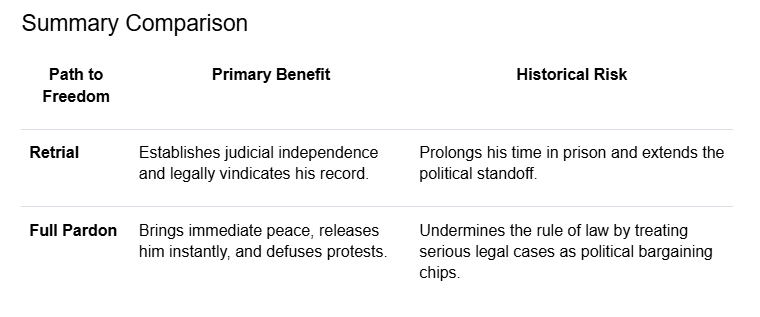
Please see the comparison of the two ideas and why we have chosen to implement both as pathways for the freedom of Imran Khan. We, those who support his release, are not without forethought, nor are we without an understanding of legal processes. We want the best route that will allow the country of Pakistan as well as the rules and regulations that govern our legal world to coexist. As long as the first call to action, allowing PM Khan to receive the best medical care that can be offered to him, is met, and his life is no longer in direct harm through inhumane conditions, we believe that a trial, as long as it may take, is the best first course of action before demanding a full, immediate pardon.
Comparison Below:
Option 1: The Push for a Retrial
A retrial involves overturning Khan's current convictions on the grounds of procedural flaws and restarting the legal proceedings under strict independent scrutiny.
-The Historic Implication: Pakistan has a long history of "judicial engineering," where courts are used to disqualify popular politicians at the behest of the military establishment. A transparent, high-profile retrial could break this cycle by setting a historic precedent that the rule of law and due process apply to everyone, regardless of political alignment.
-The Arguments for a Retrial: Proponents argue that a retrial is the only way to genuinely clear Khan’s name. His legal team maintains that the current charges—ranging from state secret leaks (Cipher case) to illegal marriage and corruption (Toshakhana)—were rushed through fast-track courts without allowing proper defense witnesses. Securing an acquittal through an open court would legally vindicate him and validate his political stance. (Source 20)
-The Risks: Retrials take time. Khan would likely remain entangled in Pakistan's sluggish legal system for months or years, during which political instability and public unrest could continue to paralyze the country.
Option 2: A Full Pardon and Immediate Release
A full pardon would mean the President or the ruling government dismisses all charges and releases Khan from prison immediately, bypassing the judicial process entirely.
-The Historic Implication: While a pardon brings immediate freedom, it risks reinforcing the historical perception that law in Pakistan is a tool of political compromise rather than justice. It would mirror past political "deals" (like the NROs or sudden exiles granted to previous leaders like Nawaz Sharif), where legal accountability is traded for political peace.
-The Arguments for a Pardon: Advocates for this route prioritize immediate national stability. With Pakistan facing severe economic inflation and deep political polarization, an immediate pardon and release could instantly de-escalate tensions, halt massive protest movements, and allow the country to move toward national reconciliation.
-The Risks: A pardon implies that the convictions were legally valid but forgiven, which Khan and his supporters fiercely reject. Furthermore, a politically motivated pardon would not resolve the underlying systemic issue: the weaponization of the judiciary against political opponents.
6.) Call to Action 2: Detailed Framework for a Fair Retrial
We demand for Former Pakistani Prime Minister Imran Khan to be issued a Retrial of his case specifically concerning the Al-Qadir Trust and Toshakhana references, alongside a comprehensive consolidation of all overlapping political charges, which has landed him in his current condition.
The Grounds for Retrial should be the following:
-Violations of Constitutional Due Process and Right to Fair Trial: The state systematically weaponized "in-camera" and secret prison trials inside Adiala Jail. This directly violates Article 10-A of the Constitution of Pakistan and international legal standards, which guarantee a fully open, public courtroom accessible to international observers, independent journalists, and defense witnesses. (Source 21 & 22)
-Arbitrary Exclusion of Defense Counsel and Witness Cross-Examination: Multiple convictions—including the fast-tracked verdicts handed down immediately prior to national elections—were rushed through by judges who actively barred defense attorneys from entering the courtroom or wrapped up cases without hearing defense arguments or allowing them to cross-examine critical witnesses. (Source 22)
-Complete Lack of Credible Evidence and Fabricated Allegations: In the Al-Qadir Trust and Toshakhana references, the prosecution relied on coerced staff testimonies and unsubstantiated asset valuations without presenting a verifiable paper trail or concrete proof of personal financial misconduct or public theft. (Source 33 & 41)
-Abuse of Judicial Loopholes Through Consecutive Detentions: The state has demonstrated clear prosecutorial malice by deploying a "revolving door" arrest mechanism. Every time the defense secures an acquittal or bail in major high-profile matters (such as the landmark Islamabad High Court acquittal in the Cipher case), secondary agencies immediately activate overlapping anti-terrorism or rioting warrants to block his physical liberation. (Source 24 & 25)
-Precedent of Judicial Engineering and Political Discrimination: Overturning these convictions is legally supported by the historic July 2024 acquittal in the Iddat case and the previous dismissal of the Cipher charges. These rulings conclusively established that the state's multi-layered legal campaign is driven entirely by political discrimination aimed at enforcing a lifetime public-office ban. (Source 20 & 22)
Additionally, we demand that this retrial be carried out by Access to adequate representation at no cost.
The initial case sentencing Khan to imprisonment found him guilty of misusing his position to buy and sell gifts. The punishment for that non-violent crime should not come with a death sentence, or inhumane conditions igniting an increase in poor health and the refusal of adequate healthcare. Furthermore, the people of Pakistan overwhelmingly show their support and solidarity in the release of the former leader. The people of the country stand by Khan, and desire for his conditions to be enhanced, and ultimately his complete removal from the prison system.
Settling for Khan to be reintroduced back into normal population within, we will use the tentative time period of 30 days, is only phase one of a multistep demand of his total release from prison.
The population of Pakistan believes that these crimes are politically induced and these claims of embezzlement of any kind have been planted and fabricated, giving the election committee no choice but to prosecute. There are advocates who share the sentiments that it is through his love for his country that foreign influence has targeted him as “dangerous”, and subsequently are pushing for his life to end behind bars.
If the people of Pakistan do not want that, if the officials have predicted for him to have better conditions, if these items are documented….then what exactly is stopping the retrial and better conditions to be brought back into questioning for massive change to take place? What influence or monolithic ideas are circulating to prevent these items from arise back in front of a judge and jury? These are questions citizens and law of officials of Pakistan must consider and demand justice for.
Lack of Evidence and the Weaponization of Jurisprudence
The initial convictions against Prime Minister Imran Khan—most notably the Al-Qadir Trust case—represent a severe departure from established legal standards. The prosecution's narrative relies entirely on a distorted "quid pro quo" theory that fails to meet the basic evidentiary thresholds required for criminal sentencing.
1. Overview of the Alleged "Crimes"
The state's primary allegation is that Khan engaged in a "favor for favor" financial arrangement with real estate tycoon Malik Riaz. The prosecution claims that Khan’s cabinet facilitated the settlement of a £190 million National Crime Agency (NCA) investigation in the United Kingdom, allowing those funds to be adjusted against a multi-billion rupee fine owed by the tycoon in Pakistan. In exchange, the state alleges that Malik Riaz donated vast tracts of high-value land to the Al-Qadir Trust—a charitable educational institution founded by Imran Khan and his wife, Bushra Bibi (Source 41)
2. The Total Failure of Credible Evidence
The "evidence" presented by the state to secure these convictions remains fundamentally flawed:
-Reliance on Inadmissible Hearsay: The state’s case is built almost exclusively on the state-managed testimonies of government staffers and political figures who were held under administrative pressure or promised immunity (Source 33)
-Absence of Personal Enrichment: The prosecution failed to establish a paper trail showing any personal financial benefit or asset transfer to Imran Khan or his family. The land in question is legally owned by a registered, non-profit charitable trust dedicated entirely to public education, completely invalidating the claim of personal corruption. (Source 41)
3. The Misapplication of Jurisprudence
A disturbing pattern in Khan's multi-layered legal ordeal is the selective weaponization of jurisprudence to achieve political exclusion. Just as the judiciary severely misapplied traditional religious jurisprudence in the now-overturned Iddat case—an invasive trial that was roundly condemned globally as a violation of basic human privacy—the state has consistently bent both national and traditional legal concepts out of shape. Rather than conducting objective, fact-based trials, the anti-corruption courts have relied on selective legal engineering to criminalize standard cabinet decisions and charitable contributions. (Source 22)
4. Critical Considerations During the Trial Framework
To correct these systemic failures, any legitimate judicial review or retrial must immediately guarantee the following protections:
-Access to Adequate and Unrestricted Council: Former Prime Minister Khan must be granted unmonitored access to top-tier defense counsel, both inside Pakistan and via international legal experts, completely free from state intimidation, wiretapping, or financial freezes.(Source 22)
-Equality of Arms: The defense must be given equal access to all state records, including confidential cabinet minutes and international agreements, to effectively dismantle the prosecution's fabricated timelines.(Source 22)
5. Binding Legal Reasoning for an Immediate Retrial
The statutory grounds for nullifying the current sentences and granting a retrial are absolute:
-Violation of Article 10-A (Right to a Fair Trial): The holding of fast-tracked, hidden prison trials violates the foundational constitutional right to an open, public defense. (Source 21 & 22)
-Reversal of Burden of Proof: National Accountability Bureau (NAB) laws were illegally twisted to force the defense to prove innocence before the prosecution had even presented concrete evidence of an actual crime, violating universal principles of criminal justice.
Demands for Re-trial:
1. Striking Down "In-Camera" and Secret Jail Trials
-The Demand: A strict requirement that all proceedings take place in a fully open, public courtroom accessible to international observers, independent journalists, and the public. (Source 21)
-Why it matters: The state has repeatedly attempted to hold trials inside high-security prisons (such as Adiala Jail) or behind closed doors, citing security risks. Khan’s team, led by high-profile defense attorneys like Barrister Salman Safdar, argues that secret trials are weaponized to rush convictions. Demanding open-court scrutiny forces prosecutors to present credible evidence under public and international legal spotlight, which previously led to the Islamabad High Court declaring his jail trials illegal. (Source 22)
2. Elimination of Fast-Track and "Hasty" Judgments
-The Demand: Establishing a legally protected, reasonable timeline that grants the defense adequate time to cross-examine state witnesses and present their own evidence. (Source 23)
-Why it matters: Multiple prior convictions against Khan were handed down in rapid succession right before major national milestones (such as the February 2024 elections), with judges occasionally barring his lawyers from entering the courtroom or wrapping up cases without hearing defense arguments. A favorable outcome relies heavily on demanding a standardized legal pacing that prevents the judiciary from rushing through verdicts.(Source 22)
3. Consolidation of Overlapping Cases (The "Loophole" Block)
-The Demand: Demanding that the judiciary address his multi-layered cases collectively, rather than allowing individual state agencies to file successive, overlapping charges.
-Why it matters: Khan's legal team has successfully won major victories, including getting his sentences suspended or securing acquittals in prominent cases like the state-secrets "Cipher" case. However, every time an acquittal or bail is ordered, state authorities immediately activate a new, secondary arrest warrant (such as new corruption allegations or rioting charges) to prevent his physical release. For a true release to happen, the courts must halt this cycle of consecutive detentions. (Source 24 & 25)
4. Direct Accountability and Oversight via Amicus Curiae
-The Demand: The continued appointment of independent judicial observers (Amicus Curiae) by the Supreme Court to monitor the conditions of his confinement and trial fairness. (Source 26)
-Why it matters: Having independent legal observers reporting directly to the Supreme Court bypasses local prison administrations and political meddling. This mechanism has already proven vital—it was an independent medical and legal report submitted by the appointed council that exposed Khan’s deteriorating health and vision loss, forcing courts to legally mandate his transfer to a hospital for proper treatment. (Sources 27 and 28)
Ultimately, the best defense strategy for Khan relies entirely on forcing the legal process out of hidden prison blocks and into highly visible, independent constitutional courts where fabricated charges struggle to stand up to open scrutiny.
7.) Call to Action 3: Detailed (Full Pardon and Immediate Release)
Complete Restoration of Political and Civil Rights
-The Condition: A full pardon must explicitly erase all criminal convictions and automatically lift all lifetime bans on holding public office.
-Why it matters: In Pakistan, a standard pardon might get a leader out of prison but leave them legally barred from contesting elections or leading their political party. Supporter morale depends entirely on Khan being legally allowed to run for Prime Minister again. Without this condition, a pardon is effectively a golden cage that ends his political career.
General Amnesty for All Party Members and Supporters
-The Condition: The pardon must not be isolated to Imran Khan alone; it must include a comprehensive general amnesty for all jailed PTI leadership, activists, and protesters arrested since 2023.
-Why it matters: If Khan accepts a personal pardon while thousands of his loyal grassroots supporters and family members (including his sisters) remain in prison, it would severely damage his reputation as a populist leader who fights for the common man. Extending the pardon to his entire base preserves party unity and public loyalty.
Immediate Lifting of Free-Speech and Media Bans
-The Condition: The state must completely lift all censorship blocks, allowing Imran Khan and the PTI party unrestricted access to mainstream television, radio, and digital media platforms, alongside the freedom to hold public rallies.
-Why it matters: Since his arrest, Pakistani media networks have faced severe restrictions against broadcasting Khan's speeches or even mentioning his name on air. A pardon is useless if he remains politically silenced. Demanding full freedom of speech ensures he can immediately re-mobilize his millions of voters.
Written Guarantees Against Political Exile
-The Condition: A binding constitutional or international guarantee that Khan will not be forced into political exile (such as being flown to London or Saudi Arabia) as a hidden requirement for his release.
-Why it matters: Historically, the Pakistani establishment has used a "pardon-and-exile" blueprint to remove powerful leaders from the local political map (as they did with former Prime Ministers Nawaz Sharif and Benazir Bhutto). Khan’s entire political brand is built on the promise that he will live, fight, and die in Pakistan. Remaining physically inside the country is a non-negotiable condition for his legacy.
International Guarantors for Enforcement
-The Condition: Securing neutral, high-profile international third parties or friendly foreign governments (such as China, Saudi Arabia, or Turkey) to act as official guarantors of the pardon agreement.
-Why it matters: Given the deep mistrust between Khan’s party and the current military and civilian establishment, any domestic agreement could easily be broken once protests cool down. Having global superpowers or international bodies oversee the terms ensures that the state cannot arbitrarily fabricate new charges to re-arrest him weeks after his release.
8.) Conclusion:
Potential International Countries and Leaders to Mediate
Historically, Pakistan’s military and civilian leaders have relied on wealthy Gulf allies or Western superpowers to broker high-stakes political compromises. If a formal negotiation for Imran Khan’s pardon and release were to materialize, the most likely mediators include:
-The United States (via Backchannels & Expatriates): Reports highlight that American-Pakistani delegations—including prominent business figures like Tanweer Ahmed and senior PTI USA leaders—have actively held sensitive, backchannel meetings inside Adiala Jail to bridge gaps between Khan and the military establishment. Additionally, the U.S. government holds tremendous leverage due to Pakistan's ongoing economic reliance on international financial institutions. (Sources 29 and 30)
-Saudi Arabia and Qatar: The Gulf states have a long history of acting as guarantors for Pakistan's political stability. Qatar, in particular, has emerged as a powerhouse mediator in the region, actively co-facilitating delicate geopolitical negotiations alongside Pakistani officials. (Sources 31 and 32)
How Past Leaders Used These Conditions
Imran Khan's firm stance against making a personal "give-and-take" deal reflects a desire to avoid the historical traps that past Pakistani Prime Ministers fell into. Historically, leaders used international mediation to secure their freedom, but it always came at a steep cost to their political careers:
1. Nawaz Sharif (The 2000 Saudi Exile Deal)
-The Context: Following a military coup in 1999, Prime Minister Nawaz Sharif was jailed and faced a potential death sentence on hijacking and corruption charges.
-The Mediation: Saudi Arabia’s Royal Family stepped in as international guarantors to negotiate a full pardon and commute his prison sentence.
-The Conditions Used: Sharif secured immediate physical freedom and the protection of his family, but he failed to secure his political rights. The military establishment forced him into a mandatory 10-year political exile in Saudi Arabia, barring him from participating in Pakistani politics for a decade. He eventually returned years later to regain power, but the deal temporarily fractured his political momentum. Although Imran Khan has stated that he refuses to accept exile, holding firm to his innocence and the manipulation of politics being the catalyst behind his imprisonment, we can pull from this instance and compare similarities that may lead to a favorable result
2. Benazir Bhutto (The 2007 National Reconciliation Ordinance)
-The Context: Former Prime Minister Benazir Bhutto lived in self-imposed exile for years to avoid corruption charges filed by the military government of General Pervez Musharraf.
-The Mediation: The United Kingdom and the United States heavily mediated backchannel talks between Bhutto and Musharraf. The Western powers wanted a stable, moderate civilian leader to help fight the War on Terror.
-The Conditions Used: This negotiation resulted in the historic National Reconciliation Ordinance (NRO) of 2007. It granted a general amnesty and dropped all corruption charges against Bhutto and hundreds of political workers. Crucially, it allowed her to return to Pakistan legally, restore her political speech, and campaign openly for the upcoming elections.
The Current Standoff
While the government has floated minor concessions—such as offering to move Khan to house arrest if he stops his anti-government agitation—Khan has repeatedly rejected these terms. His sister, Aleema Khan, has reiterated that he would rather remain in prison than accept a conditional release that forces him to drop his core demands for constitutional rights and free elections. (Source 23)
9.) FINAL DECLARATION AND CALL TO ACTION
In summary, the treatment of former Prime Minister Imran Khan represents a definitive breaking point for justice, domestic sovereignty, and basic human rights. We refuse to stand by as a globally respected leader faces systemic medical neglect and politically manufactured confinement behind closed prison doors.
By signing this petition, the international community and the people of Pakistan unite to demand immediate, measurable compliance from President Asif Ali Zardari, Prime Minister Shehbaz Sharif, and Chief Justice Yahya Afridi on three absolute priorities:
-Immediate Medical Rescue: Cease all administrative roadblocks and transfer Khan to an independent hospital to save his failing vision and health.
-Restoration of Legal Integrity: Vacate all rushed, secret convictions and institute a fully transparent, public retrial free from political interference.
-Absolute Political Liberation: Issue a full pardon that entirely restores his civil rights, grants amnesty to his supporters, and rejects any attempt at forced exile.
Justice delayed is justice denied. We demand accountability, we demand the protection of constitutional rights, and we demand the immediate release and relief of Imran Khan.
SIGN AND SUPPORT THIS PETITION!
Sources:
- https://www.britannica.com/biography/Imran-Khan
- https://shaukatkhanum.org.pk/
- https://namal.edu.pk/
- https://insafpk.org/home
- https://insafpk.org/tabdeeli-ka-safar/101-biggest-achievements-imran-khans-government
- https://www.linkedin.com/company/8171-ehsaas-program-25000-bisp
- https://borgenproject.org/the-ehsaas-program/
- https://www.unep.org/news-and-stories/story/pakistans-ten-billion-tree-tsunami
- https://www.dawn.com/news/1566978
- https://www.reuters.com/article/world/remittances-to-pakistan-hit-record-high-due-to-subdued-haj-spending-idUSKCN25D1AR/
- https://www.newswise.com/articles/a-conversation-with-prime-minister-imran-khan-of-pakistan
- https://pide.org.pk/research/what-are-the-factors-making-pakistans-exports-stagnant-insight-from-literature-review/
- https://www.brecorder.com/news/374737
- https://www.researchgate.net/publication/393860874_Governance_and_Economic_Development_in_Pakistan_A_Case_Study_of_PT_Government_2018-2022
- https://www.newswise.com/articles/a-conversation-with-prime-minister-imran-khan-of-pakistan
- https://www.gids.org.pk/with-6-growth-rate-pakistans-economic-size-jumps-to-383-billion/
- https://www.radio.gov.pk/01-03-2022/pm-unveils-incentives-package-for-promotion-of-industrial-sector
- https://www.heartfile.org/pm-imran-khan-launches-ehsaas-kafaalat-programme-for-7-million-deserving-women/
- https://www.wikiwand.com/en/Premiership_of_Imran_Khan
- https://www.jurist.org/news/2024/06/pakistan-high-court-acquits-former-pm-imran-khan-in-high-profile-cipher-case/
- https://www.reuters.com/world/asia-pacific/pakistan-court-declares-jail-trial-former-pm-imran-khan-illegal-lawyer-2023-11-21/
- https://www.aljazeera.com/news/2023/11/21/jail-trial-of-pakistans-imran-khan-has-been-declared-illegal-lawyer-says
- https://www.dawn.com/news/1768531
- https://fox8.com/news/ap-pakistans-top-court-orders-imran-khan-released-on-bail-in-a-corruption-case-he-wont-be-freed-yet/
- https://apnews.com/article/pakistan-court-suspend-imran-khan-wife-sentence-5a3f1a4134ea22578dad0c8da6a7ed74
- https://www.arabnews.pk/pakistan/ex-pm-imran-khan-lawyers-move-pakistan-court-for-his-release-on-medical-grounds-2633010
- https://www.bbc.com/news/articles/cy4kzzlydrro
- https://www.arabnews.pk/pakistan/ex-pm-imran-khan-lawyers-move-pakistan-court-for-his-release-on-medical-grounds-2633010
- https://www.facebook.com/tribunedotpk/posts/on-september-21-2026-senior-pakistani-journalist-hamid-mir-stated-that-pti-found/1541119124699120/
- https://www.facebook.com/VerifiedPakistanToday/posts/on-september-21-2026-senior-pakistani-journalist-hamid-mir-stated-that-pti-found/122328687242190003/
- https://www.facebook.com/TrendingNewsBengali/videos/iran-conveys-seven-ceasefire-conditions-to-us-via-qatari-and-pakistani-mediation/2488380508351331/
- https://www.facebook.com/igihe/posts/iran-says-conditions-for-reviving-diplomacy-conveyed-to-us-through-qatars-mediat/1506308718192183/
- https://www.aljazeera.com/news/2025/1/17/pakistans-ex-pm-imran-khan-wife-sentenced-to-jail-in-corruption-case
- https://www.aljazeera.com/news/2025/12/20/ex-pakistan-pm-imran-khan-wife-sentenced-to-17-years-in-corruption-case
- https://www.aljazeera.com/news/2026/2/12/ex-pakistan-pm-imran-khan-left-with-15-vision-in-right-eye-court-told
- the-independent.com
- https://www.bbc.com/news/articles/c3rzx1v94p8o
- https://www.dawn.com/news/1972708
- https://www.globalvillagespace.com/report-details-imran-khans-daily-routine-and-cell-facilities-in-adiala-jail/
- https://www.nation.com.pk/12-Feb-2026/report-sc-details-imran-khan-s-jail-conditions-medical-concerns
- https://en.wikipedia.org/wiki/Al-Qadir_Trust_case

16
The Issue
GLOBAL PETITION FOR IMMEDIATE JUDICIAL RELIEF AND INTERVENTION
Case Matter: The Life, Health, and Legal Rights of Former Prime Minister Imran Khan
TO THE ATTENTION OF:
Asif Ali Zardari, President of the Islamic Republic of Pakistan (Holding absolute constitutional authority to grant pardons, reprieves, and clemency under Article 45)
Shehbaz Sharif, Prime Minister of the Islamic Republic of Pakistan (Chief Executive holding administrative control over federal law enforcement and state detention facilities)
The Honorable Justice Yahya Afridi, Chief Justice of Pakistan (Head of the national judiciary with supreme oversight over constitutional rights, trial legality, and emergency legal relief)
The Honorable Justice Amin-ud-Din Khan (Pakistani jurist and the first Chief Justice of Pakistan’s Federal Constitutional Court.)
PREAMBLE
We, the undersigned members of the international community, human rights organizations, and concerned citizens, submit this formal petition to demand immediate legal, medical, and administrative intervention. The ongoing arbitrary detention of former Prime Minister Imran Khan under life-threatening conditions demands immediate remediation to prevent an irreversible miscarriage of justice.
Immediate International Intervention To Safeguard The Life, Health, and Legal Rights of Former Pakistani Prime Minister Imran Khan
Table of Contents
The Sentencing of Imran Khan
The Reality of Foreign-Imposed Regime Change
Immediate Core Demands
Strategic Rationale Behind the Demands
(Why Do We Want This?) - Call To Action Explained
The Political Target: Why Imran Khan is Imprisoned
Our Belief on Why Imran Khan is Imprisoned
Major Successes and Achievements as Prime Minister (2018–2022)
The Pre-2018 Status Quo
The Impact of Khan’s Governance
1. Economic Restructuring and Deficit Reduction
2. Export and Industrial Revival
3. Social Safety Net and Universal Health Cover
4. International Trust and Remittances
5. Long-Term Climate Resilience
Call to Action 1: Immediate Medical Care
Call to Action 2 & 3: Retrial vs. Full Pardon
Call to Action 2: Detailed Framework for a Fair Retrial
The Grounds for Retrial
Lack of Evidence and the Weaponization of Jurisprudence
Overview of the Alleged "Crimes"
The Total Failure of Credible Evidence
Reliance on Inadmissible Hearsay
Absence of Personal Enrichment
The Misapplication of Jurisprudence
Critical Considerations During the Trial Framework
Access to Adequate and Unrestricted Council
Equality of Arms
Binding Legal Reasoning for an Immediate Retrial
Violation of Article 10-A (Right to a Fair Trial)
Reversal of Burden of Proof
Demands for Re-trial
Striking Down "In-Camera" and Secret Jail Trials
Elimination of Fast-Track and "Hasty" Judgments
Consolidation of Overlapping Cases (The "Loophole" Block)
Direct Accountability and Oversight via Amicus Curiae
Call to Action 3: Detailed Terms for a Full Pardon and Immediate Release
Complete Restoration of Political and Civil Rights
General Amnesty for All Party Members and Supporters
Immediate Lifting of Free-Speech and Media Bans
Written Guarantees Against Political Exile
International Guarantors for Enforcement
Summary Checklist for a Safe Pardon
Conclusion & International Mediation
Potential International Countries and Leaders to Mediate
The United States (via Backchannels & Expatriates)
Saudi Arabia and Qatar
How Past Leaders Used These Conditions
Nawaz Sharif (The 2000 Saudi Exile Deal)
Benazir Bhutto (The 2007 National Reconciliation Ordinance)
The Current Standoff
FINAL DECLARATION AND CALL TO ACTION
1.)The Sentencing of Imran Khan:
-In 2025 former Pakistani Prime Minister Imran Khan and his wife, Bushra Bibi, were sentenced to 17 years in prison regarding a state gifts corruption case. (Source 34)
-Khan was convicted and sentenced to 14-year sentence in 2025 over a land bribery case involving the Al-Qadir Trust. (Source 33)
The Reality of Foreign-Imposed Regime Change
Khan maintains that all charges are entirely politically motivated—a sentiment overwhelmingly shared by the Pakistani public. The backing of Khan's sentiment showcases that the push for imprisonment is driven by foreign geopolitical desires, deliberately outside the scope of Pakistani rule. We, those who stand with Imran Khan, believe that the affairs of every country rest within its borders and upon its people. It is not the authority of any foreign power to step in as a legal force against any foreign citizen without the support or the request of its people. Understanding that the country of Pakistan is in disagreement over this matter, one can only assume that this is not just politically motivated, but an outright act of invasion, in the form of foreign-imposed regime change at its highest degree.
Immediate Core Demands
Immediate Medical Transfer: We demand the urgent transfer of former Prime Minister Imran Khan from Adiala Jail to a specialized hospital to receive critical medical attention and remedy his rapidly deteriorating health.
Immediate Retrial: We demand a transparent, legally sound retrial to overturn his false imprisonment and fully vindicate his historical legacy.
Full Pardon and Dismissal: In the event that corrupt judicial tactics persist, we call for an immediate presidential pardon, his unconditional release, and the absolute dismissal of all manufactured charges.
2.) Strategic Rationale Behind the Demands
(Why Do We Want This?) - Call To Action Explained:
PM Khan has been held in prolonged detention since August 2023 under conditions that human rights organizations warn violate international law.
PM Khan's health has rapidly deteriorated.
Lack of evidence regarding his sentencing and the use of Islamic Jurisprudence.
These inhumane living conditions support the argument that his life is being used as an example to keep his countrymen in fear of ever becoming too effective of a leader, as doing so will irritate the egos of other powers. This outright display of what can be called attempted murder through prolonged harmful conditions opens the door to conversations surrounding global corruption as a whole. Many countries have ineffective leaders, and their countrymen and women struggle daily to make ends meet. Many are accused of taking bribes and are even caught red-handed disenfranchising their people and pocketing funds and resources allocated for their community. Many countries, especially in the African diaspora, have leaders that the country rejects, who carry out harmful regulations that leave many destitute. The depreciation of the Nigerian Naira, which was once greater than the US dollar only 40–50 years ago, and the declining infrastructure across the entire continent of Africa are prime examples of true corruption and bribery. However, those leaders are not imprisoned; they are not removed. There is not any intervention from foreign powers that could release the people from harsh conditions that keep them between the rock and the hard place of crime or indescribable poverty. The question we all should be asking ourselves is: Why Imran Khan? Why Pakistan? Why now?
3.) Why Imran Khan? - Why is he being targeted?
Our Belief of Why Imran Khan is Imprisoned
The following is a collection of successes gathered from outside sources of Imran Khan and why it can be seen how his leadership qualities may be troubling to other societies that would want to have dominance on the global stage. Sources will be linked below.
-National Pride and Athletic Legacy: Khan was already a household name and celebrity decades before entering politics. He cemented his status as a legendary figure by captaining Pakistan’s national team to its first and only Cricket World Cup victory in 1992. (Source 1)
-Philanthropy and Humanitarian Work: Following his retirement from cricket, he pivoted to massive charitable projects. He founded the Shaukat Khanum Memorial Cancer Hospital—providing free cancer care to low-income citizens—and established the Namal Institute, a STEM-focused college for rural youth. This proved to the public that his dedication to the country was genuine. (Source 2 & 3)
-Anti-Establishment and Anti-Corruption Stance: For over two decades, Khan positioned his political party, Pakistan Tehreek-e-Insaf (PTI), as the only alternative to the deeply entrenched, dynastic political families (like the Sharifs and Bhuttos) that had dominated Pakistan for generations. His relentless focus on fighting government corruption resonated heavily with citizens tired of the status quo. (Source 4)
-Defiant, Sovereign Foreign Policy: To his supporters, Khan represented a rare leader who refused to bow to Western superpowers. He consistently criticized the U.S.-led "War on Terror," vocally condemned drone strikes in Pakistan’s tribal areas, and strongly advocated against Islamophobia on global platforms like the United Nations. (Source 5)
Major Successes and Achievements as Prime Minister (2018–2022)
During his tenure, Khan focused heavily on turning Pakistan into an "Islamic welfare state," leaving behind a legacy of major social and environmental initiatives:
Through these efforts, Pakistan built the foundation to position itself as a true competitor on the global stage, liberating its people from hardships that once kept them too confined to the country, facing the inability to travel or seeking opportunities abroad, never to return to their homeland aside from visiting relatives.
The tie here to the previous section is that corruption leads to individuals seeking means of success outside of one's homeland. If countries remain continuously in a state of vulnerability and disenfranchisement, citizens of these countries will constantly look outside themselves and outside their countries' borders for opportunities, thus enhancing the economies of whichever country seems to have the best opportunities. The result of this is that their homelands never evolve, corrupt leaders continue to stay in power, the people left behind either have to face a life of crime or deep poverty, and the country with the best opportunities remains at the top of the global stage, holding the power to implement immigration laws that prioritize themselves and the businesses created on their soil. This is manipulation at its finest. And this is what we believe is the motivation behind discrediting true leaders who want their countries to be a home for expansion, innovation, and success for their people.
The Pre-2018 Status Quo
Let’s visit the state of Pakistan before PM Khan assumed office.
The following is a collection showcasing the state of Pakistan previous to PM Khan entering office. Sources will be linked below.
-When Imran Khan assumed office as Prime Minister on August 18, 2018, Pakistan was on the brink of structural collapse due to decades of economic mismanagement, systemic corruption, and volatile governance.
-The direct contrast between the problems he inherited and how his leadership adjusted Pakistan's trajectory highlights why his tenure became a focal point for his supporters.
Before Khan's election, Pakistan was trapped in a cycle of short-term economic fixes, spearheaded by alternating dynastic political families. The primary systemic failures included:
-Record-Breaking Current Account Deficit: The previous administration artificially maintained a strong Pakistani Rupee by spending billions of physical dollars from the national reserves to subsidize imports. While this made imported goods temporarily cheap, it completely emptied the foreign exchange reserves and left the country with the largest current account deficit in its history. (Source 11)
-Industrial and Export Stagnation: Because imports were artificially subsidized, local Pakistani manufacturers could not compete. Domestic businesses shut down, exports flatlined, and the country relied entirely on foreign-made products. (Source 12)
-Severe Energy and Power Deficits: The national infrastructure was crippled by massive financial bottlenecks in the energy sector, resulting in severe daily blackouts across the country that stunted economic production. (Source 13)
-Entrenched Institutional Corruption: Government departments, tax authorities, and state-run enterprises were heavily politicized. Widespread financial evasion left the state with diminishing tax revenues and a staggering debt-to-GDP ratio. (Source 14)
Impact of PM Khan’s Governance
Now let us compare what has been accomplished under PM Khan Vs the state of Pakistan previous to his leadership to have a more in-depth view of his strides.
The following is a comparison and recap of the impact of Imran Khan's success for the country of Pakistan.
Khan’s government radically altered the country's economic and social priorities, shifting Pakistan from an import-dependent economy toward local sustainability and social protection.
1. Economic Restructuring and Deficit Reduction
Instead of burning cash to pretend the Rupee was strong, Khan allowed the currency to adjust to its true market value. While this caused painful, immediate inflation, it stopped the bleeding of foreign exchange reserves. Consequently, his administration slashed the massive inherited current account deficit by roughly 70% within his early years by heavily restricting luxury imports and prioritizing home-grown production. (Source 15)
2. Export and Industrial Revival
By eliminating import subsidies, local Pakistani industries became competitive again. Khan introduced major stimulus packages for the textile, construction, and IT startup sectors. This pivot successfully engineered an export-driven growth model, helping push Pakistan’s GDP to a record $383 billion and raising per-capita income by the end of his term. (Sources 16 and 17)
3. Social Safety Net and Universal Health Cover
Prior to 2018, lower-income citizens had virtually no state protection against medical or financial emergencies. Khan launched the Sehat Sahulat Program, a revolutionary universal health insurance initiative that gave millions of poor families free access to
private hospital care. He coupled this with the Ehsaas Programme, an internationally recognized data-driven cash transfer system that shielded the poorest citizens from starvation during global crises. (Source 18)
4. International Trust and Remittances
Because overseas Pakistanis deeply trusted Khan's personal integrity over previous leaders, foreign remittances reached all-time historic highs during his tenure. Millions of expatriates channeled money back through legal banking channels to support his economic initiatives, providing a massive cushion to the national treasury. (Source 19)
5. Long-Term Climate Resilience
While prior governments built expensive, fossil-fuel-dependent mega-projects prone to corruption, Khan pivoted to green infrastructure. His Billion Tree Tsunami reforested vast tracts of degraded land, bringing international praise and establishing a blueprint for mitigating Pakistan's vulnerability to global climate change. (Source 8)
In Short: We believe that Imran Khan was doing too well as a leader. His efforts were leading to the evolution of a new Pakistan. One where its citizens could live, work, and enrich themselves and their economies. This type of rapid success posed a threat to countries who are currently at the top of the global stage. There is no longer a reason for citizens to seek better opportunities abroad and for societies that benefit from foreign labor, this enhancement is a true detriment to their livelihood and control of power.
We believe that the goal of imprisoning such a miraculous leader and confining him to such atrocious conditions is to purposefully, rip out the spirit of the country of Pakistan and its momentum due to their love for the former cricket star and great leader.
4.) Call to Action 1: Detailed - Immediate Intervention- The Case for Immediate Medical Care:
Imran Khan’s health is actively falling rapidly in Adiala Jail.
Despite clear directives from the Supreme Court of Pakistan to transfer him to a specialized facility for necessary medical evaluations, authorities have continuously obstructed independent, comprehensive care. How is it that an order from the supreme court can be interfered with by what seems like foreign interference. This totally and outright ignorance of the order sheds light on the little power the Pakistani government has over their own citizens and their own laws. If a country cannot carry out their own laws, and the rulings of their officials are ignored , what does that say about the world we live in ? This event should terrify those that believe that their governments are safe from foreign intervention,
Khan has faced severe medical neglect, including an alarming loss of vision in his right eye and arbitrary isolation. Restricting access to his personal physicians violates the basic constitutional guarantees of prisoner health and dignity.
Specifics:
-Severe Right-Eye Ocular Impairment: Independent legal and medical evaluations submitted to the Supreme Court of Pakistan revealed that prolonged medical neglect left Imran Khan with roughly 15% vision capacity in his right eye. Specialist findings indicate this severe loss is consistent with a diagnosis of Right Central Retinal Vein Occlusion (CRVO) triggered by an untreated blood clot. In a broader clinical context, a rapid decline in eyesight under high-stress detention conditions can also resemble or be exacerbated by other serious conditions, including hypertensive retinopathy or ischemic optic neuropathy. (Source 35 & 36)
-Acute Cardiovascular and Systemic Strain: Official medical summaries indicate that Khan has suffered from uncontrolled, fluctuating blood pressure reaching levels of 140/100 mmHg or higher, accompanied by chronic headaches, chest palpitations, and severe restlessness. (Source 35 & 37)
-Substandard Solitary Confinement Environment: Reports describe him being held in a highly humid cell containing an open, un-separated toilet facility with no functional exhaust system. This environment significantly raises the risk of recurrent food poisoning and physical exhaustion. (Source 38 & 39)
-Obstruction of Independent Medical Access: Prison administrations have repeatedly blocked or delayed direct, unmonitored evaluations by his trusted personal physicians—such as Dr. Faisal Sultan and Dr. Asim Yousaf—relying instead on state-controlled medical boards whose transparency has been sharply questioned by his defense team. (Source 35 & 40)
To address advanced clinical presentations involving severe vision damage and acute cardiovascular stress, standard medical protocols prioritize at least three distinct treatment options:
-Advanced Ophthalmic Procedures: Administering targeted intravitreal eye injections (such as anti-VEGF therapies) and specialized retinal procedures to reduce macular edema and stabilize remaining vision. (Source 35)
-Aggressive Cardiovascular Management: Introducing adjusted systemic medications to safely regulate blood pressure fluctuations, prevent thromboembolic events, and stabilize heart rates. (Source 35)
-Comprehensive Diagnostic Profiling: Performing emergency specialized scans, such as a CT coronary angiography or a cardiac MRI, to thoroughly evaluate underlying vascular health and mitigate the threat of a stroke or heart attack. (Source 35 & 37)
5.) Call to Action 2 and 3: Overview - Retiral and Full Pardon
Although we are adamant that PM Khan held no responsibility in any of the charges brought against him, we understand that following the law and order of the bodies that govern us is imperative to ensuring that society stays intact and on a forward-moving trajectory. For that reason, we are open to a retrial over an immediate call for a full pardon. We also understand this ordeal is just a moment in time; we know that history will look back on this event, and when this is brought up in conversations in the future, we want PM Khan to be viewed with the utmost respect. Going through the retrial process will allow for new evidence to be entered and corrupt tactics to be discovered; this will allow PM Khan to have a fair trial and for justice to prevail, allowing him to use the very system that incarcerated him to liberate him. This not only will provide the outcome we desire, it will also strengthen morale in the legal system, giving hope to those who believe laws and legal proceedings are but a mockery of society and only beneficial to those in power as a tool of force and abuse. However, in the event that the findings remain the same and the same tactics are used, we will then move for a full pardon and an immediate dismissal of all charges.
Please see the comparison of the two ideas and why we have chosen to implement both as pathways for the freedom of Imran Khan. We, those who support his release, are not without forethought, nor are we without an understanding of legal processes. We want the best route that will allow the country of Pakistan as well as the rules and regulations that govern our legal world to coexist. As long as the first call to action, allowing PM Khan to receive the best medical care that can be offered to him, is met, and his life is no longer in direct harm through inhumane conditions, we believe that a trial, as long as it may take, is the best first course of action before demanding a full, immediate pardon.
Comparison Below:
Option 1: The Push for a Retrial
A retrial involves overturning Khan's current convictions on the grounds of procedural flaws and restarting the legal proceedings under strict independent scrutiny.
-The Historic Implication: Pakistan has a long history of "judicial engineering," where courts are used to disqualify popular politicians at the behest of the military establishment. A transparent, high-profile retrial could break this cycle by setting a historic precedent that the rule of law and due process apply to everyone, regardless of political alignment.
-The Arguments for a Retrial: Proponents argue that a retrial is the only way to genuinely clear Khan’s name. His legal team maintains that the current charges—ranging from state secret leaks (Cipher case) to illegal marriage and corruption (Toshakhana)—were rushed through fast-track courts without allowing proper defense witnesses. Securing an acquittal through an open court would legally vindicate him and validate his political stance. (Source 20)
-The Risks: Retrials take time. Khan would likely remain entangled in Pakistan's sluggish legal system for months or years, during which political instability and public unrest could continue to paralyze the country.
Option 2: A Full Pardon and Immediate Release
A full pardon would mean the President or the ruling government dismisses all charges and releases Khan from prison immediately, bypassing the judicial process entirely.
-The Historic Implication: While a pardon brings immediate freedom, it risks reinforcing the historical perception that law in Pakistan is a tool of political compromise rather than justice. It would mirror past political "deals" (like the NROs or sudden exiles granted to previous leaders like Nawaz Sharif), where legal accountability is traded for political peace.
-The Arguments for a Pardon: Advocates for this route prioritize immediate national stability. With Pakistan facing severe economic inflation and deep political polarization, an immediate pardon and release could instantly de-escalate tensions, halt massive protest movements, and allow the country to move toward national reconciliation.
-The Risks: A pardon implies that the convictions were legally valid but forgiven, which Khan and his supporters fiercely reject. Furthermore, a politically motivated pardon would not resolve the underlying systemic issue: the weaponization of the judiciary against political opponents.
6.) Call to Action 2: Detailed Framework for a Fair Retrial
We demand for Former Pakistani Prime Minister Imran Khan to be issued a Retrial of his case specifically concerning the Al-Qadir Trust and Toshakhana references, alongside a comprehensive consolidation of all overlapping political charges, which has landed him in his current condition.
The Grounds for Retrial should be the following:
-Violations of Constitutional Due Process and Right to Fair Trial: The state systematically weaponized "in-camera" and secret prison trials inside Adiala Jail. This directly violates Article 10-A of the Constitution of Pakistan and international legal standards, which guarantee a fully open, public courtroom accessible to international observers, independent journalists, and defense witnesses. (Source 21 & 22)
-Arbitrary Exclusion of Defense Counsel and Witness Cross-Examination: Multiple convictions—including the fast-tracked verdicts handed down immediately prior to national elections—were rushed through by judges who actively barred defense attorneys from entering the courtroom or wrapped up cases without hearing defense arguments or allowing them to cross-examine critical witnesses. (Source 22)
-Complete Lack of Credible Evidence and Fabricated Allegations: In the Al-Qadir Trust and Toshakhana references, the prosecution relied on coerced staff testimonies and unsubstantiated asset valuations without presenting a verifiable paper trail or concrete proof of personal financial misconduct or public theft. (Source 33 & 41)
-Abuse of Judicial Loopholes Through Consecutive Detentions: The state has demonstrated clear prosecutorial malice by deploying a "revolving door" arrest mechanism. Every time the defense secures an acquittal or bail in major high-profile matters (such as the landmark Islamabad High Court acquittal in the Cipher case), secondary agencies immediately activate overlapping anti-terrorism or rioting warrants to block his physical liberation. (Source 24 & 25)
-Precedent of Judicial Engineering and Political Discrimination: Overturning these convictions is legally supported by the historic July 2024 acquittal in the Iddat case and the previous dismissal of the Cipher charges. These rulings conclusively established that the state's multi-layered legal campaign is driven entirely by political discrimination aimed at enforcing a lifetime public-office ban. (Source 20 & 22)
Additionally, we demand that this retrial be carried out by Access to adequate representation at no cost.
The initial case sentencing Khan to imprisonment found him guilty of misusing his position to buy and sell gifts. The punishment for that non-violent crime should not come with a death sentence, or inhumane conditions igniting an increase in poor health and the refusal of adequate healthcare. Furthermore, the people of Pakistan overwhelmingly show their support and solidarity in the release of the former leader. The people of the country stand by Khan, and desire for his conditions to be enhanced, and ultimately his complete removal from the prison system.
Settling for Khan to be reintroduced back into normal population within, we will use the tentative time period of 30 days, is only phase one of a multistep demand of his total release from prison.
The population of Pakistan believes that these crimes are politically induced and these claims of embezzlement of any kind have been planted and fabricated, giving the election committee no choice but to prosecute. There are advocates who share the sentiments that it is through his love for his country that foreign influence has targeted him as “dangerous”, and subsequently are pushing for his life to end behind bars.
If the people of Pakistan do not want that, if the officials have predicted for him to have better conditions, if these items are documented….then what exactly is stopping the retrial and better conditions to be brought back into questioning for massive change to take place? What influence or monolithic ideas are circulating to prevent these items from arise back in front of a judge and jury? These are questions citizens and law of officials of Pakistan must consider and demand justice for.
Lack of Evidence and the Weaponization of Jurisprudence
The initial convictions against Prime Minister Imran Khan—most notably the Al-Qadir Trust case—represent a severe departure from established legal standards. The prosecution's narrative relies entirely on a distorted "quid pro quo" theory that fails to meet the basic evidentiary thresholds required for criminal sentencing.
1. Overview of the Alleged "Crimes"
The state's primary allegation is that Khan engaged in a "favor for favor" financial arrangement with real estate tycoon Malik Riaz. The prosecution claims that Khan’s cabinet facilitated the settlement of a £190 million National Crime Agency (NCA) investigation in the United Kingdom, allowing those funds to be adjusted against a multi-billion rupee fine owed by the tycoon in Pakistan. In exchange, the state alleges that Malik Riaz donated vast tracts of high-value land to the Al-Qadir Trust—a charitable educational institution founded by Imran Khan and his wife, Bushra Bibi (Source 41)
2. The Total Failure of Credible Evidence
The "evidence" presented by the state to secure these convictions remains fundamentally flawed:
-Reliance on Inadmissible Hearsay: The state’s case is built almost exclusively on the state-managed testimonies of government staffers and political figures who were held under administrative pressure or promised immunity (Source 33)
-Absence of Personal Enrichment: The prosecution failed to establish a paper trail showing any personal financial benefit or asset transfer to Imran Khan or his family. The land in question is legally owned by a registered, non-profit charitable trust dedicated entirely to public education, completely invalidating the claim of personal corruption. (Source 41)
3. The Misapplication of Jurisprudence
A disturbing pattern in Khan's multi-layered legal ordeal is the selective weaponization of jurisprudence to achieve political exclusion. Just as the judiciary severely misapplied traditional religious jurisprudence in the now-overturned Iddat case—an invasive trial that was roundly condemned globally as a violation of basic human privacy—the state has consistently bent both national and traditional legal concepts out of shape. Rather than conducting objective, fact-based trials, the anti-corruption courts have relied on selective legal engineering to criminalize standard cabinet decisions and charitable contributions. (Source 22)
4. Critical Considerations During the Trial Framework
To correct these systemic failures, any legitimate judicial review or retrial must immediately guarantee the following protections:
-Access to Adequate and Unrestricted Council: Former Prime Minister Khan must be granted unmonitored access to top-tier defense counsel, both inside Pakistan and via international legal experts, completely free from state intimidation, wiretapping, or financial freezes.(Source 22)
-Equality of Arms: The defense must be given equal access to all state records, including confidential cabinet minutes and international agreements, to effectively dismantle the prosecution's fabricated timelines.(Source 22)
5. Binding Legal Reasoning for an Immediate Retrial
The statutory grounds for nullifying the current sentences and granting a retrial are absolute:
-Violation of Article 10-A (Right to a Fair Trial): The holding of fast-tracked, hidden prison trials violates the foundational constitutional right to an open, public defense. (Source 21 & 22)
-Reversal of Burden of Proof: National Accountability Bureau (NAB) laws were illegally twisted to force the defense to prove innocence before the prosecution had even presented concrete evidence of an actual crime, violating universal principles of criminal justice.
Demands for Re-trial:
1. Striking Down "In-Camera" and Secret Jail Trials
-The Demand: A strict requirement that all proceedings take place in a fully open, public courtroom accessible to international observers, independent journalists, and the public. (Source 21)
-Why it matters: The state has repeatedly attempted to hold trials inside high-security prisons (such as Adiala Jail) or behind closed doors, citing security risks. Khan’s team, led by high-profile defense attorneys like Barrister Salman Safdar, argues that secret trials are weaponized to rush convictions. Demanding open-court scrutiny forces prosecutors to present credible evidence under public and international legal spotlight, which previously led to the Islamabad High Court declaring his jail trials illegal. (Source 22)
2. Elimination of Fast-Track and "Hasty" Judgments
-The Demand: Establishing a legally protected, reasonable timeline that grants the defense adequate time to cross-examine state witnesses and present their own evidence. (Source 23)
-Why it matters: Multiple prior convictions against Khan were handed down in rapid succession right before major national milestones (such as the February 2024 elections), with judges occasionally barring his lawyers from entering the courtroom or wrapping up cases without hearing defense arguments. A favorable outcome relies heavily on demanding a standardized legal pacing that prevents the judiciary from rushing through verdicts.(Source 22)
3. Consolidation of Overlapping Cases (The "Loophole" Block)
-The Demand: Demanding that the judiciary address his multi-layered cases collectively, rather than allowing individual state agencies to file successive, overlapping charges.
-Why it matters: Khan's legal team has successfully won major victories, including getting his sentences suspended or securing acquittals in prominent cases like the state-secrets "Cipher" case. However, every time an acquittal or bail is ordered, state authorities immediately activate a new, secondary arrest warrant (such as new corruption allegations or rioting charges) to prevent his physical release. For a true release to happen, the courts must halt this cycle of consecutive detentions. (Source 24 & 25)
4. Direct Accountability and Oversight via Amicus Curiae
-The Demand: The continued appointment of independent judicial observers (Amicus Curiae) by the Supreme Court to monitor the conditions of his confinement and trial fairness. (Source 26)
-Why it matters: Having independent legal observers reporting directly to the Supreme Court bypasses local prison administrations and political meddling. This mechanism has already proven vital—it was an independent medical and legal report submitted by the appointed council that exposed Khan’s deteriorating health and vision loss, forcing courts to legally mandate his transfer to a hospital for proper treatment. (Sources 27 and 28)
Ultimately, the best defense strategy for Khan relies entirely on forcing the legal process out of hidden prison blocks and into highly visible, independent constitutional courts where fabricated charges struggle to stand up to open scrutiny.
7.) Call to Action 3: Detailed (Full Pardon and Immediate Release)
Complete Restoration of Political and Civil Rights
-The Condition: A full pardon must explicitly erase all criminal convictions and automatically lift all lifetime bans on holding public office.
-Why it matters: In Pakistan, a standard pardon might get a leader out of prison but leave them legally barred from contesting elections or leading their political party. Supporter morale depends entirely on Khan being legally allowed to run for Prime Minister again. Without this condition, a pardon is effectively a golden cage that ends his political career.
General Amnesty for All Party Members and Supporters
-The Condition: The pardon must not be isolated to Imran Khan alone; it must include a comprehensive general amnesty for all jailed PTI leadership, activists, and protesters arrested since 2023.
-Why it matters: If Khan accepts a personal pardon while thousands of his loyal grassroots supporters and family members (including his sisters) remain in prison, it would severely damage his reputation as a populist leader who fights for the common man. Extending the pardon to his entire base preserves party unity and public loyalty.
Immediate Lifting of Free-Speech and Media Bans
-The Condition: The state must completely lift all censorship blocks, allowing Imran Khan and the PTI party unrestricted access to mainstream television, radio, and digital media platforms, alongside the freedom to hold public rallies.
-Why it matters: Since his arrest, Pakistani media networks have faced severe restrictions against broadcasting Khan's speeches or even mentioning his name on air. A pardon is useless if he remains politically silenced. Demanding full freedom of speech ensures he can immediately re-mobilize his millions of voters.
Written Guarantees Against Political Exile
-The Condition: A binding constitutional or international guarantee that Khan will not be forced into political exile (such as being flown to London or Saudi Arabia) as a hidden requirement for his release.
-Why it matters: Historically, the Pakistani establishment has used a "pardon-and-exile" blueprint to remove powerful leaders from the local political map (as they did with former Prime Ministers Nawaz Sharif and Benazir Bhutto). Khan’s entire political brand is built on the promise that he will live, fight, and die in Pakistan. Remaining physically inside the country is a non-negotiable condition for his legacy.
International Guarantors for Enforcement
-The Condition: Securing neutral, high-profile international third parties or friendly foreign governments (such as China, Saudi Arabia, or Turkey) to act as official guarantors of the pardon agreement.
-Why it matters: Given the deep mistrust between Khan’s party and the current military and civilian establishment, any domestic agreement could easily be broken once protests cool down. Having global superpowers or international bodies oversee the terms ensures that the state cannot arbitrarily fabricate new charges to re-arrest him weeks after his release.
8.) Conclusion:
Potential International Countries and Leaders to Mediate
Historically, Pakistan’s military and civilian leaders have relied on wealthy Gulf allies or Western superpowers to broker high-stakes political compromises. If a formal negotiation for Imran Khan’s pardon and release were to materialize, the most likely mediators include:
-The United States (via Backchannels & Expatriates): Reports highlight that American-Pakistani delegations—including prominent business figures like Tanweer Ahmed and senior PTI USA leaders—have actively held sensitive, backchannel meetings inside Adiala Jail to bridge gaps between Khan and the military establishment. Additionally, the U.S. government holds tremendous leverage due to Pakistan's ongoing economic reliance on international financial institutions. (Sources 29 and 30)
-Saudi Arabia and Qatar: The Gulf states have a long history of acting as guarantors for Pakistan's political stability. Qatar, in particular, has emerged as a powerhouse mediator in the region, actively co-facilitating delicate geopolitical negotiations alongside Pakistani officials. (Sources 31 and 32)
How Past Leaders Used These Conditions
Imran Khan's firm stance against making a personal "give-and-take" deal reflects a desire to avoid the historical traps that past Pakistani Prime Ministers fell into. Historically, leaders used international mediation to secure their freedom, but it always came at a steep cost to their political careers:
1. Nawaz Sharif (The 2000 Saudi Exile Deal)
-The Context: Following a military coup in 1999, Prime Minister Nawaz Sharif was jailed and faced a potential death sentence on hijacking and corruption charges.
-The Mediation: Saudi Arabia’s Royal Family stepped in as international guarantors to negotiate a full pardon and commute his prison sentence.
-The Conditions Used: Sharif secured immediate physical freedom and the protection of his family, but he failed to secure his political rights. The military establishment forced him into a mandatory 10-year political exile in Saudi Arabia, barring him from participating in Pakistani politics for a decade. He eventually returned years later to regain power, but the deal temporarily fractured his political momentum. Although Imran Khan has stated that he refuses to accept exile, holding firm to his innocence and the manipulation of politics being the catalyst behind his imprisonment, we can pull from this instance and compare similarities that may lead to a favorable result
2. Benazir Bhutto (The 2007 National Reconciliation Ordinance)
-The Context: Former Prime Minister Benazir Bhutto lived in self-imposed exile for years to avoid corruption charges filed by the military government of General Pervez Musharraf.
-The Mediation: The United Kingdom and the United States heavily mediated backchannel talks between Bhutto and Musharraf. The Western powers wanted a stable, moderate civilian leader to help fight the War on Terror.
-The Conditions Used: This negotiation resulted in the historic National Reconciliation Ordinance (NRO) of 2007. It granted a general amnesty and dropped all corruption charges against Bhutto and hundreds of political workers. Crucially, it allowed her to return to Pakistan legally, restore her political speech, and campaign openly for the upcoming elections.
The Current Standoff
While the government has floated minor concessions—such as offering to move Khan to house arrest if he stops his anti-government agitation—Khan has repeatedly rejected these terms. His sister, Aleema Khan, has reiterated that he would rather remain in prison than accept a conditional release that forces him to drop his core demands for constitutional rights and free elections. (Source 23)
9.) FINAL DECLARATION AND CALL TO ACTION
In summary, the treatment of former Prime Minister Imran Khan represents a definitive breaking point for justice, domestic sovereignty, and basic human rights. We refuse to stand by as a globally respected leader faces systemic medical neglect and politically manufactured confinement behind closed prison doors.
By signing this petition, the international community and the people of Pakistan unite to demand immediate, measurable compliance from President Asif Ali Zardari, Prime Minister Shehbaz Sharif, and Chief Justice Yahya Afridi on three absolute priorities:
-Immediate Medical Rescue: Cease all administrative roadblocks and transfer Khan to an independent hospital to save his failing vision and health.
-Restoration of Legal Integrity: Vacate all rushed, secret convictions and institute a fully transparent, public retrial free from political interference.
-Absolute Political Liberation: Issue a full pardon that entirely restores his civil rights, grants amnesty to his supporters, and rejects any attempt at forced exile.
Justice delayed is justice denied. We demand accountability, we demand the protection of constitutional rights, and we demand the immediate release and relief of Imran Khan.
SIGN AND SUPPORT THIS PETITION!
Sources:
- https://www.britannica.com/biography/Imran-Khan
- https://shaukatkhanum.org.pk/
- https://namal.edu.pk/
- https://insafpk.org/home
- https://insafpk.org/tabdeeli-ka-safar/101-biggest-achievements-imran-khans-government
- https://www.linkedin.com/company/8171-ehsaas-program-25000-bisp
- https://borgenproject.org/the-ehsaas-program/
- https://www.unep.org/news-and-stories/story/pakistans-ten-billion-tree-tsunami
- https://www.dawn.com/news/1566978
- https://www.reuters.com/article/world/remittances-to-pakistan-hit-record-high-due-to-subdued-haj-spending-idUSKCN25D1AR/
- https://www.newswise.com/articles/a-conversation-with-prime-minister-imran-khan-of-pakistan
- https://pide.org.pk/research/what-are-the-factors-making-pakistans-exports-stagnant-insight-from-literature-review/
- https://www.brecorder.com/news/374737
- https://www.researchgate.net/publication/393860874_Governance_and_Economic_Development_in_Pakistan_A_Case_Study_of_PT_Government_2018-2022
- https://www.newswise.com/articles/a-conversation-with-prime-minister-imran-khan-of-pakistan
- https://www.gids.org.pk/with-6-growth-rate-pakistans-economic-size-jumps-to-383-billion/
- https://www.radio.gov.pk/01-03-2022/pm-unveils-incentives-package-for-promotion-of-industrial-sector
- https://www.heartfile.org/pm-imran-khan-launches-ehsaas-kafaalat-programme-for-7-million-deserving-women/
- https://www.wikiwand.com/en/Premiership_of_Imran_Khan
- https://www.jurist.org/news/2024/06/pakistan-high-court-acquits-former-pm-imran-khan-in-high-profile-cipher-case/
- https://www.reuters.com/world/asia-pacific/pakistan-court-declares-jail-trial-former-pm-imran-khan-illegal-lawyer-2023-11-21/
- https://www.aljazeera.com/news/2023/11/21/jail-trial-of-pakistans-imran-khan-has-been-declared-illegal-lawyer-says
- https://www.dawn.com/news/1768531
- https://fox8.com/news/ap-pakistans-top-court-orders-imran-khan-released-on-bail-in-a-corruption-case-he-wont-be-freed-yet/
- https://apnews.com/article/pakistan-court-suspend-imran-khan-wife-sentence-5a3f1a4134ea22578dad0c8da6a7ed74
- https://www.arabnews.pk/pakistan/ex-pm-imran-khan-lawyers-move-pakistan-court-for-his-release-on-medical-grounds-2633010
- https://www.bbc.com/news/articles/cy4kzzlydrro
- https://www.arabnews.pk/pakistan/ex-pm-imran-khan-lawyers-move-pakistan-court-for-his-release-on-medical-grounds-2633010
- https://www.facebook.com/tribunedotpk/posts/on-september-21-2026-senior-pakistani-journalist-hamid-mir-stated-that-pti-found/1541119124699120/
- https://www.facebook.com/VerifiedPakistanToday/posts/on-september-21-2026-senior-pakistani-journalist-hamid-mir-stated-that-pti-found/122328687242190003/
- https://www.facebook.com/TrendingNewsBengali/videos/iran-conveys-seven-ceasefire-conditions-to-us-via-qatari-and-pakistani-mediation/2488380508351331/
- https://www.facebook.com/igihe/posts/iran-says-conditions-for-reviving-diplomacy-conveyed-to-us-through-qatars-mediat/1506308718192183/
- https://www.aljazeera.com/news/2025/1/17/pakistans-ex-pm-imran-khan-wife-sentenced-to-jail-in-corruption-case
- https://www.aljazeera.com/news/2025/12/20/ex-pakistan-pm-imran-khan-wife-sentenced-to-17-years-in-corruption-case
- https://www.aljazeera.com/news/2026/2/12/ex-pakistan-pm-imran-khan-left-with-15-vision-in-right-eye-court-told
- the-independent.com
- https://www.bbc.com/news/articles/c3rzx1v94p8o
- https://www.dawn.com/news/1972708
- https://www.globalvillagespace.com/report-details-imran-khans-daily-routine-and-cell-facilities-in-adiala-jail/
- https://www.nation.com.pk/12-Feb-2026/report-sc-details-imran-khan-s-jail-conditions-medical-concerns
- https://en.wikipedia.org/wiki/Al-Qadir_Trust_case
The Decision Makers


Petition Updates
Share this petition
Petition created on October 1, 2026