
There is a senate enquiry into how the varroa incursion has been handled. I’m interested in if anyone would suggest anything else to include.
It is due on the 26th of August
This is a draft response
Dear Standing Committee
On behalf of the Facebook and GoFundMe crowdfunding platforms entitled “Stop Varroa Mite Spreading in Australia” established on Saturday 9 July 2022, I would like to make the following submission to the Standing Committee’s Inquiry on the Adequacy of Australia’s biosecurity measures and response preparedness, in particular with respect to Varroa mite.
Introduction
When it comes to Varroa Destructor, Australian beekeepers have been able to maintain a successful last stand far better than New Zealanders even though NZ beekeepers don’t have to deal with the challenges associated with jurisdictional confusion between State and Federal biosecurity responsibility. Australian beekeepers are the last apiarists standing, globally.
The current Varroa incursion was picked up by sentinel hives at the Port of Newcastle. Sentinel hive use is co-ordinated by Plant Health Australia so that “industry is directly involved in decision making about mounting and managing an emergency plant pest response from the outset”[1].
In this submission, I hope to persuade the Standing Committee that this type of direct industry involvement requires judicial scrutiny because spreading Varroa is actually in the interests of agrochemical manufacturers and the monoculture industry they supply. I call them the “continuity of pollination” lobby group. And I ask, rhetorically for now, is every bee hive currently in the Murray Darling Basin a sentinel hive?
Let us hope the answer is yes. What would be the point of finding Varroa at a monoculture crop in the Basin if the affected hive is destroyed but all the other hives are allowed to leave? Rather, that hive should be treated as if it were a sentinel and the region around it declared a bee hive stand still zone.
As at the time of writing, the continuity of pollination lobby group funded by rent-seeking agrochemical and horticultural cartels, under the umbrella of a (what is to me grotesque) multi-jurisdictional Emergency Plant Pest Response Deed, seems to have already convinced the relevant Federal ministers that it is totally fine for bee hives to leave the Murray Darling Basin and travel freely throughout the east of Australia. . The Deed was funded using Commonwealth legislation; namely the Plant Health Australia (Plant Industries) Funding Act 2002(Cth.).
The EPPR Deed appears to rest on the ill-founded assumption that Varroa will so decimate bee hives that there will only be a handful of chemically enabled mega-commercial bee keepers who will have the financial resources to deliver hives to the Murray Darling Basin for pollination services and who will in turn enjoy huge cartel-like financial returns. The Deed fails to provide for compensation for bee hives being prohibited from migrating to or after pollination from the Basin.
According to the US Food and Drug Administration “Honey bees are like flying dollar bills buzzing over U.S. crops”. With bee deployment the most lucrative practice of all, it should be no wonder to this standing Committee that Australia is right now courting an agribusiness generated ecological disaster.
Other than a few of largest industrial bee keepers who stand to make considerable cartel like profits and who can’t afford not to drench their hives in expensive chemicals, Australian bee keepers more broadly, are asking whether allowing potentially mite ridden hives to leave the horticultural mono-crops in the Murray Darling Basin is rational, fair or sustainable given the proportion of financial losses the mite will cause them, estimated at either 9 dead hives for every 10 living hives or honey so tainted with chemicals that it cannot be sold.
This submission understands that a misguided financial rationale for allowing potentially mite infected hives to free range has been promulgated by Plant Health Australia and its “continuity of pollination” mantra. That rationale is that the value of honey production in Australia, estimated to be $138 million, can be compared to the value of crops benefitting from honey bee pollination, estimated at $14.2 billion, with the result that honey bee die off is simply business as usual, as it has unfortunately become over the rest of the planet.
Victoria, South Australia and Queensland to be commended, NSW maybe not
The Murray Darling Basin spans the eastern States. Upon becoming aware of the Varroa incursion, New South Wales should have at the very least declared a 100-day bee hive State-wide standstill. Fortunately, the neighbouring States acted swiftly to ensure that no NSW hives would cross into their borders. But bees forage for up to 10k from their hive. Hopefully this will not mean the mite has crossed into Victoria over the Murray River.
Time will tell whether and how badly NSW has failed. My submission is that the NSW government decision to allow the movement of hives around NSW has already backfired because just after that decision a new Varroa incursion was found in Coffs Harbour. Accordingly, I respectfully request that this standing committee address the national ramifications of NSWs current Varroa mite hive permit system, which allowed hives outside biosecurity zones to be moved around the State before the full extent of the incursion was determined.
A bee hive standstill would have provided a real opportunity for the Varroa mite to be contained and hopefully eradicated from Australia. Bee keepers would have been able to focus on the welfare of their hives in situ which would have meant more careful monitoring for Varroa and also the opportunity for researchers to derive invaluable information without being overwhelmed by the disaster of a super spreader event.
Instead, NSW is implementing a Fipronil honey baits (which kills all insects including the critically endangered Green Carpenter Bee on a 7-month half-life) without any consideration of the short and long term environmental consequences. Environmental considerations should be equal to human health and primary production in all stages of Australia’s approach to managing biosecurity and protecting endangered habitat and species, but not so here in this issue or so it seems. Non-industrial bee keepers whose hives are still thriving and pollinating whilst they remain in place could end up being sacrificed. Far better would be to have the NSW Emergency Management Zones treated also as research zones such that no hives are allowed out and buffer zones are properly managed and imposed around high mite count regions. The Green Carpenter Bee could eat Fiprinol and we would never know – the last populations of this endangered species will have been killed by Fripronil.
Australia should have located the perimeter of the infestation before giving into the demands of agribusiness. . Urgent Commonwealth leadership is required to organise compensation to stop the commercial migration of hives and quite literally save the Australian environment’s honey bees and endangered species and habitats from Varroa and Fipronil.
For the former, for Varroa, the EPPR Deed should be immediately varied so that bee keepers whose hives have to stay in the pollination regions are compensated and to ensure that this compensation extends to protect apiarists from migratory hive super spreading in the years to come. The Commonwealth has the power to request and require this.
For the latter, for Fipronil, the Commonwealth Environment Minister should declare its use as a threatening process under the Environmental Protection and Biodiversity Conservation Act 1999 (Cth.) and make sure that precautionary principles are given priority over the kill all insects mentality driving the using of Fipronil.
Government Capture
How did the NSW government and the EPPR Deed signatories came to the conclusion to allow migratory beekeeping while simultaneously killing bee hives and commencing a State sponsored Fiprinol poisoning program? The answer, in my submission, is that Australia’s Varroa-free bee hives are vulnerable to agrochemical lobbyists who have captured all level of Australia’s governments.
For example, Croplife, an industry association made up of global agrochemical manufacturers, formed BeeConnected in conjunction with the Australian Honey Bee Industry Council with the obvious aim of distracting bee keepers into thinking that pesticide laden monocultures can co-exist with healthy bee populations. Nothing could be further from the truth.
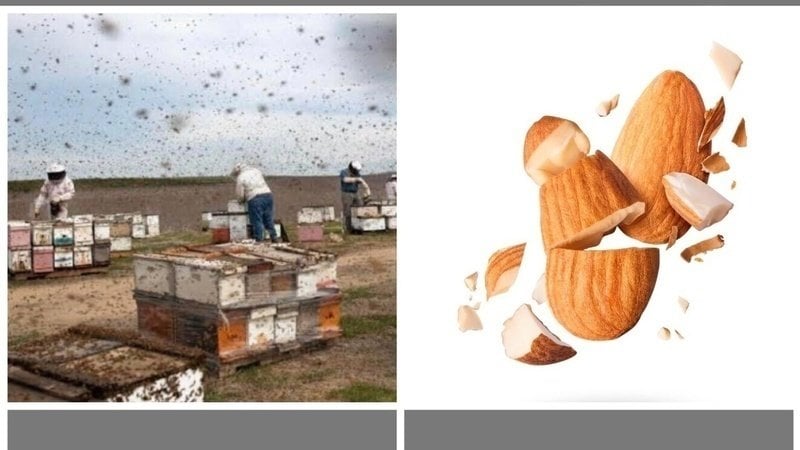
Big horticulture’s monoculture crops are so devoid of life that bee hives have to be carted in on semi-trailers and the bees are then sent out often on suicide mission to pollinate trees and plants that are drenched in a chemical cocktail of herbicides, fungicides, and insecticides. Bees, during their time on pollination duty, often catch diseases such as American Foul Brood and then they are trucked all around Australia potentially infecting bee hives across the country.
The chemical, agricultural and horticultural industries always avoid using the word “systemic” because it reveals too much horrible truth.
A systemic insecticide describes a circumstance where the actual plant is the poison delivery system, for years in trees and for the life of the plant. Systemic poisons have every capacity to carry out the reason they are manufactured, to have the almond tree or the canola plant itself demolish all invertebrates, all spiders, all worms, snails, insects.
Systemic poisons have broken the food chain and now every monoculture is weaponised by having been treated with a systemic pesticide or fungicide, including plants grown for pollinators.
The current Varroa incursion should not be used as a springboard to further industrialise Australia's agriculture system.
Multi-jurisdictional loopholes again being used to profit cartels
In what surely must be a contender for the worst drafting award of any legislation in the developed world, the Biosecurity Act 2015 (Cth.) actually provides, at s28, that a power or function conferred by the Biosecurity Act must not be exercised or performed in such a way as to contravene section 92 of the Constitution (trade and commerce among the States to be free). Really, trade and commerce and Varroa mites must remain free; extraordinary!
Indeed, the two primary submissions I wish to make on behalf of the community of Australian beekeepers who have contributed to my crowd sourced funding platforms are these:
a. compensation for bee keepers not providing pollination service should have been in place for this year. The EPPR Deed ensured that it wasn’t, with the result that the billions of burnt bees of Newcastle and surrounds and the nearby wild and indigenous poisoned bees have simply died in vain;
b. individual States, bio-regions and local government areas should be permitted to restrict the movement of beehives into their localities if those hives have been involved in pollination migration.
Australian honeybee decline is about to be blamed on Varroa mite
Without a post-incursion bee hive standstill, or at the very least a total ban on any interstate movements, Varroa mite will quickly become a convenient scapegoat for the increasing decline in honey bee hive numbers since about the year 2000.
According to Jeffrey Gibbs’ article in the September 2016 edition of the Australasian Beekeeping Journal:
Honey bee populations in Australia are in crisis. The numbers of bees under the care of commercial honeyproducers are at an all-time low. Commercial beekeepers wintering losses of thirty per cent are now accepted asthe norm, according to Des Cannon, Editor of The ABK. Bee diseases have never been more prevalent inAustralia. Every commercial beekeeper is battling disease and this battle is a full time job. A battle fought bybeekeepers alone at the expense of their own time and money. Eight out of ten (or more) commercial beekeepers are reliant on antibiotic to keep their bees alive. The choice is between dosing or death. Contamination of honey with antibiotic is a live issue. Yet the Australian government, honey packers and pesticide companies have not acknowledged the battle our beekeepers are fighting. In fact, it is a massive cover up. If we haven’t got a problem, we can’t fix it. The frontline brandished by government, honey packers and pesticide companies to defer any concern for the honeybee is that “the Australian honeybee is not in decline, despite the increased use of this group of insecticides [sic. neonicotinoids] in agriculture and horticulture since the mid 1990’s”[2] … An unfounded statement and simplistic argument, contrary to the anecdotal evidence of beekeepers Australia wide.
For big horticulture it is pretty easy to control the messages for the public to keep the conversation away from pesticides and especially systemic ones. And, as usual with all divide and rule polemics, we can now expect Australian bee keepers to start pointing the finger at each other (treatment vs treatment-free).. This will no doubt be followed by shaming and blaming the Australian bee keeping community to keep submissions like this one from influencing law and policy.
It is not widely known that trucking tens of millions of bees in late winter to vast agribusiness monocultures by industrial beekeepers is so profitable. In fact, hives imported from Australia have routinely been used to keep these huge monocultures afloat overseas. This is the price of the globalisation of the industrialisation of bee hives. Bees as a disposable and migratory commodity.
The fact that Varroa mites are about to join the reasons for disease super spreading at the almond, fruit tree and canola pollination events every Spring is not discussed by any but the most vocal of Australia’s beekeepers. Big horticulture devours the precious water of the Murray Darling Basin and replaces living soil with mono-crop orchards which require a drenching of systemic poisons. This means honey bees leave the Basin with weakened immune systems, whether they are also infested with Varroa or not.
While the Commonwealth currently seems to consider indirect responsibility for enforcing State livestock control legislation is enough, it does have a critical role in promoting the harmonisation of biosecurity enforcement provisions and practices to ensure the glorious achievement of Australian beekeepers in keeping Australia Varroa free up to now is not, to put it bluntly, stolen by rogue agrochemical horticulturalists and their twisted, chemically enforced rent-seeking.
Recommendations
To improve the adequacy of Australia’s biosecurity measures in relation to the very recent (June 2022) incursion of Varroa, the Commonwealth should immediately require all hives throughout the Murray Darling Basin to be checked for Varroa incursions as if they were sentinel hives and then also commence a judicial inquiry into Plant Health Australia and its connection with big horticulture, with terms of reference to include:
a. Examine the national ramifications of NSWs current Varroa mite hive permit system, which allows hives outside biosecurity zones to be moved around the State;
b. Examine my allegations that the continuity of pollination lobby group promulgated the passage of the Plant Health Australia (Plant Industries) Funding Act 2002(Cth.) in such a manner as to ensure the financial interests of horticulturalists were not exposed to losses from a bee hive stand-still;
c. Examination of the extent to which the failure of the EPPR Deed to provide compensation in the event of an Australia wide bee hive stand-still is also likely to have resulted from that lobbying;
d. Examine what legislative changes are needed to promote honey bee biosecurity jurisdictional cohesion; and
e. Whether individual States, bio-regions or local government areas should be permitted to restrict the movement of bee hives into their localities if those hives have been involved in pollination migration.
Thank you very much for the opportunity of being able to make this submission.
There is no substitute for honey bee pollination, yes, but please prohibit big horticulture from super spreading Varroa because there is no second Australia, there is no other place in the world where Varroa is not established.