
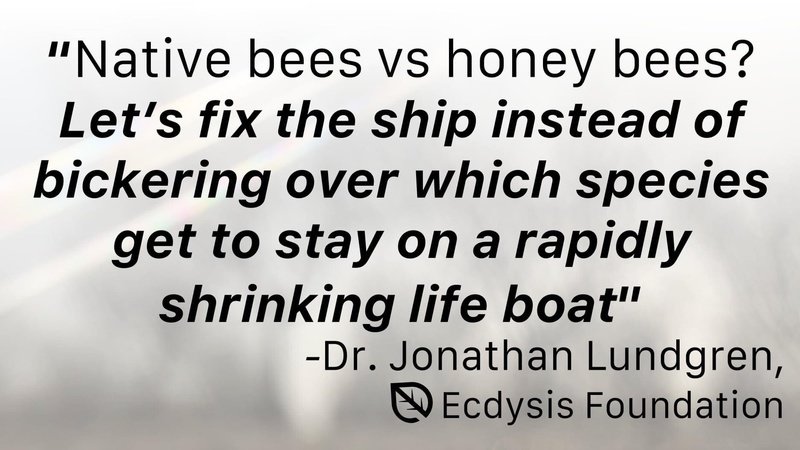
The way to save native pollinators is to adopt approaches that can save all insects. Including honey bees.
Bee enthusiasts and bee keepers ought be allies, and we need to be acting as such. We need to focus on real and practical solutions that can protect habitat, rather than bickering which species get to stay on an ever shrinking life boat.
We are suffering such dire circumstances, this is not the time to fight over what bees are good or which ones are “bad”.
The popularity of beekeeping is creating an ever increasing army that has an intimate relationships with nature that are fighting to protect both indigenous bees along with the introduced European honeybee.
Native bees are insects, and the planet is losing all insects at an alarming rate. At the current extinction rates, much of the insect life on Earth will be gone in around 60 years; about the same time that most of the planet’s topsoil will be gone. And this species loss isn’t because of the honey bees that has lived along side indigenous bees in Australia over the last 200 years.
Our food system is at the crux of this problem. It can be the source of species loss, or the solution to species loss. Food production is a destructive process. At its least, agriculture replaces life from a habitat with life that we choose. This can be done well. Or this can be done poorly. Right now, it is often done poorly.
Industrialized agriculture removes plant diversity from the landscape at unprecedented scales. It replaces it with a monoculture of a single crop or livestock species. The natural resource base is destroyed, along with all the ecosystem functions that drove the productivity of this habitat. Agrochemicals herbicides like glyphosate , insecticides like Neonicotinoids and fertilisers are then used to restore some of this habitat’s productivity. But these chemicals remove additional life from the farm, forcing the need for additional reliance on agrichemicals. And so cranks the treadmill.
This treadmill of industrialized agriculture functions to benefit and perpetuate only itself; not the farmers, not the agricultural communities, not animal or human wellbeing, but the companies that stand to profit from the ever-increasing use of inputs to sustain it. Farmers are ensnared. The initial products of industrial agriculture are mostly grain that humans don’t eat, and beef. A long-term product of industrial agriculture is carbon emissions, and removing the ability of the biological community to sequester carbon. Another product is desertification of habitats. Another product is pollution of water and land. Another product is reduced nutrient density of foods and immunocompromised species, including humans. Another product is species loss.
The product of industrialized agriculture is vastly fewer insects. Fewer native bees. And fewer exploited diseased honey bees.
As landscapes have changed, we are living through a massive evolutionary experiment, selecting for a very small sliver of species that can survive within a depauperated, toxic landscape.
It doesn’t have to be this way.
The way to save native pollinators is to adopt approaches that can save all insects. Including honey bees.
The best that we can do is minimize the impact that our food system has on the natural resources of this planet. One of the strongest tools for reversing planetary scale problems is our food system.
The practices on regenerative farms are creeping onto a wider swath of the farming community. And where plants proliferate, life swells. All groups of microbes, fungi, and animals diversify according to the number of plant species and their biomass in a habitat. Where plants proliferate, bees thrive.
The solution is beautiful small scale localised farming can feed the world.