
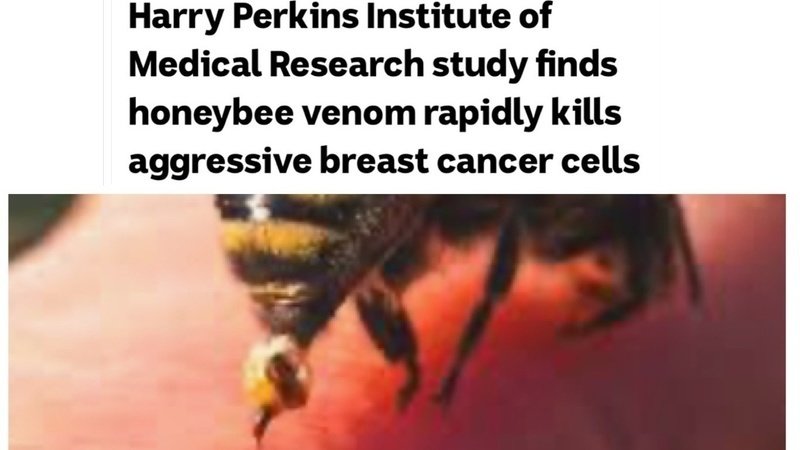
The research showed a specific concentration of the venom killed 100 per cent of triple-negative breast cancer and HER2-enriched breast cancer cells within 60 minutes, while having minimal effects on normal cells.
We found that the venom from honeybees is remarkably effective in killing some of these really aggressive breast cancer cells at concentrations which aren't as damaging to normal cells," Dr Duffy said.
The bees were put to sleep with carbon dioxide and kept on ice before the venom was extracted and injected into the tumours
She said a component of the venom called melittin is what had the killing effect.
The researchers reproduced the melittin synthetically and found it mirrored the majority of the anti-cancer effects of the honeybee venom.
"What melittin does is it actually enters the surface, or the plasma membrane and forms holes or pores and it just causes the cells to die.
Chief Scientist Professor Peter Klinken said
“it was a significant development, which provided another example of where compounds in nature could be used to treat human diseases.”
Dr Duffy said “ There's a long way to go in terms of how we would deliver it in the body ”
Bee venom has been used as a therapy for thousands of years. Episode 6 of Netflix series Unwell explains how doctors , scientists and naturopaths are collaborating and using bee venom to cure Lyme disease and other illnesses.
https://www.instagram.com/tv/CDzSzMPDfxE/?igshid=m9et3a0ctwkn
Vice also covered Bee Venom as a therapy.
It is likely bee venom therapy was the first form of acupuncture.
Bees don't need to die when donating their venom. People harvest bee venom using a glass plate near the entrance of a hive with electrodes that cause a vibration, the bees sting the glass but don't lose their stinger because it isn't going into skin so the barbs aren't getting stuck. The venom needs to be scraped off the glass every 30 minutes and stored in a black bottle to prevent it from losing it's potency.