平和を伝える“物語”としての建築、「国際基督教大学(ICU)本館」(1944年竣工/1953年増改築)─Bunga.net にICUの建築に関する記事が掲載!

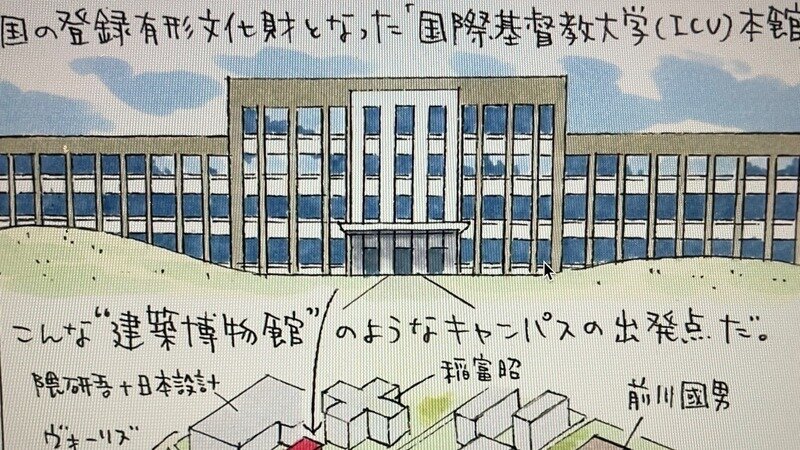
2026年6月1日付にて、Bunga.net に、ICUの建築についての記事が掲載されました!
ICUのキャンパスが、建築史に残る、建築家が手がけた建物に満ちた「建築博物館」とも言えるキャンパスであること、
ICUという大学が、アメリカと日本の戦争という負の歴史の中で生まれたこと、
「バカ山」をめぐる、顧問建築家のウィリアム・メレル・ヴォーリズと、アントニンレーモンドの関係性に至るまで、大変に美しい写真と親しみやすいイラストによって、丁寧に記述してくださっています。
是非ご一読ください!
また、このchange.org の活動について、記事の中で触れて下さっています。
一部、記事を転載いたします。
”本館を巡る最近のエピソードにも触れておきたい。
実は本館は、2016年時点のキャンパスグランドデザイン計画では、建て替えられる可能性があった。
鉄筋コンクリート建造物の寿命は築 60~70 年程度という、建設業界で広く共有されていた理解からだ。そのときの配置図には、本館の位置に「新本館」と書かれている。
これに対し、同窓生などから残すべきという声が出たことや、高齢鉄筋コンクリート造の修繕・保存の
事例が実際に出てきたこともあり、保存活用の方向に風向きが変わった。
曲折を経て、2024年に大成建設が改修することになった。
この件について筆者がネットを調べていて、感動したことがある。
それは、反対の声を挙げた中に現役の学生たちがいたこと。
自分が学生だったら、古いよりも新しい校舎の方がうれしいだろうと思う。
彼らは校舎そのもの保存ではなく、「ばか山空間をこわさないで!」と訴えたのだ。
署名を集めるサイトを立ち上げ、こう訴えた。
「ICUのばか山は、単なる広場ではありません。
一人で思索に耽りながら過ごすこともでき、学生同士が対話をすることもできる場所です。
天気の良い日には、ここで授業を行うことさえあり、ICUの学生、卒業生にとって、最もICUらしい場所として、なくてはならない場所です。
卒業後も、再びこの場所に戻ってくる卒業生は多く、日本にも、海外にも、同じような空間が存在している大学は稀であり、唯一無二の、ICU生のアイデンティティーとも言える場所なのです」
素晴らしい文章。レーモンドもヴォーリズもこれを読んだら、手を取り合って泣くのではないか。”
ICUの本館が、これまでと全く異なる建物になるかもしれない、ということを聞いたとき、
関係者の喪失感は、計り知れないものがありました。
新しい建物の方が良い、という、日本の社会を覆い尽くす潮流の中で、老朽化した本館よりも、新しい方が今の学生にとっては良いのではないか、という声も少なからず、ありましたが、このように、記事に取り扱っていただき、ICUキャンパス保全会のメンバーも、手を取り合って感激し、これまでの活動に思いを馳せた次第です。
耐震性を高め、空調などの設備を最新のものに更新し、その上で、これまでの関係者の心にある本館の思い出を、一切失わせないという、他に類を見ないほどの、熱意に満ちた素晴らしい改修工事を行なって下さった、すべての関係者の皆様と、貴重な資料を保存して下さっているICUアーカイブの関係者の皆様、
そして、ICUの状況を注視して下さった、すべての関係者の皆様に心から感謝をいたします。
本当にありがとうございました。
On June 1, 2026, an article about the architecture of ICU was published on Bunga.net!
The article carefully describes how ICU’s campus can truly be called an “architectural museum,” filled with buildings designed by architects whose works remain in the history of architecture. It also explains how ICU as a university was born out of the tragic history of war between the United States and Japan.
From the story surrounding “Baka-yama” to the relationship between the advisory architect William Merrell Vories and Antonin Raymond, the article thoughtfully presents these themes with exceptionally beautiful photographs and approachable illustrations.
We hope you will take the time to read it.
The article also mentions the change.org campaign.
Below is a partial excerpt from the article:
“I would also like to touch on a recent episode concerning the Main Building.
In fact, according to the Campus Grand Design Plan as of 2016, there was a possibility that the Main Building would be rebuilt.
This was based on the widely shared understanding within the construction industry that reinforced concrete buildings have a lifespan of approximately 60 to 70 years. In the layout plan at the time, the words ‘New Main Building’ were written where the current Main Building stands.
In response, voices calling for its preservation were raised by alumni and others, and as examples of repairing and preserving aging reinforced concrete structures began to emerge, the direction gradually shifted toward preservation and adaptive reuse.
After various twists and turns, Taisei Corporation was appointed to carry out the renovation in 2024.
While researching this matter online, I came across something that deeply moved me.
Among those who raised voices in opposition were current students.
If I were a student, I might simply be happy to have a new building rather than an old one.
However, they did not argue merely for preserving the school building itself—they appealed, ‘Please don’t destroy the Baka-yama space!’
They launched a petition website and wrote:
‘Baka-yama at ICU is not merely an open plaza.
It is a place where one can spend time alone in contemplation, and also where students can engage in dialogue with one another.
On sunny days, classes are even held here. For ICU students and alumni, it is the place that most embodies what ICU is—it is indispensable.
Many alumni return to this place even after graduation. There are few universities, whether in Japan or overseas, that possess a similar space. It is truly one of a kind—a place that can be called part of the identity of ICU students.’
What a wonderful statement. If Raymond and Vories were to read this, they might well take each other’s hands and weep.”
When we first heard that ICU’s Main Building might be transformed into something entirely different from what it had been, the sense of loss among those involved was immeasurable.
Amid the prevailing trend in Japanese society that newer buildings are inherently better, there were indeed voices suggesting that a new structure might be preferable for current students over the aging Main Building. Yet to have the issue treated in such depth in this article moved the members of the ICU Campus Preservation Society to join hands in gratitude and reflect on the journey of our efforts thus far.
We would like to express our heartfelt thanks to everyone involved in carrying out this extraordinarily passionate and exemplary renovation—one that strengthened the building’s earthquake resistance, updated its air conditioning and other facilities to the latest standards, and yet did not allow a single cherished memory of the Main Building, held in the hearts of generations, to be lost.
We also extend our sincere gratitude to the staff of the ICU Archives for preserving invaluable materials, and to all those who have continued to watch over and care about ICU’s situation.
Thank you very much.
Translated by ChatGPT.