

Help us protect a landmark research study for serious mental illness
The Issue
I am a Harvard Medical School psychiatrist and founder of the McLean Hospital Metabolic and Mental Health Program. After treating severe mental illness for almost three decades, I know how desperately we need more effective treatments for people living with schizophrenia and other serious psychiatric conditions.
As the Baltimore Sun reports, the Maryland Health Secretary, Dr. Laura Herrera Scott, recently halted an ongoing, privately-funded inpatient study of a medical ketogenic diet for treating schizophrenia. This decision comes as a shock, given that the Department of Health’s own 16-week review of the study found no ethical or safety issues and the study is overseen by three regulatory and oversight boards. Led by expert researcher, Dr. Deanna Kelly, the trial is a landmark inpatient study of a ketogenic diet for psychotic illness and is a collaborative initiative with the Maryland Psychiatric Research Center and Spring Grove Hospital Center.
Considering the burden schizophrenia places on individuals and society – more than 2 million adults in the U.S. suffer from this condition, and many are failed by existing treatments – it is crucial that researchers and clinicians are encouraged to pursue new potential treatments. My clinical experience, along with early pilot studies, indicates that a ketogenic diet is a promising approach to treating even the most serious mental illnesses, often leading to dramatic improvements in both metabolic and psychiatric health.
Our goal with this petition is to persuade Maryland's Health Secretary to reconsider her stance and permit this promising study to move forward. This could mark a pivotal turning point in our long quest for safe, effective treatments for schizophrenia and other persistent mental illnesses–and in protecting the most vulnerable patients’ rights to access innovative therapies. We hope to send a strong message to government leaders that the only ethical option is to support–not stand in the way of–research that could help alleviate the suffering of millions.
Please join our cause and sign this petition. Together, we can help ensure better mental health for all.
UPDATE July 13, 2024:
Clarifying Ethical and Regulatory Standards: A Response to Dr. Herrera Scott
Dr. Hererra Scott recently shared a letter explaining why she shut down a privately funded study of a medical ketogenic diet for treating schizophrenia at Spring Grove Hospital Center:
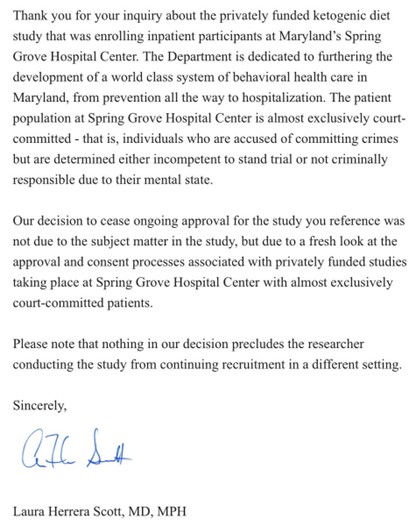
The following points make clear that this study was conducted with the highest standards of ethical and regulatory oversight:
- All scientific and clinical studies must undergo the same IRB approval process, whether publicly or privately funded. This study was IRB-approved by the University of Maryland and overseen by two entities: the Spring Grove Hospital Center Research Committee and an independent Data Safety Monitoring Board.
- Because many patients in the inpatient setting had court charges, both studies were fully approved under 45 CFR 46.306 regulations for the inclusion of court-ordered patients. As part of these regulations a prisoner representative must be present for the IRB meeting and the study must provide benefits to all participants.
- The study only recruited those with the capacity for medical decision-making. It did not enroll those with legal guardians or legally authorized representatives – all participants had to have independent decision-making ability to participate.
- Every patient was referred by their physician, who determined they were a good candidate and met the threshold for the informed consent process. The informed consent process allows patients to learn about the study and ask questions. It detailed the purpose, risks, benefits, alternatives to treatment, and other aspects.
- All Spring Grove Hospital Center studies require a formal assessment of the participant’s capacity to consent. The ketogenic diet study required two signatures, an additional safety measure to assess the capacity to appreciate risk.
- The study was entirely voluntary, and participants could stop immediately at any point.
- Physicians had complete autonomy to prescribe and treat however they best saw fit for each patient throughout the study.
- The study followed strict ethical guidelines and good clinical practice. It aimed to provide additional regulated opportunities to improve patient care.
- The study's Principal Investigator is a national expert in consent for clinical trials in inpatient psychiatry settings. She has taught lectures on the topic of ethical conduct of research and informed consent and she has presented on the safe and ethical inclusion of court-ordered patients into clinical research at international meetings.
Given these robust safeguards and the potential benefits of the ketogenic diet study for patients with severe mental illness, we urge Dr. Hererra Scott to reverse the decision to halt this vital research. Continuing this study could provide significant advancements in treatment options for a vulnerable population, ultimately improving patient outcomes and quality of life.
Your support is crucial in ensuring that innovative and ethically sound research can proceed for the benefit of all.

21,682
The Issue
I am a Harvard Medical School psychiatrist and founder of the McLean Hospital Metabolic and Mental Health Program. After treating severe mental illness for almost three decades, I know how desperately we need more effective treatments for people living with schizophrenia and other serious psychiatric conditions.
As the Baltimore Sun reports, the Maryland Health Secretary, Dr. Laura Herrera Scott, recently halted an ongoing, privately-funded inpatient study of a medical ketogenic diet for treating schizophrenia. This decision comes as a shock, given that the Department of Health’s own 16-week review of the study found no ethical or safety issues and the study is overseen by three regulatory and oversight boards. Led by expert researcher, Dr. Deanna Kelly, the trial is a landmark inpatient study of a ketogenic diet for psychotic illness and is a collaborative initiative with the Maryland Psychiatric Research Center and Spring Grove Hospital Center.
Considering the burden schizophrenia places on individuals and society – more than 2 million adults in the U.S. suffer from this condition, and many are failed by existing treatments – it is crucial that researchers and clinicians are encouraged to pursue new potential treatments. My clinical experience, along with early pilot studies, indicates that a ketogenic diet is a promising approach to treating even the most serious mental illnesses, often leading to dramatic improvements in both metabolic and psychiatric health.
Our goal with this petition is to persuade Maryland's Health Secretary to reconsider her stance and permit this promising study to move forward. This could mark a pivotal turning point in our long quest for safe, effective treatments for schizophrenia and other persistent mental illnesses–and in protecting the most vulnerable patients’ rights to access innovative therapies. We hope to send a strong message to government leaders that the only ethical option is to support–not stand in the way of–research that could help alleviate the suffering of millions.
Please join our cause and sign this petition. Together, we can help ensure better mental health for all.
UPDATE July 13, 2024:
Clarifying Ethical and Regulatory Standards: A Response to Dr. Herrera Scott
Dr. Hererra Scott recently shared a letter explaining why she shut down a privately funded study of a medical ketogenic diet for treating schizophrenia at Spring Grove Hospital Center:
The following points make clear that this study was conducted with the highest standards of ethical and regulatory oversight:
- All scientific and clinical studies must undergo the same IRB approval process, whether publicly or privately funded. This study was IRB-approved by the University of Maryland and overseen by two entities: the Spring Grove Hospital Center Research Committee and an independent Data Safety Monitoring Board.
- Because many patients in the inpatient setting had court charges, both studies were fully approved under 45 CFR 46.306 regulations for the inclusion of court-ordered patients. As part of these regulations a prisoner representative must be present for the IRB meeting and the study must provide benefits to all participants.
- The study only recruited those with the capacity for medical decision-making. It did not enroll those with legal guardians or legally authorized representatives – all participants had to have independent decision-making ability to participate.
- Every patient was referred by their physician, who determined they were a good candidate and met the threshold for the informed consent process. The informed consent process allows patients to learn about the study and ask questions. It detailed the purpose, risks, benefits, alternatives to treatment, and other aspects.
- All Spring Grove Hospital Center studies require a formal assessment of the participant’s capacity to consent. The ketogenic diet study required two signatures, an additional safety measure to assess the capacity to appreciate risk.
- The study was entirely voluntary, and participants could stop immediately at any point.
- Physicians had complete autonomy to prescribe and treat however they best saw fit for each patient throughout the study.
- The study followed strict ethical guidelines and good clinical practice. It aimed to provide additional regulated opportunities to improve patient care.
- The study's Principal Investigator is a national expert in consent for clinical trials in inpatient psychiatry settings. She has taught lectures on the topic of ethical conduct of research and informed consent and she has presented on the safe and ethical inclusion of court-ordered patients into clinical research at international meetings.
Given these robust safeguards and the potential benefits of the ketogenic diet study for patients with severe mental illness, we urge Dr. Hererra Scott to reverse the decision to halt this vital research. Continuing this study could provide significant advancements in treatment options for a vulnerable population, ultimately improving patient outcomes and quality of life.
Your support is crucial in ensuring that innovative and ethically sound research can proceed for the benefit of all.
The Decision Makers
Supporter Voices
Petition Updates
Share this petition
Petition created on July 1, 2024