

HELP TRANSFER WIKIE AND KEIJO, OR IT WILL BE TOO LATE
O problema
elizê project May blue return to being a home, not a sentence.
⚠️Here is just a preview of our project. We will soon provide the link to the full PDF (most likely on the 20th).
current situation
Wikie and Keijo are two orcas currently living at Marineland Antibes, France. They are mother and son, aged 23 and 11 respectively. They are the last surviving members of the original group of four orcas. Moana, Wikie’s eldest son, died in 2023, and Inouk, Wikie’s brother, passed away in 2024.
Over the years, the park’s conditions have deteriorated, particularly after new regulations were introduced by the French government. The Ministerial Decree of May 3, 2017 banned captive breeding of these animals, mandated a 150% increase in tank size, among other conditions. The final blow came with the Law No. 2021-1534 of November 30, 2021, which prohibited cetacean shows (a key attraction at Marineland) by December 1, 2026, and banned the acquisition, sale, and breeding of cetaceans for entertainment purposes.
These restrictions rendered the park unsustainable. The looming deadline, combined with mounting activist boycotts, triggered a domino effect that left Wikie and her son without options. Proposals to relocate them to Japan and Spain were both denied. Now, their only remaining possibility is euthanasia.
Our Proposal
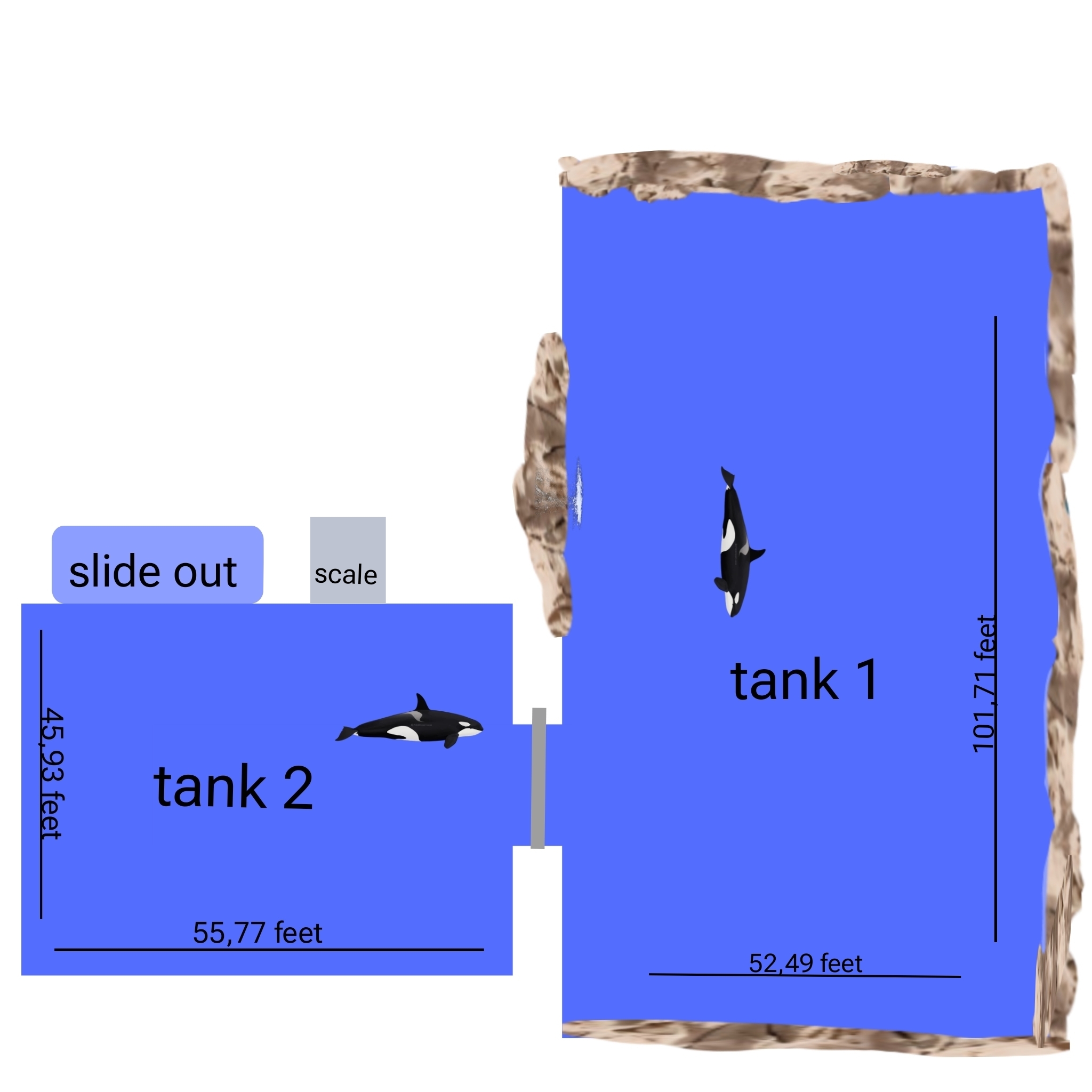
Our proposal envisions a dedicated care center located away from public access, with strong potential for future expansion. Situated in a city in the south of Minas Gerais, Brazil, a region colder than Antibes. Monte verde also provides substantial infrastructure without the hyper-urbanization that could pose risks or disturbances to the animals, as might occur in other Settings.The initial project design includes:
Tank 1: 31 x 16 x 11 meters
Tank 2 : 17 x 14 x 11 meters
While the facility is smaller than the one in Antibes, it is designed to serve as a temporary and emergency space given the current circumstances. Its quality, however, will be maintained at the highest possible level—something Antibes can no longer guarantee. To help offset the smaller size, our team has been researching and planning a wide range of enrichment activities, compiling a list of over 30 different types to ensure optimal mental and physical stimulation for the animals.
Why Not a Marine Sanctuary?
Wikie and Keijo were both born and raised in captivity. Their bodies are not adapted to life in the wild; they are unaccustomed to dealing with natural marine organisms, unable to integrate into wild pods, and are extremely dependent on their trainers.
A clear example is Keiko, the orca made famous by Free Willy. While he thrived in his previous home at the Oregon Aquarium, he failed to adapt after release. Keiko often sought out human interaction—even from complete strangers—just to receive attention. Not long after contact with humans was restricted, he undertook a long and aimless solo journey and eventually died. It’s important to note: Keiko was a wild-caught orca. Imagine now Wikie and Keijo, born in captivity, living alongside trainers daily since birth.
Marine sanctuaries—or rather, sea pens—are costly and time-consuming to build. Sanitary control is also significantly lower than in captive environments, which is critical when dealing with animals in fragile conditions like these.
Our project is, as previously stated, an emergency initiative—downsized to accommodate the urgent timeframe and immediate need, while still allowing for realistic expansion in the near future. Based on the academic articles by Radhika N. Makecha and Lauren E. Highfill (2018), Environmental Enrichment, Marine Mammals, and Animal Welfare: A Brief Review, and by Graham Law (2017), Environmental Enrichment for Killer Whales (Orcinus orca) at Zoological Institutions: Untried and Untested, we can affirm that environmental enrichment plays a fundamental role in the well-being of marine mammals in human care. These studies show that, even with space limitations, enrichment can significantly improve animals’ quality of life and can partially compensate for reduced physical space by encouraging natural behaviors and supporting mental health.
Project Phases
-phase 1- Following the signing of agreements, the project will be submitted to IBAMA (Brazilian Institute of the Environment and Renewable Natural Resources) for evaluation. Simultaneously, legal procedures will be initiated to obtain the necessary permits, including:
•Preliminary License (LP)
•Installation License (LI)
•Operating License (LO)
As well as conducting an Environmental Impact Assessment (EIA) and a Report of Environmental Impact (RIMA) in accordance with CONAMA Resolution No. 01/1986.
- Phase 2 - Once approved, we will launch a fundraising and construction campaign, forming partnerships with universities to foster scientific advancement in this area—currently underdeveloped in Brazil. This phase will also include authorization for wildlife keeping through IBAMA and registration with SISFAUNA, as well as securing architectural and sanitary approvals.
-Phase 3 - After securing all authorizations, construction of the facility will begin immediately, with optimizations to complete it as swiftly as possible. During this period, we will continue to work on the permits for possession and transfer of the orcas, complying with CFMV Resolution No. 877/2008.
-Phase 4 - Upon arrival of the animals, we will proceed with their official registration under IBAMA Normative Instruction No. 140/2006. IBAMA will then issue a statement granting possession, under strict conditions emphasizing animal welfare, conservation, non-exploitation (no shows), and no reproduction
-phase 5 - Approximately 1,5 /2 years later, we plan to expand the facility by constructing at least one additional tank measuring 21 x 16 meters.
If the goals are met on schedule, the average timeframe for the project to be completed is six months. We are open to negotiating with France to temporarily house them in another facility until construction is finished, as Antibes is currently in no condition to accommodate them for such a long period, given the severely degraded state of its overall system.
If desired, our team can provide the dietary management plan spreadsheet and the complete list of enrichment strategies, along with a concept design of the tank from the inside. This design features environmental enrichments that are uncommon in other facilities and are as natural and stimulating as possible.

71
O problema
elizê project May blue return to being a home, not a sentence.
⚠️Here is just a preview of our project. We will soon provide the link to the full PDF (most likely on the 20th).
current situation
Wikie and Keijo are two orcas currently living at Marineland Antibes, France. They are mother and son, aged 23 and 11 respectively. They are the last surviving members of the original group of four orcas. Moana, Wikie’s eldest son, died in 2023, and Inouk, Wikie’s brother, passed away in 2024.
Over the years, the park’s conditions have deteriorated, particularly after new regulations were introduced by the French government. The Ministerial Decree of May 3, 2017 banned captive breeding of these animals, mandated a 150% increase in tank size, among other conditions. The final blow came with the Law No. 2021-1534 of November 30, 2021, which prohibited cetacean shows (a key attraction at Marineland) by December 1, 2026, and banned the acquisition, sale, and breeding of cetaceans for entertainment purposes.
These restrictions rendered the park unsustainable. The looming deadline, combined with mounting activist boycotts, triggered a domino effect that left Wikie and her son without options. Proposals to relocate them to Japan and Spain were both denied. Now, their only remaining possibility is euthanasia.
Our Proposal
Our proposal envisions a dedicated care center located away from public access, with strong potential for future expansion. Situated in a city in the south of Minas Gerais, Brazil, a region colder than Antibes. Monte verde also provides substantial infrastructure without the hyper-urbanization that could pose risks or disturbances to the animals, as might occur in other Settings.The initial project design includes:
Tank 1: 31 x 16 x 11 meters
Tank 2 : 17 x 14 x 11 meters
While the facility is smaller than the one in Antibes, it is designed to serve as a temporary and emergency space given the current circumstances. Its quality, however, will be maintained at the highest possible level—something Antibes can no longer guarantee. To help offset the smaller size, our team has been researching and planning a wide range of enrichment activities, compiling a list of over 30 different types to ensure optimal mental and physical stimulation for the animals.
Why Not a Marine Sanctuary?
Wikie and Keijo were both born and raised in captivity. Their bodies are not adapted to life in the wild; they are unaccustomed to dealing with natural marine organisms, unable to integrate into wild pods, and are extremely dependent on their trainers.
A clear example is Keiko, the orca made famous by Free Willy. While he thrived in his previous home at the Oregon Aquarium, he failed to adapt after release. Keiko often sought out human interaction—even from complete strangers—just to receive attention. Not long after contact with humans was restricted, he undertook a long and aimless solo journey and eventually died. It’s important to note: Keiko was a wild-caught orca. Imagine now Wikie and Keijo, born in captivity, living alongside trainers daily since birth.
Marine sanctuaries—or rather, sea pens—are costly and time-consuming to build. Sanitary control is also significantly lower than in captive environments, which is critical when dealing with animals in fragile conditions like these.
Our project is, as previously stated, an emergency initiative—downsized to accommodate the urgent timeframe and immediate need, while still allowing for realistic expansion in the near future. Based on the academic articles by Radhika N. Makecha and Lauren E. Highfill (2018), Environmental Enrichment, Marine Mammals, and Animal Welfare: A Brief Review, and by Graham Law (2017), Environmental Enrichment for Killer Whales (Orcinus orca) at Zoological Institutions: Untried and Untested, we can affirm that environmental enrichment plays a fundamental role in the well-being of marine mammals in human care. These studies show that, even with space limitations, enrichment can significantly improve animals’ quality of life and can partially compensate for reduced physical space by encouraging natural behaviors and supporting mental health.
Project Phases
-phase 1- Following the signing of agreements, the project will be submitted to IBAMA (Brazilian Institute of the Environment and Renewable Natural Resources) for evaluation. Simultaneously, legal procedures will be initiated to obtain the necessary permits, including:
•Preliminary License (LP)
•Installation License (LI)
•Operating License (LO)
As well as conducting an Environmental Impact Assessment (EIA) and a Report of Environmental Impact (RIMA) in accordance with CONAMA Resolution No. 01/1986.
- Phase 2 - Once approved, we will launch a fundraising and construction campaign, forming partnerships with universities to foster scientific advancement in this area—currently underdeveloped in Brazil. This phase will also include authorization for wildlife keeping through IBAMA and registration with SISFAUNA, as well as securing architectural and sanitary approvals.
-Phase 3 - After securing all authorizations, construction of the facility will begin immediately, with optimizations to complete it as swiftly as possible. During this period, we will continue to work on the permits for possession and transfer of the orcas, complying with CFMV Resolution No. 877/2008.
-Phase 4 - Upon arrival of the animals, we will proceed with their official registration under IBAMA Normative Instruction No. 140/2006. IBAMA will then issue a statement granting possession, under strict conditions emphasizing animal welfare, conservation, non-exploitation (no shows), and no reproduction
-phase 5 - Approximately 1,5 /2 years later, we plan to expand the facility by constructing at least one additional tank measuring 21 x 16 meters.
If the goals are met on schedule, the average timeframe for the project to be completed is six months. We are open to negotiating with France to temporarily house them in another facility until construction is finished, as Antibes is currently in no condition to accommodate them for such a long period, given the severely degraded state of its overall system.
If desired, our team can provide the dietary management plan spreadsheet and the complete list of enrichment strategies, along with a concept design of the tank from the inside. This design features environmental enrichments that are uncommon in other facilities and are as natural and stimulating as possible.
Mensagens de apoiadores
Atualizações do abaixo-assinado
Compartilhar este abaixo-assinado
Abaixo-assinado criado em 10 de abril de 2025