
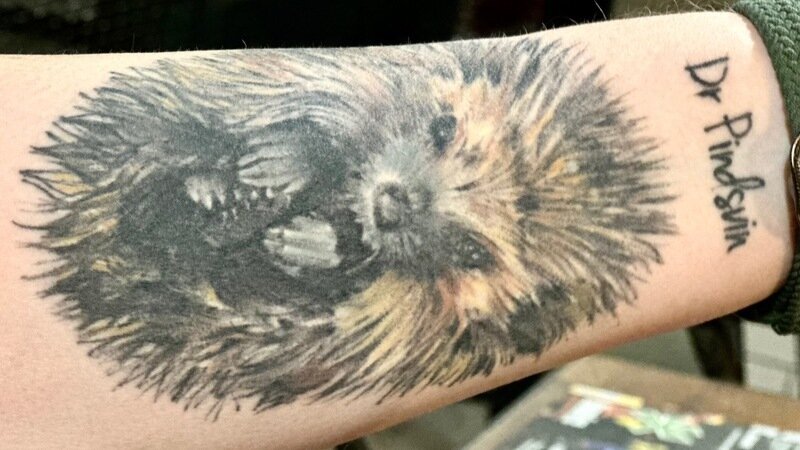
Some of you may know that I have a hedgehog tattoo ... it arrived as part of my midlife crisis (and played a significant role in my book, The Beauty in the Beast) ... but it is nothing compared to the tattoo on the forearm of Dr Sophie Lund Rasmussen!
Sophie is working through WildCRU at the University of Oxford - one of the world's foremost wildlife conservation departments - and she is there to work on hedgehogs ... which is appropriate given that her name is Dr Pindsvin!!
And what a good name for a hedgehog the Danish have - prickle-pig!
So, last night she was back over from Denmark - I got to have dinner with her - talk a lot about hedgehogs - and photograph the tattoo!
Her research on hedgehogs first hit the news a couple of years ago when she revealed the potential risk caused by robot lawnmowers ... and the news loved her rather innovative research ... using road kill hedgehogs as crash-test dummies to see whether the robots would do as designed, and avoid causing injury. Many did not. For a short review about her research, look here. This link will also take you on to the full scientific paper should you wish to learn more.
We also talked about her toxicological work - now this is not published yet, so I can share no details. But ... what a frightening load of chemicals we have spread into the world ... Now, I am not one of those very pure sorts who treats my body as a temple and gets freaked at the word chemical (we are, of course, full of natural and unnatural chemicals!) ... but I do have a specific concern.
A while back - a researcher at Bristol University looked at the spread of rodenticide in hedgehogs. Now, obviously, rat poison is not put down for hedgehogs. And when rat poison is used, it should be done in such a way that hedgehogs cannot get to it ... because it will kill them.
The results were shocking - 2/3 of the 120 hedgehogs that were tested had at least one rodenticide in their livers (these were animals that had died at hedgehog rescues) - and nearly a quarter had more than one. For full paper, follow this link.
This alone might not have been enough to kill the hedgehog. But we know that the poison can reduce the number of young a female produces, if she is not killed. And we also know that one of the major problems facing hedgehogs is habitat fragmentation ... stick with me ... these two things are VERY linked.
The fragmentation caused by roads, development, fences etc - creates islands. Now, we know from the work of Tom Moorehouse that there are minimum requirements of area and starting population for hedgehogs to be able to thrive. See this report.
Essentially, in good habitat, we need around 30 hedgehogs in 90ha of unfragmented land for them to be able to survive into the future.
But ... this is based on a reproductive rate unaffected by external factors, such as poison. If our 30 hedgehogs are in their 90ha, but each female produces just 10% fewer young over their lifetime, this could tip the population from being viable into one that is slowly slipping into another localised extinction.
I hope I am making sense - not had any coffee yet this morning.
Anyway - back to Sophie's work. She has been finding a veritable cocktail of chemicals in the bodies of her hedgehogs. And what we were talking about last night was what potential this can have ... the synergistic impacts. What that means is the way that different chemicals can act together to make situations unexpectedly different ... so, for example, no one will have ever studied the impact that a mix of glyphosate, flame-retardant, rodenticide and molluscicide will have on the fertility of a hedgehog (or even its ability to live!)
Which means that the hedgehog highways are all the more important. Yes, it would be amazing if we could NOT be spreading potentially damaging chemicals into the environment. But as they are already out there, we need to at least do what we can - which means ensuring hedgehogs have as large an area to be able to move around as possible ... as this increases the number of hedgehogs in a given 'island'.
So - keep an eye out for stories that include Dr Hedgehog! Hopefully by the end of the year she should have a new paper published. This work really does increase the urgency of the need to get hedgehog highways everywhere (alongside all of the other changes too ... check out this handy guide for simple steps you can take.)
Wow - I feel I should have started this update with a warning!!
Thank you - again - for the kindness of those who have been helping support my work.