Help Advance Three Statewide Solutions for California's Animals
The Issue
Tell California Legislative Leadership: Our Animals and Communities Cannot Wait Another Year
Every day across California:
Shelters reach capacity.
Rescue organizations are forced to tell families, "We're sorry—we have no room."
Healthy, adoptable animals lose their lives because shelters are overwhelmed.
Families struggle to find affordable spay and neuter services.
Irresponsible breeding continues to add more animals to an already overcrowded system.
California can do better.
We are Animal Rescuers For Change (ARFC), a coalition representing more than 100 frontline California rescue organizations.
Unlike many organizations that primarily focus on advocacy, our members spend most of their time not in Sacramento, but on the front lines—responding to abandoned animals, assisting overwhelmed shelters, helping families keep their pets, arranging emergency veterinary care, and finding homes for animals that have nowhere else to go.
For many years, dedicated California animal welfare organizations have worked tirelessly to advance important legislative reforms. They have invested countless hours developing proposals, educating policymakers, and advocating for systemic solutions. While many of those efforts advanced the conversation, several key proposals have not yet become law, leaving many of the same underlying challenges unresolved.
Building upon those years of work, we spent more than two years researching California's animal welfare system, meeting with legislators and stakeholders, and developing practical statewide proposals through California Legislative Counsel. Our proposals incorporate concepts advanced over many years by multiple organizations and previous legislative efforts, while also reflecting the firsthand experience of frontline rescue organizations responding daily to California's growing animal welfare crisis.
Today, those solutions are ready.
Although all three proposals were fully drafted by Legislative Counsel, the original authoring offices reached California's 35-bill introduction limit before the measures could be introduced within the Legislature's internal timelines.
However, California's constitutional deadline for passing bills is August 31, 2026. There is still an opportunity for these proposals to be considered if Legislative Leadership authorizes their introduction under existing legislative procedures.
California's rules—including Joint Rule 54—recognize that legislation may proceed through existing exceptions with the permission of Legislative Leadership.
We respectfully ask Speaker Robert Rivas, Senate President pro Tempore Monique Limón, and the Senate Committee on Rules to exercise that existing authority so these completed proposals may receive consideration during the 2026 Legislative Session, before the constitutional deadline.
We are not asking for a new rule.
We are not asking for special treatment.
We are asking Legislative Leadership to use authority that already exists so these fully drafted, extensively researched proposals—built upon years of work by California animal welfare advocates and informed by the experience of frontline rescue organizations—can finally receive legislative consideration.
California's animals and communities cannot wait another year.
The Three Statewide Solutions
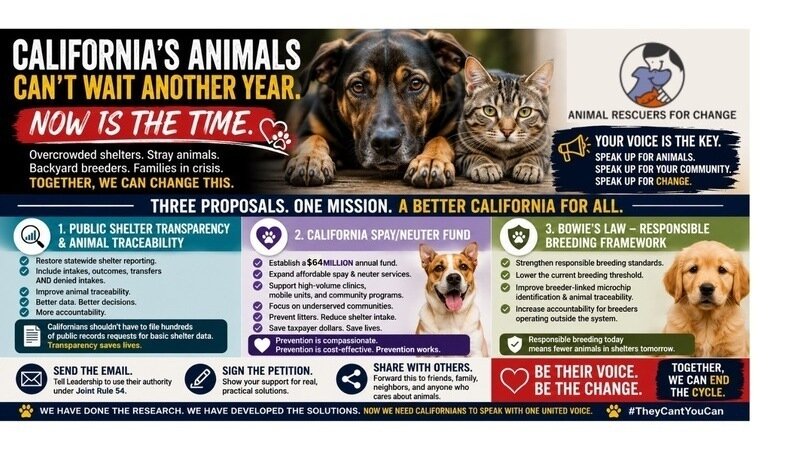
1. Restore Public Shelter Transparency
California cannot solve problems it cannot accurately measure.
This proposal would restore standardized statewide reporting by public shelters, improve transparency regarding animal intake, transfers, euthanasia, and outcomes, strengthen animal traceability through integrating rescue intakes and outcomes, and provide lawmakers and the public with reliable statewide information.
It would also reduce the need for hundreds of California Public Records Act requests simply to obtain basic information about publicly funded shelters.
2. Expand Affordable Spay and Neuter Services
The most humane and cost-effective way to reduce shelter overcrowding is to prevent unwanted litters before they occur.
This proposal establishes the California Spay-Neuter Program, supported by a $64 million annual General Fund investment for 16 years. The program would provide funding to public animal shelters, private shelters with public contracts, and nonprofit organizations whose primary mission is providing spay and neuter services, with priority given to communities experiencing the highest shelter overpopulation and euthanasia rates.
By investing in prevention, the proposal aims to reduce pet overpopulation, lower shelter intake and euthanasia, relieve pressure on shelters and rescue organizations, and reduce long-term taxpayer costs.
3. Strengthen Responsible Breeding Accountability
California continues to struggle with pet overpopulation while breeder accountability remains inconsistent.
Building upon California's existing breeder regulations, Bowie's Law strengthens responsible breeding standards by lowering the threshold for breeder regulation from three litters or 20 dogs per year to one litter or six dogs, requiring breeder-linked microchip identification before puppies reach eight weeks of age, documented veterinary health examinations, and age-appropriate immunizations before a dog may be sold or transferred. The proposal also requires animal shelters to maintain a publicly accessible list of adoptable and held animals, improving public visibility and access to adoption opportunities. Together, these measures strengthen animal traceability, breeder accountability, and shelter transparency while helping reduce the number of animals entering California's shelter system.
Why These Reforms Matter
The recent Miranda Rescue investigation demonstrated why California needs stronger statewide systems.
Volunteers were forced to submit more than 200 California Public Records Act requests simply to determine which public shelters transferred animals.
Records obtained so far document 2,757 dogs transferred from California public shelters to Miranda's Rescue.
Yet the full picture remains incomplete because numerous shelters never produced records, while some organizations operating publicly funded shelters claimed they were not subject to the California Public Records Act.
Californians should not have to investigate their own public shelter system simply to obtain basic information.
California already requires shelters to maintain operational records, and until 2016 operated a statewide shelter reporting system.
Today, California continues to struggle with fragmented shelter data, increasing euthanasia, overcrowded shelters limiting intake, inadequate access to affordable spay and neuter services, and inconsistent breeder accountability.
California's Animals Cannot Wait Another Year
Every month these reforms are delayed:
More shelters reach capacity.
More rescue organizations are forced to say "no."
More families cannot access affordable spay and neuter services.
More stray animals remain on our streets.
More irresponsible breeding continues.
More healthy, adoptable animals lose their lives.
If you've seen overwhelmed shelters...
If your local rescue has stopped accepting animals...
If you've seen stray dogs or cats in your community...
If you've struggled to find affordable spay and neuter services...
If you've watched backyard breeders advertise litter after litter while shelters remain full...
Then you've seen why these reforms matter.
Your Signature Can Make the Difference
As rescuers, we can research.
We can meet with legislators.
We can prepare reports.
We can work with Legislative Counsel to draft legislation.
But Legislative Leadership also needs to hear directly from Californians.
Every signature demonstrates that Californians support practical, statewide solutions.
Every signature tells Legislative Leadership that these proposals deserve the opportunity to be considered.
Every signature helps build momentum for greater transparency, stronger prevention, and meaningful accountability throughout California's animal welfare system.
Our Goal: 10,000 California Voices
We are asking Californians to join together in support of these three statewide solutions.
Our goal is to gather 10,000 signatures demonstrating broad public support for transparency, prevention, and responsible breeding accountability.
Each signature sends a simple message:
California's animals and the communities that care for them cannot wait another year.
Please Sign and Share
By signing this petition, you are respectfully asking:
Speaker Robert Rivas
Senate President pro Tempore Monique Limón
The Senate Committee on Rules
to exercise the Legislature's existing authority under Joint Rule 54 and allow these three completed Legislative Counsel proposals to receive consideration during the 2026 Legislative Session.
After signing, please share this petition with your family, friends, neighbors, fellow rescuers, adopters, volunteers, veterinarians, and everyone who believes California can do better.
Together, 10,000 voices can send a powerful message to California's Legislative Leadership that our animals, our shelters, and our communities deserve practical statewide solutions.
Please sign today and help us reach 10,000 signatures.

586
The Issue
Tell California Legislative Leadership: Our Animals and Communities Cannot Wait Another Year
Every day across California:
Shelters reach capacity.
Rescue organizations are forced to tell families, "We're sorry—we have no room."
Healthy, adoptable animals lose their lives because shelters are overwhelmed.
Families struggle to find affordable spay and neuter services.
Irresponsible breeding continues to add more animals to an already overcrowded system.
California can do better.
We are Animal Rescuers For Change (ARFC), a coalition representing more than 100 frontline California rescue organizations.
Unlike many organizations that primarily focus on advocacy, our members spend most of their time not in Sacramento, but on the front lines—responding to abandoned animals, assisting overwhelmed shelters, helping families keep their pets, arranging emergency veterinary care, and finding homes for animals that have nowhere else to go.
For many years, dedicated California animal welfare organizations have worked tirelessly to advance important legislative reforms. They have invested countless hours developing proposals, educating policymakers, and advocating for systemic solutions. While many of those efforts advanced the conversation, several key proposals have not yet become law, leaving many of the same underlying challenges unresolved.
Building upon those years of work, we spent more than two years researching California's animal welfare system, meeting with legislators and stakeholders, and developing practical statewide proposals through California Legislative Counsel. Our proposals incorporate concepts advanced over many years by multiple organizations and previous legislative efforts, while also reflecting the firsthand experience of frontline rescue organizations responding daily to California's growing animal welfare crisis.
Today, those solutions are ready.
Although all three proposals were fully drafted by Legislative Counsel, the original authoring offices reached California's 35-bill introduction limit before the measures could be introduced within the Legislature's internal timelines.
However, California's constitutional deadline for passing bills is August 31, 2026. There is still an opportunity for these proposals to be considered if Legislative Leadership authorizes their introduction under existing legislative procedures.
California's rules—including Joint Rule 54—recognize that legislation may proceed through existing exceptions with the permission of Legislative Leadership.
We respectfully ask Speaker Robert Rivas, Senate President pro Tempore Monique Limón, and the Senate Committee on Rules to exercise that existing authority so these completed proposals may receive consideration during the 2026 Legislative Session, before the constitutional deadline.
We are not asking for a new rule.
We are not asking for special treatment.
We are asking Legislative Leadership to use authority that already exists so these fully drafted, extensively researched proposals—built upon years of work by California animal welfare advocates and informed by the experience of frontline rescue organizations—can finally receive legislative consideration.
California's animals and communities cannot wait another year.
The Three Statewide Solutions
1. Restore Public Shelter Transparency
California cannot solve problems it cannot accurately measure.
This proposal would restore standardized statewide reporting by public shelters, improve transparency regarding animal intake, transfers, euthanasia, and outcomes, strengthen animal traceability through integrating rescue intakes and outcomes, and provide lawmakers and the public with reliable statewide information.
It would also reduce the need for hundreds of California Public Records Act requests simply to obtain basic information about publicly funded shelters.
2. Expand Affordable Spay and Neuter Services
The most humane and cost-effective way to reduce shelter overcrowding is to prevent unwanted litters before they occur.
This proposal establishes the California Spay-Neuter Program, supported by a $64 million annual General Fund investment for 16 years. The program would provide funding to public animal shelters, private shelters with public contracts, and nonprofit organizations whose primary mission is providing spay and neuter services, with priority given to communities experiencing the highest shelter overpopulation and euthanasia rates.
By investing in prevention, the proposal aims to reduce pet overpopulation, lower shelter intake and euthanasia, relieve pressure on shelters and rescue organizations, and reduce long-term taxpayer costs.
3. Strengthen Responsible Breeding Accountability
California continues to struggle with pet overpopulation while breeder accountability remains inconsistent.
Building upon California's existing breeder regulations, Bowie's Law strengthens responsible breeding standards by lowering the threshold for breeder regulation from three litters or 20 dogs per year to one litter or six dogs, requiring breeder-linked microchip identification before puppies reach eight weeks of age, documented veterinary health examinations, and age-appropriate immunizations before a dog may be sold or transferred. The proposal also requires animal shelters to maintain a publicly accessible list of adoptable and held animals, improving public visibility and access to adoption opportunities. Together, these measures strengthen animal traceability, breeder accountability, and shelter transparency while helping reduce the number of animals entering California's shelter system.
Why These Reforms Matter
The recent Miranda Rescue investigation demonstrated why California needs stronger statewide systems.
Volunteers were forced to submit more than 200 California Public Records Act requests simply to determine which public shelters transferred animals.
Records obtained so far document 2,757 dogs transferred from California public shelters to Miranda's Rescue.
Yet the full picture remains incomplete because numerous shelters never produced records, while some organizations operating publicly funded shelters claimed they were not subject to the California Public Records Act.
Californians should not have to investigate their own public shelter system simply to obtain basic information.
California already requires shelters to maintain operational records, and until 2016 operated a statewide shelter reporting system.
Today, California continues to struggle with fragmented shelter data, increasing euthanasia, overcrowded shelters limiting intake, inadequate access to affordable spay and neuter services, and inconsistent breeder accountability.
California's Animals Cannot Wait Another Year
Every month these reforms are delayed:
More shelters reach capacity.
More rescue organizations are forced to say "no."
More families cannot access affordable spay and neuter services.
More stray animals remain on our streets.
More irresponsible breeding continues.
More healthy, adoptable animals lose their lives.
If you've seen overwhelmed shelters...
If your local rescue has stopped accepting animals...
If you've seen stray dogs or cats in your community...
If you've struggled to find affordable spay and neuter services...
If you've watched backyard breeders advertise litter after litter while shelters remain full...
Then you've seen why these reforms matter.
Your Signature Can Make the Difference
As rescuers, we can research.
We can meet with legislators.
We can prepare reports.
We can work with Legislative Counsel to draft legislation.
But Legislative Leadership also needs to hear directly from Californians.
Every signature demonstrates that Californians support practical, statewide solutions.
Every signature tells Legislative Leadership that these proposals deserve the opportunity to be considered.
Every signature helps build momentum for greater transparency, stronger prevention, and meaningful accountability throughout California's animal welfare system.
Our Goal: 10,000 California Voices
We are asking Californians to join together in support of these three statewide solutions.
Our goal is to gather 10,000 signatures demonstrating broad public support for transparency, prevention, and responsible breeding accountability.
Each signature sends a simple message:
California's animals and the communities that care for them cannot wait another year.
Please Sign and Share
By signing this petition, you are respectfully asking:
Speaker Robert Rivas
Senate President pro Tempore Monique Limón
The Senate Committee on Rules
to exercise the Legislature's existing authority under Joint Rule 54 and allow these three completed Legislative Counsel proposals to receive consideration during the 2026 Legislative Session.
After signing, please share this petition with your family, friends, neighbors, fellow rescuers, adopters, volunteers, veterinarians, and everyone who believes California can do better.
Together, 10,000 voices can send a powerful message to California's Legislative Leadership that our animals, our shelters, and our communities deserve practical statewide solutions.
Please sign today and help us reach 10,000 signatures.
The Decision Makers

Supporter Voices
Petition Updates
Share this petition
Petition created on August 2, 2026