

Heart of Hale roads environment
The Issue
Following a review of Strategy Papers (available on the Haringey website) related to Tottenham Hale regeneration
- TOTTENHAM HALE DISTRICT CENTRE FRAMEWORK, STREETS & SPACES STRATEGY Adams & Sutherland, NOVEMBER 2015
- PART 4: TOTTENHAM HALE, DISTRICT CENTRE FRAMEWORK
the key objective
“The road environment and traffic behaviour, especially speed, should be transformed in order to calm traffic and shift the balance from vehicles to pedestrians and cyclists”
is not being achieved in the Heart of Hale area and, more specifically, around the new developments on Ashley Road 1.
This has a negative impact on residents' lifestyle health and safety
ONGOING CONCERNS
Unsustainable Speed limit and Traffic flow
Concern:
Watermead way, is a heavy traffic street. The combination of high-speed limit and a double lane moving west to east results into consistent high levels of noise and air pollution throughout day and night. Watermead way is constantly bearing heavy traffic, and, above all, lack of regulated restrictions enhances bad and irresponsible behaviour from motorists. The latter often race at the traffic light speeding beyond normal and cars/motorbikes overtake one another constantly honking. This not only represents a concerning factor towards health and safety of neighbouring pedestrians but further contributes to disruptive noise and general chaos.
Proposal:
Regulated lower speeding limits and road bumps would help reduce risk for people passing-by, noise and pollution to those living in the Heart of Hale and drive, overall, better motorists’ behaviour.
Pedestrian Crossing limitations
Concern:
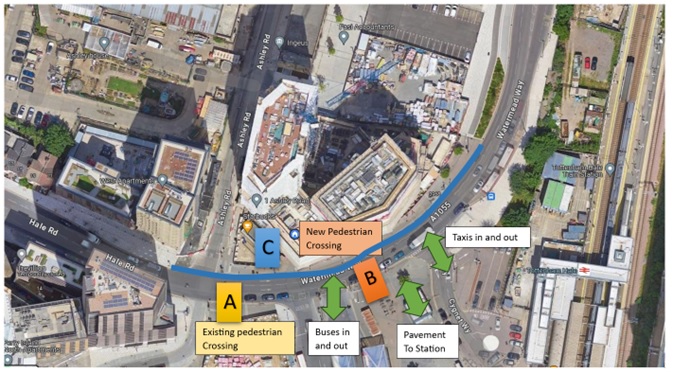
The attached snapshot (Heart of Hale Street view) shows an outline of traffic flow and the existing pedestrian crossing. From quick observation it is evident how anyone coming from the station pavement who wishes to cross Watermead way and reach Ashely Road or any of the Ashely Road buildings needs to pass through the buses “in and out” area and reach the western pedestrian crossing (marked A). This forces people to wait multiple times and makes the overall experience unnecessarily lengthy and frustrating also considering that traffic light (A) for pedestrians allows limited crossing time compared to motor regulated traffic. Pedestrians currently often take a high risk and cross anyway on the “B” mark but without any formal regulation.
Proposal
Since the car flow is stopped in correspondence of mark B to allow buses to flow in and out, it would make more sense to add a pedestrian crossing linking the station pavement directly to Ashley Road 1 building in correspondence of the B mark. Pedestrians would not be interfering with any traffic as it is anyway stopped and would not need to wait for buses and reach all the way to mark A.
Cycleways
Concern
2-way Cycleways exist only on the eastern section of Watermead Way. This does not allow cyclists to safely cycle on the western side of Watermead way, towards the station or into Hale Road. Additionally, the lack of implementation of fully extended cycleways, as originally envisaged by the borough improvements strategy paper, is unhelpful towards a more disciplined traffic around the area.
Proposal
Implement a 2-way cycle path (C mark) , separated from existing traffic, to enable safe cycling and improve noise levels and pollution by slowing down the traffic flow. This is a proposal that forms part of the strategy papers where the original proposal was to reduce Watermead Way width to 7.5m and build a two-way cycle lane.
Enquiries to Haringey Council through the FOI process (freedom of information requests) asked an up to date status on how the street works strategy is being delivered. Despite having received some comfort that this is regularly under review no specific further actions have been planned other than what already implemented and visible.
NOW is the time to take action and initiate a formal review to push the original street strategy to come to fruition. Today's road environment has NOT sufficiently transformed the traffic behaviour to shift the balance from vehicles to pedestrians and cyclists.

The Issue
Following a review of Strategy Papers (available on the Haringey website) related to Tottenham Hale regeneration
- TOTTENHAM HALE DISTRICT CENTRE FRAMEWORK, STREETS & SPACES STRATEGY Adams & Sutherland, NOVEMBER 2015
- PART 4: TOTTENHAM HALE, DISTRICT CENTRE FRAMEWORK
the key objective
“The road environment and traffic behaviour, especially speed, should be transformed in order to calm traffic and shift the balance from vehicles to pedestrians and cyclists”
is not being achieved in the Heart of Hale area and, more specifically, around the new developments on Ashley Road 1.
This has a negative impact on residents' lifestyle health and safety
ONGOING CONCERNS
Unsustainable Speed limit and Traffic flow
Concern:
Watermead way, is a heavy traffic street. The combination of high-speed limit and a double lane moving west to east results into consistent high levels of noise and air pollution throughout day and night. Watermead way is constantly bearing heavy traffic, and, above all, lack of regulated restrictions enhances bad and irresponsible behaviour from motorists. The latter often race at the traffic light speeding beyond normal and cars/motorbikes overtake one another constantly honking. This not only represents a concerning factor towards health and safety of neighbouring pedestrians but further contributes to disruptive noise and general chaos.
Proposal:
Regulated lower speeding limits and road bumps would help reduce risk for people passing-by, noise and pollution to those living in the Heart of Hale and drive, overall, better motorists’ behaviour.
Pedestrian Crossing limitations
Concern:
The attached snapshot (Heart of Hale Street view) shows an outline of traffic flow and the existing pedestrian crossing. From quick observation it is evident how anyone coming from the station pavement who wishes to cross Watermead way and reach Ashely Road or any of the Ashely Road buildings needs to pass through the buses “in and out” area and reach the western pedestrian crossing (marked A). This forces people to wait multiple times and makes the overall experience unnecessarily lengthy and frustrating also considering that traffic light (A) for pedestrians allows limited crossing time compared to motor regulated traffic. Pedestrians currently often take a high risk and cross anyway on the “B” mark but without any formal regulation.
Proposal
Since the car flow is stopped in correspondence of mark B to allow buses to flow in and out, it would make more sense to add a pedestrian crossing linking the station pavement directly to Ashley Road 1 building in correspondence of the B mark. Pedestrians would not be interfering with any traffic as it is anyway stopped and would not need to wait for buses and reach all the way to mark A.
Cycleways
Concern
2-way Cycleways exist only on the eastern section of Watermead Way. This does not allow cyclists to safely cycle on the western side of Watermead way, towards the station or into Hale Road. Additionally, the lack of implementation of fully extended cycleways, as originally envisaged by the borough improvements strategy paper, is unhelpful towards a more disciplined traffic around the area.
Proposal
Implement a 2-way cycle path (C mark) , separated from existing traffic, to enable safe cycling and improve noise levels and pollution by slowing down the traffic flow. This is a proposal that forms part of the strategy papers where the original proposal was to reduce Watermead Way width to 7.5m and build a two-way cycle lane.
Enquiries to Haringey Council through the FOI process (freedom of information requests) asked an up to date status on how the street works strategy is being delivered. Despite having received some comfort that this is regularly under review no specific further actions have been planned other than what already implemented and visible.
NOW is the time to take action and initiate a formal review to push the original street strategy to come to fruition. Today's road environment has NOT sufficiently transformed the traffic behaviour to shift the balance from vehicles to pedestrians and cyclists.
Petition Updates
Share this petition
Petition created on 22 February 2024