
Health and Safety of School Colour Runs
The issue
Currently, coloured cornstarch powders are used during fundraising colour runs at schools across Queensland, and nationally.
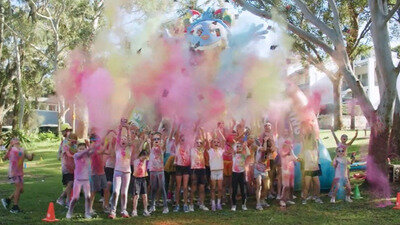
These events are intended to be enjoyable fundraising events for schools, however, there are concerns regarding airborne distribution of cornstarch and the potential for children (and staff) to inhale the powder, resulting in short-term, and potential long-term detrimental health consequences. Unlike eating cornstarch, intentionally dispersing a fine powder into the air creates a different exposure route, particularly for children who may inhale significant amounts during running and physical exertion.
Fundraising companies mention on their websites that the starch is only to be applied to the lower half of children’s bodies; however, photographs and videos from the events show children’s faces/hair covered in powder residue and powder being dispersed through large volumes of air over the heads of children and staff members.
Colour run companies provide coloured powders and online fundraising support for schools and provide their services to at least 2000 schools every year, though this may be an underestimate.
Health and Safety
1. Respiratory inflammation: Research has demonstrated that inhalation of cornstarch powder can produce an inflammatory response in the airways. In one human study, exposure to cornstarch powder (in tiny amounts from surgical gloves) resulted in increased inflammatory cells in the lungs and evidence of subclinical airway inflammation. In another study, were exposed to aerosolised cornstarch-glove powder. They received an initial bronchoscopy and then again at 2 to 3 weeks after exposure. The results demonstrated the powder caused subclinical airway inflammation as well as a large number of eosinophilic granulocytes, which can cause tissue damage. In addition to tissue damage, it was found that cornstarch powder may cause adhesions and scarring. A letter to the editor of the Australian College of Surgeons in 2020 outlined a case of chemical pneumonitis after cornstarch inhalation after participation in a colour run.
https://doi.org/10.1111/ans.15965Digital Object Identifier (DOI)
https://pubmed.ncbi.nlm.nih.gov/12762351/
2. Children's developing lungs: Children may be particularly vulnerable to inhaled particulate matter because their respiratory systems are still developing. Research on particulate exposure has associated inhalable particles with respiratory symptoms in children, and more recent research has found associations between long-term fine-particle exposure and impaired lung growth and airway inflammation.
https://pmc.ncbi.nlm.nih.gov/articles/PMC12278304/
https://pubmed.ncbi.nlm.nih.gov/2923355/
3. Particle size
Cornstarch contains a range of particle sizes including particles less than 10 microns in diameter (range 2-30 microns). This is important, because particles less than 10 microns in size are classified as "respirable". These dust particles are so small that they are invisible under normal lighting conditions and can remain suspended in the air for prolonged periods of time. Their extremely small size also means they can be breathed deep into the lungs and lead to lung damage. As a reference, silica dust, which is known to cause the lung condition, silicosis, is known to range in size from 4-10 microns. Therefore, it is possible that repeated exposure to cornstarch powder could potentially cause long-term lung health consequences, similar to those seen in exposure to silica dust.
https://www.researchgate.net/figure/Particle-size-analysis-of-starches_tbl1_228660773
https://www.worksafe.qld.gov.au/safety-and-prevention/hazards/hazardous-exposures/hazardous-dusts
4. Product purity and contamination: Although food-grade cornstarch is generally considered safe when consumed orally, it is quite different when deliberately aerosolising large quantities of powder for inhalation. It is unclear whether the particular product being used has been independently tested for contaminants such as talc, lead, arsenic, cadmium, mercury and other heavy metals. Testing of other various powdered consumer products has demonstrated that trace heavy-metal contamination can occur, depending on the product and its ingredients.
All colours of the powders contain talc and most contain coal tar as tartrazine. This is documented on Asthma Australia's website. https://asthma.org.au/wp-content/uploads/Fact_sheets/FCTRE009_Asthma-and-Colour-Fun-Runs_V2_201906.pdf
Tartrazine alone contains a high proportion of respirable particles and is considered toxic when inhaled.
In summary, I would ask education departments across Australia to consider creating and adopting a policy/procedure which would mean no cornstarch or other fine powders should be used during school-run events.
Possible Alternatives
Schools could consider an alternative that does not involve throwing or aerosolising cornstarch. For example, colour runs could retain its colour-themed concept without using airborne powder. Coloured decorations, flags, ribbons, etc could provide the same sense of fun while eliminating potentially harmful respiratory exposure.
Some colour run companies offer slime as an alternative to powders, however they also pose potential health risks, especially in the context of coming into contact with children’s skin/eyes.
Key ingredients in the slime products:
1. Sodium polyacrylate
- strong skin and eye irritant - known to cause skin burns and eye damage and other MSDS sheets say to avoid contact with skin and eyes
https://www.ewg.org/research/diaper-guide
- The National Toxicology Program has classified acrylamide as reasonably anticipated to cause cancer in humans, based on studies assessing oral ingestion
National Cancer Institute, Acrylamide and Cancer Risk. National Institutes of Health. cancer.gov/about-cancer/causes-prevention/risk/diet/acrylamide-fact-sheet#:~:text=Acrylamide%20is%20a%20chemical%20used,water%20and%20wastewater%2C%20including%20sewage
- Not biodegradable and can persist in the environment for decades
https://biologyinsights.com/what-is-sodium-polyacrylate-and-how-does-it-work/
2. Propenoic acid
- Classified as hazardous by WorkSafe Australia including harmful if in contact with the skin and can cause severe burns
- Absorbed through skin - exposure and causes acute and chronic toxicity
I appreciate the considerable work that goes into organising school events and the importance of fundraising to help improve school resources and facilities. In raising this concern, the hope is that satisfactory alternatives can be found allowing children and school communities to enjoy fun runs/fundraising activities safely.

80
The issue
Currently, coloured cornstarch powders are used during fundraising colour runs at schools across Queensland, and nationally.
These events are intended to be enjoyable fundraising events for schools, however, there are concerns regarding airborne distribution of cornstarch and the potential for children (and staff) to inhale the powder, resulting in short-term, and potential long-term detrimental health consequences. Unlike eating cornstarch, intentionally dispersing a fine powder into the air creates a different exposure route, particularly for children who may inhale significant amounts during running and physical exertion.
Fundraising companies mention on their websites that the starch is only to be applied to the lower half of children’s bodies; however, photographs and videos from the events show children’s faces/hair covered in powder residue and powder being dispersed through large volumes of air over the heads of children and staff members.
Colour run companies provide coloured powders and online fundraising support for schools and provide their services to at least 2000 schools every year, though this may be an underestimate.
Health and Safety
1. Respiratory inflammation: Research has demonstrated that inhalation of cornstarch powder can produce an inflammatory response in the airways. In one human study, exposure to cornstarch powder (in tiny amounts from surgical gloves) resulted in increased inflammatory cells in the lungs and evidence of subclinical airway inflammation. In another study, were exposed to aerosolised cornstarch-glove powder. They received an initial bronchoscopy and then again at 2 to 3 weeks after exposure. The results demonstrated the powder caused subclinical airway inflammation as well as a large number of eosinophilic granulocytes, which can cause tissue damage. In addition to tissue damage, it was found that cornstarch powder may cause adhesions and scarring. A letter to the editor of the Australian College of Surgeons in 2020 outlined a case of chemical pneumonitis after cornstarch inhalation after participation in a colour run.
https://doi.org/10.1111/ans.15965Digital Object Identifier (DOI)
https://pubmed.ncbi.nlm.nih.gov/12762351/
2. Children's developing lungs: Children may be particularly vulnerable to inhaled particulate matter because their respiratory systems are still developing. Research on particulate exposure has associated inhalable particles with respiratory symptoms in children, and more recent research has found associations between long-term fine-particle exposure and impaired lung growth and airway inflammation.
https://pmc.ncbi.nlm.nih.gov/articles/PMC12278304/
https://pubmed.ncbi.nlm.nih.gov/2923355/
3. Particle size
Cornstarch contains a range of particle sizes including particles less than 10 microns in diameter (range 2-30 microns). This is important, because particles less than 10 microns in size are classified as "respirable". These dust particles are so small that they are invisible under normal lighting conditions and can remain suspended in the air for prolonged periods of time. Their extremely small size also means they can be breathed deep into the lungs and lead to lung damage. As a reference, silica dust, which is known to cause the lung condition, silicosis, is known to range in size from 4-10 microns. Therefore, it is possible that repeated exposure to cornstarch powder could potentially cause long-term lung health consequences, similar to those seen in exposure to silica dust.
https://www.researchgate.net/figure/Particle-size-analysis-of-starches_tbl1_228660773
https://www.worksafe.qld.gov.au/safety-and-prevention/hazards/hazardous-exposures/hazardous-dusts
4. Product purity and contamination: Although food-grade cornstarch is generally considered safe when consumed orally, it is quite different when deliberately aerosolising large quantities of powder for inhalation. It is unclear whether the particular product being used has been independently tested for contaminants such as talc, lead, arsenic, cadmium, mercury and other heavy metals. Testing of other various powdered consumer products has demonstrated that trace heavy-metal contamination can occur, depending on the product and its ingredients.
All colours of the powders contain talc and most contain coal tar as tartrazine. This is documented on Asthma Australia's website. https://asthma.org.au/wp-content/uploads/Fact_sheets/FCTRE009_Asthma-and-Colour-Fun-Runs_V2_201906.pdf
Tartrazine alone contains a high proportion of respirable particles and is considered toxic when inhaled.
In summary, I would ask education departments across Australia to consider creating and adopting a policy/procedure which would mean no cornstarch or other fine powders should be used during school-run events.
Possible Alternatives
Schools could consider an alternative that does not involve throwing or aerosolising cornstarch. For example, colour runs could retain its colour-themed concept without using airborne powder. Coloured decorations, flags, ribbons, etc could provide the same sense of fun while eliminating potentially harmful respiratory exposure.
Some colour run companies offer slime as an alternative to powders, however they also pose potential health risks, especially in the context of coming into contact with children’s skin/eyes.
Key ingredients in the slime products:
1. Sodium polyacrylate
- strong skin and eye irritant - known to cause skin burns and eye damage and other MSDS sheets say to avoid contact with skin and eyes
https://www.ewg.org/research/diaper-guide
- The National Toxicology Program has classified acrylamide as reasonably anticipated to cause cancer in humans, based on studies assessing oral ingestion
National Cancer Institute, Acrylamide and Cancer Risk. National Institutes of Health. cancer.gov/about-cancer/causes-prevention/risk/diet/acrylamide-fact-sheet#:~:text=Acrylamide%20is%20a%20chemical%20used,water%20and%20wastewater%2C%20including%20sewage
- Not biodegradable and can persist in the environment for decades
https://biologyinsights.com/what-is-sodium-polyacrylate-and-how-does-it-work/
2. Propenoic acid
- Classified as hazardous by WorkSafe Australia including harmful if in contact with the skin and can cause severe burns
- Absorbed through skin - exposure and causes acute and chronic toxicity
I appreciate the considerable work that goes into organising school events and the importance of fundraising to help improve school resources and facilities. In raising this concern, the hope is that satisfactory alternatives can be found allowing children and school communities to enjoy fun runs/fundraising activities safely.
Petition Updates
Share this petition
Petition created on 30 October 2026