
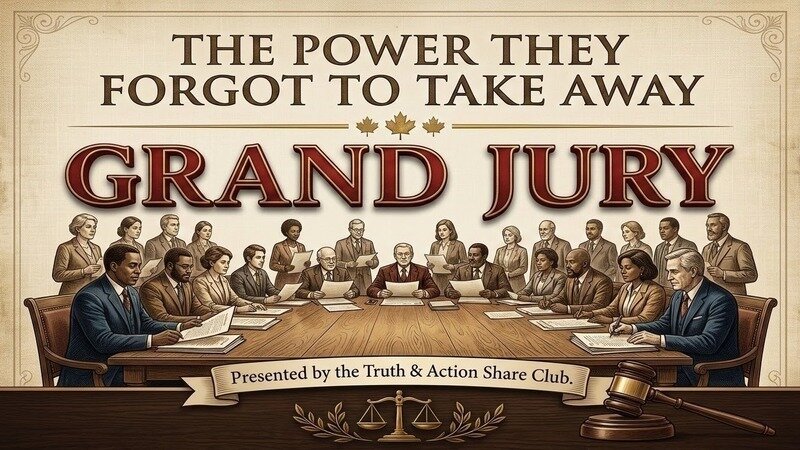
THIS IS A 4 PART ARTICLE THAT IS BEING PITCHED TO DRUTHERS
Canada is entering a constitutional crossroads.
The Grand Jury on Treason initiative is emerging in direct response to the NSICOP foreign interference report and growing public concern surrounding foreign interference, election interference, executive secrecy, prosecutorial gatekeeping, and the accelerating transformation of Canada's judicial and constitutional systems toward digitised administrative management.
The issue is no longer merely political disagreement. The concern is that many of the institutions responsible for investigating wrongdoing are increasingly structurally incapable of acting when allegations touch political, bureaucratic, administrative, or executive power itself. The gatekeepers and the subjects of the allegations are increasingly the same institutional actors.
This is where the grand jury argument enters.
The initiative is not calling for revolution, violence, or destabilisation. Precisely the opposite: lawful constitutional mechanisms must be exhausted in order to prevent societal collapse, emergency governance, and the destruction of constitutional order itself. Canada still possesses functioning constitutional infrastructure — courts, inherited common law, criminal procedure, due process protections, jury traditions, and the continuing force of the Canadian Bill of Rights. The question is whether Canadians still possess a lawful constitutional mechanism capable of independently placing serious allegations of public wrongdoing before the judiciary without first passing through the systems implicated in that wrongdoing.
Historically, this is exactly what grand jury presentment was designed to do.
Why the Current System Is Failing
One of the central constitutional problems in Canada today is that almost all serious criminal allegations must first pass through prosecutorial gatekeeping before they can ever reach a judge. Without grand jury presentment, citizens cannot directly place evidence of major public wrongdoing before the court. Everything must first go through prosecutors.
This creates a structural accountability problem when allegations themselves involve political institutions, executive power, administrative systems, or public officials. Prosecutors already discard the overwhelming majority of complaints before any independent judicial examination ever occurs. Citizens are increasingly blocked from meaningful access to judicial scrutiny in matters involving institutional power — not because their allegations lack seriousness, but because the gatekeeping system filters them before any judge ever sees the evidence.
Presentment historically solved that constitutional problem by allowing citizens to place evidence of serious public wrongdoing directly before the judiciary without requiring prosecutorial permission first. That distinction is critical. Presentment restores a direct constitutional pathway between the people and the courts. That is why the legal committee supporting the Grand Jury on Treason initiative is now examining potential investigation into administrative and prosecutorial obstruction of justice arising from systemic barriers preventing constitutional matters from properly reaching judges.
The Courts Are Changing in Real Time
The erosion of traditional court process is no longer theoretical. It is already occurring openly through administrative practice.
Under the Rules of Civil Procedure, hearings are to occur in person unless otherwise ordered by the court. Administration has increasingly reversed that legal structure in practice by treating virtual hearings as the default while requiring citizens to seek permission for genuine physical hearings.
Consider one observed proceeding that demonstrates how far this transformation has already gone. A woman specifically completed and filed the required form requesting an in-person hearing because she did not want a virtual appearance. Court administration approved the request. But when she arrived at the courthouse expecting an actual courtroom proceeding, there was no judge physically present, no defendants physically present, and no ordinary courtroom process taking place. Instead, the proceeding consisted of the woman sitting in a room with a single clerk and a computer screen connecting her into a remote hearing. The audio system malfunctioned: she could not properly hear the participants, the participants could not properly hear her, and the clerk assisting with the technology could not fix the problem. Yet the proceeding continued anyway.
This demonstrates that the system increasingly preserves the language of in-person while eliminating the actual substance of physical courtroom process. This is not merely administrative modernisation. It represents a structural shift away from physical open courts, away from direct judicial engagement, away from human courtroom process, and toward increasingly digitised administrative management systems. Judges themselves are fully aware this transformation is occurring because they witness it daily from inside the system.
Why the Accountability Gap Is Now Judicially Confirmed
The constitutional accountability gap described by this initiative is not merely theoretical. It has been confirmed, in different dimensions, by the Supreme Court of Canada itself.
In Alford v Canada (Attorney General), 2026 SCC 14, the Supreme Court upheld the constitutional validity of section 12 of the NSICOP Act — the provision that strips members of the national security and intelligence committee of parliamentary privilege if they publicly disclose what they learn through their committee work. The appeal was dismissed eight to one. The one parliamentary body with legislated access to classified intelligence and national security information is legally silenced about what it finds, and the Supreme Court has confirmed that silencing is constitutionally valid.
The significance of Alford is not that the challenge failed. The significance is what the outcome confirms: that every existing institutional mechanism for accountability — parliamentary oversight, prosecutorial discretion, administrative process — has been either legally insulated, administratively bypassed, or judicially confirmed as properly restricted. The accountability gap the Grand Jury on Treason initiative describes is not a conspiracy theory. It is a structural constitutional condition with a Supreme Court decision sitting at its centre.
The full analysis of Alford, alongside R v Power, Krieger v Law Society of Alberta, Canada (Attorney General) v Power 2024, and the Reference re Secession of Quebec, is carried out in Part Three.
Why Judges Will Likely Act on Grand Jury Presentments
The fringe controlled-opposition narrative claims judges should simply be abandoned as hopelessly compromised. The actual evidence points in the opposite direction.
If judges were already completely captured, there would be little reason for prosecutors, administrators, and procedural gatekeeping systems to work so aggressively to prevent major constitutional matters from reaching them in the first place. The existence and intensity of the filtering is itself evidence that independent judicial scrutiny still matters — to those who benefit from its absence most of all.
The decisions judges are still issuing whenever major constitutional matters finally do reach open court confirm this further. In Canada (Attorney General) v Power, 2024 SCC 26, the Supreme Court held that the state does not have absolute immunity from liability for enacting legislation that is clearly unconstitutional or was in bad faith or an abuse of power. That is not the ruling of a captured court. In the Alberta oil and gas constitutional litigation, courts issued major rulings restraining federal overreach into provincial jurisdiction. In the Emergencies Act rulings of Justice Richard Mosley, the Federal Court ruled that the government's invocation of the Emergencies Act was unlawful, unreasonable, and violated constitutional protections.
These decisions do not prove the judiciary is uniformly independent. They prove it is not uniformly captured. That distinction matters enormously for the grand jury argument. The real constitutional problem is not that judges cannot act. The real constitutional problem is that more and more important matters are being prevented from reaching judges at all through prosecutorial filtering, administrative obstruction, procedural gatekeeping, and increasingly digitised systems of management. Grand jury presentment addresses precisely that structural problem.
Restoration — Not Revolution
The Grand Jury on Treason initiative is not intended to destroy constitutional order. It is intended to restore it.
Unlike violence, riots, destabilisation campaigns, or revolutionary rhetoric, grand jury presentment operates through lawful constitutional process: evidence, witnesses, procedure, open judicial scrutiny, and due process. The objective is not chaos. The objective is restoration — restoration of constitutional accountability, restoration of due process, restoration of meaningful judicial oversight, restoration of common-law protections, and restoration of the principle that public power remains subordinate to law rather than above it.
The legal and constitutional foundations for the Grand Jury on Treason initiative are extensive and rooted in the Canadian Bill of Rights, common law due process, and the historic distinction between indictment and presentment — arguments almost entirely absent from mainstream constitutional discussion.
Part Two examines those constitutional foundations in detail.
Coming in Part Two: The Constitutional Foundations LINK: tinyurl.com/bd58bjpe
Indictment vs presentment — they were never the same thing, Section 576 of the Criminal Code of Canada, the statute revision controversy and the clerk argument, the Ontario sheriff and Jury Act issue, why grand jury was never abolished, the federal jurisdiction argument, the Canadian Bill of Rights and the meaning of "shall continue to exist", and Magna Carta, Blackstone, and the two-fold barrier.
Part Three: Prosecutorial Gatekeeping and the Accountability Gap LINK: /tinyurl.com/3yvj8kah
How prosecutors increasingly block constitutional matters from reaching judges, and the significance of R v Power, Krieger v Law Society of Alberta, Canada (Attorney General) v Power 2024, and Alford v Canada (Attorney General) 2026 — with full honest treatment of what each case actually holds.
Part Four: Administrative Transformation and Constitutional Restoration LINK: tinyurl.com/dnrwmswt
The Criminal Code section 9 debate, the ultra vires argument involving revision clerks, the shift toward virtual-first and administrative court systems, the NSICOP constitutional implications, the controlled-opposition argument, and why constitutional restoration differs fundamentally from revolution.