
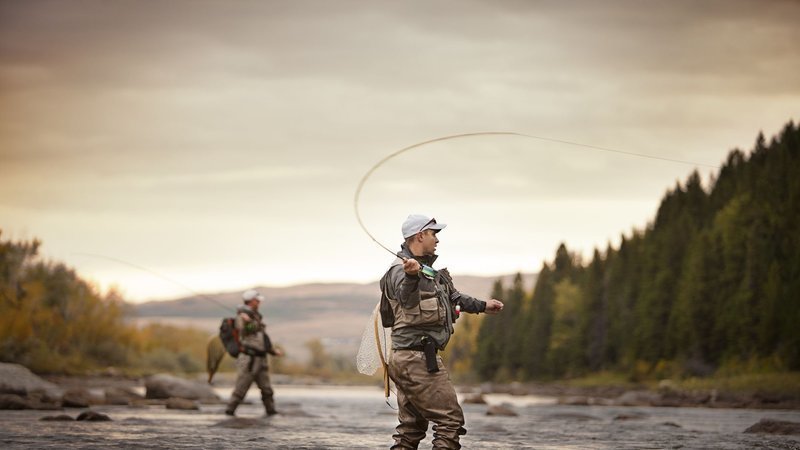
Wading Into Controversy: Ontario’s Waterbed Law
Fortunately for anglers, Common Law water rights in Ontario no longer apply.
July 31 2017
By G. Chambers, SFBCA Vice Chairman
In Ontario, the water in lakes and rivers belongs to everyone. As long as you are in a boat or float tube, you can fish pretty much anywhere in our province where the regulations allow. Unfortunately, the same public access rules do not apply to the bottom (a.k.a. the waterbed). As soon as you step foot on the bottom of a lake or river, you could be breaking the law.
History of Waterbed Ownership in Ontario
For many years in Ontario, water rights were based on old English Common law. Under Common Law, if you owned land on both sides of a river you also owned the waterbed that ran through your property.
Likewise if you only owned land on one side of the river, you owned the waterbed to the halfway mark of the river (the landowner on the other side of the river owned the other half of the waterbed). Under Common Law, private property owners had a legal right to restrict anyone from wading through their property.
Fortunately for anglers, Common Law water rights in Ontario no longer apply.
Beds of Navigable Waters Act In 1911, the passage of the Beds of Navigable Waters Act replaced Common Law practices and changed the rules of waterbed ownership in favour of the public. While property owners abutting non-navigable waters (i.e. rivers too narrow or too shallow to float a canoe down) continue to own those waterbeds, the beds of navigable rivers are a different story.
Under the current Act, if a piece of water is (1) navigable and (2) hasn’t specifically been deeded to an abutting property owner then the waterbed is Crown Land and open to the public to use.
What’s a Navigable River?
The first part in determining whether a waterbed is crown land is to figure out if the waterway is navigable.
Although the Act does not specifically define navigability, several court cases (Coleman V. Ontario) have established legal precedent that the Ontario Ministry of Natural Resources follows. Basically for a waterway to be navigable “it must have real or potential practical value to the public as a means of travel or transport, generally from one point of public access to another point of public access.” Court cases have also established several other key principles:
1. navigability in law requires that the waterway be navigable in fact. It must be capable in its natural state of being traversed by large or small craft of some sort;
2. navigable also means floatable in the sense that the river or stream is used or is capable of use for floating logs or log rafts or booms;
3. a river may be navigable over part of its course and not navigable over other parts;
4. to be navigable, a river need not in fact be used for navigation so long as it is realistically capable of being so used;
5. a river is not necessarily navigable if it is used only for private purposes or if it is used for purposes which do not require transportation along the river (i.e., fishing);
6. navigation need not be continuous, but may fluctuate with the seasons;
7. where a proprietary interest asserted depends on a Crown grant, navigability is initially to be determined as at the date of the Crown grant.
Private Ownership of Waterbed Requires a Deed
Assuming that a waterway meets the definition of navigability as established by the courts, the next step is to determine if the Crown ever granted or deeded away waterbed ownership to a private property owner.
If “yes” then the waterbed is private property even if the waterway is navigable. If the waterbed was never deeded away then it remains Crown land.
Lately, many landowners that have property abutting a river have been going to land registry offices to get copies of original deeds. Often these deeds do say something like: “Lot 1, Concession X, together with the with the woods and waters therein…”
Landowners claim that the phrase “Woods and Water herein” gives them ownership of the waterbed. Ontario courts have ruled however that many of these old deeds are too vague in their wording and to do not represent an “express grant”. As the Act clearly says, if there is no specific or express grant of the waterbed to the landowner (Grantee) then the land remains as Crown Land:
“Section 1 Beds of Navigable Waters Act
Where land that borders on a navigable body of water or stream, or on which the whole or apart of a navigable body of water or stream flows, has been heretofore or is hereafter granted by the Crown, it shall be deemed, in the absence of an express grant of it, that the bed of such body of water was not intended to pass and did not pass to the grantee.”
Which Rivers Can I Wade?
If a waterway is navigable and if the waterbed has not been expressly granted to a landowner, then it is public land and you are free to wade it.
While most anglers can probably tell the difference between a navigable and non-navigable river just by looking at it, how are we supposed to know if the waterbed has been deeded to a private property owner?
I guess you could spend time and effort going to a land registry office, but a better option would be to contact your local MNR office.
If a waterbed has been recorded as Crown Land they can tell you.
If a waterway that you want to wade has not been assessed, request the local MNR Area Supervisor to start the process.