Why Many Still Say Thích Minh Tuệ?

Dear supporters,
Many of you have asked why we continue to use the name Thích Minh Tuệ.
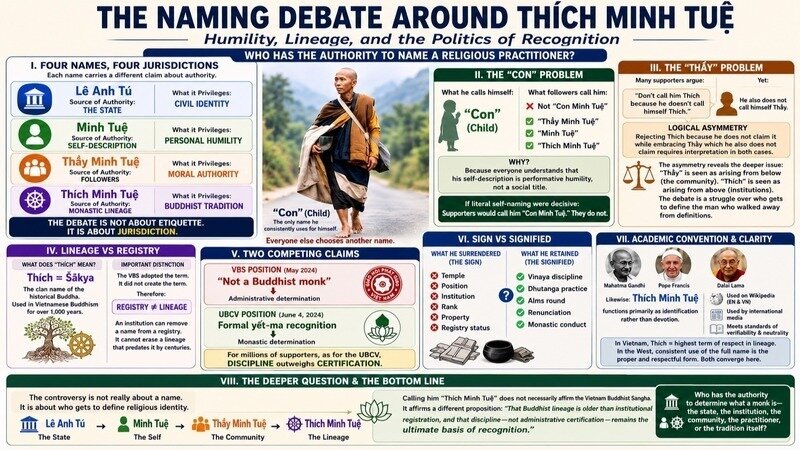
The answer goes far beyond etiquette. It goes to the heart of this campaign: Who has the authority to define religious identity?
The Vietnamese government insists on his civil name, Lê Anh Tú, after declaring him "not a Buddhist monk" in May 2024. Yet the honorific Thích is not a government-issued credential. It derives from the Śākya lineage of the historical Buddha and has been used in Vietnamese Buddhism for over a thousand years — long before the Vietnam Buddhist Sangha (VBS) existed. An administrative circular may alter a registry, but it cannot erase a spiritual lineage.
Since renouncing institutional affiliation, he simply calls himself Minh Tuệ, and even more humbly, con (child) before everyone he meets. Ironically, the less status he claims for himself, the more the world has recognized him.
From Gudadiya Baba ("the Patchwork-Cloth Saint") in Bodh Gaya, to a Living Arahant in Sri Lanka, a Bodhisattva in Conduct recognized by Vietnamese Buddhist leaders abroad, and even "a Gospel Without Words" from a Catholic priest, communities across cultures have independently reached for the highest spiritual language available to describe the same barefoot ascetic.
That is why millions continue to call him Thích Minh Tuệ — not to contradict his humility, but to affirm that authentic religious identity is recognized through lived practice, not political decree.
📄 New SSRN Research Released
This 46-page study is the most comprehensive documented account of Thích Minh Tuệ to date, tracing his path from land surveyor in Hà Tĩnh Province to one of the most widely observed religious ascetics in the contemporary world. Part I includes the full analysis of the naming question — how the debate over Lê Anh Tú, Minh Tuệ, and Thích Minh Tuệ reflects a much deeper struggle over religious freedom, institutional authority, and the right of a living Buddhist tradition to recognize its own practitioners.
Read the paper here:
https://papers.ssrn.com/sol3/papers.cfm?abstract_id=6986358
📚 A Larger Story Is Being Written
This paper is the opening installment of a much larger scholarly project: the first comprehensive account of Thích Minh Tuệ's pilgrimage.
Drawing on field documentation, eyewitness testimony, media reports, and Buddhist sources, the full work chronicles his extraordinary journey — from a solitary Vietnamese dhutaṅga monk walking barefoot with an alms bowl, to an international symbol of religious freedom whose pilgrimage has crossed Vietnam, Laos, Thailand, Malaysia, Indonesia, Singapore, Sri Lanka, India, and Nepal. It also examines the global response to his walk, the challenges he has faced, and the profound spiritual and social impact of a life lived in radical simplicity.
We look forward to sharing more as this project develops.
Thank you for standing with us and helping protect the freedom of peaceful religious practice.
Please continue sharing this petition so that Thích Minh Tuệ can continue to walk in peace.
👉 Sign and share: https://www.change.org/TMTWalk4Peace
With gratitude,
The TMTWalk4Peace Campaign