To me it was like WIKI-LEAKS secrets being revealed: Technical Publication SJ2016-1 from SJRWMD

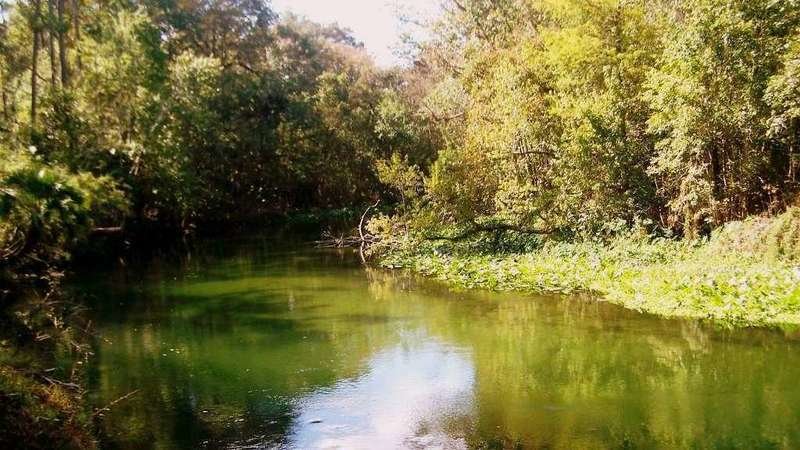
YES, to "Ocklawahaman" it was sort of like WIKI-LEAKS secrets being revealed. I am referring to "Technical Publication SJ2016-1: Effects on Lower St. Johns River Nutrient Supply and TMDL Target Compliance from the Restoration of a Free-Flowing Ocklawaha River" which is authored by John Hendrickson, Environmental Scientist VI, of the SJRWMD.
Nobody -- other than John Hendrickson of SJRWMD -- had ever explained to me before in clear black and white AMERICAN English why the Ocklawaha River hasn't already been restored to free-flowing again (by the breaching of Rodman Dam) after Governor Lawton Chiles and the Cabinet in 1997 mandated that this would happen!
Hendrickson, John. 2016. Effects on Lower St. Johns River Nutrient Supply and TMDL Target Compliance from the Restoration of a Free-Flowing Ocklawaha River. Technical Publication SJ2016-1. 107 pages. St. Johns River Water Management District, Palatka, Florida.
SOME EXACTLY QUOTED EXCERPTS FROM "Technical Publication SJ2016-1":
"Despite the predicted increase in downstream nutrient load, the positive aspects related to the restoration of floodplain functions, increased unique habitat and migratory fish passage appeared to provide overall net environmental gain. At the directive of then-Gov. Lawton Chiles and the Florida Cabinet, FDEP in 1997 submitted a permit application to SJRWMD for the removal of Rodman Reservoir to restore a free-flowing lower Ocklawaha River.
"But in 1999, once the permit application package was complete, the case for the restoration was deemed insufficient to meet the environmental resource permit (ERP) and consumptive use permit (CUP) public interest tests, and SJRWMD staff informed FDEP that they could not recommend approval to their Governing Board. The most prominent concern contributing to the recommendation of denial centered on the potential adverse impacts of increased nutrient load to the lower St. Johns River. Adding to this concern was the fact that the lower St. Johns at the time was one of the most prominent water bodies included on the 1999 consent decree between the U.S. Environmental Protection Agency and Earthjustice to establish Total Maximum Daily Loads (TMDLs) for impaired Florida waters. FDEP requested that SJRWMD not take agency action and to hold the permit in abeyance indefinitely, a status which has continued until this day."
"This report details the results of analyses performed by the St. Johns River Water Management District about the possible downstream effects of restoring of the lower Ocklawaha River to a free-flowing condition by removing the Rodman Reservoir. The analysis represents the most comprehensive reassessment to date focusing on the changes in nitrogen and phosphorus export from a free-flowing Ocklawaha River."
"This analysis estimates that a free-flowing Ocklawaha River will increase the average TP load to the lower St. Johns River by 11.5 metric tons (MT)/yr in reservoir-full years, and by 0.1 MT/yr in drawdown years. If drawdowns are conducted once every three years (the 2012 and upcoming 2015 drawdowns were both postponed a year hence will have been conducted on 4-year cycles), then the long-term median discharge condition phosphorus load increase under a free-flowing Ocklawaha River will be 7.7 MT/yr. To put this load in context, the allocated domestic wastewater phosphorus load to the freshwater lower St. Johns River is 12.4 MT/yr, and the annual load from the Georgia Pacific Palatka Mill was estimated in 2011 to be 11.5 MT/yr (LSJR BMAP, 2011). The Tri-County Agricultural Area (TCAA) delivers an average annual estimated phosphorus load of 84 MT/yr (FDEP, 2008). Two of the SJRWMD-designed and built regional stormwater treatment systems in the TCAA together removed an annual average of 4.5 MT/yr (2009–2014; Livingston-Way, 2014 Draft BMAP). And, since 2012, SJRWMD has conducted a gizzard shad harvest program on Lake George which has annually removed approximately 4.6 MT/yr. So the predicted phosphorus load increase from a free-flowing lower Ocklawaha, while not insignificant, is in the range of other permitted phosphorus loads to the LSJR, and within the realm of reduction achieved by projects currently functioning elsewhere in the basin. Should FDEP choose to pursue this restoration, and if a mitigation were deemed appropriate to offset potential harm based on the predicted phosphorus load increase, it would likely be achievable through a combination of treatment project options directed elsewhere in the middle St. Johns, Lake George, or the freshwater LSJR. This fact, combined with the understanding of adverse impacts that accompany reservoir drawdowns, a necessary management action for the maintenance of the reservoir (Hendrickson et al., 2016), appears sufficient such that a recommendation of denial, on the grounds of the detrimental impacts to downstream water quality, is no longer a certainty for this restoration permit."
"Meet the Technical Team" from SJRWMD webpage last accessed in September 2016:
"Name: John Hendrickson
"Title: Environmental Scientist VI Education: Master of Science, Forest Hydrology, University of Florida Bachelor of Science, Forest Science, Pennsylvania State University
"Experience: Hendrickson has been with the district since November 1985 where he has directed the district’s ambient water quality monitoring program and the point and nonpoint source subprogram for the Lower St. Johns River Surface Water Improvement and Management (SWIM) program. He has managed numerous contractual projects, participated in several state panels developing water quality criteria, and co-authored regulatory targets for dissolved oxygen, numeric nutrient criteria, pollution credit trading, and the Lower St. Johns River total maximum daily load (TMDL) and the plankton element of the district’s Water Supply Impact Study. Primary Initiative Responsibility: Hendrickson is the lead scientist for the Lower St. Johns River Basin. His primary responsibilities include design of surface water quality monitoring programs, assessment of water quality and progress toward meeting restoration objectives established under the TMDL program."