Weekly Markham Hill Moment of History - 2020 9 28

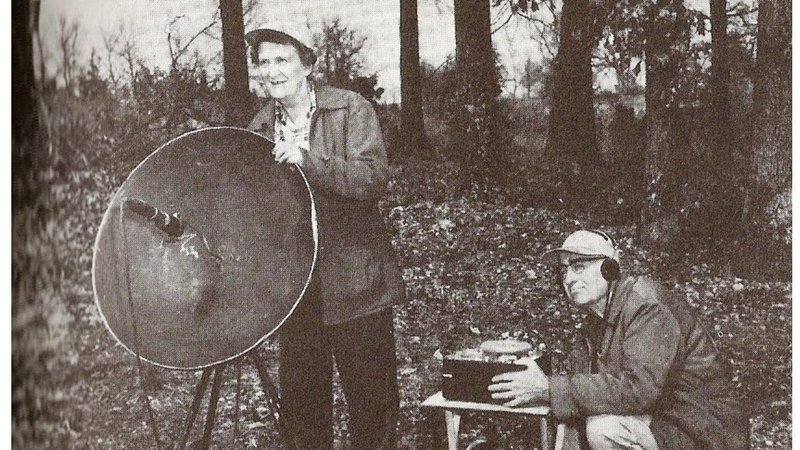
Title: Evangeline Archer and the Stillwells
Evangeline Archer and the Stillwells were good friends. Who are Jerry and Norma Stillwell?
Joe Neal writes about Jerry and Norma Stillwell in his article “Avian Echoes: The Stillwells in Fayetteville”, posted on March 8, 2015 by Northwest Arkansas Audubon Society. Here are some excerpts.
“AVIAN ECHOES is the name Jerry and Norma Stillwell gave their new home in Fayetteville in September 1950, six miles from the UA campus AND two miles from the pavement. They were birding luminaries sixty years ago. The growing post-WWII US birding community knew them from their highly professional and well-received field recordings of wild birds. When they settled in Arkansas, the Stillwells were in the middle of a 12-year, 180,000 mile journey that would result in three ground-breaking long-playing records: BIRD SONGS OF DOORYARD, FIELD AND FOREST (2 for eastern US, 1 for western). Today that house is in the city, on pavement, just past the Mt Comfort church, on Hughmount Road. That much has changed, but their bird recordings are fresh as the day they were recorded.”
“Doug James knew them early in his career and invited them to give a program at the very first fall meeting ever held by Arkansas Audubon Society — at Lake Wedington in the Ozark National Forest west of Fayetteville, October 4-6, 1957. According to the AAS newsletter: “Friday evening everyone traveled to the home of Mr. and Mrs. Jerry Stillwell near Fayetteville to listen to their impeccably accurate recorded reproductions of bird sounds, which were accompanied by colored slides of birds, followed by refreshments… Saturday afternoon the Society enjoyed a visit with the Stillwells and with Dr. William Baerg, the author of Birds of Arkansas.""
“Jerry was born in Kansas in 1888, Norma, also a Kansan, in 1894. Norma would eventually write the book BIRD SONGS (1964). According to Norma, “I grew up under a mulberry tree, whose fruits are doubtless the best natural lure for the greatest variety of birds. Not until I met Jerry, as a classmate at the university in Lawrence, did I begin to realize there are many kinds of birds in addition to robins, redbirds, and ‘Jenny-wrens’. After our honeymoon Jerry began telling friends that, sometime after meeting him, I had thrown away my violin and bought a bird book. I gave away my violin after he had given me the bird book.”"
"Early in Jerry’s career as a mechanical engineer, he was an instructor at UA-Fayetteville (1921-1922) in Heat Power Engineering. The couple lived below campus, on west Dickson Street. Starting in 1926, Jerry found a career as a technical editor for the American Petroleum Institute in Dallas, which became home base."
"He got his first Brush recorder on March 20, 1948. On March 31, while Jerry was at work, Norma successfully recorded a Northern Cardinal in their yard. “There flashed in both our minds the dream of a new hobby: recording bird songs on tape.””
“In Fayetteville they made friends including entomologist Dr. William Baerg, tarantula expert who published two books on Arkansas birds (1931, 1951), and Eloise Baerg, “a pillar of the cultural and religious circles … sympathetic to birders”. Norma also found a special friend. “Evangeline Archer and I were kindred souls in our love of wild flowers and hatred of billboards.” Within a few years, Evangeline would be a key leader in the fight to protect the Buffalo River from dams and create the nation’s first National River.”
From the Local Line column in the Northwest Arkansas Times, April 2, 1960, Ted R. Wylie writes, “An article on Jerry Stillwell, who with Mrs. Stillwell traveled more than 100,000 miles to record the songs of American birds, is published in the April edition of the Audubon Magazine. It is written by Mrs. Laird Archer of Fayetteville, who has known the Stillwells well. Mr. Stillwell died in Dallas last September. For some time they lived near Fayetteville, and Mrs. Archer prepared the story in her numerous visits with the Stillwells. The couple went into nearly every state of the union recording bird songs. Much of their travel was “following the bluebirds.” They compiled three volumes of recordings. Their first long-playing record came out in 1952, and the two worked four years before they started it and reported 800 hours of editing went into it. It is an interesting account of the life the Stillwells led after their retirement from their first job of 23 years in oil work in Texas.”
The Audubon Magazine is published by the National Audubon Society. In Evangeline Archer’s article “Yours, Jerry Stillwell” published in the April 1960 issue, she quotes Jerry Stillwell. “Every song or call we recorded carries us back to the field and our memories. The Audubon warbler means to us the Sangre de Christo range in New Mexico, 7000 feet up. Our prairie chickens we found in Oklahoma. We were lucky in Nebraska; on the North Platte River we were just at the right time for migrating cranes. In the Poconos we recorded our first hermit thrush, deep in the hemlock woods. Our pine siskin came from Windsor Ranch, in New Mexico. A magpie conversation is our memento from the Garden of the Gods. Western grebes mean Klamath Lake, Oregon. Scott’s oriole, Ramsey Canyon in Arizona. Our bird memories are also flower memories, and tree memories, and landscape memories. And memories of friends. Friends have helped us, many times.”
Evangeline finishes her article with, “One might have expected the Stillwells to remain at home at Avian Echoes, with its comfort, convenience, and sweep of view, and rest from their travels. But the Stillwells – as well as birds – were unpredictable. Soon they were talking about which way to go – west or south? It was not long before the usual series of postcards mailed en route began to arrive: Mesa, Arizona. “There are thousands of Gambel’s sparrows in this country now. Not one singing. Reported to be on strike against E. Taft Benson.” Tucson. “We backtracked to try for the elf owl – not yet found. Just now I am trying to recuperate from burning the candle at both ends and in the middle on that derned owl.” Devil’s Lake, North Dakota. “This country full of lakes. Lakes full of ducks. And ducks full of abhorrence for mikes.” Ely, Minnesota. “Saw five loons yesterday – and not one had a good word to say.” All signed, “Yours, Jerry Stillwell.””
(Photos from Joe Neal's online article “Avian Echoes: The Stillwells in Fayetteville”, posted on March 8, 2015 by Northwest Arkansas Audubon Society.)
#SaveMarkhamHill #PreserveFayetteville #KeepFayettevilleForested #MarkhamHillWildlife #MarkhamHillHistory