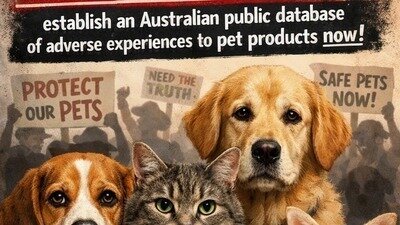

Establish public database for suspected adverse experiences to pet products
The issue
Unlike the Therapeutic Goods Administration's publicly accessible database of adverse event notifications to human medicines and vaccines there currently is no Australian publicly accessible database of suspected adverse experience reports to APVMA approved veterinary products.
The confidential commercial information provisions of the Agricultural and Veterinary Chemicals Code Act 1994 are being used to prevent the public disclosure of information received by the APVMA's Adverse Experience Reporting Program. For example, the details and outcomes of consumer complaints i.e. suspected adverse experience reports to APVMA approved veterinary products.
However, manufacturers of products authorised for use in both the European Union and Australia share all the unassessed suspected adverse experience reports they receive with the European Medicines Agency who then publish the details of these reports on their worldwide publicly accessible database. Why can't the APVMA also share the details of these Australian unassessed suspected adverse experiences reports, without disclosing private information, with the Australian public? How can details of unassessed adverse experiences that are in the public domain be considered confidential commercial information?
The Agricultural and Veterinary Chemicals Code Act 1994 should be amended to exclude details of suspected adverse experience reports as confidential commercial information for all products approved by the APVMA. This would avoid the different treatment of the manufacturers of products that are also authorised for use in the European Union. Is it fair that details of suspected adverse experiences for some products are in the public domain whilst others are hidden? Is there some sort of government agreement to hide the harm caused to pets by APVMA approved veterinary products? Why can't we have our own Australian publicly accessible database of suspected adverse experience reports to APVMA approved veterinary products?
The lack of transparency of the APVMA's adverse experience reporting program casts a huge cloud of doubt over the integrity of the government as well as the APVMA's program. The government needs to establish an Australian publicly accessible database of suspected adverse experiences to APVMA approved veterinary products.

1,450
The issue
Unlike the Therapeutic Goods Administration's publicly accessible database of adverse event notifications to human medicines and vaccines there currently is no Australian publicly accessible database of suspected adverse experience reports to APVMA approved veterinary products.
The confidential commercial information provisions of the Agricultural and Veterinary Chemicals Code Act 1994 are being used to prevent the public disclosure of information received by the APVMA's Adverse Experience Reporting Program. For example, the details and outcomes of consumer complaints i.e. suspected adverse experience reports to APVMA approved veterinary products.
However, manufacturers of products authorised for use in both the European Union and Australia share all the unassessed suspected adverse experience reports they receive with the European Medicines Agency who then publish the details of these reports on their worldwide publicly accessible database. Why can't the APVMA also share the details of these Australian unassessed suspected adverse experiences reports, without disclosing private information, with the Australian public? How can details of unassessed adverse experiences that are in the public domain be considered confidential commercial information?
The Agricultural and Veterinary Chemicals Code Act 1994 should be amended to exclude details of suspected adverse experience reports as confidential commercial information for all products approved by the APVMA. This would avoid the different treatment of the manufacturers of products that are also authorised for use in the European Union. Is it fair that details of suspected adverse experiences for some products are in the public domain whilst others are hidden? Is there some sort of government agreement to hide the harm caused to pets by APVMA approved veterinary products? Why can't we have our own Australian publicly accessible database of suspected adverse experience reports to APVMA approved veterinary products?
The lack of transparency of the APVMA's adverse experience reporting program casts a huge cloud of doubt over the integrity of the government as well as the APVMA's program. The government needs to establish an Australian publicly accessible database of suspected adverse experiences to APVMA approved veterinary products.
Supporter voices
Petition Updates
Share this petition
Petition created on 12 August 2025