Ending Racial Discrimination in Firearm Rights and Policing in California
The Issue
ENDING RACIAL DISCRIMINATION IN FIREARM RIGHTS AND POLICING IN
CALIFORNIA
To:
Governor Gavin Newsom and the California State Legislature
From:
Concerned Citizens of California
QUICK SUMMARY
Why is this petition necessary?
California says its laws apply equally to everyone. But equal wording
does not automatically guarantee equal treatment or equal results.
This petition asks California to examine whether its firearm laws and
policing practices—historically and today—can produce unequal
consequences for Black Californians through administrative barriers,
police discretion, enforcement, criminal penalties, and institutional
practices.
What does the evidence show?
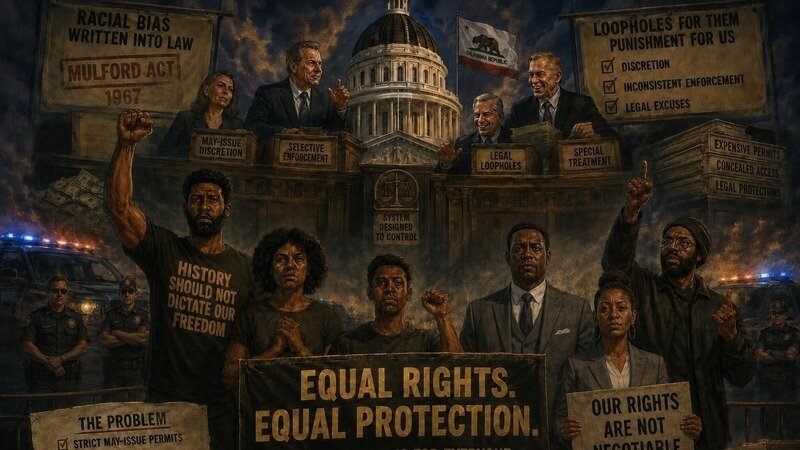
California’s firearm history includes the 1967 Mulford Act, enacted
after armed Black Panthers publicly exercised then-lawful firearm rights
in Oakland and protested proposed restrictions at the State Capitol;
Governor Ronald Reagan signed it, and the NRA of that era supported the
measure.
California’s firearm system has continued to expand and change,
including CCW requirements, purchasing restrictions, criminal penalties,
firearm prohibitions, and relinquishment requirements.
A qualifying misdemeanor carry conviction can create a 10-year firearm
prohibition, followed by firearm relinquishment requirements under
California law.
California policing data shows measurable racial disparities in stops
and other police interventions, while Oakland body-camera research found
measurable differences in officer communication with Black and white
motorists.
San Leandro provides a local example: in 2024, Black residents were
stopped at a substantially higher population-adjusted rate than white
residents in the same city.
What is the central question?
Can laws that are race-neutral on paper still produce racially unequal
outcomes through administrative barriers, police discretion,
enforcement, criminal penalties, and institutional practices?
What is this petition asking California to do?
Strengthen California’s existing shall-issue CCW system through uniform
standards, transparent processing, written denials, meaningful appeals,
and removal of unnecessary county-to-county barriers.
Investigate the history and present-day operation of California’s
firearm system, including the Mulford Act, subsequent restrictions,
racial disparities, enforcement, and loss and restoration of firearm
rights.
Identify and reform firearm laws or enforcement practices that produce
unjustified racial disparities or unnecessary burdens on
constitutionally protected firearm rights.
Measure what is happening through transparent statewide reporting of
racial disparities in firearm-related stops, searches, arrests,
prosecutions, convictions, sentencing, and firearm-rights restrictions.
What this petition is NOT asking for
It is not asking California to ignore legitimate firearm-violence
concerns.
It asks whether California can address firearm violence while applying
constitutional firearm rights equally across racial lines.
Why sign?
If California’s laws and policing are fair, they should withstand
examination.
If they are producing unjustified racial disparities, California should
know why and fix what needs fixing.
EQUAL RIGHTS REQUIRE EQUAL APPLICATION.
PREAMBLE
California cannot fully address equal constitutional protection without
examining a firearm system whose history includes restrictions adopted
during a period of intense conflict over armed Black political
organization and self-defense.
Constitutional rights should not become less accessible, more dangerous
to exercise, or more heavily punished because of race.
California is not exempt from America’s history of racial
discrimination, and its firearm laws are not exempt from examination
simply because their language appears race-neutral.
This petition demands that California examine the historical
development, present-day operation, and racial impact of its firearm
laws and reform laws and practices that produce unequal treatment or
unjustified racial disparities.
THE HISTORICAL RECORD CANNOT BE IGNORED
California’s firearm laws did not develop in isolation.
During the 1960s, the Black Panther Party for Self-Defense openly
exercised California’s then-existing firearm laws while conducting armed
patrols that monitored police activity in Oakland.
At the time, California already restricted concealed carrying of
concealable firearms without a license, while the carrying of firearms
openly was not subject to the same statewide prohibition on loaded
public carry that would be enacted in 1967.
California’s earlier firearms laws therefore did not amount to an
absence of firearm regulation; the significant change in 1967 was the
creation of a statewide criminal restriction on carrying a loaded
firearm in specified public places.
California court decisions tracing the earlier statutes confirm the
distinction between concealed-carry restrictions and possession/open
carry.
In 1967, armed Panthers entered the California State Capitol to protest
Assemblyman Don Mulford’s proposed firearm restrictions.
The resulting Mulford Act, enacted July 28, 1967, added Penal Code
section 12031 and prohibited carrying a loaded firearm on the person or
in a vehicle in public places and public streets within incorporated
cities and certain prohibited areas, subject to statutory exceptions. It
also imposed restrictions involving loaded firearms in specified
government buildings and locations.
The law did not simply prohibit all public possession of firearms.
Unloaded open carry remained legally distinct from loaded carry under
the law at that time.
The historical significance of the Act was its creation of a statewide
restriction on loaded public carry, not the elimination of every form of
open firearm possession.
Governor Ronald Reagan supported the proposal and signed the Mulford Act
into law on July 28, 1967. Contemporary and historical records document
his support for the measure.
The National Rifle Association of that era also supported the
legislation. Historical accounts document the NRA’s support for the
Mulford Act during the same period in which the Black Panthers were
using California’s then-lawful open-carry framework to publicly exercise
armed self-defense and monitor police interactions.
The record does not establish that every individual involved in 1967
acted from the same personal racial motive. That is not necessary to
establish the documented historical sequence.
The documented sequence is clear:
Black political organization exercised a then-lawful firearm right →
political pressure intensified → California restricted loaded public
carry → the restriction was supported by major political and
institutional figures of the period → that restriction became part of
the development of California’s firearm regulatory system.
Does that history deserve examination?
RACE CANNOT BE REMOVED FROM THE DISCUSSION
Does a law have to contain the word “race” to have a racial history, a
racial context, or unequal racial consequences?
Does writing a restriction to apply to everyone automatically erase the
circumstances surrounding its creation?
California therefore should not examine firearm laws only by asking:
“Does the statute mention race?”
It should also ask:
“What circumstances produced the law, who was being targeted by the
political response at the time, how did the law develop afterward, and
who bears its consequences today?”
Do the historical circumstances surrounding the Mulford Act make those
questions impossible to dismiss?
Should California examine whether racial discrimination helped shape
portions of its firearm regulatory framework and whether that history
continues to influence unequal outcomes today?
Do we need to prove what was inside every individual’s mind in 1967 to
examine what government actions produced and what those actions continue
to produce?
THE PROBLEM IN CALIFORNIA
Equal Rights Must Mean Equal Access
California has moved from its former discretionary CCW system to an
objective-criteria framework.
Under SB 2, a licensing authority is generally required to issue or
renew a CCW license when an applicant meets the statutory requirements
and is not disqualified under specified criteria. California DOJ
describes the current system as an objective-criteria system replacing
the former “good cause” and “good moral character” requirements.
That change does not eliminate the need to examine whether access is
equal in practice.
California should ensure that CCW requirements, processing, fees,
training requirements, documentation, investigations, and appeals are
applied consistently and transparently across counties.
California’s current CCW rules also continue to change.
AB 1078 amended CCW eligibility and application requirements, including
provisions concerning non-California residents, disqualification
standards, restraining-order considerations, renewal procedures,
fingerprint and background-check procedures, additional grounds
affecting issuance or revocation, and certain public-transit firearm
rules. It also changed California’s firearm-purchase limit beginning
April 1, 2026.
California DOJ issued amended AB 1078 implementation guidance on August
7, 2026, through Information Bulletin 2026-DLE-13.
Then, on August 31, 2026, California DOJ issued Information Bulletin
2026-DLE-14, with the new changes taking effect September 1, 2026.
Those changes include:
New fingerprint requirements for CCW renewal applicants;
Increased renewal fees;
An updated renewal-notification process;
DOJ confirmation of firearm eligibility before a renewal can be issued;
Federal Rap Back enrollment for licensing authorities;
Mandatory enrollment of licensing authorities in the federal Rap Back
system by December 31, 2026.
The new renewal system requires licensing authorities to submit renewal
applicants’ fingerprints and applicable fees to DOJ, and a renewal
cannot be issued until DOJ confirms the applicant’s eligibility to
possess, receive, own, or purchase a firearm.
A constitutional right should not become easier or harder to exercise
simply because a Californian lives in one county rather than another.
The Criminal Trap Between Lawful Ownership and Carry
A person may lawfully possess a firearm while still facing criminal
prosecution for carrying it without the authorization required by
California law.
California law separately regulates concealed carry and loaded public
carry.
Current Penal Code section 25850 makes carrying a loaded firearm on
one’s person or in a vehicle in specified public places unlawful, with
the statute providing different penalties depending on circumstances.
The current law also expressly recognizes licensed carry as an exception
through California’s CCW framework.
That distinction can turn a carry violation into a criminal matter with
consequences that extend far beyond the original conduct.
Importantly, California’s firearm-rights restrictions can extend beyond
the original carry offense.
Penal Code §29805 currently provides a 10-year firearm prohibition
following specified misdemeanor convictions. Critically for this
petition, §29805(f) expressly includes certain misdemeanor convictions
under Penal Code §25400 and §25850, as well as certain violations of
§§26350 and 26400.
California law also provides a firearm-relinquishment mechanism under
Penal Code §29810.
For a person subject to §29805, firearms generally must be relinquished
within 48 hours after conviction if the person remains out of custody,
or within 14 days if the person is in custody, subject to the statutory
procedures and possible court-authorized extensions.
This creates a criminal trap:
CARRY VIOLATION ➡️QUALIFYING MISDEMEANOR CONVICTION ➡️ 10-YEAR FIREARM
PROHIBITION ➡️FIREARM RELINQUISHMENT
Should California examine whether this pathway can impose
disproportionate criminal consequences upon Black Californians?
The Cumulative Expansion of Restrictions
California’s firearm regulatory system has expanded through decades of
additional restrictions involving carrying, purchasing, storage,
possession, manufacturing, and enforcement.
The current system includes restrictions governing areas such as CCW
licensing, firearm purchases, sensitive places, firearm-prohibiting
orders, firearm manufacturing, and other aspects of firearm possession
and transfer.
California DOJ continues to issue new and amended firearm-law guidance,
including multiple 2026 changes.
For example, AB 1078 changed California’s firearm-purchase limit
effective April 1, 2026, from the previous one-firearm-per-30-day
framework to a limit of three firearms cumulatively within a 30-day
period, subject to statutory exceptions.
AB 1263 also amended Penal Code §29805 effective January 1, 2026, adding
additional firearm-related misdemeanor offenses that can result in a
10-year firearm prohibition.
Individual restrictions should not be examined only one at a time.
California should examine the cumulative burden created when multiple
restrictions operate together and determine whether that system provides
equal constitutional protection in practice.
Disproportionate Consequences Require Examination
California should examine racial disparities in firearm-related stops,
arrests, prosecutions, convictions, sentencing, and loss of firearm
rights.
Where Black Californians experience disproportionate firearm-related
stops, arrests, prosecutions, convictions, or loss of firearm rights,
California should identify the causes and determine whether those
disparities are justified by legitimate factors or reflect unequal
enforcement or structural barriers.
If Black Californians are disproportionately subjected to criminal
consequences or permanent loss of firearm rights, should California
dismiss those outcomes simply because individual statutes are written in
race-neutral language?
Should equal treatment under the law be measured by how the law
operates—not merely by how the statute is written?
Financial Interests Must Not Influence Enforcement
Enforcement decisions should never be influenced by financial
incentives, funding formulas, grant metrics, or revenue generation.
Constitutional rights must not be affected by financial interests.
California should examine whether any financial structure creates
incentives that increase firearm-related arrests, citations, seizures,
or prosecutions.
No specific California firearm-revenue scheme is established by the
evidence cited in this petition. The demand is that California examine
whether any financial structure creates incentives that increase
firearm-related arrests, citations, seizures, or prosecutions.
If such incentives exist, they should be identified and eliminated.
DEMANDS FOR FIREARM REFORM
Strengthen California’s Existing Shall-Issue System
California should:
Establish genuinely uniform statewide CCW standards.
Require transparent processing timelines.
Provide meaningful written explanations for denials.
Provide meaningful appeal procedures.
Prevent unnecessary county-to-county differences in the exercise of
constitutional rights.
Ensure fees and training requirements do not create unreasonable
barriers.
Require equal application of the law regardless of race, location, or
socioeconomic status.
Establish a California Firearm Rights and Equity Review
California should establish an independent review of:
The historical development of firearm restrictions;
The circumstances surrounding the Mulford Act;
The subsequent expansion of California firearm laws;
Racial disparities in firearm permitting and enforcement;
Firearm-related arrests and prosecutions;
Restoration and loss of firearm rights;
And the cumulative practical burden of California’s firearm regulatory
system.
The purpose is not to rewrite history.
The purpose is to determine whether the consequences of that history
remain present in California law and enforcement today.
Review and Reform Discriminatory Laws
Where the review identifies firearm laws or enforcement practices that
produce unjustified racial disparities or unnecessary burdens on
constitutionally protected firearm rights, California should:
Repeal them;
Amend them;
Replace them;
Or establish safeguards against unequal enforcement.
Protect Rights From Unequal Enforcement
California should require transparent statewide reporting of racial
disparities involving firearm:
Stops;
Searches;
Arrests;
Prosecutions;
Convictions;
Sentencing;
And firearm-rights restrictions.
Should the State be able to correct disparities that it refuses to
measure?
WHY THIS REFORM MATTERS
This petition does not ask California to ignore legitimate concerns
about firearm violence.
It asks California to confront another constitutional question:
Can a government address firearm violence while also ensuring that
constitutional firearm rights are applied equally across racial lines?
The answer should be yes.
California should not have to choose between constitutional rights and
responsible government.
It should demand both.
A DIRECT APPEAL TO GOVERNOR GAVIN NEWSOM AND THE CALIFORNIA LEGISLATURE
California has repeatedly demonstrated that laws can be changed when
their consequences no longer reflect the principles the State claims to
uphold.
The history surrounding California’s firearm laws deserves the same
honesty.
The Mulford Act, the Black Panther Party, Governor Ronald Reagan, and
the National Rifle Association of that era are all part of the
documented history surrounding the development of California’s firearm
restrictions.
Should we erase that history simply because the laws eventually applied
to everyone?
Should we assume that race stopped mattering simply because racial
language was removed from legislation?
The question is not whether every person involved in those historical
events can be proven to have held a racist motive.
The question is whether race, racial conflict, and the suppression of
armed Black political organization played a role in shaping firearm
policy—and whether the resulting system continues to produce unequal
consequences today.
California should answer that question honestly.
If California’s laws are fair, they should withstand that examination.
Equal Rights Require Equal Application.
A QUESTION BEFORE WE MOVE FORWARD
Are we truly living in a post-racial society?
If the answer is yes, then why should the possibility that racism
influenced firearm legislation be considered unacceptable to discuss?
Now consider your own reaction.
If reading that racism may have influenced California firearm
legislation produces anger, defensiveness, dismissal, or an immediate
desire to reject the premise, ask yourself:
What exactly am I reacting to?
Am I rejecting the evidence?
Am I rejecting the question?
Or am I reacting to the discomfort of having racism placed directly into
a discussion where I would rather not see it?
Is that distinction worth examining?
The concept commonly described as white fragility includes defensive
reactions that can occur when discussions of racism, racial privilege,
or racial inequality create discomfort or challenge existing
assumptions.
So consider the possibility from the other direction:
If the mere suggestion that racism may have influenced government policy
produces a stronger reaction than the possibility that racism actually
did influence government policy, what does that reaction tell you?
But should you be willing to examine why you accept or reject them?
If California truly is a post-racial society, then why should
confronting evidence of racial discrimination be something we are afraid
to do?
FROM RACE-BASED LAW TO RACE-NEUTRAL LANGUAGE — AND THE QUESTION OF WHAT
HAPPENS AFTER THE LAW REACHES THE STREET
That change matters.
But it raises a direct question:
When the language of the law changes from explicitly racial to
race-neutral, does that necessarily eliminate every institutional
mechanism through which racial inequality can be produced?
The distinction is important because legislation establishes the rules,
but law enforcement determines how those rules are experienced in the
street.
A law can be written without racial language while still giving an
officer discretion over:
Whom to stop;
Whom to question;
Whom to search;
Whose explanation to believe;
When conduct appears suspicious;
When a person is considered noncompliant;
And when an encounter escalates into detention, arrest, or force.
The critical bridge is:
Race-neutral law ➡️ police discretion ➡️ individual enforcement ➡️
measurable outcomes.
THE DIFFERENCE BETWEEN POLICY AND POLICING
Every organization can have a written policy that appears neutral while
leaving employees substantial discretion in how that policy is enforced.
The employee may be enforcing the written policy.
But the employee still decides how, when, and against whom that policy
is applied.
Police officers operate within a far more consequential version of that
relationship.
A written law may authorize an officer to make a stop.
The officer decides who gets stopped.
A law may authorize a search under particular circumstances.
The officer decides whose circumstances appear suspicious enough to
justify further intervention.
A law may authorize an arrest.
The officer determines when the encounter crosses that threshold.
And during the encounter, an officer’s interpretation of a person’s
words and behavior can determine whether the interaction remains
conversational or becomes an enforcement action.
So the institutional question becomes:
If the written rule is race-neutral but the person applying the rule has
discretion, where can racial bias enter the system if it is not
contained in the wording of the law itself?
CALIFORNIA’S PRESENT-DAY RESULTS
California’s Racial and Identity Profiling Act data provides a way to
examine the results rather than merely the language of the law.
Millions of vehicle and pedestrian stops have been collected under
California’s statewide profiling system.
The 2026 RIPA report analyzes 5,065,428 stops conducted by 533
California law-enforcement agencies during 2024. The report identifies
continuing racial disparities in stops and other police actions.
Black Californians are stopped disproportionately compared with their
population share and experience higher levels of several forms of police
intervention.
Black people are also searched at higher rates while, in important
categories of searches, searches of Black people produce contraband less
frequently than searches of white people.
That creates an uncomfortable question:
If race is not supposed to influence enforcement, why does the group
experiencing more searches not consistently produce more evidence of the
conduct those searches are supposedly intended to uncover?
And another:
If the law applies equally to everyone, what explains the recurring
difference in who is stopped, searched, subjected to force, and
arrested?
The statistics do not establish the intent of every individual officer.
They establish measurable racial disparities in police contact and
intervention.
Do those disparities demonstrate that the outcomes are not racially
neutral?
Does that distinction matter?
SAN LEANDRO: SAME CITY, DIFFERENT POLICE CONTACT
San Leandro provides an especially useful California example because it
is a racially mixed city rather than an overwhelmingly Black or
overwhelmingly white jurisdiction.
In 2024, San Leandro police recorded 690 stops. After adjusting for
population, Black residents were stopped approximately 6.5 times as
often as white residents.
In plain language:
A Black resident of San Leandro was substantially more likely to
experience a police stop than a white resident living in the same city.
This does not prove that every stop was racially motivated.
It establishes a measurable population-adjusted racial difference in
police stops.
Does it establish a measurable racial difference in police contact
within the same jurisdiction?
So the question becomes:
What produces a disparity of that magnitude when Black and white
residents are subject to the same written laws and the same police
department?
And because stop statistics alone cannot tell us exactly what happened
inside each encounter, another question follows:
What happens after the officer decides to stop the person?
That is where California’s body-camera research becomes important.
WHEN THE ENCOUNTER ITSELF CHANGES
Research using actual Oakland police body-camera footage examined
hundreds of traffic stops involving Black and white motorists.
The researchers found measurable differences in how officers
communicated with the two groups.
White motorists were more likely to receive highly respectful forms of
language.
Black motorists were more likely to receive less respectful and more
controlling forms of communication.
Officers were more likely to use language such as “sir,” “ma’am,”
“please,” and “thank you” with white motorists, while Black motorists
were more likely to receive informal language and controlling commands.
The study analyzed 981 stops conducted by 245 officers and 36,738 usable
officer utterances.
This matters because communication occurs before searches, handcuffing,
arrest, or physical force.
So the question becomes:
If two people are stopped for comparable reasons, why would the
officer’s communication and level of control change depending upon the
race of the person being addressed?
Does this provide one observable point at which racial difference enters
an otherwise race-neutral enforcement system?
FROM “WHY DID YOU STOP ME?” TO “JUST OBEY”
There is another interactional pattern that deserves examination.
Some documented encounters involving Black civilians show an interaction
beginning with an ordinary police question or investigation and then
shifting toward a struggle over obedience.
The sequence can become:
Question ➡️ disagreement ➡️ command ➡️ continued questioning ➡️
accusation of noncompliance ➡️ escalation ➡️ enforcement.
The original issue can become secondary.
The interaction becomes about whether the person will stop questioning
the officer and simply obey.
That raises a more specific question:
Do documented interactions between some white officers and Black
civilians suggest that, in some encounters, an officer’s objective can
shift from investigating the original issue to enforcing verbal
obedience itself?
There are documented encounters in which officers have told Black
civilians to stop talking, characterized questioning or disagreement as
disrespect, threatened enforcement, or escalated after continued verbal
challenges.
These occurrences do not, by themselves, establish racial motivation.
They are nevertheless relevant evidence about how police encounters
involving Black civilians can escalate.
But they should not be erased or dismissed.
The appropriate question is:
If continued questioning can contribute to escalation, and if Black
civilians experience this interaction disproportionately, could
discretionary enforcement be one place where racialized expectations of
obedience enter an otherwise race-neutral system?
WHEN KNOWLEDGE DOESN’T PROTECT THE PERSON
The question becomes even more difficult when the Black person actually
understands the law or police procedure.
California has documented examples involving Black judges and Black
law-enforcement personnel.
Judge David Cunningham III
Cunningham was a Black Los Angeles Superior Court judge and former
president of the Los Angeles Police Commission.
He was stopped over an alleged seat-belt violation.
The encounter resulted in him being shoved against his vehicle,
handcuffed, placed in a police vehicle, and accused of resisting. His
account and the UCLA Police Department’s account differed regarding the
circumstances that led to the handcuffing.
His professional position did not prevent the encounter from becoming
physically coercive.
The facts of the encounter can be stated directly.
Whether race contributed to the officers’ treatment is a separate
question.
If a Black judge, lawyer, and former police commissioner can experience
an aggressive encounter over a relatively minor traffic matter, could
race affect how an officer initially perceives and responds to a Black
person before knowing who that person is?
Bernard Robins — Los Angeles
An off-duty Black LAPD officer was approached by fellow officers while
outside his parents’ home.
Robins identified himself as an LAPD officer and disclosed that he was
armed because he was carrying his service weapon.
Despite that identification, officers ordered him against a fence and
handcuffed him.
He repeatedly explained that he was an officer and questioned why he
remained restrained.
An officer characterized his manner as coming at him “sideways.”
The important fact is simple:
He was actually a police officer.
So the question becomes:
If a Black police officer can identify himself as an officer and still
be treated as a suspect, could the officer’s initial perception of the
Black person matter more than the person’s actual identity?
The Los Angeles Times documented Robins’ account of the encounter and
his allegation of biased policing.
Black Undercover Officer — Los Angeles
California has also documented an even more unusual circumstance
involving a Black undercover LAPD investigator.
The officer was working undercover and was therefore intentionally not
identifiable as law enforcement.
A white LAPD officer who did not know his identity allegedly assaulted
him while he was handcuffed. The contemporaneous Los Angeles Times
report identified the officer involved as Michael L. Sillers and
described the incident involving the handcuffed undercover officer.
This single event does not establish racial motivation. The relevant
issue is the contrast between the officer’s treatment of the same Black
law-enforcement professional when his professional identity was known
versus when it was unknown.
The significance is the contrast:
Same Black person.
Same actual professional identity.
Different perceived identity.
The officer confronting him did not know he was dealing with another
police officer.
That raises an unusually direct question:
If a Black law-enforcement officer can receive dramatically different
treatment when his professional identity is unknown, what does that tell
us about the role of perception in police encounters involving Black
people?
THIS IS NOT AN ARGUMENT THAT WHITE PEOPLE NEVER EXPERIENCE POLICE ABUSE
A serious comparison has to include cases that complicate the argument.
White Californians have also experienced severe and unjustified police
force.
That fact cannot simply be ignored.
Does the existence of aggressive encounters involving white people
eliminate racial disparities?
It changes the question.
The question is not:
“Can white people be mistreated by police?”
They can.
The stronger question is:
“Under comparable circumstances, does race affect how frequently an
encounter becomes controlling, hostile, invasive, forceful, or
arrest-driven?”
That is a question that can be tested.
And California’s body-camera research, statewide RIPA data, and
individual documented encounters provide evidence from different levels
of the system.
THE PATTERN: LAW ➡️ DISCRETION ➡️ ENCOUNTER ➡️RESULT
The evidence therefore needs to be viewed as a chain rather than as
isolated incidents.
Written law
Race-neutral language.
Police authority
The law gives officers powers of enforcement.
Discretion
Officers decide whom to stop, question, search, detain, arrest, or use
force against.
Human interaction
The officer interprets the person’s behavior, words, cooperation,
disagreement, and perceived threat.
Enforcement
The encounter can remain routine—or become increasingly controlling and
physical.
Results
California’s data shows racial differences in the frequency of stops,
searches, force and arrests.
The critical question is therefore not merely:
“Is the law racist?”
It is:
“Can a race-neutral legal system still produce racially unequal
enforcement through the discretion and mechanisms that operate between
the written law and the final result?”
THE QUESTION CALIFORNIA HAS NOT FULLY ANSWERED
California can point to race-neutral statutes.
Police departments can point to race-neutral policies.
Individual officers can point to enforcement of those statutes and
policies.
Do any of those facts automatically explain the racial disparities
appearing in the results?
So the question remains:
If the legislation is race-neutral, the written policies are
race-neutral, and racism is not supposed to influence enforcement, then
what explains the recurring racial pattern appearing in California’s
actual policing results?
And if the answer is that the disparities are caused by factors other
than racism, then those causes should be identified, measured, and
addressed.
But if racial bias can enter through discretionary enforcement even when
the written law itself contains no racial language, does changing the
wording of the law alone solve the problem?
Is that the institutional issue this petition asks California to
confront?
The question is not whether every officer is racist.
The question is whether a system can produce racially unequal results
without requiring every individual officer—or every written law—to
explicitly express racism.
And if it can:
Should California reform only the language of its laws, or should it
also examine the discretionary enforcement mechanisms through which
those laws become reality?
RESEARCH AND DOCUMENTATION
The historical, legal, statistical, and research claims referenced in
this petition are based on publicly available government records,
California legislation, court records, California Department of Justice
reporting, academic research, and documented historical sources.
Readers are encouraged to examine the underlying evidence and reach
their own conclusions.
“The evidence is publicly available. We provided the research trail.
Examine it.”
California Firearm Law
California Penal Code §25850 — Carrying a Loaded Firearm
https://leginfo.legislature.ca.gov/faces/codes_displaySection.xhtml?lawCode=PEN§ionNum=25850
Current California statute governing carrying a loaded firearm in
specified public places.
California Penal Code §29805 — 10-Year Firearm Prohibition
https://leginfo.legislature.ca.gov/faces/codes_displaySection.xhtml?lawCode=PEN§ionNum=29805
Particularly important because §29805(f) includes specified misdemeanor
convictions under §25400 and §25850 that can trigger a 10-year firearm
prohibition.
California Penal Code §29810 — Firearm Relinquishment
https://leginfo.legislature.ca.gov/faces/billTextClient.xhtml?bill_id=202320240AB732
AB 732 amended California’s firearm-relinquishment procedures, including
the 48-hour period for persons out of custody and 14-day period for
persons in custody.
AB 1078 — California Firearms
California Legislative Information — AB 1078
https://leginfo.legislature.ca.gov/faces/billTextClient.xhtml?bill_id=202520260AB1078
The complete legislative record includes changes involving:
CCW licensing;
nonresident applicants;
disqualification standards;
restraining/protective orders;
renewal procedures;
fingerprint/background checks;
issuance and revocation;
public-transit firearm rules;
and the three-firearms-within-30-days purchase limit.
California DOJ — AB 1078 Guidance
Information Bulletin 2026-DLE-13 — August 7, 2026
https://oag.ca.gov/system/files/media/2026-dle-13.pdf
Updated DOJ guidance regarding laws amended under AB 1078.
California DOJ — Latest CCW Renewal Changes
Information Bulletin 2026-DLE-14 — August 31, 2026
https://oag.ca.gov/system/files/media/2026-dle-14.pdf
Effective September 1, 2026.
It covers:
new CCW renewal fingerprint requirements;
increased renewal fees;
renewal notification;
DOJ firearm-eligibility confirmation;
new federal Rap Back enrollment;
federal subsequent arrest/disposition notifications;
and mandatory licensing-authority enrollment by December 31, 2026.
California DOJ — New and Amended Firearm Laws
Information Bulletin 2026-DLE-02
https://oag.ca.gov/system/files/media/2026-dle-02.pdf
Includes 2026 firearm-law changes including AB 451 and other
legislation.
AB 1263 — Additional Firearm-Related Misdemeanors
AB 1263 amended §29805 effective January 1, 2026, adding specified
firearm-manufacturing and weapons offenses to the 10-year prohibition
framework.
California DOJ — AB 1263 / Firearm Law Guidance
https://oag.ca.gov/system/files/media/2025-dle-18.pdf
AB 451 — Law-Enforcement Policies and Firearm Relinquishment
AB 451 requires state and local law-enforcement agencies, by January 1,
2027, to develop and implement written policies and standards concerning
service and enforcement of protection and restraining orders involving
firearm-access restrictions.
The law also addresses consistent firearm-relinquishment procedures and
requires agencies to provide public information concerning service and
relinquishment.
California DOJ — 2026-DLE-02
https://oag.ca.gov/system/files/media/2026-dle-02.pdf
California CCW Regulations / Shall-Issue System
California Department of Justice — Carry Concealed Weapons Licenses
https://oag.ca.gov/firearms/regs/ccwl
Official DOJ explanation of SB 2 and California’s objective-criteria CCW
system.
California DOJ — Firearms
General California Department of Justice firearm information and
resources.
OPEN-CARRY STATUS
California DOJ — Information Bulletin 2026-DLE-10
https://oag.ca.gov/system/files/media/2026-dle-10.pdf
The Ninth Circuit’s January 2, 2026 panel decision concerning certain
California open-carry restrictions was vacated after the Ninth Circuit
ordered rehearing en banc on April 15, 2026.
California DOJ states that the state’s open-carry restrictions therefore
remain in effect pending further action.
MULFORD ACT / BLACK PANTHER HISTORY
Ronald Reagan Presidential Library — 1967 Press Conference
Primary-source material documenting Reagan’s position on the Mulford
proposal and loaded weapons.
Ronald Reagan Presidential Library — July 1967
Contemporary gubernatorial press material concerning Reagan’s scheduled
signing of the Mulford legislation.
HISTORY — NRA, Gun Control & the Black Panthers
https://www.history.com/articles/black-panthers-gun-control-nra-support-mulford-act
Readable secondary historical account examining the Black Panthers,
Mulford Act, Reagan and NRA connection.
CALIFORNIA POLICING DISPARITIES
California Racial and Identity Profiling Advisory Board — 2026 Annual
Report
https://caoversight.org/report/ripa/annual-2026
Official 2026 RIPA report analyzing 2024 stop data from 533 agencies and
more than 5 million stops.
RIPA 2026 Appendix
https://caoversight.org/report/ripa/annual-2026-appendix
Detailed tables containing stop counts and racial/identity breakdowns.
SAN LEANDRO
San Francisco Chronicle — 2024 San Leandro Police Stops
Contains the 2024 San Leandro figure of 690 stops and the
population-adjusted 6.5-times Black/white stop disparity.
San Francisco Chronicle — 2023 San Leandro Police Stops
Provides the 2023 comparison, when Black people were stopped
approximately 3.3 times as often as white people based on stops per
10,000 residents.
OAKLAND BODY-CAMERA RESEARCH
Proceedings of the National Academy of Sciences
“Language from police body camera footage shows racial disparities in
officer respect”
https://doi.org/10.1073/pnas.1702413114
The underlying peer-reviewed study examining Oakland police body-camera
footage. It analyzed 981 stops involving Black and white motorists, 245
officers and 36,738 usable officer utterances.
Stanford University — Research Information
Stanford’s publication page for the same research.
DAVID CUNNINGHAM III
Los Angeles Times — 2013 Police Encounter
https://www.latimes.com/local/la-xpm-2013-nov-25-la-me-judge-ucla-20131126-story.html
Contemporaneous reporting describing Cunningham’s account, the UCLA
Police Department’s explanation, and the disputed circumstances of the
encounter.
Los Angeles Times — 2014 Investigation
Reporting on the UCLA Police Department’s investigation and its finding
concerning the officers.
Los Angeles Times — 2014 Settlement
https://www.latimes.com/local/lanow/la-me-ln-ucla-cunningham-20140711-story.html
Reporting on the later settlement and resulting police training
measures.
BERNARD ROBINS
Los Angeles Times
Reporting concerning off-duty LAPD officer Bernard Robins’ encounter
with fellow officers outside his parents’ home.
1988 UNDERCOVER LAPD INVESTIGATOR
Los Angeles Times Archive
https://www.latimes.com/archives/la-xpm-1988-04-26-me-1683-story.html
Contemporaneous reporting concerning the alleged assault of a handcuffed
undercover officer and the separate incident involving undercover vice
officer Glen E. Younger.
FINAL QUESTION
California can point to race-neutral laws.
California can point to race-neutral policies.
California can point to individual officers enforcing those laws and
policies.
But California also has:
A documented history involving race and firearm regulation;
A modern shall-issue CCW system;
Continuously changing firearm restrictions;
Criminal consequences for certain carry violations;
Firearm prohibitions that can follow qualifying misdemeanor convictions;
Mandatory firearm relinquishment mechanisms;
Substantial police discretion;
Documented racial disparities in police stops and interventions;
Documented differences in officer communication;
And individual cases raising questions about how Black people are
perceived and treated during police encounters.
The question is therefore not simply:
“Is every California law racist?”
Nor is it:
“Is every California police officer racist?”
The larger question is:
Can a system composed of race-neutral laws, discretionary enforcement,
administrative procedures, criminal penalties, and institutional
practices still produce racially unequal outcomes?
And if the answer is yes:
Should California examine and reform the mechanisms through which those
unequal outcomes occur?
EQUAL RIGHTS REQUIRE EQUAL APPLICATION.

8
The Issue
ENDING RACIAL DISCRIMINATION IN FIREARM RIGHTS AND POLICING IN
CALIFORNIA
To:
Governor Gavin Newsom and the California State Legislature
From:
Concerned Citizens of California
QUICK SUMMARY
Why is this petition necessary?
California says its laws apply equally to everyone. But equal wording
does not automatically guarantee equal treatment or equal results.
This petition asks California to examine whether its firearm laws and
policing practices—historically and today—can produce unequal
consequences for Black Californians through administrative barriers,
police discretion, enforcement, criminal penalties, and institutional
practices.
What does the evidence show?
California’s firearm history includes the 1967 Mulford Act, enacted
after armed Black Panthers publicly exercised then-lawful firearm rights
in Oakland and protested proposed restrictions at the State Capitol;
Governor Ronald Reagan signed it, and the NRA of that era supported the
measure.
California’s firearm system has continued to expand and change,
including CCW requirements, purchasing restrictions, criminal penalties,
firearm prohibitions, and relinquishment requirements.
A qualifying misdemeanor carry conviction can create a 10-year firearm
prohibition, followed by firearm relinquishment requirements under
California law.
California policing data shows measurable racial disparities in stops
and other police interventions, while Oakland body-camera research found
measurable differences in officer communication with Black and white
motorists.
San Leandro provides a local example: in 2024, Black residents were
stopped at a substantially higher population-adjusted rate than white
residents in the same city.
What is the central question?
Can laws that are race-neutral on paper still produce racially unequal
outcomes through administrative barriers, police discretion,
enforcement, criminal penalties, and institutional practices?
What is this petition asking California to do?
Strengthen California’s existing shall-issue CCW system through uniform
standards, transparent processing, written denials, meaningful appeals,
and removal of unnecessary county-to-county barriers.
Investigate the history and present-day operation of California’s
firearm system, including the Mulford Act, subsequent restrictions,
racial disparities, enforcement, and loss and restoration of firearm
rights.
Identify and reform firearm laws or enforcement practices that produce
unjustified racial disparities or unnecessary burdens on
constitutionally protected firearm rights.
Measure what is happening through transparent statewide reporting of
racial disparities in firearm-related stops, searches, arrests,
prosecutions, convictions, sentencing, and firearm-rights restrictions.
What this petition is NOT asking for
It is not asking California to ignore legitimate firearm-violence
concerns.
It asks whether California can address firearm violence while applying
constitutional firearm rights equally across racial lines.
Why sign?
If California’s laws and policing are fair, they should withstand
examination.
If they are producing unjustified racial disparities, California should
know why and fix what needs fixing.
EQUAL RIGHTS REQUIRE EQUAL APPLICATION.
PREAMBLE
California cannot fully address equal constitutional protection without
examining a firearm system whose history includes restrictions adopted
during a period of intense conflict over armed Black political
organization and self-defense.
Constitutional rights should not become less accessible, more dangerous
to exercise, or more heavily punished because of race.
California is not exempt from America’s history of racial
discrimination, and its firearm laws are not exempt from examination
simply because their language appears race-neutral.
This petition demands that California examine the historical
development, present-day operation, and racial impact of its firearm
laws and reform laws and practices that produce unequal treatment or
unjustified racial disparities.
THE HISTORICAL RECORD CANNOT BE IGNORED
California’s firearm laws did not develop in isolation.
During the 1960s, the Black Panther Party for Self-Defense openly
exercised California’s then-existing firearm laws while conducting armed
patrols that monitored police activity in Oakland.
At the time, California already restricted concealed carrying of
concealable firearms without a license, while the carrying of firearms
openly was not subject to the same statewide prohibition on loaded
public carry that would be enacted in 1967.
California’s earlier firearms laws therefore did not amount to an
absence of firearm regulation; the significant change in 1967 was the
creation of a statewide criminal restriction on carrying a loaded
firearm in specified public places.
California court decisions tracing the earlier statutes confirm the
distinction between concealed-carry restrictions and possession/open
carry.
In 1967, armed Panthers entered the California State Capitol to protest
Assemblyman Don Mulford’s proposed firearm restrictions.
The resulting Mulford Act, enacted July 28, 1967, added Penal Code
section 12031 and prohibited carrying a loaded firearm on the person or
in a vehicle in public places and public streets within incorporated
cities and certain prohibited areas, subject to statutory exceptions. It
also imposed restrictions involving loaded firearms in specified
government buildings and locations.
The law did not simply prohibit all public possession of firearms.
Unloaded open carry remained legally distinct from loaded carry under
the law at that time.
The historical significance of the Act was its creation of a statewide
restriction on loaded public carry, not the elimination of every form of
open firearm possession.
Governor Ronald Reagan supported the proposal and signed the Mulford Act
into law on July 28, 1967. Contemporary and historical records document
his support for the measure.
The National Rifle Association of that era also supported the
legislation. Historical accounts document the NRA’s support for the
Mulford Act during the same period in which the Black Panthers were
using California’s then-lawful open-carry framework to publicly exercise
armed self-defense and monitor police interactions.
The record does not establish that every individual involved in 1967
acted from the same personal racial motive. That is not necessary to
establish the documented historical sequence.
The documented sequence is clear:
Black political organization exercised a then-lawful firearm right →
political pressure intensified → California restricted loaded public
carry → the restriction was supported by major political and
institutional figures of the period → that restriction became part of
the development of California’s firearm regulatory system.
Does that history deserve examination?
RACE CANNOT BE REMOVED FROM THE DISCUSSION
Does a law have to contain the word “race” to have a racial history, a
racial context, or unequal racial consequences?
Does writing a restriction to apply to everyone automatically erase the
circumstances surrounding its creation?
California therefore should not examine firearm laws only by asking:
“Does the statute mention race?”
It should also ask:
“What circumstances produced the law, who was being targeted by the
political response at the time, how did the law develop afterward, and
who bears its consequences today?”
Do the historical circumstances surrounding the Mulford Act make those
questions impossible to dismiss?
Should California examine whether racial discrimination helped shape
portions of its firearm regulatory framework and whether that history
continues to influence unequal outcomes today?
Do we need to prove what was inside every individual’s mind in 1967 to
examine what government actions produced and what those actions continue
to produce?
THE PROBLEM IN CALIFORNIA
Equal Rights Must Mean Equal Access
California has moved from its former discretionary CCW system to an
objective-criteria framework.
Under SB 2, a licensing authority is generally required to issue or
renew a CCW license when an applicant meets the statutory requirements
and is not disqualified under specified criteria. California DOJ
describes the current system as an objective-criteria system replacing
the former “good cause” and “good moral character” requirements.
That change does not eliminate the need to examine whether access is
equal in practice.
California should ensure that CCW requirements, processing, fees,
training requirements, documentation, investigations, and appeals are
applied consistently and transparently across counties.
California’s current CCW rules also continue to change.
AB 1078 amended CCW eligibility and application requirements, including
provisions concerning non-California residents, disqualification
standards, restraining-order considerations, renewal procedures,
fingerprint and background-check procedures, additional grounds
affecting issuance or revocation, and certain public-transit firearm
rules. It also changed California’s firearm-purchase limit beginning
April 1, 2026.
California DOJ issued amended AB 1078 implementation guidance on August
7, 2026, through Information Bulletin 2026-DLE-13.
Then, on August 31, 2026, California DOJ issued Information Bulletin
2026-DLE-14, with the new changes taking effect September 1, 2026.
Those changes include:
New fingerprint requirements for CCW renewal applicants;
Increased renewal fees;
An updated renewal-notification process;
DOJ confirmation of firearm eligibility before a renewal can be issued;
Federal Rap Back enrollment for licensing authorities;
Mandatory enrollment of licensing authorities in the federal Rap Back
system by December 31, 2026.
The new renewal system requires licensing authorities to submit renewal
applicants’ fingerprints and applicable fees to DOJ, and a renewal
cannot be issued until DOJ confirms the applicant’s eligibility to
possess, receive, own, or purchase a firearm.
A constitutional right should not become easier or harder to exercise
simply because a Californian lives in one county rather than another.
The Criminal Trap Between Lawful Ownership and Carry
A person may lawfully possess a firearm while still facing criminal
prosecution for carrying it without the authorization required by
California law.
California law separately regulates concealed carry and loaded public
carry.
Current Penal Code section 25850 makes carrying a loaded firearm on
one’s person or in a vehicle in specified public places unlawful, with
the statute providing different penalties depending on circumstances.
The current law also expressly recognizes licensed carry as an exception
through California’s CCW framework.
That distinction can turn a carry violation into a criminal matter with
consequences that extend far beyond the original conduct.
Importantly, California’s firearm-rights restrictions can extend beyond
the original carry offense.
Penal Code §29805 currently provides a 10-year firearm prohibition
following specified misdemeanor convictions. Critically for this
petition, §29805(f) expressly includes certain misdemeanor convictions
under Penal Code §25400 and §25850, as well as certain violations of
§§26350 and 26400.
California law also provides a firearm-relinquishment mechanism under
Penal Code §29810.
For a person subject to §29805, firearms generally must be relinquished
within 48 hours after conviction if the person remains out of custody,
or within 14 days if the person is in custody, subject to the statutory
procedures and possible court-authorized extensions.
This creates a criminal trap:
CARRY VIOLATION ➡️QUALIFYING MISDEMEANOR CONVICTION ➡️ 10-YEAR FIREARM
PROHIBITION ➡️FIREARM RELINQUISHMENT
Should California examine whether this pathway can impose
disproportionate criminal consequences upon Black Californians?
The Cumulative Expansion of Restrictions
California’s firearm regulatory system has expanded through decades of
additional restrictions involving carrying, purchasing, storage,
possession, manufacturing, and enforcement.
The current system includes restrictions governing areas such as CCW
licensing, firearm purchases, sensitive places, firearm-prohibiting
orders, firearm manufacturing, and other aspects of firearm possession
and transfer.
California DOJ continues to issue new and amended firearm-law guidance,
including multiple 2026 changes.
For example, AB 1078 changed California’s firearm-purchase limit
effective April 1, 2026, from the previous one-firearm-per-30-day
framework to a limit of three firearms cumulatively within a 30-day
period, subject to statutory exceptions.
AB 1263 also amended Penal Code §29805 effective January 1, 2026, adding
additional firearm-related misdemeanor offenses that can result in a
10-year firearm prohibition.
Individual restrictions should not be examined only one at a time.
California should examine the cumulative burden created when multiple
restrictions operate together and determine whether that system provides
equal constitutional protection in practice.
Disproportionate Consequences Require Examination
California should examine racial disparities in firearm-related stops,
arrests, prosecutions, convictions, sentencing, and loss of firearm
rights.
Where Black Californians experience disproportionate firearm-related
stops, arrests, prosecutions, convictions, or loss of firearm rights,
California should identify the causes and determine whether those
disparities are justified by legitimate factors or reflect unequal
enforcement or structural barriers.
If Black Californians are disproportionately subjected to criminal
consequences or permanent loss of firearm rights, should California
dismiss those outcomes simply because individual statutes are written in
race-neutral language?
Should equal treatment under the law be measured by how the law
operates—not merely by how the statute is written?
Financial Interests Must Not Influence Enforcement
Enforcement decisions should never be influenced by financial
incentives, funding formulas, grant metrics, or revenue generation.
Constitutional rights must not be affected by financial interests.
California should examine whether any financial structure creates
incentives that increase firearm-related arrests, citations, seizures,
or prosecutions.
No specific California firearm-revenue scheme is established by the
evidence cited in this petition. The demand is that California examine
whether any financial structure creates incentives that increase
firearm-related arrests, citations, seizures, or prosecutions.
If such incentives exist, they should be identified and eliminated.
DEMANDS FOR FIREARM REFORM
Strengthen California’s Existing Shall-Issue System
California should:
Establish genuinely uniform statewide CCW standards.
Require transparent processing timelines.
Provide meaningful written explanations for denials.
Provide meaningful appeal procedures.
Prevent unnecessary county-to-county differences in the exercise of
constitutional rights.
Ensure fees and training requirements do not create unreasonable
barriers.
Require equal application of the law regardless of race, location, or
socioeconomic status.
Establish a California Firearm Rights and Equity Review
California should establish an independent review of:
The historical development of firearm restrictions;
The circumstances surrounding the Mulford Act;
The subsequent expansion of California firearm laws;
Racial disparities in firearm permitting and enforcement;
Firearm-related arrests and prosecutions;
Restoration and loss of firearm rights;
And the cumulative practical burden of California’s firearm regulatory
system.
The purpose is not to rewrite history.
The purpose is to determine whether the consequences of that history
remain present in California law and enforcement today.
Review and Reform Discriminatory Laws
Where the review identifies firearm laws or enforcement practices that
produce unjustified racial disparities or unnecessary burdens on
constitutionally protected firearm rights, California should:
Repeal them;
Amend them;
Replace them;
Or establish safeguards against unequal enforcement.
Protect Rights From Unequal Enforcement
California should require transparent statewide reporting of racial
disparities involving firearm:
Stops;
Searches;
Arrests;
Prosecutions;
Convictions;
Sentencing;
And firearm-rights restrictions.
Should the State be able to correct disparities that it refuses to
measure?
WHY THIS REFORM MATTERS
This petition does not ask California to ignore legitimate concerns
about firearm violence.
It asks California to confront another constitutional question:
Can a government address firearm violence while also ensuring that
constitutional firearm rights are applied equally across racial lines?
The answer should be yes.
California should not have to choose between constitutional rights and
responsible government.
It should demand both.
A DIRECT APPEAL TO GOVERNOR GAVIN NEWSOM AND THE CALIFORNIA LEGISLATURE
California has repeatedly demonstrated that laws can be changed when
their consequences no longer reflect the principles the State claims to
uphold.
The history surrounding California’s firearm laws deserves the same
honesty.
The Mulford Act, the Black Panther Party, Governor Ronald Reagan, and
the National Rifle Association of that era are all part of the
documented history surrounding the development of California’s firearm
restrictions.
Should we erase that history simply because the laws eventually applied
to everyone?
Should we assume that race stopped mattering simply because racial
language was removed from legislation?
The question is not whether every person involved in those historical
events can be proven to have held a racist motive.
The question is whether race, racial conflict, and the suppression of
armed Black political organization played a role in shaping firearm
policy—and whether the resulting system continues to produce unequal
consequences today.
California should answer that question honestly.
If California’s laws are fair, they should withstand that examination.
Equal Rights Require Equal Application.
A QUESTION BEFORE WE MOVE FORWARD
Are we truly living in a post-racial society?
If the answer is yes, then why should the possibility that racism
influenced firearm legislation be considered unacceptable to discuss?
Now consider your own reaction.
If reading that racism may have influenced California firearm
legislation produces anger, defensiveness, dismissal, or an immediate
desire to reject the premise, ask yourself:
What exactly am I reacting to?
Am I rejecting the evidence?
Am I rejecting the question?
Or am I reacting to the discomfort of having racism placed directly into
a discussion where I would rather not see it?
Is that distinction worth examining?
The concept commonly described as white fragility includes defensive
reactions that can occur when discussions of racism, racial privilege,
or racial inequality create discomfort or challenge existing
assumptions.
So consider the possibility from the other direction:
If the mere suggestion that racism may have influenced government policy
produces a stronger reaction than the possibility that racism actually
did influence government policy, what does that reaction tell you?
But should you be willing to examine why you accept or reject them?
If California truly is a post-racial society, then why should
confronting evidence of racial discrimination be something we are afraid
to do?
FROM RACE-BASED LAW TO RACE-NEUTRAL LANGUAGE — AND THE QUESTION OF WHAT
HAPPENS AFTER THE LAW REACHES THE STREET
That change matters.
But it raises a direct question:
When the language of the law changes from explicitly racial to
race-neutral, does that necessarily eliminate every institutional
mechanism through which racial inequality can be produced?
The distinction is important because legislation establishes the rules,
but law enforcement determines how those rules are experienced in the
street.
A law can be written without racial language while still giving an
officer discretion over:
Whom to stop;
Whom to question;
Whom to search;
Whose explanation to believe;
When conduct appears suspicious;
When a person is considered noncompliant;
And when an encounter escalates into detention, arrest, or force.
The critical bridge is:
Race-neutral law ➡️ police discretion ➡️ individual enforcement ➡️
measurable outcomes.
THE DIFFERENCE BETWEEN POLICY AND POLICING
Every organization can have a written policy that appears neutral while
leaving employees substantial discretion in how that policy is enforced.
The employee may be enforcing the written policy.
But the employee still decides how, when, and against whom that policy
is applied.
Police officers operate within a far more consequential version of that
relationship.
A written law may authorize an officer to make a stop.
The officer decides who gets stopped.
A law may authorize a search under particular circumstances.
The officer decides whose circumstances appear suspicious enough to
justify further intervention.
A law may authorize an arrest.
The officer determines when the encounter crosses that threshold.
And during the encounter, an officer’s interpretation of a person’s
words and behavior can determine whether the interaction remains
conversational or becomes an enforcement action.
So the institutional question becomes:
If the written rule is race-neutral but the person applying the rule has
discretion, where can racial bias enter the system if it is not
contained in the wording of the law itself?
CALIFORNIA’S PRESENT-DAY RESULTS
California’s Racial and Identity Profiling Act data provides a way to
examine the results rather than merely the language of the law.
Millions of vehicle and pedestrian stops have been collected under
California’s statewide profiling system.
The 2026 RIPA report analyzes 5,065,428 stops conducted by 533
California law-enforcement agencies during 2024. The report identifies
continuing racial disparities in stops and other police actions.
Black Californians are stopped disproportionately compared with their
population share and experience higher levels of several forms of police
intervention.
Black people are also searched at higher rates while, in important
categories of searches, searches of Black people produce contraband less
frequently than searches of white people.
That creates an uncomfortable question:
If race is not supposed to influence enforcement, why does the group
experiencing more searches not consistently produce more evidence of the
conduct those searches are supposedly intended to uncover?
And another:
If the law applies equally to everyone, what explains the recurring
difference in who is stopped, searched, subjected to force, and
arrested?
The statistics do not establish the intent of every individual officer.
They establish measurable racial disparities in police contact and
intervention.
Do those disparities demonstrate that the outcomes are not racially
neutral?
Does that distinction matter?
SAN LEANDRO: SAME CITY, DIFFERENT POLICE CONTACT
San Leandro provides an especially useful California example because it
is a racially mixed city rather than an overwhelmingly Black or
overwhelmingly white jurisdiction.
In 2024, San Leandro police recorded 690 stops. After adjusting for
population, Black residents were stopped approximately 6.5 times as
often as white residents.
In plain language:
A Black resident of San Leandro was substantially more likely to
experience a police stop than a white resident living in the same city.
This does not prove that every stop was racially motivated.
It establishes a measurable population-adjusted racial difference in
police stops.
Does it establish a measurable racial difference in police contact
within the same jurisdiction?
So the question becomes:
What produces a disparity of that magnitude when Black and white
residents are subject to the same written laws and the same police
department?
And because stop statistics alone cannot tell us exactly what happened
inside each encounter, another question follows:
What happens after the officer decides to stop the person?
That is where California’s body-camera research becomes important.
WHEN THE ENCOUNTER ITSELF CHANGES
Research using actual Oakland police body-camera footage examined
hundreds of traffic stops involving Black and white motorists.
The researchers found measurable differences in how officers
communicated with the two groups.
White motorists were more likely to receive highly respectful forms of
language.
Black motorists were more likely to receive less respectful and more
controlling forms of communication.
Officers were more likely to use language such as “sir,” “ma’am,”
“please,” and “thank you” with white motorists, while Black motorists
were more likely to receive informal language and controlling commands.
The study analyzed 981 stops conducted by 245 officers and 36,738 usable
officer utterances.
This matters because communication occurs before searches, handcuffing,
arrest, or physical force.
So the question becomes:
If two people are stopped for comparable reasons, why would the
officer’s communication and level of control change depending upon the
race of the person being addressed?
Does this provide one observable point at which racial difference enters
an otherwise race-neutral enforcement system?
FROM “WHY DID YOU STOP ME?” TO “JUST OBEY”
There is another interactional pattern that deserves examination.
Some documented encounters involving Black civilians show an interaction
beginning with an ordinary police question or investigation and then
shifting toward a struggle over obedience.
The sequence can become:
Question ➡️ disagreement ➡️ command ➡️ continued questioning ➡️
accusation of noncompliance ➡️ escalation ➡️ enforcement.
The original issue can become secondary.
The interaction becomes about whether the person will stop questioning
the officer and simply obey.
That raises a more specific question:
Do documented interactions between some white officers and Black
civilians suggest that, in some encounters, an officer’s objective can
shift from investigating the original issue to enforcing verbal
obedience itself?
There are documented encounters in which officers have told Black
civilians to stop talking, characterized questioning or disagreement as
disrespect, threatened enforcement, or escalated after continued verbal
challenges.
These occurrences do not, by themselves, establish racial motivation.
They are nevertheless relevant evidence about how police encounters
involving Black civilians can escalate.
But they should not be erased or dismissed.
The appropriate question is:
If continued questioning can contribute to escalation, and if Black
civilians experience this interaction disproportionately, could
discretionary enforcement be one place where racialized expectations of
obedience enter an otherwise race-neutral system?
WHEN KNOWLEDGE DOESN’T PROTECT THE PERSON
The question becomes even more difficult when the Black person actually
understands the law or police procedure.
California has documented examples involving Black judges and Black
law-enforcement personnel.
Judge David Cunningham III
Cunningham was a Black Los Angeles Superior Court judge and former
president of the Los Angeles Police Commission.
He was stopped over an alleged seat-belt violation.
The encounter resulted in him being shoved against his vehicle,
handcuffed, placed in a police vehicle, and accused of resisting. His
account and the UCLA Police Department’s account differed regarding the
circumstances that led to the handcuffing.
His professional position did not prevent the encounter from becoming
physically coercive.
The facts of the encounter can be stated directly.
Whether race contributed to the officers’ treatment is a separate
question.
If a Black judge, lawyer, and former police commissioner can experience
an aggressive encounter over a relatively minor traffic matter, could
race affect how an officer initially perceives and responds to a Black
person before knowing who that person is?
Bernard Robins — Los Angeles
An off-duty Black LAPD officer was approached by fellow officers while
outside his parents’ home.
Robins identified himself as an LAPD officer and disclosed that he was
armed because he was carrying his service weapon.
Despite that identification, officers ordered him against a fence and
handcuffed him.
He repeatedly explained that he was an officer and questioned why he
remained restrained.
An officer characterized his manner as coming at him “sideways.”
The important fact is simple:
He was actually a police officer.
So the question becomes:
If a Black police officer can identify himself as an officer and still
be treated as a suspect, could the officer’s initial perception of the
Black person matter more than the person’s actual identity?
The Los Angeles Times documented Robins’ account of the encounter and
his allegation of biased policing.
Black Undercover Officer — Los Angeles
California has also documented an even more unusual circumstance
involving a Black undercover LAPD investigator.
The officer was working undercover and was therefore intentionally not
identifiable as law enforcement.
A white LAPD officer who did not know his identity allegedly assaulted
him while he was handcuffed. The contemporaneous Los Angeles Times
report identified the officer involved as Michael L. Sillers and
described the incident involving the handcuffed undercover officer.
This single event does not establish racial motivation. The relevant
issue is the contrast between the officer’s treatment of the same Black
law-enforcement professional when his professional identity was known
versus when it was unknown.
The significance is the contrast:
Same Black person.
Same actual professional identity.
Different perceived identity.
The officer confronting him did not know he was dealing with another
police officer.
That raises an unusually direct question:
If a Black law-enforcement officer can receive dramatically different
treatment when his professional identity is unknown, what does that tell
us about the role of perception in police encounters involving Black
people?
THIS IS NOT AN ARGUMENT THAT WHITE PEOPLE NEVER EXPERIENCE POLICE ABUSE
A serious comparison has to include cases that complicate the argument.
White Californians have also experienced severe and unjustified police
force.
That fact cannot simply be ignored.
Does the existence of aggressive encounters involving white people
eliminate racial disparities?
It changes the question.
The question is not:
“Can white people be mistreated by police?”
They can.
The stronger question is:
“Under comparable circumstances, does race affect how frequently an
encounter becomes controlling, hostile, invasive, forceful, or
arrest-driven?”
That is a question that can be tested.
And California’s body-camera research, statewide RIPA data, and
individual documented encounters provide evidence from different levels
of the system.
THE PATTERN: LAW ➡️ DISCRETION ➡️ ENCOUNTER ➡️RESULT
The evidence therefore needs to be viewed as a chain rather than as
isolated incidents.
Written law
Race-neutral language.
Police authority
The law gives officers powers of enforcement.
Discretion
Officers decide whom to stop, question, search, detain, arrest, or use
force against.
Human interaction
The officer interprets the person’s behavior, words, cooperation,
disagreement, and perceived threat.
Enforcement
The encounter can remain routine—or become increasingly controlling and
physical.
Results
California’s data shows racial differences in the frequency of stops,
searches, force and arrests.
The critical question is therefore not merely:
“Is the law racist?”
It is:
“Can a race-neutral legal system still produce racially unequal
enforcement through the discretion and mechanisms that operate between
the written law and the final result?”
THE QUESTION CALIFORNIA HAS NOT FULLY ANSWERED
California can point to race-neutral statutes.
Police departments can point to race-neutral policies.
Individual officers can point to enforcement of those statutes and
policies.
Do any of those facts automatically explain the racial disparities
appearing in the results?
So the question remains:
If the legislation is race-neutral, the written policies are
race-neutral, and racism is not supposed to influence enforcement, then
what explains the recurring racial pattern appearing in California’s
actual policing results?
And if the answer is that the disparities are caused by factors other
than racism, then those causes should be identified, measured, and
addressed.
But if racial bias can enter through discretionary enforcement even when
the written law itself contains no racial language, does changing the
wording of the law alone solve the problem?
Is that the institutional issue this petition asks California to
confront?
The question is not whether every officer is racist.
The question is whether a system can produce racially unequal results
without requiring every individual officer—or every written law—to
explicitly express racism.
And if it can:
Should California reform only the language of its laws, or should it
also examine the discretionary enforcement mechanisms through which
those laws become reality?
RESEARCH AND DOCUMENTATION
The historical, legal, statistical, and research claims referenced in
this petition are based on publicly available government records,
California legislation, court records, California Department of Justice
reporting, academic research, and documented historical sources.
Readers are encouraged to examine the underlying evidence and reach
their own conclusions.
“The evidence is publicly available. We provided the research trail.
Examine it.”
California Firearm Law
California Penal Code §25850 — Carrying a Loaded Firearm
https://leginfo.legislature.ca.gov/faces/codes_displaySection.xhtml?lawCode=PEN§ionNum=25850
Current California statute governing carrying a loaded firearm in
specified public places.
California Penal Code §29805 — 10-Year Firearm Prohibition
https://leginfo.legislature.ca.gov/faces/codes_displaySection.xhtml?lawCode=PEN§ionNum=29805
Particularly important because §29805(f) includes specified misdemeanor
convictions under §25400 and §25850 that can trigger a 10-year firearm
prohibition.
California Penal Code §29810 — Firearm Relinquishment
https://leginfo.legislature.ca.gov/faces/billTextClient.xhtml?bill_id=202320240AB732
AB 732 amended California’s firearm-relinquishment procedures, including
the 48-hour period for persons out of custody and 14-day period for
persons in custody.
AB 1078 — California Firearms
California Legislative Information — AB 1078
https://leginfo.legislature.ca.gov/faces/billTextClient.xhtml?bill_id=202520260AB1078
The complete legislative record includes changes involving:
CCW licensing;
nonresident applicants;
disqualification standards;
restraining/protective orders;
renewal procedures;
fingerprint/background checks;
issuance and revocation;
public-transit firearm rules;
and the three-firearms-within-30-days purchase limit.
California DOJ — AB 1078 Guidance
Information Bulletin 2026-DLE-13 — August 7, 2026
https://oag.ca.gov/system/files/media/2026-dle-13.pdf
Updated DOJ guidance regarding laws amended under AB 1078.
California DOJ — Latest CCW Renewal Changes
Information Bulletin 2026-DLE-14 — August 31, 2026
https://oag.ca.gov/system/files/media/2026-dle-14.pdf
Effective September 1, 2026.
It covers:
new CCW renewal fingerprint requirements;
increased renewal fees;
renewal notification;
DOJ firearm-eligibility confirmation;
new federal Rap Back enrollment;
federal subsequent arrest/disposition notifications;
and mandatory licensing-authority enrollment by December 31, 2026.
California DOJ — New and Amended Firearm Laws
Information Bulletin 2026-DLE-02
https://oag.ca.gov/system/files/media/2026-dle-02.pdf
Includes 2026 firearm-law changes including AB 451 and other
legislation.
AB 1263 — Additional Firearm-Related Misdemeanors
AB 1263 amended §29805 effective January 1, 2026, adding specified
firearm-manufacturing and weapons offenses to the 10-year prohibition
framework.
California DOJ — AB 1263 / Firearm Law Guidance
https://oag.ca.gov/system/files/media/2025-dle-18.pdf
AB 451 — Law-Enforcement Policies and Firearm Relinquishment
AB 451 requires state and local law-enforcement agencies, by January 1,
2027, to develop and implement written policies and standards concerning
service and enforcement of protection and restraining orders involving
firearm-access restrictions.
The law also addresses consistent firearm-relinquishment procedures and
requires agencies to provide public information concerning service and
relinquishment.
California DOJ — 2026-DLE-02
https://oag.ca.gov/system/files/media/2026-dle-02.pdf
California CCW Regulations / Shall-Issue System
California Department of Justice — Carry Concealed Weapons Licenses
https://oag.ca.gov/firearms/regs/ccwl
Official DOJ explanation of SB 2 and California’s objective-criteria CCW
system.
California DOJ — Firearms
General California Department of Justice firearm information and
resources.
OPEN-CARRY STATUS
California DOJ — Information Bulletin 2026-DLE-10
https://oag.ca.gov/system/files/media/2026-dle-10.pdf
The Ninth Circuit’s January 2, 2026 panel decision concerning certain
California open-carry restrictions was vacated after the Ninth Circuit
ordered rehearing en banc on April 15, 2026.
California DOJ states that the state’s open-carry restrictions therefore
remain in effect pending further action.
MULFORD ACT / BLACK PANTHER HISTORY
Ronald Reagan Presidential Library — 1967 Press Conference
Primary-source material documenting Reagan’s position on the Mulford
proposal and loaded weapons.
Ronald Reagan Presidential Library — July 1967
Contemporary gubernatorial press material concerning Reagan’s scheduled
signing of the Mulford legislation.
HISTORY — NRA, Gun Control & the Black Panthers
https://www.history.com/articles/black-panthers-gun-control-nra-support-mulford-act
Readable secondary historical account examining the Black Panthers,
Mulford Act, Reagan and NRA connection.
CALIFORNIA POLICING DISPARITIES
California Racial and Identity Profiling Advisory Board — 2026 Annual
Report
https://caoversight.org/report/ripa/annual-2026
Official 2026 RIPA report analyzing 2024 stop data from 533 agencies and
more than 5 million stops.
RIPA 2026 Appendix
https://caoversight.org/report/ripa/annual-2026-appendix
Detailed tables containing stop counts and racial/identity breakdowns.
SAN LEANDRO
San Francisco Chronicle — 2024 San Leandro Police Stops
Contains the 2024 San Leandro figure of 690 stops and the
population-adjusted 6.5-times Black/white stop disparity.
San Francisco Chronicle — 2023 San Leandro Police Stops
Provides the 2023 comparison, when Black people were stopped
approximately 3.3 times as often as white people based on stops per
10,000 residents.
OAKLAND BODY-CAMERA RESEARCH
Proceedings of the National Academy of Sciences
“Language from police body camera footage shows racial disparities in
officer respect”
https://doi.org/10.1073/pnas.1702413114
The underlying peer-reviewed study examining Oakland police body-camera
footage. It analyzed 981 stops involving Black and white motorists, 245
officers and 36,738 usable officer utterances.
Stanford University — Research Information
Stanford’s publication page for the same research.
DAVID CUNNINGHAM III
Los Angeles Times — 2013 Police Encounter
https://www.latimes.com/local/la-xpm-2013-nov-25-la-me-judge-ucla-20131126-story.html
Contemporaneous reporting describing Cunningham’s account, the UCLA
Police Department’s explanation, and the disputed circumstances of the
encounter.
Los Angeles Times — 2014 Investigation
Reporting on the UCLA Police Department’s investigation and its finding
concerning the officers.
Los Angeles Times — 2014 Settlement
https://www.latimes.com/local/lanow/la-me-ln-ucla-cunningham-20140711-story.html
Reporting on the later settlement and resulting police training
measures.
BERNARD ROBINS
Los Angeles Times
Reporting concerning off-duty LAPD officer Bernard Robins’ encounter
with fellow officers outside his parents’ home.
1988 UNDERCOVER LAPD INVESTIGATOR
Los Angeles Times Archive
https://www.latimes.com/archives/la-xpm-1988-04-26-me-1683-story.html
Contemporaneous reporting concerning the alleged assault of a handcuffed
undercover officer and the separate incident involving undercover vice
officer Glen E. Younger.
FINAL QUESTION
California can point to race-neutral laws.
California can point to race-neutral policies.
California can point to individual officers enforcing those laws and
policies.
But California also has:
A documented history involving race and firearm regulation;
A modern shall-issue CCW system;
Continuously changing firearm restrictions;
Criminal consequences for certain carry violations;
Firearm prohibitions that can follow qualifying misdemeanor convictions;
Mandatory firearm relinquishment mechanisms;
Substantial police discretion;
Documented racial disparities in police stops and interventions;
Documented differences in officer communication;
And individual cases raising questions about how Black people are
perceived and treated during police encounters.
The question is therefore not simply:
“Is every California law racist?”
Nor is it:
“Is every California police officer racist?”
The larger question is:
Can a system composed of race-neutral laws, discretionary enforcement,
administrative procedures, criminal penalties, and institutional
practices still produce racially unequal outcomes?
And if the answer is yes:
Should California examine and reform the mechanisms through which those
unequal outcomes occur?
EQUAL RIGHTS REQUIRE EQUAL APPLICATION.
The Decision Makers

Petition Updates
Share this petition
Petition created on September 7, 2025