

End the Burden of Explanation: Support Public Awareness Tools for Disabilities
The Issue
End the Burden of Explanation: Support Public Awareness Tools for Disabilities
As a 22-year-old woman navigating the world with hearing loss, an auditory processing disorder, autism and ADHD, it can be very difficult to navigate normal day-to-day life. Nearly every second of my day involves asking those around me to speak a little louder or face me while speaking so I can read their lips. Sometimes it’s frustrating, depressing, and even embarrassing when you continuously find yourself explaining that just “speaking slower” doesn’t help.
Speaking from experience, the worst thing for someone with a disability is the unfairness of it all, just trying to navigate basic situations. The world we live in is only accessible to someone without any issues or concerns, which makes living a “normal” life feel nearly impossible for people like me.
Recently, I traveled from my home in California to my childhood home in Indiana to visit family, something I've done multiple times, and that is always marked by the same awkward situations. I’ve taken this trip three times now, and every time the same challenges arise. This last trip in July was the absolute worst of them all.
I recently heard about a few techniques that allow airport staff to recognize your disabilities, even invisible ones, from afar. However, training seemed voluntary, or the techniques were unheard of, and I found myself nearly in tears, born of frustration, as I tried to reach each destination without making anyone too annoyed by having to repeat things to me, or by frustrating myself, and ultimately feeling more lost and alone. Unfortunately for me, I ran into staff members who were visibly annoyed when I didn’t hear them. Those tears of frustration nearly spilled over when boarding time came, unable to even hear what groups were being called. Worst of all, no one knew, and no one cared.
Sadly, for those like me and many others, this is our normal. Not normal, but a normal we have learned to expect. Although the airport situation was the driving reason behind this campaign, it isn’t the only place where people like me become frustrated. Places like stores - waiting for someone to assist when checking out or looking for something, doctors’ offices where you have to listen as best as you can for your name to be called, restaurants when you have to order or wait to be called, and any other place you can think of that may produce concern for those with any type of disability.
To bridge this gap, we have designed public awareness scarves that serve as a simple, powerful way to communicate. Designed to serve as a clear yet dignified visual signal, the scarf enables individuals with non-apparent disabilities to navigate public spaces more easily and with greater peace of mind. Instead of enduring the physical and emotional toll of repeatedly explaining, justifying, or detailing personal health challenges out loud, wearers can communicate their need for patience or accommodation at a glance. By removing the exhausting demand for constant verbal disclosure, the scarf restores autonomy and transforms potentially high-stress environments into spaces of mutual understanding. We also recommend annual training to raise awareness of what these scarves mean and the steps to take if one is visualized.
With that, we provide 5 sub-group examples of such conditions and things that are impacting our everyday lives, and suggest that such practices be required in the United States of America in every state:
Conditions, Concerns, and what changes are needed:
Scarves:
Scarf Colors: Wear the color you need the most help with, depending on the area you are headed to.
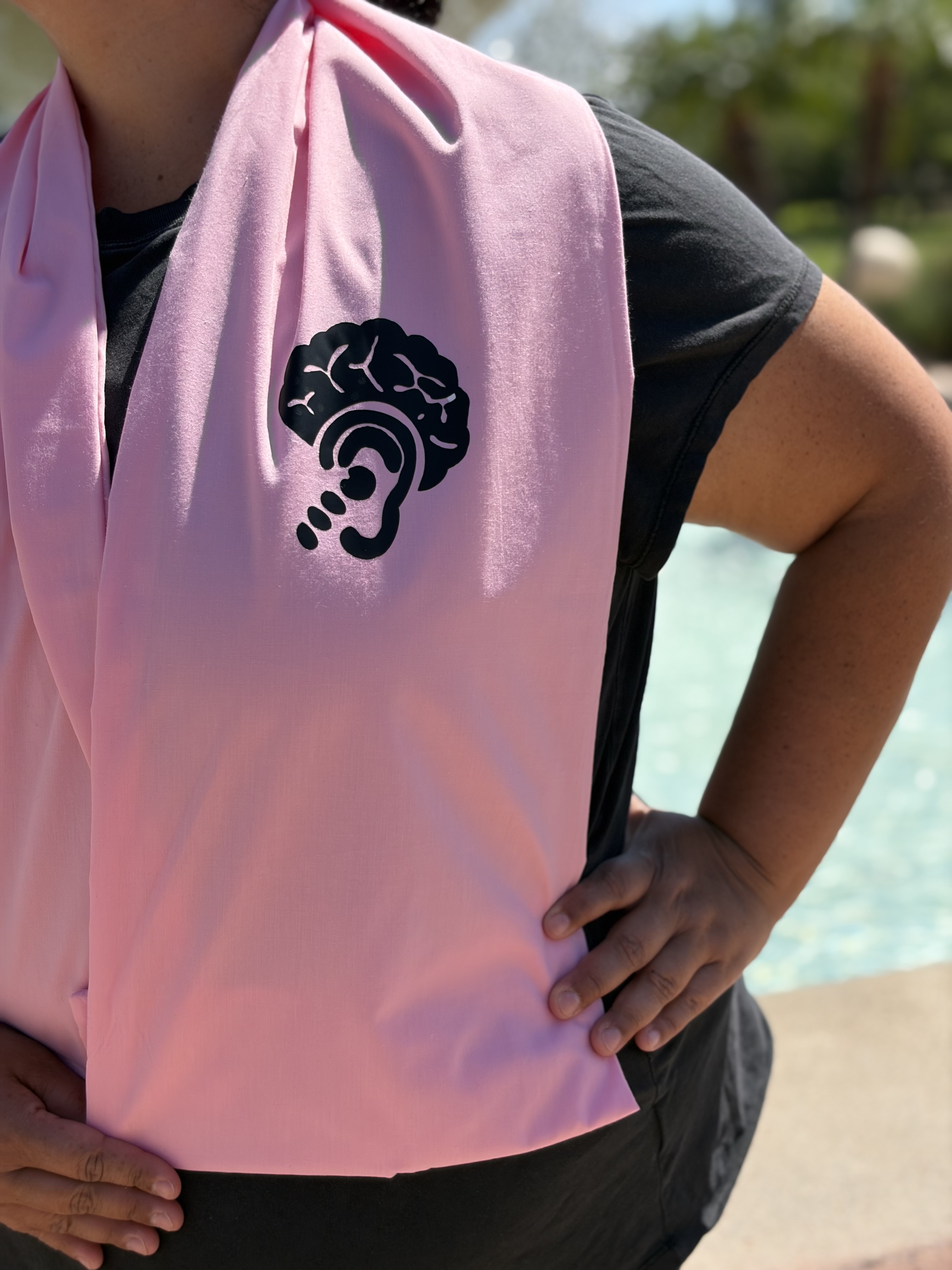
Pink:
Auditory / Verbal Assist/ Mental Health
Hearing issues, Auditory Processing Disorder, deafness, non-verbal communication, or speech impediments. PTSD, panic disorders, depression, and other mental health conditions.
Please speak louder and look toward the individual while speaking with your lips; have a known ASL speaker on standby. Do not touch; offer verbal assistance and ask how you can help (do not assume); have on hand or standby fidget toys or items to help calm them down that you may provide.
Purple:
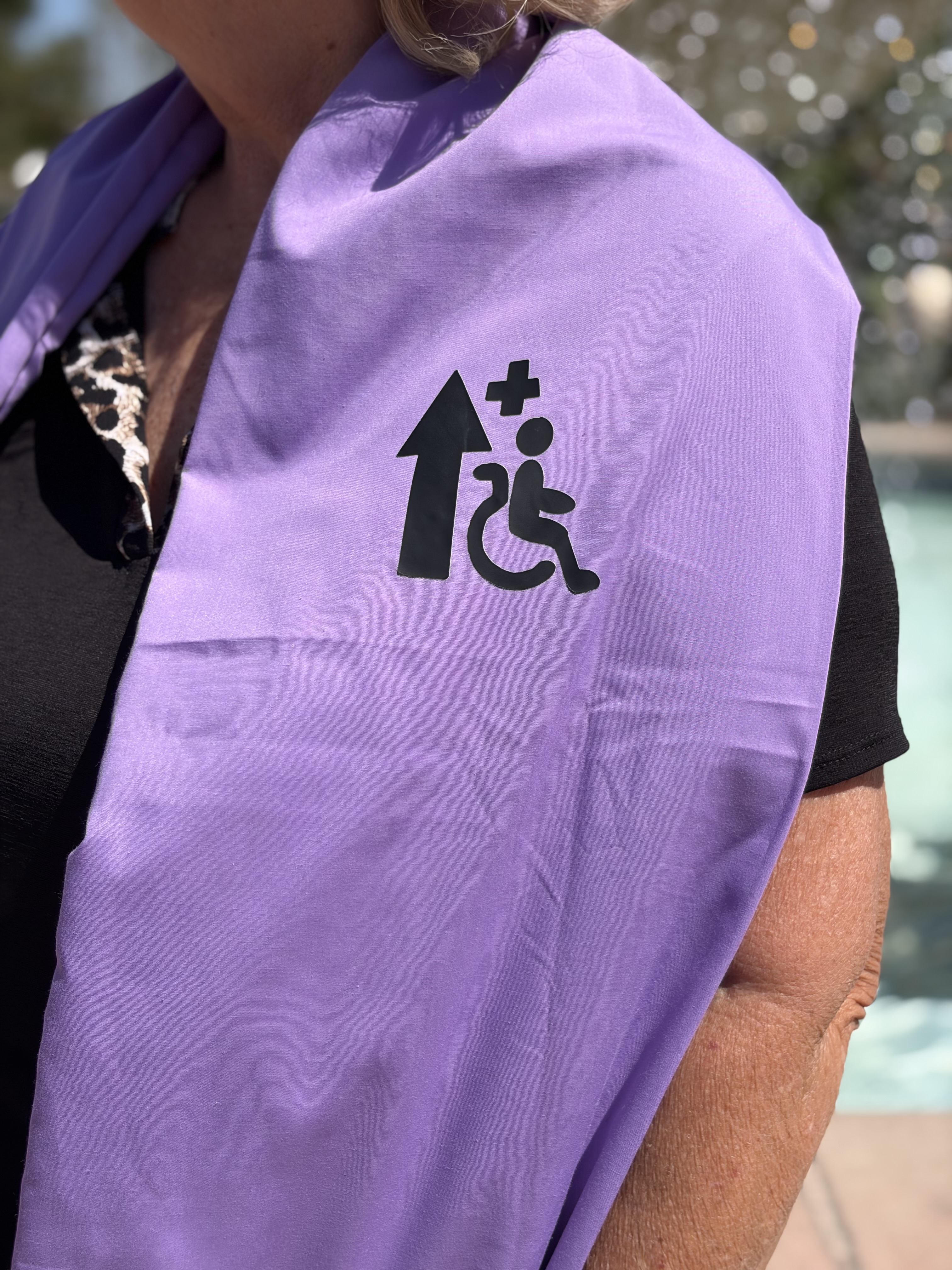
Mobility, Physical & Chronic Assist
Wheelchair users, physical mobility aids, balance issues, chronic pain, fatigue, or endurance limitations.
Offer assistance, provide patience, and understanding.
Blue:
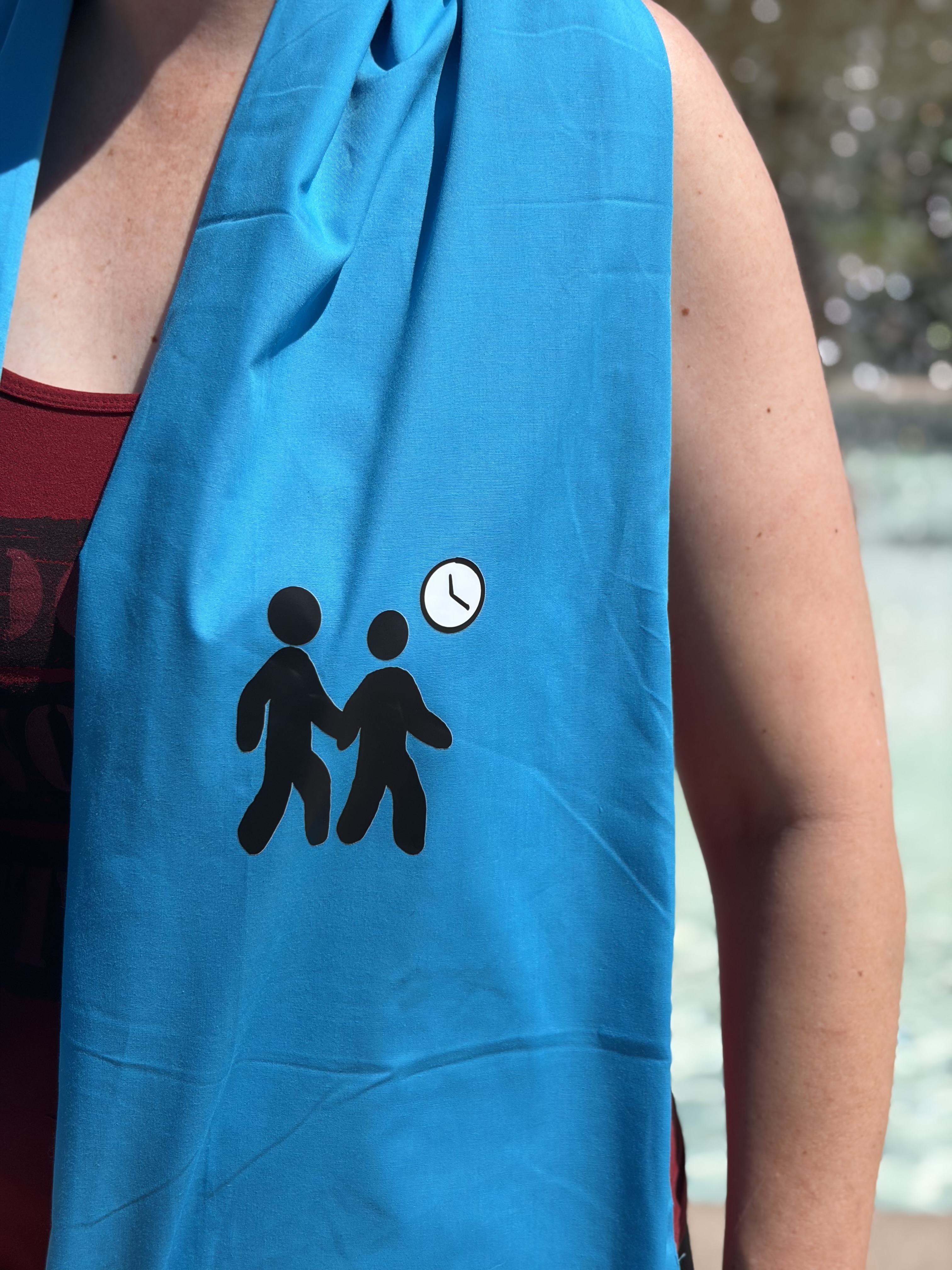
Companion / Extra Time Assist
Accompanying a family member or individual with a disability who needs extra time, patience, or group accommodations.
Loved ones can wear this shawl for ANY type of disability their loved one has. Regardless of their disability, they will know that their family needs a little more time and assistance.
Give patience and extra time.
Orange:
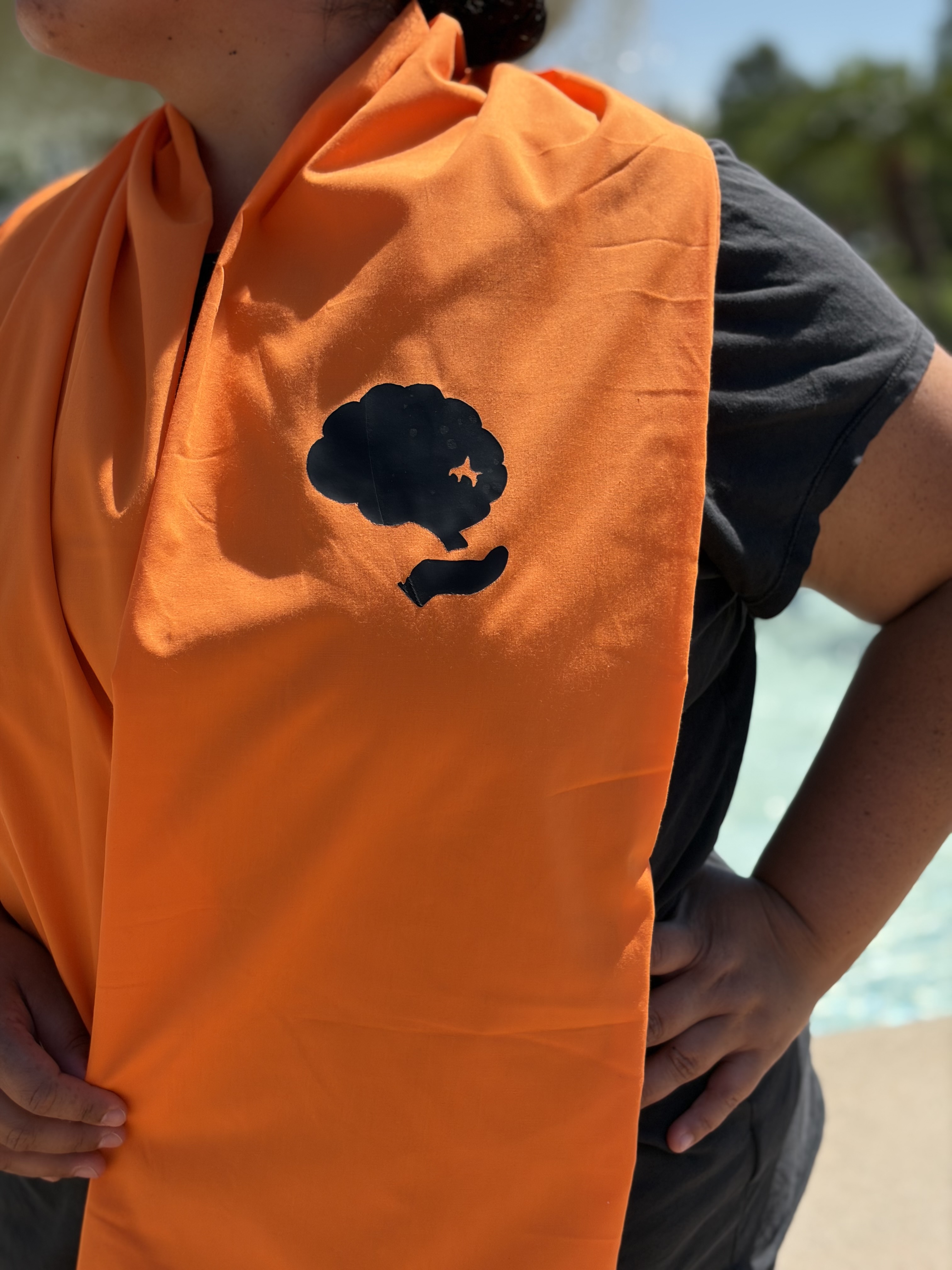
Neurodivergent
Autism, severe ADHD, sensory overload, or intense stress in crowded spaces.
Do not touch; offer verbal assistance and ask how you can help (do not assume); have on hand or standby fidget toys or items to help calm them down that you may provide.
Red:
Visual / Navigation Assist
Sight issues, partial blindness, color blindness, or severe depth perception difficulties.
Speak in their direction, use a slower and more distinctive/specific tone and directions, and offer guided assistance.
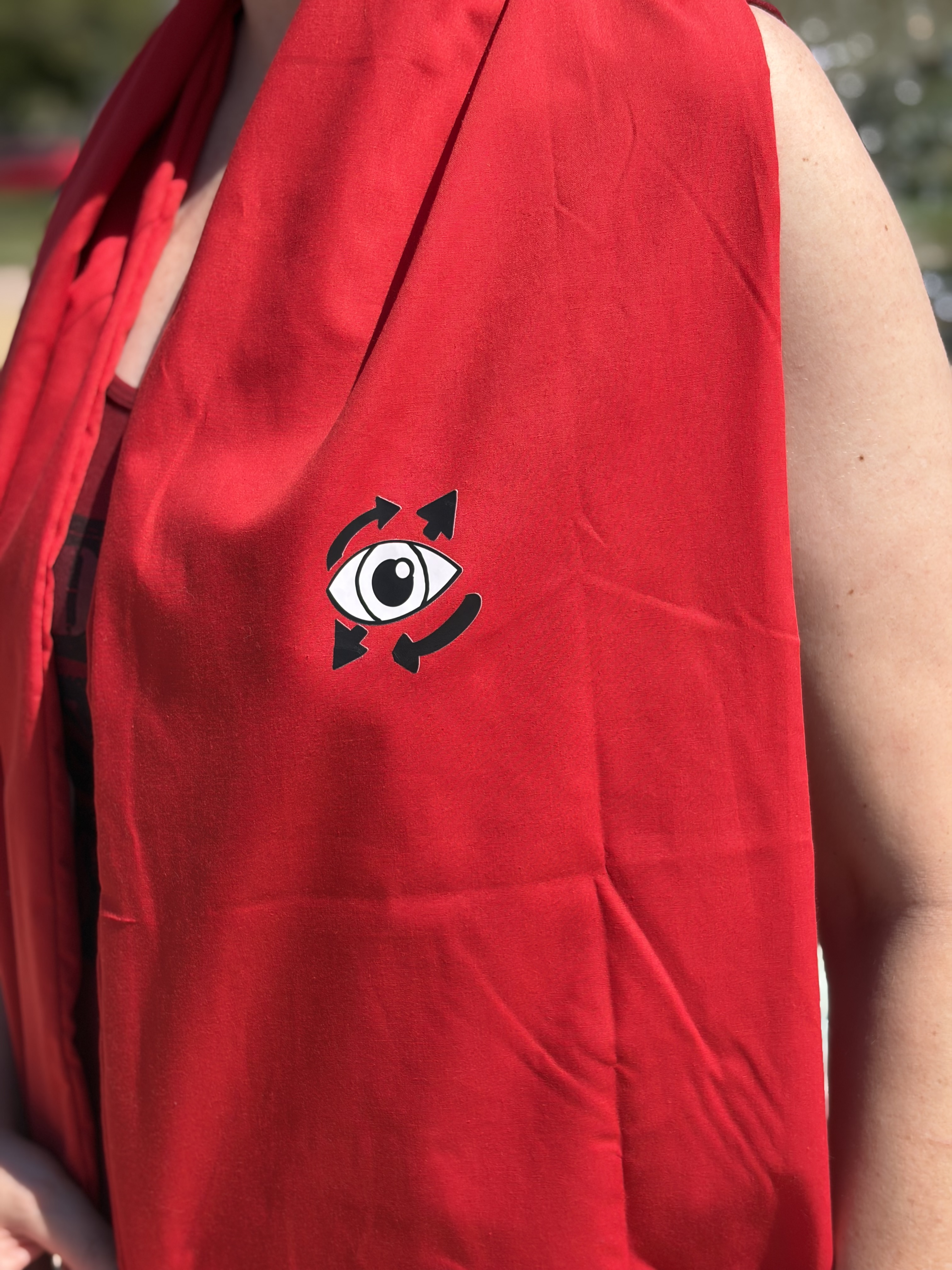
Scarves and Buttons (sold separately): The scarves come in this simple color with a vinyl logo, and the buttons can be used to detail specific disabilities and aids they need. We are aiming to provide such practices and requirements in each state in the United States of America in relation to our concerns, conditions, and accessibility needs:
1. KABAMM ACKNOWLEDGMENT ACCESSIBILITY REQUIREMENT:
To make change more visible and accessible, we have developed a new form of wear for public spaces. We have come up with a basic colored scarf to drape around your shoulders in public spaces. The color of the shawl resonates with the main color of need shown in the chart above. Then we produce buttons that display a specific QR code linking to a website designed to address your needs and accessibility concerns directly.
We want to nationally recognize our efforts in making these scarves and buttons, and we want to require that people working in public spaces be trained to recognize them and provide the appropriate reaction and assistance.
Legal Requirements:
Training: Training should take place immediately, and refresher courses need to be offered annually. All staff members should be knowledgeable about each color’s meaning and the correct responses to use when a scarf is seen.
Check-ins: Staff in all areas must be randomly tested to ensure their knowledge and handling are up to date.
Staff visibility: Please place flyers and important info posters about visibility and staff actions in many areas throughout the public space where they reside and conduct their business.
2. Free classes for those who are hard of hearing and visually challenged:
We also aim to have the government provide free ASL classes for people diagnosed as hard of hearing, and to make classes available for those diagnosed as blind or sight-challenged, to teach them Braille or to use a cane or other devices that aid in their everyday lives. Why charge those in need for classes and devices that they need to live their everyday lives just a little bit easier? With free classes for both conditions, we are making the world a little more accepting.
Legal requirements:
Classes readily available, offered: Have at hand to inform those who receive such a diagnosis.
Locations: We suggest that local community colleges offer a full week of classes at various times each year, where families can come and learn ASL or use visual aids such as canes. (Example: Chaffey Community College in California can offer a week-long course for families annually at no cost for those who have documented proof of their disability).
3 . Offer sensory hours in public spaces when applicable.
Public spaces like grocery stores, malls, etc., need to be required to engage in sensory-free environments during the suggested hours of 7-8 AM and again from 7-8 PM, where such would be required:
Legal requirements: Between the hours of 7-8 AM and 7-8 PM
No loud noises or distractions: No stocking, unboxing, etc. Have this done or partially done before these hours.
Lighting: Dimmed and flashing lights are prohibited during these hours to accommodate light-sensitive individuals.
Readily available staff: Staff who are specifically trained to offer support are available and trained to recognize the scarves and what is needed, support-wise.
4. Disability paperwork shouldn’t cost.
Why, if we go to a psychiatrist or psychologist, does it cost them to give you documented proof that you received the diagnosis physically? Especially to receive accommodations. Please make documentation free for all patients.
JOIN OUR FIGHT:
Providing standardized, visible scarves and training the public to recognize them solves two key challenges: making invisible disabilities visible and raising overall awareness of accessibility needs. We can accommodate your request to wear a scarf. Pairing visibility with public education helps bridge the gap between help, understanding, and effective support.

17
The Issue
End the Burden of Explanation: Support Public Awareness Tools for Disabilities
As a 22-year-old woman navigating the world with hearing loss, an auditory processing disorder, autism and ADHD, it can be very difficult to navigate normal day-to-day life. Nearly every second of my day involves asking those around me to speak a little louder or face me while speaking so I can read their lips. Sometimes it’s frustrating, depressing, and even embarrassing when you continuously find yourself explaining that just “speaking slower” doesn’t help.
Speaking from experience, the worst thing for someone with a disability is the unfairness of it all, just trying to navigate basic situations. The world we live in is only accessible to someone without any issues or concerns, which makes living a “normal” life feel nearly impossible for people like me.
Recently, I traveled from my home in California to my childhood home in Indiana to visit family, something I've done multiple times, and that is always marked by the same awkward situations. I’ve taken this trip three times now, and every time the same challenges arise. This last trip in July was the absolute worst of them all.
I recently heard about a few techniques that allow airport staff to recognize your disabilities, even invisible ones, from afar. However, training seemed voluntary, or the techniques were unheard of, and I found myself nearly in tears, born of frustration, as I tried to reach each destination without making anyone too annoyed by having to repeat things to me, or by frustrating myself, and ultimately feeling more lost and alone. Unfortunately for me, I ran into staff members who were visibly annoyed when I didn’t hear them. Those tears of frustration nearly spilled over when boarding time came, unable to even hear what groups were being called. Worst of all, no one knew, and no one cared.
Sadly, for those like me and many others, this is our normal. Not normal, but a normal we have learned to expect. Although the airport situation was the driving reason behind this campaign, it isn’t the only place where people like me become frustrated. Places like stores - waiting for someone to assist when checking out or looking for something, doctors’ offices where you have to listen as best as you can for your name to be called, restaurants when you have to order or wait to be called, and any other place you can think of that may produce concern for those with any type of disability.
To bridge this gap, we have designed public awareness scarves that serve as a simple, powerful way to communicate. Designed to serve as a clear yet dignified visual signal, the scarf enables individuals with non-apparent disabilities to navigate public spaces more easily and with greater peace of mind. Instead of enduring the physical and emotional toll of repeatedly explaining, justifying, or detailing personal health challenges out loud, wearers can communicate their need for patience or accommodation at a glance. By removing the exhausting demand for constant verbal disclosure, the scarf restores autonomy and transforms potentially high-stress environments into spaces of mutual understanding. We also recommend annual training to raise awareness of what these scarves mean and the steps to take if one is visualized.
With that, we provide 5 sub-group examples of such conditions and things that are impacting our everyday lives, and suggest that such practices be required in the United States of America in every state:
Conditions, Concerns, and what changes are needed:
Scarves:
Scarf Colors: Wear the color you need the most help with, depending on the area you are headed to.
Pink:
Auditory / Verbal Assist/ Mental Health
Hearing issues, Auditory Processing Disorder, deafness, non-verbal communication, or speech impediments. PTSD, panic disorders, depression, and other mental health conditions.
Please speak louder and look toward the individual while speaking with your lips; have a known ASL speaker on standby. Do not touch; offer verbal assistance and ask how you can help (do not assume); have on hand or standby fidget toys or items to help calm them down that you may provide.
Purple:
Mobility, Physical & Chronic Assist
Wheelchair users, physical mobility aids, balance issues, chronic pain, fatigue, or endurance limitations.
Offer assistance, provide patience, and understanding.
Blue:
Companion / Extra Time Assist
Accompanying a family member or individual with a disability who needs extra time, patience, or group accommodations.
Loved ones can wear this shawl for ANY type of disability their loved one has. Regardless of their disability, they will know that their family needs a little more time and assistance.
Give patience and extra time.
Orange:
Neurodivergent
Autism, severe ADHD, sensory overload, or intense stress in crowded spaces.
Do not touch; offer verbal assistance and ask how you can help (do not assume); have on hand or standby fidget toys or items to help calm them down that you may provide.
Red:
Visual / Navigation Assist
Sight issues, partial blindness, color blindness, or severe depth perception difficulties.
Speak in their direction, use a slower and more distinctive/specific tone and directions, and offer guided assistance.
Scarves and Buttons (sold separately): The scarves come in this simple color with a vinyl logo, and the buttons can be used to detail specific disabilities and aids they need. We are aiming to provide such practices and requirements in each state in the United States of America in relation to our concerns, conditions, and accessibility needs:
1. KABAMM ACKNOWLEDGMENT ACCESSIBILITY REQUIREMENT:
To make change more visible and accessible, we have developed a new form of wear for public spaces. We have come up with a basic colored scarf to drape around your shoulders in public spaces. The color of the shawl resonates with the main color of need shown in the chart above. Then we produce buttons that display a specific QR code linking to a website designed to address your needs and accessibility concerns directly.
We want to nationally recognize our efforts in making these scarves and buttons, and we want to require that people working in public spaces be trained to recognize them and provide the appropriate reaction and assistance.
Legal Requirements:
Training: Training should take place immediately, and refresher courses need to be offered annually. All staff members should be knowledgeable about each color’s meaning and the correct responses to use when a scarf is seen.
Check-ins: Staff in all areas must be randomly tested to ensure their knowledge and handling are up to date.
Staff visibility: Please place flyers and important info posters about visibility and staff actions in many areas throughout the public space where they reside and conduct their business.
2. Free classes for those who are hard of hearing and visually challenged:
We also aim to have the government provide free ASL classes for people diagnosed as hard of hearing, and to make classes available for those diagnosed as blind or sight-challenged, to teach them Braille or to use a cane or other devices that aid in their everyday lives. Why charge those in need for classes and devices that they need to live their everyday lives just a little bit easier? With free classes for both conditions, we are making the world a little more accepting.
Legal requirements:
Classes readily available, offered: Have at hand to inform those who receive such a diagnosis.
Locations: We suggest that local community colleges offer a full week of classes at various times each year, where families can come and learn ASL or use visual aids such as canes. (Example: Chaffey Community College in California can offer a week-long course for families annually at no cost for those who have documented proof of their disability).
3 . Offer sensory hours in public spaces when applicable.
Public spaces like grocery stores, malls, etc., need to be required to engage in sensory-free environments during the suggested hours of 7-8 AM and again from 7-8 PM, where such would be required:
Legal requirements: Between the hours of 7-8 AM and 7-8 PM
No loud noises or distractions: No stocking, unboxing, etc. Have this done or partially done before these hours.
Lighting: Dimmed and flashing lights are prohibited during these hours to accommodate light-sensitive individuals.
Readily available staff: Staff who are specifically trained to offer support are available and trained to recognize the scarves and what is needed, support-wise.
4. Disability paperwork shouldn’t cost.
Why, if we go to a psychiatrist or psychologist, does it cost them to give you documented proof that you received the diagnosis physically? Especially to receive accommodations. Please make documentation free for all patients.
JOIN OUR FIGHT:
Providing standardized, visible scarves and training the public to recognize them solves two key challenges: making invisible disabilities visible and raising overall awareness of accessibility needs. We can accommodate your request to wear a scarf. Pairing visibility with public education helps bridge the gap between help, understanding, and effective support.
Petition Updates
Share this petition
Petition created on September 1, 2026