
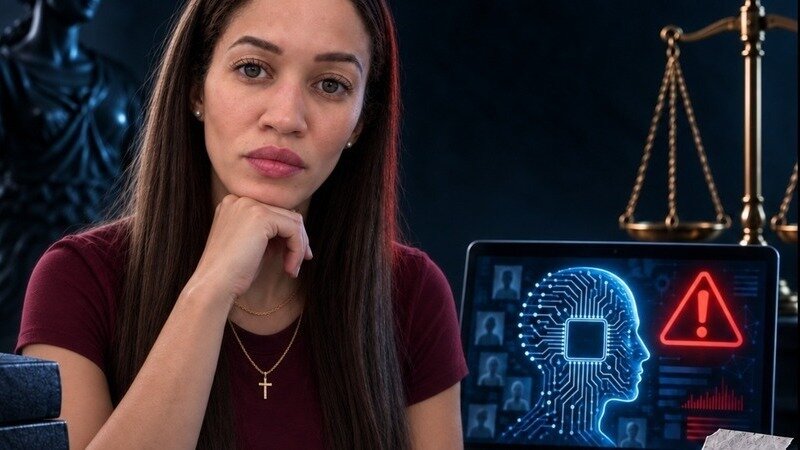
End Legal Protection for Possessing AI-Generated Child Sexual Abuse Material at Home
The Issue
On August 25, 2026, the U.S. Court of Appeals for the Seventh Circuit ruled that a federal law prohibiting possession of obscene virtual child sexual abuse material was unconstitutional as applied to private possession inside the home when no actual child was depicted.
The ruling did not make all AI-generated child sexual abuse material legal, and separate production and distribution charges remained in place. But it exposes a troubling question as artificial intelligence becomes capable of creating increasingly realistic sexual images depicting children.
And we should ask an important question: Where did AI learn what a child looks like in the first place?
AI does not create its understanding of the human body from nothing. Generative models learn patterns from enormous collections of existing images. Researchers have documented known child sexual abuse material in AI training datasets, and some models used to generate abusive material have been trained or fine-tuned using actual abuse imagery. Even when a generated child is technically “fake,” the technology used to create that image may still have learned from images of real human beings—including real children.
That reality makes the distinction between “real” and “virtual” far more complicated than it may sound.
For Christians, protecting children is not something we should treat casually.
“Defend the weak and the fatherless; uphold the cause of the poor and the oppressed.” — Psalm 82:3
“Open your mouth for the mute, for the rights of all the unfortunate.” — Proverbs 31:8
Our laws were not written with today’s generative AI in mind. Congress should examine whether current federal protections adequately address technology capable of producing realistic sexual depictions of children while remaining consistent with the Constitution.
The question Americans should be asking is simple:
Should realistic sexual abuse material depicting children receive fundamentally different treatment simply because AI generated the child depicted?
Technology has changed. Our laws must seriously confront what that technology can now create.
Children deserve protection. Technology deserves accountability. And this issue deserves action.
Paid partnership. Jasenta Buell is a Change Ambassador who receives compensation in connection with this petition.

21
The Issue
On August 25, 2026, the U.S. Court of Appeals for the Seventh Circuit ruled that a federal law prohibiting possession of obscene virtual child sexual abuse material was unconstitutional as applied to private possession inside the home when no actual child was depicted.
The ruling did not make all AI-generated child sexual abuse material legal, and separate production and distribution charges remained in place. But it exposes a troubling question as artificial intelligence becomes capable of creating increasingly realistic sexual images depicting children.
And we should ask an important question: Where did AI learn what a child looks like in the first place?
AI does not create its understanding of the human body from nothing. Generative models learn patterns from enormous collections of existing images. Researchers have documented known child sexual abuse material in AI training datasets, and some models used to generate abusive material have been trained or fine-tuned using actual abuse imagery. Even when a generated child is technically “fake,” the technology used to create that image may still have learned from images of real human beings—including real children.
That reality makes the distinction between “real” and “virtual” far more complicated than it may sound.
For Christians, protecting children is not something we should treat casually.
“Defend the weak and the fatherless; uphold the cause of the poor and the oppressed.” — Psalm 82:3
“Open your mouth for the mute, for the rights of all the unfortunate.” — Proverbs 31:8
Our laws were not written with today’s generative AI in mind. Congress should examine whether current federal protections adequately address technology capable of producing realistic sexual depictions of children while remaining consistent with the Constitution.
The question Americans should be asking is simple:
Should realistic sexual abuse material depicting children receive fundamentally different treatment simply because AI generated the child depicted?
Technology has changed. Our laws must seriously confront what that technology can now create.
Children deserve protection. Technology deserves accountability. And this issue deserves action.
Paid partnership. Jasenta Buell is a Change Ambassador who receives compensation in connection with this petition.
Petition Updates
Share this petition
Petition created on September 17, 2026